


Paramedic work can involve lifting, patient transfers, driving and working in restricted spaces. If you have back, neck or shoulder discomfort, an assessment can explore the symptoms and suitable options without assuming work is the only cause. Here are practical ways to prepare for an appointment, describe your work demands and recognise when medical or workplace injury assessment is needed.
- Chiropractic care for paramedics starts with assessment, not an automatic course of adjustments.
- MyChiro offers chiropractic care in Bondi Junction for local patients, including paramedics.
- Patient handling and shift work belong in your assessment history, not just the location of discomfort.
- Workplace controls, medical assessment and chiropractic discussions serve different purposes; one does not replace the others.
Why this matters
Paramedic work combines patient transfers, equipment handling, driving and tasks performed in restricted spaces. An appointment discussion needs that context. Describing your concern simply as back pain leaves out the circumstances in which you need to move, lift and make decisions.
MyChiro offers chiropractic care in Bondi Junction for local patients, including paramedics. You can review the factual clinic information at MyChiro, but the decision to proceed with any intervention belongs after assessment and informed consent.
This guide cannot determine the cause of your symptoms or whether you are fit for operational duties. Assessment findings and workplace requirements should guide those decisions. New symptoms after an incident, concerns about your ability to perform duties and questions about work restrictions need the relevant medical and occupational assessment pathways.
Back and joint discomfort during paramedic work
For paramedics considering chiropractic care, the useful starting point is a discussion that connects musculoskeletal concerns with actual job demands. A clinic assessment and a workplace risk assessment answer different questions. Neither should be presented as a substitute for the other.
Your job title alone does not describe your workload. Tell the assessing practitioner whether your concern occurs during a stretcher transfer, while carrying equipment, after driving or away from work altogether. Explain which duties remain manageable and which require assistance or modification.
For understanding physical work demands, Safe Work Australia's Model Code of Practice: Hazardous Manual Tasks describes risk factors including force, repetitive movement, sustained or awkward postures and vibration. Its focus is controlling hazardous tasks, not prescribing chiropractic care. Use it alongside your service's current procedures rather than treating a personal exercise routine as the entire answer.
An adjustment does not replace a lifting aid, adequate assistance or an incident report. If a task cannot be completed within your service's procedures, address the task through the workplace system.
How to prepare for a musculoskeletal assessment
1. Record your duties and concerns
Start with a plain note on your phone or paper. You do not need a paid app, wearable device or detailed anatomical vocabulary to describe what happens during your shift.
Record 3 task examples: a patient-handling task, an equipment-handling task and a driving or documentation task. This is an appointment preparation checklist, not a diagnostic test. Include what you were doing, where you noticed discomfort and whether you changed your approach.
Avoid deciding in advance that the problem is a misalignment, nerve pressure or poor posture. Describe your experience first; leave interpretation to the assessment. A record of events is more useful than a label borrowed from an online article.
- Write down when the concern began and whether an incident preceded it.
- Describe the task, available space and equipment involved.
- Note what you stopped, modified or needed help completing.
- Include previous assessments, relevant health history and current medicines.
2. Check the medical and workplace pathway
Before considering adjustments, decide whether your concern belongs first with a medical practitioner or your workplace injury process. Do not use a routine chiropractic appointment to delay assessment after significant trauma or when symptoms raise concern about a serious condition.
New bladder or bowel control problems, saddle numbness or rapidly worsening leg weakness require emergency assessment. Other new or progressive nerve symptoms require prompt medical review. These are examples, not a complete checklist. If you are unsure about new or worsening symptoms, obtain medical advice rather than testing yourself through lifting or stretching.
Keep the medical assessment process separate from your workplace incident-reporting requirements. An incident can require reporting even when you have not yet received a diagnosis.
- Seek urgent medical attention for concerning neurological changes or significant trauma.
- Call 000 for a medical emergency.
- Follow your service's incident-reporting and injury-management procedures.
- Ask who can assess restrictions, modified duties and return-to-work requirements.
3. Prepare questions before choosing an intervention
Write your questions before making an appointment. You can check a chiropractor's registration through Ahpra's public register and ask the clinic about the appointment process without committing to a course of care.
MyChiro provides chiropractic care and spinal adjustments; that factual service description does not establish that either is appropriate for your concern. The next discussion is about assessment findings, available options, risks and referral where indicated. No intervention should be a prerequisite for getting those questions answered.
The guide to preparing for your first chiropractor appointment provides another place to organise your questions. Bring relevant documents you already have, rather than arranging tests solely because you assume an appointment requires them.
- Ask what the assessment involves and what information to bring.
- Ask why a proposed intervention is being considered for you.
- Request discussion of risks, alternatives and the option not to proceed.
- Ask when referral or reassessment would be appropriate.
4. Review the task before changing your technique
A patient transfer is not simply a gym lift with a different load. The patient's needs, available space, equipment and coordination with colleagues all belong in the task assessment. Follow your employer's training rather than adopting a universal lifting instruction from a blog.
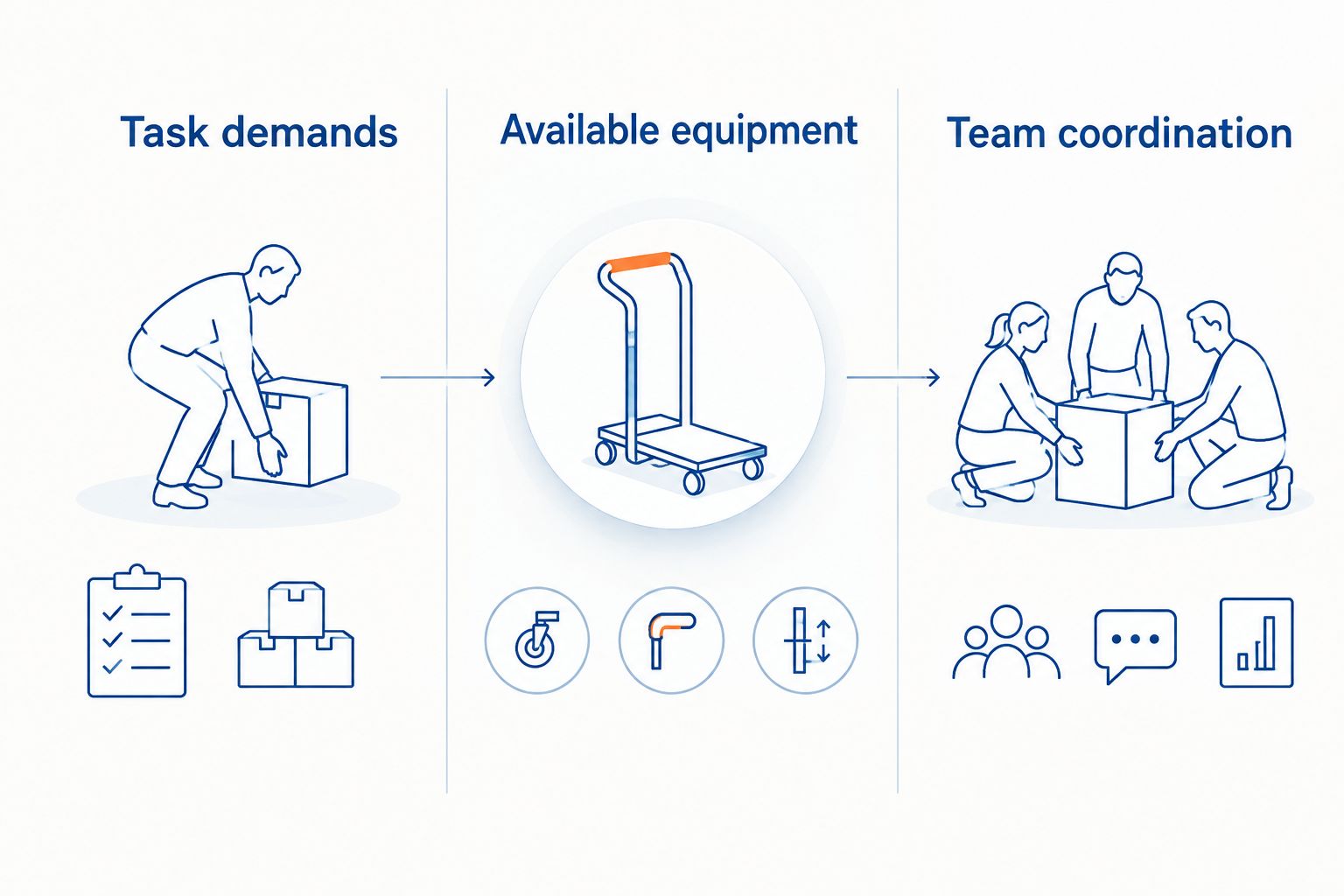
Use 3 review headings: Task demands, Available equipment and Team coordination. These organise a conversation with your supervisor or manual-handling team. They do not certify a transfer as suitable or override your service's procedures.
A clinician can hear about a difficult task, but a clinic visit cannot redesign a staircase, maintain a stretcher or supply another crew member. Keep responsibility for workplace controls within the workplace process.
- Task demands: identify the movement, access restrictions and handling requirements.
- Available equipment: check which approved aids the task requires.
- Team coordination: agree roles and communication before the transfer.
- Report equipment faults or situations outside your training and procedures.
5. Review your driving and documentation setup
Check the setup you actually use on shift, not an ideal desk arrangement. Start with the vehicle's approved seat and steering adjustments and the workspace available for documentation. Keep visibility, restraint use and operational requirements as the boundaries for any change.
Do not add a cushion or accessory if it interferes with vehicle controls, restraints or employer requirements. Equipment marketed for posture is not automatically suitable for an ambulance. Ask the appropriate workplace contact before modifying shared equipment.
When reviewing an ambulance vehicle or workstation, note both comfort and operational constraints. If a setting cannot safely be changed, raise the limitation through the workplace process.
- Check that approved adjustments preserve access to controls and visibility.
- Review where you place documentation equipment during stationary tasks.
- Discuss permitted opportunities to change position between tasks.
- Record shared-vehicle or equipment limitations for your workplace review.
6. Discuss activity around your actual duties
If you want exercise advice, start by explaining your current activities and the demands of your roster. Do not copy a rehabilitation programme intended for someone with a different diagnosis or work role.
Ask a qualified health professional whether an individual activity plan is appropriate following assessment. The discussion should distinguish ordinary exercise from patient handling, emergency tasks and return-to-work decisions. Completing an exercise does not establish readiness to transfer a patient or resume unrestricted duties.
Avoid arbitrary sets, repetitions and lifting targets from generic guides. A useful plan explains the activity, how to adjust it and when to seek reassessment. It should also fit the instructions you have received from anyone managing a workplace injury.
- Describe your current exercise, previous advice and operational duties.
- Ask which activities are appropriate for your assessed circumstances.
- Request clear instructions for modifying or stopping an activity.
- Keep work clearance separate from progress in a personal exercise plan.
7. Agree on review points before continuing care
If care is proposed, ask how the decision will be reviewed. Attendance alone is not a reason to continue an intervention, and a roster should not become an automatic appointment schedule.
Bring 2 questions to each review: What has changed, and does the plan still make sense? Discuss changes in your concern, daily activities and work demands without assuming that improvement or deterioration has a single cause. New information can require a different assessment or referral.
MyChiro chiropractic care should be considered through the same informed-consent questions you would ask of any provider. This guide does not recommend a standing adjustment schedule for paramedics or establish an expected result.
- Agree on the purpose of any proposed care and its review points.
- Ask what would prompt modification, stopping or referral.
- Report new symptoms and changes in duties or medical advice.
- Keep relevant workplace and clinical instructions consistent.
Compare assessment and support options
Choose a pathway by the question it needs to answer, not by a promise of relief. The options below have different roles and limitations. Several can be relevant without every paramedic needing all of them.
| Option | Appropriate for discussing | Practical advantage | Key limitation |
|---|---|---|---|
| General practitioner or urgent medical service | New, unexplained or concerning symptoms; assessment after injury | Provides a medical assessment pathway and considers referral | Does not replace your employer's task-risk assessment |
| Occupational health or workplace injury team | Duty restrictions, incident processes and return-to-work requirements | Connects health information with workplace responsibilities | The pathway depends on your employer and circumstances |
| Physiotherapist | Whether individual movement or exercise guidance is appropriate | Provides a setting to discuss activity and functional demands | Exercise advice alone cannot change hazardous working conditions |
| Chiropractic assessment, including MyChiro | Whether chiropractic care is appropriate following assessment | Provides a setting to discuss chiropractic options and consent | Does not establish suitability for adjustments or replace medical assessment |
| Employer manual-handling review | Equipment, assistance, access and transfer procedures | Addresses the task and available workplace controls | Does not diagnose an individual's symptoms |
Ask each provider which question they are addressing. This avoids confusing a discussion about an adjustment with a decision about work capacity or a review of an unsafe task.
Common mistakes paramedics make when considering care
Treating every concern as a lifting problem
A symptom noticed after a shift does not establish its cause. Describe the timing and duties without assuming that one transfer, posture or body structure explains everything. Medical assessment is important when the history or symptoms require it.
Booking around the roster instead of an assessed need
A regular roster does not justify regular adjustments. Ask why care is proposed and how it will be reviewed. Scheduling convenience belongs after the decision about whether an appointment or intervention is appropriate.
Using personal fitness to compensate for missing controls
A personal training programme cannot supply an unavailable lifting aid or resolve restricted access. Report the task problem and follow the employer's escalation process. Do not treat your willingness to lift as evidence that the task is acceptable.
Confusing an appointment with clearance for duty
Attending a clinic does not automatically establish readiness for patient handling, driving or unrestricted operational work. Follow the applicable medical and workplace requirements, including any existing restrictions. Clarify who is responsible for each decision.
Measuring progress only by discomfort at rest
Your appointment history should include the tasks you can and cannot complete, not just how you feel while sitting in a consulting room. Describe function without testing yourself through duties you have been advised to avoid. Report new limitations rather than waiting for the next routine review.
FAQ
What is chiropractic care for paramedics?
Chiropractic care for paramedics is assessment and discussion of chiropractic options in the context of musculoskeletal concerns and job demands. Whether an intervention is appropriate depends on individual assessment, consent and referral needs.
Do paramedics need regular chiropractic adjustments?
Being a paramedic does not establish a need for regular chiropractic adjustments. Any proposed care should have an individual rationale and agreed review points rather than follow a roster automatically.
Should I see a chiropractor after a patient-lifting incident?
Follow your workplace injury process and obtain the appropriate medical assessment after a patient-lifting incident. Do not use a routine chiropractic appointment to delay assessment of significant trauma or concerning symptoms.
Can chiropractic care replace a manual-handling review?
Chiropractic care does not replace a manual-handling review. Equipment, staffing, access and transfer procedures need to be addressed through the workplace risk-management process.
What should I bring to a chiropractic assessment?
Bring a description of your concerns, relevant health history, current medicines and any existing assessment or work-restriction documents. Include examples of patient handling, equipment handling and driving tasks that are relevant to your concern.
When does back pain need urgent medical attention?
Back pain with new bladder or bowel control problems, saddle numbness or rapidly worsening leg weakness requires emergency medical assessment. Significant trauma or other new neurological symptoms also need timely medical attention. In Australia, call 000 in an emergency.
Does MyChiro provide chiropractic care for local paramedics?
MyChiro is a chiropractic clinic and wellness centre in Bondi Junction, Sydney, providing chiropractic care and spinal adjustments. Local paramedics can discuss their concerns, but suitability for any intervention requires individual assessment.
One last thing
For your 2026 assessment, bring a description of the task you most want to discuss—not just the name of the painful area. Explain the space, equipment, assistance and instructions involved. A recommendation about your care and a recommendation about your workplace are different decisions; ask who is responsible for each.
Related guides
- Chiropractic care for shift workers with back pain
- Lifting heavy objects and protecting your back
- Qualifications to check when choosing a Sydney chiropractor