

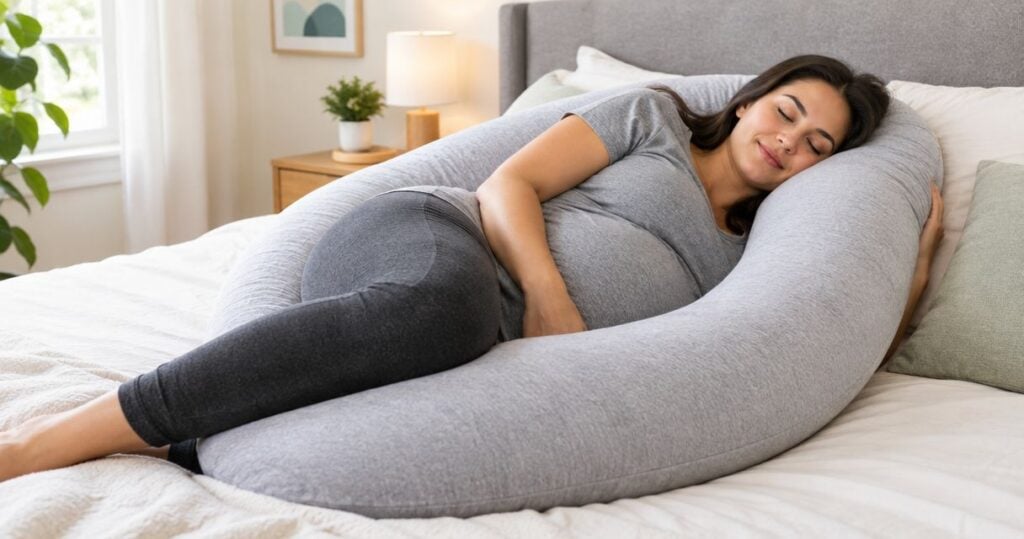
For pregnancy pillow shopping, start with the support area you want to change: a straight body pillow for front support, a U-shaped pillow for support on both sides, or a wedge for a smaller contact area. This 2026 guide compares pillow shapes for comfort and fit, not their ability to treat back or hip pain.
- Mychiro’s pregnancy pillow guide compares shapes and fit, not clinical outcomes.
- A straight body pillow suits front support without surrounding your whole body.
- A U-shaped pregnancy pillow occupies both sides of the bed; check its footprint before choosing.
- A wedge suits a small support area but does not replace a head or leg pillow.
- Discuss new, persistent or worsening pregnancy-related pain with your maternity care team.
Why this matters
A pregnancy pillow is a bedding accessory. Its shape tells you where it can sit; it does not establish whether it will address the cause of back or hip pain.
Mychiro is a chiropractic clinic and wellness centre in Bondi Junction, Sydney. This guide provides general shopping information, not a recommendation for chiropractic care during pregnancy or an individual assessment.
Separate these decisions: choosing bedding that feels comfortable and obtaining advice about symptoms. A pillow purchase should not delay a discussion with your midwife, GP or obstetrician about pain that is new, persistent, worsening or affecting everyday activity.
Choose a pillow for its fit, not a promise of pain relief. A large pillow is not automatically more suitable than an ordinary pillow you already own.
What makes a pregnancy pillow suitable?
Use these criteria when comparing pregnancy pillows in 2026. They are practical buying checks, not evidence of a clinical benefit.
- Support location: Decide whether you want something beside your abdomen, behind your back, between your legs or in several places.
- Height and firmness: Check whether the pillow feels comfortable in your usual position. A shape name does not tell you how firm a particular model is.
- Bed footprint: Compare the stated dimensions with the space available on your mattress, including room for another sleeper.
- Repositioning: Consider whether you can move the pillow and get into or out of bed without struggling around it.
- Cleaning instructions: Check the cover, filling and washing requirements separately. A washable cover does not mean the whole pillow is washable.
- Head-pillow independence: Decide whether you want to keep your existing head pillow or use a design that incorporates one.
Before choosing a different shape, identify what is uncomfortable about your present arrangement. Is the pillow too tall, too firm, difficult to move or simply in the wrong place? Those observations are more useful than choosing by a product’s pregnancy label alone.
Pregnancy pillow shapes at a glance
The comparison below lists shapes, not named products. Features such as removable covers, adjustable filling and specific dimensions vary by model and need checking individually.
| Pillow shape | Suitable for | Distinctive feature | Key limitation |
|---|---|---|---|
| Straight body pillow | Front support while keeping a separate head pillow | One long cushion placed alongside the body | Does not also surround the back |
| U-shaped pillow | An arrangement with cushions on both sides | Two long arms connected at one end | Occupies substantial bed space |
| C-shaped pillow | A curved arrangement around one side | Continuous curved cushion | Head and body positioning are linked |
| Pregnancy wedge | A small, local support area | Compact tapered cushion | Does not provide full-length support |
| Separate ordinary pillows | Trying different placements with existing bedding | Independently movable cushions | Several pieces need repositioning |
The order follows different shopping needs rather than a clinical ranking. None of these shapes establishes a diagnosis, corrects an underlying condition or proves that one product will provide more comfort than another.
1. Straight body pillow: for front support
A straight body pillow is a long cushion you place beside yourself. Depending on its length and your preferred arrangement, you can position part of it near your upper body and part between your legs while keeping your usual head pillow.
This shape gives you a straightforward starting point if you do not want a pillow surrounding you. Check the actual model rather than assuming every body pillow has the same length, thickness or filling.
Straight body pillow advantages:
- Keeps the head pillow separate from the body cushion.
- Provides a continuous cushion along one side.
- Has a simple shape to reposition.
Straight body pillow limitations:
- Does not provide a second cushion behind your back.
- A thick model can feel awkward between your legs.
- You need to move it if you want it on the opposite side.
Suitable for: Someone looking for a single front cushion while retaining their usual head pillow.
For your 2026 shortlist, compare the body pillow’s dimensions with your own bed arrangement. Do not assume the longest model is the appropriate choice; extra length is only useful when you have a place for it.
Verdict: Consider a straight body pillow when front support is your main requirement.
2. U-shaped pillow: for cushions on both sides
A U-shaped pregnancy pillow has two long arms joined by a curved section. You lie between the arms, with cushion material available in front of and behind you.
The key distinction is its footprint. Before choosing, picture where both arms will sit and whether the connected section will replace your head pillow or remain elsewhere in your arrangement.
U-shaped pillow advantages:
- Places cushions on both sides of your body.
- Provides a connected arrangement rather than separate pieces.
- Offers several contact areas within one pillow.
U-shaped pillow limitations:
- Takes up room on both sides of the sleeper.
- Is bulkier to move and store than a wedge.
- Links the position of its arms to the connected section.
Suitable for: Someone who specifically wants cushions on both sides and has enough bed space for the whole shape.
Ask yourself whether you actually want all those contact areas. If only one small area needs a cushion, a surrounding design introduces bulk without necessarily matching that preference.
Verdict: Consider a U-shaped pillow for two-sided cushioning; skip this shape if bed space is already tight.
3. C-shaped pillow: for a connected curved arrangement
A C-shaped pregnancy pillow curves around one side of your body. Its ends and middle section can be arranged near different contact areas, depending on the model and how you position it.
Unlike separate pillows, the sections remain connected. Moving one end changes the arrangement of the rest, which matters if you prefer to adjust your head and leg cushions independently.
C-shaped pillow advantages:
- Combines several cushion areas in one curved piece.
- Can replace an arrangement of separate cushions.
- Leaves an opening rather than surrounding both sides equally.
C-shaped pillow limitations:
- Does not allow every section to move independently.
- The upper curve may not suit your head-pillow preference.
- Its overall size still needs checking against your mattress.
Suitable for: Someone who prefers a connected, curved cushion rather than a straight pillow or several separate pieces.
For a 2026 purchase, check photographs showing the entire pillow and read the dimensions. A close-up image of fabric or filling does not show how much mattress space the curved shape occupies.
Verdict: Consider a C-shaped pillow if you want connected sections; skip it if independent head support is a priority.
4. Pregnancy wedge: for a small support area
A pregnancy wedge is a compact cushion with a tapered profile. It is intended for a local placement rather than cushioning the whole body.
The wedge’s height, slope and firmness matter more than the category name. Avoid forcing it into a position that feels uncomfortable or using a product in a way that conflicts with its instructions.
Pregnancy wedge advantages:
- Occupies a smaller area than a full-length pillow.
- Leaves your existing head pillow arrangement separate.
- Is easier to accommodate when you want only local cushioning.
Pregnancy wedge limitations:
- Does not provide full-length front or back support.
- Does not replace a separate cushion between the legs.
- Its fixed slope may not match your preferred position.
Suitable for: Someone wanting a small cushion in one specific location rather than a surrounding pillow.
Do not choose a wedge because you assume firmer pressure must be more helpful. Comfort is a reason to adjust or remove a cushion, not to persist with an arrangement that feels wrong.
Verdict: Consider a wedge for a small support area, not as a substitute for several different cushions.
5. Separate ordinary pillows: for trying independent placements
Ordinary pillows let you change each contact area separately. You can retain your head pillow and try another cushion beside your body or between your legs without committing to a connected shape.
Start with bedding you already own when it suits the arrangement you want. There is no requirement to buy a dedicated pregnancy pillow simply because you are pregnant.
Separate-pillow advantages:
- Each cushion moves independently.
- Lets you compare placements using existing bedding.
- Keeps your head-pillow choice separate.
Separate-pillow limitations:
- Several cushions can move apart during the night.
- Each piece needs repositioning separately.
- Existing pillows may not have the height or firmness you prefer.
Suitable for: Someone who wants to understand their preferences before choosing a larger, connected pillow.
If you find a comfortable arrangement, write down which cushion goes where. That gives you a practical reference when comparing a dedicated shape rather than starting again with an unfamiliar design.
Verdict: Try suitable ordinary pillows before buying a connected design you have not used.
Check fit before choosing
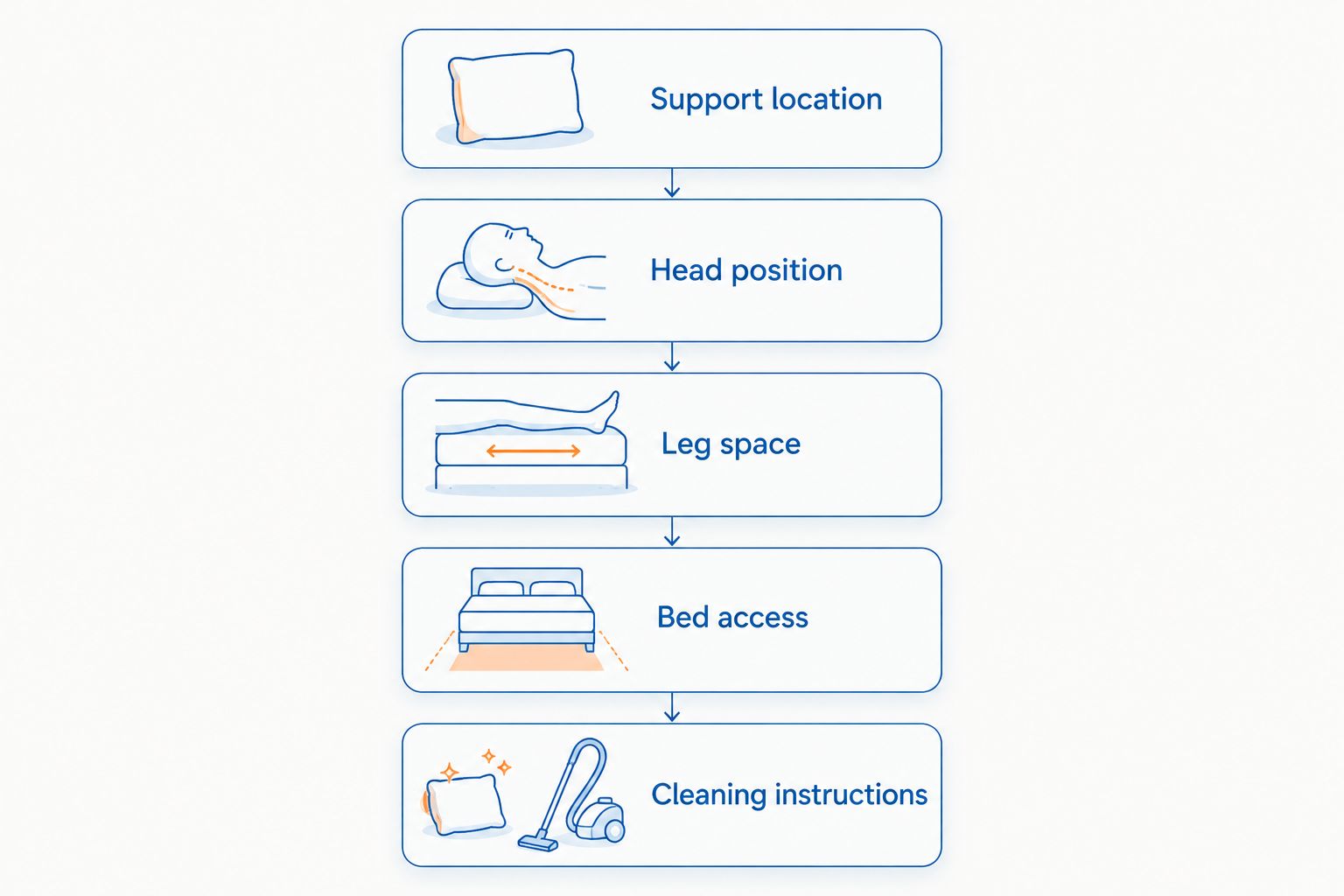
Use this sequence to compare bedding arrangements. It is a comfort check, not an exercise prescription or a test for the cause of pain.
- Support location: Identify the single contact area you want to change first.
- Head position: Keep your head pillow separate unless you deliberately want an integrated design.
- Leg space: Check whether the cushion leaves your legs in a comfortable position rather than forcing them apart.
- Bed access: Make sure the arrangement leaves room to move the pillow and get out of bed.
- Cleaning instructions: Read the care requirements before deciding whether the model suits your routine.
Change one part of the arrangement at a time. Otherwise, you cannot tell which change you prefer.
A pillow that feels unsuitable does not become suitable because it has a pregnancy-specific name. Remove or reposition uncomfortable bedding and discuss ongoing symptoms with your maternity care team.
Pregnancy sleep guidance and when to seek advice
Australian Pregnancy, Birth and Baby guidance recommends going to sleep on your side from 28 weeks of pregnancy. Either side is an option; if you wake on your back, the guidance is to turn onto your side and return to sleep. This advice concerns sleep position, not evidence that a particular pillow treats pain.
For your 2026 sleep questions, use your maternity care team and authoritative pregnancy information rather than product advertising. Follow individual advice from your treating professionals where your circumstances require it.
Contact your maternity service promptly about pain accompanied by vaginal bleeding, fluid loss, fever, contractions or reduced fetal movements. Severe pain or new weakness also needs medical assessment rather than a different pillow. In an emergency in Australia, call 000.
Keep the pillow comparison separate from decisions about hands-on care. Mychiro’s pregnancy pillow information does not establish whether adjustments or any other clinical service may be appropriate for you.
How these options are compared
This 2026 guide compares five pillow shapes by support location, independent positioning, mattress footprint, movement and cleaning checks. It does not rank named products or claim that one shape produces a clinical outcome.
Use manufacturer information for model-specific dimensions, materials and care instructions. Use a qualified health professional for questions about symptoms; those are different sources answering different questions.
Which pregnancy pillow should you choose?
If you are undecided, identify one support area and try a suitable ordinary pillow first. A straight body pillow is the next shape to consider when you want a continuous front cushion without replacing your head pillow.
Choose a U-shaped or C-shaped design only when you want the connected arrangement it provides. Choose a wedge when a small cushion matches your preference. Do not let a larger shape distract from fit, ease of movement or medical advice about ongoing pain.
FAQ
Which pregnancy pillow shape should I start with for back discomfort?
Start by identifying where you want cushioning, rather than assuming a particular shape will address back discomfort. A straight body pillow provides a front cushion; separate pillows allow independent placements. Discuss persistent or worsening pain with your maternity care team.
Is a U-shaped pregnancy pillow more suitable than a C-shaped pillow?
A U-shaped pillow suits a preference for cushions on both sides, while a C-shaped pillow provides a connected curved arrangement around one side. Neither shape is universally suitable. Compare bed space and whether you want independent head support.
Can I use an ordinary pillow instead of a pregnancy pillow?
Yes, an ordinary pillow can be used as bedding for a comfortable arrangement. Separate pillows let you adjust each contact area independently, although they require separate repositioning.
Will a pregnancy pillow treat my hip pain?
A pregnancy pillow should not be assumed to treat hip pain. It is a bedding accessory, and the cause of symptoms needs assessment when pain is new, persistent, worsening or affecting daily activity.
When should I start sleeping on my side during pregnancy?
Pregnancy, Birth and Baby recommends going to sleep on your side from 28 weeks of pregnancy. Either side is an option, and if you wake on your back, turn onto your side and return to sleep. Ask your maternity care team about individual circumstances.
Do I need the firmest pregnancy pillow?
No, maximum firmness is not a universal requirement. Compare the actual pillow’s height, firmness and placement, and do not persist with a cushion that feels uncomfortable.
When should I contact my maternity care team about back or hip pain?
Contact your maternity care team about new, persistent, worsening or activity-limiting pain. Seek prompt assessment when pain occurs with bleeding, fluid loss, fever, contractions, reduced fetal movements or new weakness. Call 000 for an emergency in Australia.
One last thing
The part of a large pregnancy pillow near your head can determine whether the whole arrangement feels comfortable. If you already like your head pillow, choose a body-support shape that lets you keep it separate rather than changing both at once.
Mychiro’s final shopping recommendation is simple: describe the arrangement you want before choosing the product shape. That description is more useful than a promise printed on the packaging.
Related guides
- Choosing a mattress for back comfort and support
- Pillow considerations for side sleepers with neck pain
- Knee pillow options for side sleepers with hip pain