
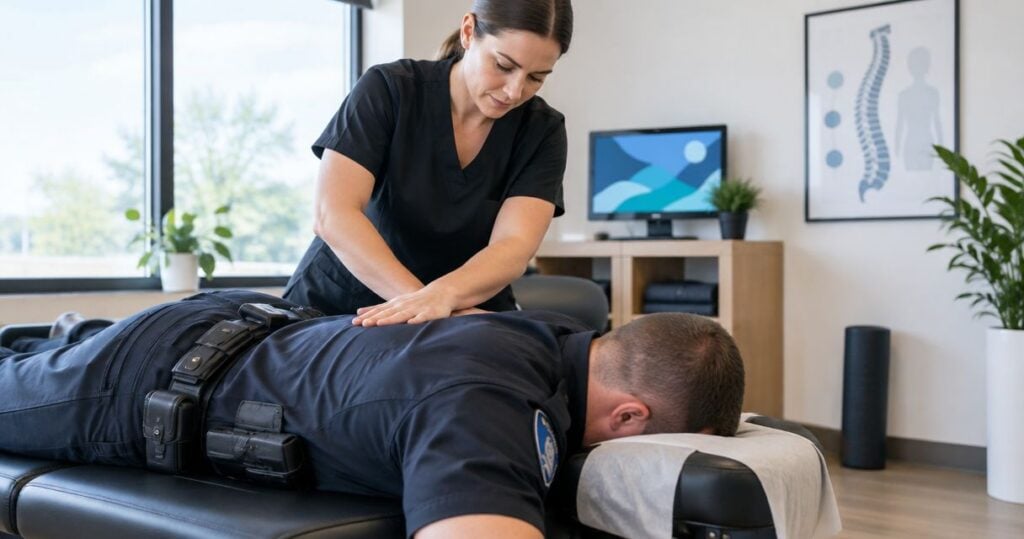
Police officers’ chiropractic care is assessment-led musculoskeletal care with the aim of informing decisions about work-related concerns and whether chiropractic services are appropriate. This 2026 guide to chiropractic care for police officers covers duty equipment, vehicle time and changing rosters; MyChiro is a chiropractic clinic and wellness centre in Bondi Junction, Sydney.
- Chiropractic care for police officers starts with assessment, not an automatic adjustment or appointment schedule.
- MyChiro offers chiropractic care in Bondi Junction; suitability for individual police officers requires assessment.
- Discuss duty-belt fit, vehicle seating and shift-work demands without changing operational equipment requirements.
- Medical assessment takes priority for new symptoms after trauma or symptoms suggesting a serious condition.
Why chiropractic care matters for police officers
For police officers considering chiropractic care, the useful question is whether an assessment addresses a specific concern—not whether everyone in the occupation needs adjustments. Describe the tasks you perform and the difficulties you experience. Your job title alone does not establish a diagnosis or justify a course of care.
Police duties differ between assignments. Your concern might arise during vehicle patrol, standing duties, equipment use, training or report writing, so an appointment should reflect your actual role rather than a generic description of policing.
Assessment comes before decisions about adjustments, exercise or referral. A discussion should cover your health history, current symptoms, work demands and preferences, including the option not to proceed with a proposed service.
MyChiro is a Bondi Junction chiropractic clinic for local patients considering chiropractic care. Its location and service category help you identify an option; they do not establish that chiropractic care is appropriate for your particular concern.
This guide provides general appointment preparation and workplace discussion points. It does not diagnose symptoms, prescribe exercises or determine fitness for operational duties.
How to approach chiropractic care in 2026
Start with information you can gather yourself: a brief task record, relevant health documents and questions about your workplace requirements. You do not need equipment purchases or a prearranged series of appointments to prepare for an assessment.
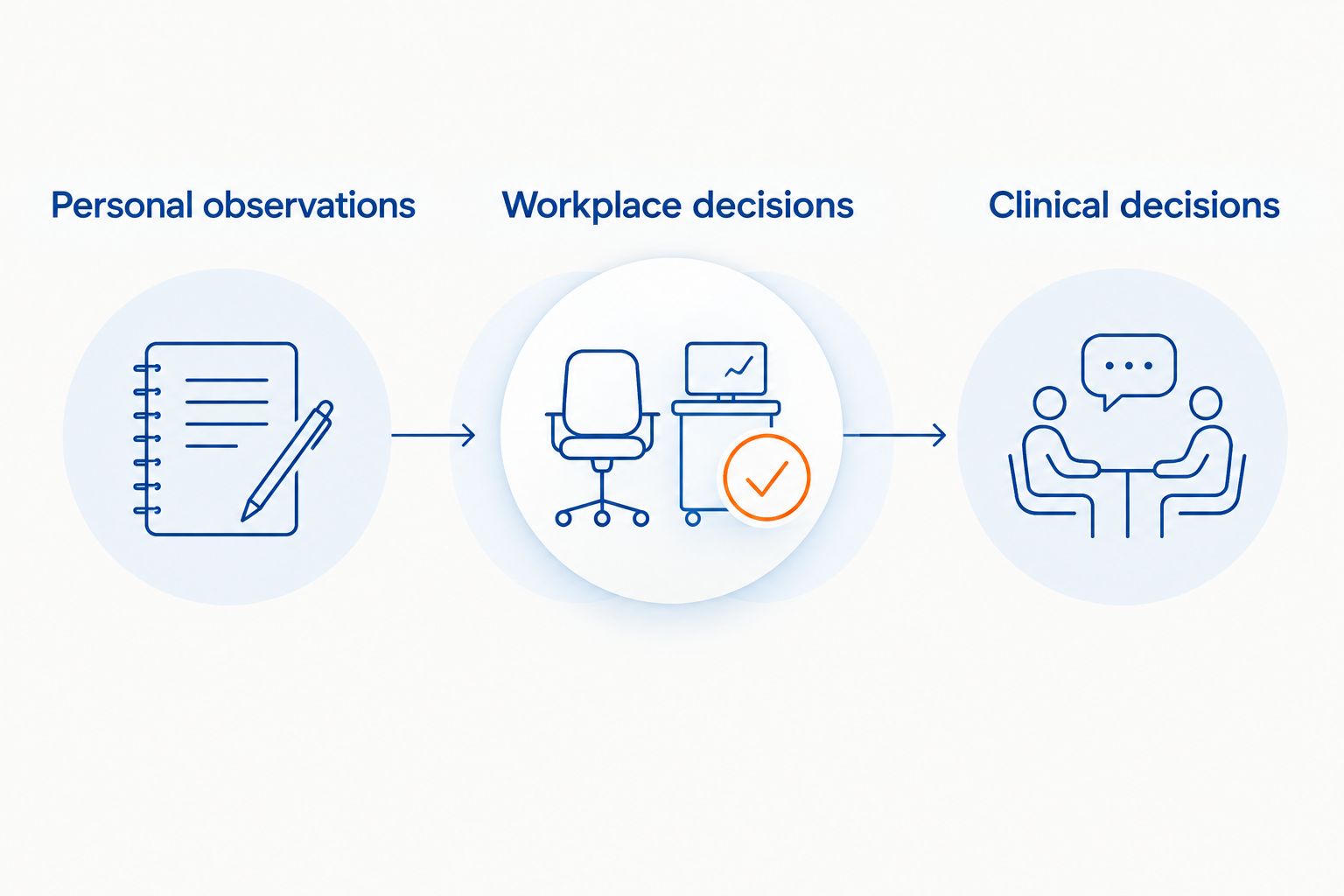
The following steps separate personal observations, workplace decisions and clinical decisions. Keep those responsibilities distinct, particularly where police equipment or operational readiness is involved.
Record the tasks associated with your concern
Write down what you were doing when you noticed the concern, rather than labelling it as a spinal problem. Record vehicle time, desk duties, standing, training and equipment use separately. Describe the symptom in your own words without trying to identify its cause.
For an initial record, use 3 shifts as a practical starting point—not a clinical monitoring requirement. If symptoms need prompt medical attention, do not wait to finish the record. Avoid operational details, identifying information or anything restricted by your employer’s confidentiality requirements.
A short record helps you communicate your experience without relying on memory. It also gives you something concrete to discuss if your duties change between appointments.
- Note the task and approximate time symptoms began.
- Describe the location and nature of the concern.
- Record whether you were wearing duty equipment.
- Note any effect on an ordinary activity.
- Keep confidential police information out of personal notes.
Review equipment through approved workplace channels
Begin with the equipment guidance and adjustment process provided by your employer. Do not remove protective equipment, relocate operational items or modify a duty belt solely because a general health article suggests doing so. Equipment decisions must account for access, protection and workplace requirements.
Describe the practical problem: an item contacting the seat, difficulty using an approved adjustment, or discomfort during a particular task. An occupational health or workplace equipment discussion is different from a clinical diagnosis. Both may be relevant, but neither substitutes for the other.
Avoid buying a replacement belt, support or cushion before checking whether it is permitted and whether it addresses the issue you have identified.
- Check the approved equipment-fitting instructions.
- Record where equipment contacts the seat or body.
- Raise fitting questions with the authorised workplace contact.
- Ask whether an approved equipment review is available.
- Keep protective and operational requirements unchanged.
Prepare for an individual clinical assessment
Gather your symptom record, relevant medical history and any existing care instructions. Explain whether the concern is longstanding, new or connected to an incident. Do not present a workplace incident as routine stiffness; ask about medical assessment and follow the applicable reporting process.
At MyChiro, chiropractic care and spinal adjustments are offered services. An offered service is not an automatic recommendation for every patient. You can ask what an assessment involves and whether another health professional should be involved before deciding about care.
For your 2026 appointment preparation, write down 2 work tasks you want to discuss. These are conversation prompts, not promised outcomes—for example, vehicle entry and report writing.
- Bring a list of current medicines and relevant diagnoses.
- Describe previous care and any concerns about it.
- Explain the duties you actually perform.
- Ask what the assessment can and cannot establish.
- Identify questions about referral or coordination with your GP.
Ask about consent, alternatives and limitations
Before any proposed adjustment, request an explanation of the procedure, its purpose, relevant risks, alternatives and uncertainties. Ask how the recommendation relates to your assessment rather than accepting a general claim about police officers or spinal alignment.
You can decline a procedure or ask for time to consider it. Ask which parts of the proposed plan are optional, what information supports the recommendation and what would prompt a change of approach. Do not assume that an adjustment is necessary because an appointment is with a chiropractor.
For background on the procedure, read what to expect from spinal manipulation. Educational material does not replace a discussion about your circumstances or establish consent on its own.
- Ask what procedure is being proposed.
- Request an explanation of relevant risks and limitations.
- Discuss alternatives, including not proceeding.
- Ask what evidence supports the specific recommendation.
- Confirm how to raise concerns after the appointment.
Discuss vehicle, desk and roster arrangements
Review the arrangements you can change within workplace rules before purchasing accessories. Check whether you understand the vehicle’s approved seat adjustments and whether report-writing equipment has an established setup process. Describe any difficulty reaching controls or using the workstation rather than forcing a particular posture.
Movement opportunities depend on the assignment. Do not follow a fixed break schedule from an online article when it conflicts with operational duties; raise practical opportunities with your supervisor or occupational health contact.
Roster changes also matter when discussing appointments or a proposed home programme. Explain your actual schedule so recommendations can be considered against it, rather than agreeing to a routine you cannot reasonably follow.
- Review permitted vehicle-seat and workstation adjustments.
- Keep controls, restraints and required equipment accessible.
- Discuss task changes through workplace channels.
- Explain roster variations to your health professional.
- Check approval before adding workplace accessories.
Agree on a plan without automatic ongoing visits
Ask for a clear explanation of any proposed care plan: its purpose, proposed review point, limitations and circumstances that would lead to referral or a different approach. An appointment schedule should follow an individual assessment, not simply your occupation or the fact that you wear a duty belt.
If exercise is proposed, request instructions appropriate to your circumstances rather than copying a police fitness routine or another officer’s rehabilitation programme. Clarify how the plan relates to existing medical advice and employer-directed rehabilitation.
Biopsychosocial care considers physical, psychological and social circumstances together. You can discuss sleep, stress and work demands without accepting an unsupported claim that adjustments address those concerns.
- Ask why each element of the plan is proposed.
- Request clear instructions for any suggested activity.
- Discuss existing medical or rehabilitation advice.
- Agree on what will be reviewed and when.
- Ask what would justify changing or ending the plan.
Review function and workplace responsibilities separately
Choose observations that describe your everyday experience, such as whether you can complete report writing comfortably or whether a particular vehicle task remains difficult. Record changes without assuming that an appointment caused them. Symptoms and work circumstances can change together.
For each review in 2026, bring 1 written question about the next decision: continue, change the approach, pause or seek another assessment. This is an organisational prompt, not a prescribed review frequency.
A clinical appointment does not automatically provide clearance for operational duties. Confirm your employer’s process for fitness-for-duty decisions, documentation and workplace restrictions rather than assuming any practitioner’s letter meets those requirements.
- Compare the same tasks across your notes.
- Record changes in duties or equipment alongside symptoms.
- Ask whether the original plan still has a clear purpose.
- Confirm who handles workplace clearance and restrictions.
- Seek reassessment rather than repeating an unclear plan.
Compare assessment and workplace options
The appropriate starting point depends on the question you need answered. In 2026, choose an option by its role and limitations, not by a promise of rapid results or a colleague’s experience.
These options are not interchangeable. A workplace review cannot diagnose a medical condition, while an individual clinical appointment cannot authorise changes to police equipment or override an employer’s operational requirements.
| Option | Suited to | Useful role | Key limitation |
|---|---|---|---|
| Personal task record | Preparing for a discussion | Organises observations about symptoms and duties | Cannot establish a diagnosis or suitability for care |
| Workplace equipment or ergonomic review | Questions about approved gear, seating and workstations | Addresses workplace arrangements within employer processes | Does not replace clinical assessment |
| GP assessment | New, unexplained or medically concerning symptoms | Provides medical assessment and discussion of referral | Does not itself resolve equipment or roster questions |
| Physiotherapy assessment | Discussing movement, exercise and rehabilitation needs | Provides an individual assessment within the practitioner’s scope | Does not replace employer fitness-for-duty processes |
| Chiropractic assessment | Considering whether chiropractic services are appropriate | Allows discussion of assessment findings and proposed care | Adjustments are not appropriate for every person or concern |
Ask each provider what they can address and when they would refer you elsewhere. There is no need to select a procedure before the assessment that informs that decision.
Common mistakes police officers make when considering care
Assuming equipment contact proves a spinal diagnosis
A duty-belt item touching the seat is an observation, not proof of nerve pressure, a disc problem or spinal misalignment. Describe what happens and arrange the appropriate workplace or clinical discussion. Avoid adopting a diagnosis from a diagram or social post.
Changing operational equipment without approval
Moving an item or adding a cushion can affect how the approved setup works. Keep workplace requirements in place and ask the authorised contact about permitted changes. A health appointment does not replace that approval process.
Using a colleague’s result as a recommendation
Another officer’s experience does not establish what is appropriate for your symptoms, health history or duties. Ask for the reasoning behind your own recommendation, including its limitations. Do not select a procedure on the strength of an anecdote.
Treating appointment attendance as duty clearance
Attending care and being cleared for operational work are separate matters. Confirm which practitioner, documentation and employer process apply to your circumstances. Tell the assessing professional about the actual task requirements rather than asking for a general statement about policing.
Continuing without a clear review decision
Repeated appointments need an individual rationale and a review process. Ask what is being assessed, what would change the plan and whether referral is appropriate. Avoid assuming that an indefinite schedule is necessary because your work remains physically demanding.
When medical assessment takes priority
Do not use this guide to manage an injury after a collision, assault or fall. Follow workplace incident procedures and seek medical assessment appropriate to the event and symptoms before considering routine chiropractic care.
Healthdirect Australia’s public information on back pain identifies symptoms requiring urgent medical attention, including loss of bladder or bowel control and weakness or numbness in the legs. For this 2026 guide, that advice is a referral boundary—not a suggestion that chiropractic adjustments address those symptoms.
Seek urgent medical assessment for those symptoms, particularly numbness around the groin or buttocks or new, progressive weakness. Severe pain with fever or feeling seriously unwell also needs medical attention. If you are uncertain about urgency, contact an appropriate medical or emergency service rather than waiting for a routine appointment.
FAQ
What is chiropractic care for police officers?
Chiropractic care for police officers is individual assessment and discussion of whether chiropractic services are appropriate for a musculoskeletal concern. Police duties provide context; they do not establish a diagnosis or a need for adjustments.
Do police officers need regular chiropractic adjustments?
Being a police officer does not by itself establish a need for regular adjustments. Any proposed care schedule should have an individual rationale, relevant consent discussion and a review point.
Can I move items on my duty belt if they feel uncomfortable?
Check your employer’s approved equipment process before moving operational items or changing the setup. Describe the contact or discomfort and request an authorised fitting review where available.
Should I see a GP or a chiropractor first?
Medical assessment takes priority for concerning symptoms or symptoms after trauma. For a non-urgent musculoskeletal concern, discuss assessment options and whether referral is appropriate rather than selecting a procedure in advance.
What should I bring to a chiropractic assessment?
Bring your relevant health history, medicines list, existing care instructions and a brief description of your duties and symptoms. Keep operationally sensitive information out of personal notes.
Can a chiropractic appointment clear me for police duties?
A chiropractic appointment does not automatically provide fitness-for-duty clearance. Confirm your employer’s requirements for the assessing practitioner, documentation and any work restrictions.
Where is MyChiro located?
MyChiro is a chiropractic clinic and wellness centre in Bondi Junction, Sydney. Whether chiropractic care is appropriate for an individual police officer requires assessment.
One last thing
Bring a task question, not a request for a particular adjustment. For example: explain that a duty-belt item contacts the vehicle seat, then ask which parts of the problem belong with your workplace equipment contact and which require clinical assessment.
That distinction keeps the next decision specific. Your occupation informs the assessment; it does not determine the procedure. For your next discussion in 2026, start with the concern, the relevant task and the question you need answered.
Related guides
- Prepare for your first chiropractor appointment
- Lower back pain when sitting: practical steps
- Qualifications to check when choosing a Sydney chiropractor