

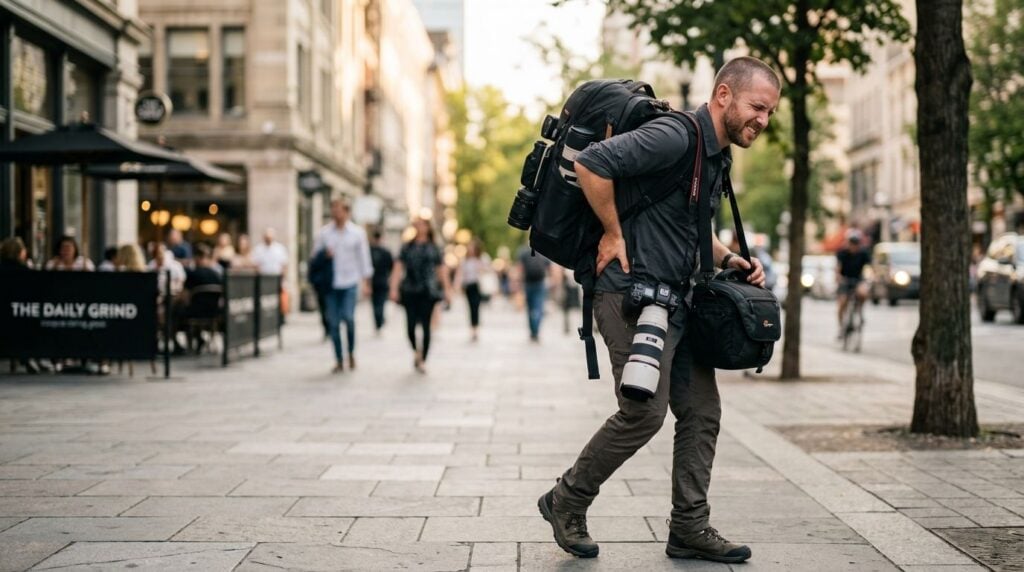
Photographers who carry heavy camera bodies, multiple lenses, tripods and lighting gear for hours at a time put repeated, asymmetric load through the neck, shoulders and lower back. Wedding and event photographers face a different pattern of strain than a landscape photographer hiking with a single pack, and both differ again from a studio photographer standing at a tethered rig all day.
- A chiropractor for photographers back pain looks at posture, gear load and repetitive movement patterns, not just the sore spot.
- Single-shoulder camera bags and monopods create uneven load through one side of the spine and hips over a full shoot.
- Core strength, gear redistribution and scheduled breaks reduce daily strain before any clinical assessment is needed.
- MyChiro in Bondi Junction offers spinal assessments for photographers with recurring neck, shoulder or lower back strain in 2026.
Why this matters
Camera gear has gotten heavier as photographers add backup bodies, prime lenses and off-camera lighting to a single shoot. A professional body paired with a telephoto lens commonly sits in the 2-4kg range on its own, and a loaded shoulder bag with two or three lenses, a flash and accessories often pushes past 10kg. That weight rarely sits centred on the body — it hangs off one shoulder, one hip, or one strap for hours.
Repetitive single-side carrying, crouching for low-angle shots, and standing hunched over a viewfinder for extended periods are the mechanical patterns a chiropractor is trained to assess. Learning how to lift heavy objects safely is a reasonable starting point before a shoot ever begins, because the load pattern that causes strain often starts the moment gear goes into the car.
Why chiropractic care matters for photographers
Photographers rarely have a single point of injury — the strain builds across a full working day, sometimes a full wedding season. A chiropractor assessing a photographer will typically ask about shoot length, gear weight, dominant carrying side and how often the photographer changes position during a session.
That differs from a desk-based worker's assessment, where the main variable is chair setup and screen height. For a photographer, the variables include tripod height, whether shots are handheld or supported, and how much walking or crouching happens between locations. A chiropractic assessment can look at spinal alignment, muscle tension patterns and joint mobility in this context, and any recommendations are made following that individual assessment rather than as a general prescription.
Audit your camera bag and gear load
Start with what you're actually carrying and how.
- Weigh your typical shoot-day bag, including lenses, flash and accessories
- Note which shoulder or hip carries the bag on a normal day
- Check whether a backpack-style bag with a hip belt distributes weight more evenly than a shoulder bag
- Separate rarely-used lenses into a second bag you only bring when needed
- Rotate carrying sides deliberately during long shoots
Adjust your carrying technique and gear distribution
How you position gear across your body matters as much as the total weight.
- Use a chest harness or dual-strap system for heavier bodies with long lenses
- Keep a second camera on a cross-body strap rather than looping it around one shoulder
- Attach a monopod to a belt system for long lens work instead of holding it one-handed for extended periods
- Avoid stacking multiple bags on the same shoulder
- Consider a rolling case for studio or event setups where terrain allows it
The same load-distribution thinking applies to other roles that carry heavy tools for a living, which is why chiropractic care for tradies and manual labourers covers similar ground on uneven daily loads.
Correct your shooting posture during long sessions
Crouching, leaning and craning at the viewfinder for hours adds up.
- Bring the camera to eye level rather than bending your neck down to it
- Use a tripod or monopod for static shots instead of holding position for minutes at a time
- Alternate between kneeling on one knee and standing rather than staying in one crouch
- Keep your core braced when leaning forward to frame a shot
- Check your standing posture between shots rather than only during setup
Build core and upper back strength
A stronger midsection reduces how much of the carrying load transfers to your lower back.
- Add planks and dead bugs to a weekly routine, not just cardio
- Work on upper back and rear shoulder strength to counter the forward-hunched shooting posture
- Include hip and glute strengthening if you crouch or kneel often on shoots
- Keep sessions short and consistent — three 20-minute sessions a week beats one long one
Schedule regular movement breaks during shoots
Standing or crouching in one position for too long is often worse than the weight itself.
- Build in a two-minute stretch or walk every 30-60 minutes during long events
- Swap shoulders or bag position at each break
- Set gear down fully rather than resting it against your body during downtime
- Use breaks to reset your standing posture before the next set of shots
Stretch before and after gear-heavy days
A short routine before and after a shoot reduces stiffness the next morning.
- Neck and shoulder rolls before loading the car
- Chest opener stretches to counter the forward-hunched carrying posture
- Hip flexor stretches if you've been crouching or kneeling for hours
- Gentle spinal twists at the end of a long shoot day
Track pain patterns and flare triggers
Keep a simple note of when discomfort shows up.
- Record which shoulder or side feels tighter after a shoot
- Note whether pain follows specific gear (long lens vs. compact setup)
- Track how many hours into a shoot discomfort typically starts
- Flag any pain that doesn't ease within a day or two of rest
Get a professional spinal assessment
If gear changes and stretching aren't shifting recurring stiffness, a chiropractic assessment can look at what's driving the pattern. This step follows the ones above rather than replacing them — an assessment works best once basic load and posture habits are already in place.
“If a single-shoulder camera bag leaves one side of your neck stiff by the end of a shoot, the load is unbalanced, not you.”
Comparing your options as a photographer with back pain
| Option | Best for | Key limitation |
|---|---|---|
| Self-directed gear and posture changes | Early-stage stiffness after long shoots | Requires consistency; doesn't address underlying joint or spinal issues |
| Remedial massage | Muscle tightness and short-term tension relief | Doesn't assess spinal alignment or joint mechanics |
| Physiotherapy | Rehabilitation after a specific injury | Often more exercise-focused than manual adjustment-based |
| Chiropractic assessment | Recurring stiffness, uneven carrying patterns, postural strain | Requires an in-person assessment before any specific recommendation |
Common mistakes photographers make
- Carrying everything on one shoulder for an entire event — the imbalance compounds over a multi-hour wedding or corporate shoot far more than a single heavy lift would
- Skipping the tripod to save setup time — handheld shooting with a long lens for extended periods loads the shoulders and neck repeatedly
- Crouching for low-angle shots without support — repeated deep crouches without a knee pad or monopod add up across a shoot day
- Ignoring early neck stiffness after events — treating it as normal fatigue rather than a pattern worth reviewing
- Not varying bag setup between different types of shoots — a wedding kit and a landscape hiking kit need different carrying systems, not the same bag every time
An assessment can also flag when discomfort points toward something beyond day-to-day strain, similar to how chiropractic care for travellers carrying heavy luggage covers repeated heavy-load carrying in a different context.
Book a spinal assessment
Discuss shoot-day gear load and posture patterns with a chiropractor at MyChiro.
FAQ
What causes back pain in photographers who carry heavy gear?
Repeated single-shoulder carrying, crouching for low-angle shots and standing for hours without breaks are the main mechanical patterns behind back and neck strain in photographers. The load itself matters less than how consistently it’s carried on one side of the body.
How can photographers reduce back strain from camera equipment?
Redistributing weight with a chest harness or hip-belt backpack, rotating carrying sides, and scheduling short movement breaks every 30-60 minutes during long shoots all reduce cumulative strain. Core and upper back strengthening exercises support these changes over time.
Is chiropractic care suitable for photographers with chronic back pain?
A chiropractic assessment can review spinal alignment, posture and joint mobility relevant to a photographer’s carrying and shooting patterns. Whether any adjustment or exercise plan is appropriate depends on the individual assessment, not a general answer.
How often should a photographer see a chiropractor?
There’s no fixed schedule that applies to every photographer — frequency depends on shoot volume, gear weight and how a chiropractor assesses your specific pattern of strain. Some photographers only need an initial assessment plus a follow-up after gear or technique changes.
Can a heavy camera bag cause long-term back problems?
Years of asymmetric loading through one shoulder or hip can contribute to postural imbalance and recurring stiffness, though outcomes vary by individual and by how gear is carried day to day. Reviewing bag setup and carrying side early reduces that cumulative load.
What stretches help before and after a long shoot?
Neck and shoulder rolls, chest openers and hip flexor stretches address the main areas loaded during a typical shoot day. Gentle spinal twists at the end of a session can ease stiffness that builds from standing or crouching for hours.
How do I know if my back pain needs an assessment?
Stiffness that doesn’t ease within a day or two of rest, or pain that’s consistently worse on the side you carry your bag, is worth discussing with a chiropractor or another qualified health professional. Sudden sharp pain or pain radiating down a limb warrants prompt medical assessment.
Does a tripod reduce back strain compared to handheld shooting?
Yes — a tripod or monopod removes the sustained isometric load of holding a camera and lens at height for minutes at a time, which is one of the more repetitive strain patterns in event and wildlife photography. It won’t address gear-carrying load between locations, which needs a separate fix.
One last thing
The carrying side matters more than most photographers assume — swapping which shoulder holds the bag every 30 minutes during a long shoot does more for even load distribution than a lighter bag alone. Gear weight gets the attention; carrying pattern is usually the bigger factor.
Related guides
- Ergonomic setups for shift workers with back pain
- Chiropractic care for students carrying heavy backpacks
- How to lift heavy objects safely to protect your back


