

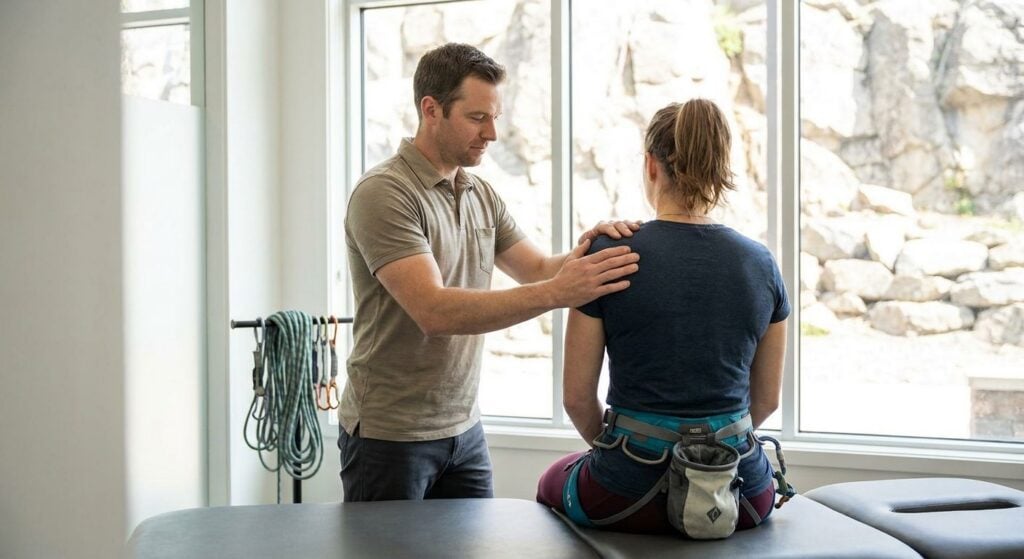
Shoulder strain from rock climbing shows up as pinching on overhead reaches, a dull ache after a hangboard session, or a shoulder that clicks when you rack a jug. A chiropractor for rock climbers looks at how repetitive loading, grip position and scapular control interact, then works alongside strength and mobility work rather than replacing it. Climbers put shoulders through end-range positions under load far more often than most gym-goers, which is why generic shoulder advice often misses the mark.
- Shoulder strain in climbers usually stems from load spikes, poor scapular control or grip-driven overuse, not one single injury.
- A chiropractor for rock climbers can assess joint mobility and movement patterns alongside a structured strength and mobility plan.
- Rotator cuff and scapular strengthening 2-3 times a week is the most consistent self-managed step climbers report using.
- Ongoing shoulder pain, night pain or loss of strength warrants assessment by a chiropractor or other qualified health professional.
- MyChiro in Bondi Junction offers assessment-based care that can be discussed as part of a broader climbing recovery plan.
Why chiropractic care matters for rock climbers
Climbing asks the shoulder to work in positions few other sports demand: fully flexed and externally rotated on a high reach, loaded in a shoulder-behind-the-hip position on a roof, or locked off with the arm close to the body on a crimp. Each of these positions relies on the rotator cuff and scapular stabilisers to keep the humeral head centred in the socket.
When those stabilisers fatigue faster than they recover — a common pattern during a heavy training block or a climbing trip with back-to-back sessions — the joint capsule and surrounding soft tissue start to take load they weren't built for. That's when climbers report the classic signs: a pinch at the top of a reach, an ache that lingers into the next day, or stiffness that makes warm-up climbs feel harder than they should.
A chiropractic assessment can help identify whether shoulder or upper thoracic joint restriction is contributing to that pattern, alongside the strength and mobility gaps a climbing coach or physiotherapist would also look at. This is assessment-led, not a single fix — most climbers need a combination of load management, targeted exercise and, where appropriate following assessment, manual therapy.
Track your climbing load and pain pattern
Before changing anything, get clear on what's actually driving the strain. Climbers who log sessions tend to spot the pattern faster than those relying on memory.
- Note session frequency, wall angle (slab, vertical, overhang) and grip type used most
- Record when the ache starts — during the session, after, or the next morning
- Track whether pain is sharp and localised or a dull, diffuse ache
- Flag any sessions with a sudden jump in volume or intensity
- Note sleep position and whether lying on the affected side wakes you
Reset shoulder mobility with daily drills
Stiff thoracic spine and tight pecs force the shoulder to compensate on overhead moves. A short daily mobility routine, done away from the wall, keeps the joint moving through its full range without load.
- Wall slides against a flat wall, 2 sets of 10
- Thoracic extension over a foam roller, 60 seconds
- Doorway pec stretch, 3 rounds of 20-30 seconds per side
- Cross-body shoulder stretch, held gently, no bouncing
- Band pull-aparts for scapular activation, 2 sets of 15
Strengthen the rotator cuff and scapular stabilisers
This is the step climbers skip most often, and it's the one most consistently linked to fewer recurring shoulder niggles in strength and conditioning literature on overhead athletes. Two to three sessions a week, separate from climbing days, is a reasonable starting target.
- External rotation with a light band or cable, 3 sets of 12-15
- Prone Y-T-W raises for lower trap and scapular control
- Face pulls to balance pressing-dominant climbing movements
- Scapular push-ups to build serratus anterior control
- Isometric holds at end-range shoulder flexion, building tolerance gradually
Adjust your climbing technique and grip style
Technique changes reduce load on a strained shoulder without taking you off the wall entirely.
- Favour straight-arm hangs over bent-arm positions when the shoulder is irritable
- Use flagging and foot positioning to reduce reliance on shoulder-driven moves
- Reduce campus board and dynamic move volume during a flare-up
- Swap steep overhangs for vertical or slab routes temporarily
- Warm up with easy traverses for 10-15 minutes before working hard problems
Get a chiropractic assessment for joint restriction
If mobility work and strengthening plateau, or if pain persists past two to three weeks despite load changes, an assessment can identify whether upper thoracic or shoulder joint restriction is part of the picture. A chiropractor can check joint mobility, muscle tone and movement patterns across the shoulder girdle and spine, and discuss whether adjustments, soft tissue work or referral to another qualified health professional may be appropriate following that assessment.
This is also the point to compare notes with how chiropractic care for surfers with shoulder and back pain is approached — another overhead-loading sport with a similar shoulder strain pattern, and useful context for what an assessment-based plan can look like.
Build a structured return-to-climbing plan
Returning too fast is the single biggest driver of repeat shoulder strain in climbers. A staged plan protects the progress made in the steps above.
- Reintroduce volume before intensity — more easy climbs before harder single moves
- Cap session length for the first two weeks back
- Keep the strengthening routine running even once pain settles
- Reassess pain and range of motion weekly, not just at the end of a block
Discuss your shoulder strain assessment
Book a chiropractic assessment at the Bondi Junction clinic to discuss your climbing shoulder strain.
Comparison of shoulder strain management options for climbers
| Option | Best for | Key limitation |
|---|---|---|
| Self-guided mobility and strengthening | Mild, early-stage strain with no red flags | Requires consistency; slow to show change without guidance |
| Physiotherapist-guided rehab | Climbers wanting a structured, progressive loading program | May need multiple sessions to build and adjust the plan |
| Chiropractic assessment and care | Climbers with joint stiffness or restriction alongside muscular strain | Works best combined with strength work, not as a standalone step |
| Rest and activity modification | Acute flare-ups or sharp, localised pain | Doesn't address the underlying load or technique pattern on its own |
Common mistakes rock climbers make with shoulder strain
- Climbing through sharp pain instead of dropping intensity for a session or two — sharp, localised pain is a signal to stop and reassess, not push through.
- Skipping the mobility and strength work once pain settles, which sets up the same strain to return during the next hard training block.
- Blaming one session for pain that actually built up over weeks of steadily increasing volume without matching recovery.
- Overloading the front of the shoulder with pressing and pulling work while neglecting rear-delt and scapular stabiliser training.
- Waiting months before getting an assessment, which can let a manageable strain pattern become a longer-standing restriction.
Stretch and mobility routines built for other overhead sports translate well here too — the stretches for swimmer's shoulder pain cover similar rotator cuff and capsule mobility work climbers can adapt to their own warm-up.
FAQ
What causes shoulder strain in rock climbers?
Shoulder strain in climbers usually comes from repetitive overhead and end-range loading combined with fatigue in the rotator cuff and scapular stabilisers. Training load spikes, poor warm-up and grip-heavy sessions are common contributing factors.
Can a chiropractor help with climbing shoulder pain?
A chiropractor can assess joint mobility, movement patterns and muscle tone around the shoulder and thoracic spine, and discuss whether adjustments or soft tissue work may be appropriate following assessment. This is typically combined with strengthening and mobility work rather than used alone.
Is it OK to keep climbing with shoulder pain?
Mild, dull discomfort that settles quickly may allow modified climbing at reduced intensity, but sharp or worsening pain is a signal to stop and get assessed. Continuing to load an irritated shoulder can extend recovery time.
How long does climbing shoulder strain take to settle?
Recovery timelines vary depending on severity and how quickly load is managed, and can range from a couple of weeks for mild strain to longer for more persistent cases. A qualified health professional can give a timeframe specific to the presentation.
What exercises help rotator cuff strength for climbers?
Band external rotations, prone Y-T-W raises, face pulls and scapular push-ups target the muscles climbers rely on to stabilise the shoulder during overhead and locked-off positions. These are typically done 2-3 times a week separate from climbing sessions.
Should I see a physiotherapist or a chiropractor for shoulder strain?
Both can play a role — physiotherapists often lead structured strength and rehab programs, while chiropractors focus on joint mobility and movement assessment. Many climbers use a combination, and a chiropractor can discuss referral options where appropriate.
Does grip style affect shoulder strain in climbing?
Yes, heavy reliance on bent-arm or dynamic moves places more load on the front of the shoulder than straight-arm hangs and flagging technique. Adjusting grip and movement style during a flare-up can reduce load while other steps take effect.
When should a climber worry about shoulder pain?
Pain that wakes you at night, persists beyond two to three weeks despite rest and load management, or comes with noticeable weakness or loss of range should be assessed by a chiropractor or other qualified health professional. These signs suggest more than simple overuse.
One last thing
The shoulder position climbers underestimate most isn't the big overhang move — it's the static lock-off close to the body on a crimp, where the rotator cuff works hard with almost no visible motion. Building isometric strength at that exact angle, not just through big ranges of motion, is often the missing piece in a climber's shoulder program in 2026.
Related guides