

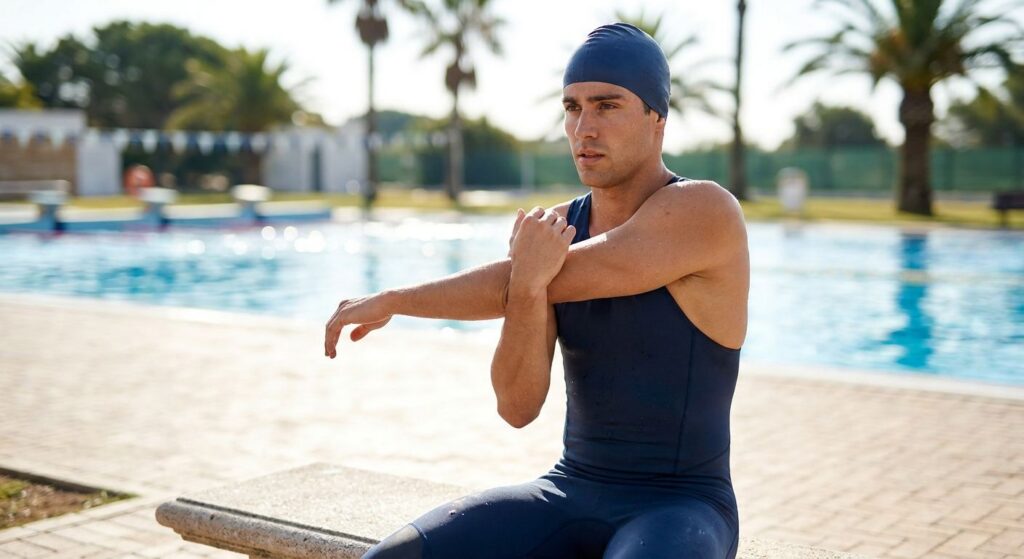
Swimmer's shoulder is the catch-all term for the pinching, aching or stiffness that shows up after months of freestyle and butterfly sets, and the right stretches can be part of a broader approach to managing it alongside guidance from a qualified health professional.
- Sleeper stretch and doorway pec stretch top the list of best stretches for swimmers shoulder for internal and external rotation range in 2026.
- General stretching guidelines suggest 10-30 second holds, 2-3 sets, done 2-3 times a week.
- Posterior capsule tightness (GIRD) is often the missed piece — stretching the front of the shoulder alone rarely addresses it.
- Persistent shoulder pain beyond two weeks or pain that disturbs sleep warrants assessment by a health professional, not just more stretching.
Why this matters
Overhead, repetitive shoulder motion is the defining feature of competitive swimming, and sports medicine literature has long flagged shoulder pain as one of the most commonly reported complaints among swimmers, with some published estimates putting lifetime prevalence in competitive swimmers well above 50%. The repetitive nature of freestyle and butterfly stroke puts the rotator cuff and shoulder capsule through thousands of overhead cycles per week during a typical training block in 2026.
Stretching is one piece of managing shoulder mobility for swimmers, but it is not a stand-alone fix. Chiropractic care for swimmers with shoulder pain typically looks at the whole kinetic chain — thoracic mobility, scapular control and rotator cuff strength — rather than the shoulder joint in isolation, and any stretching routine works best when it sits inside that bigger picture with input from a qualified health professional.
How this list was ranked
Each stretch below was assessed against three factors: how directly it targets the internal/external rotation deficit common in overhead swimmers, how well it's supported in general sports rehabilitation practice, and how easy it is to do correctly without equipment. This is general education, not a substitute for an individual assessment — what's appropriate for one swimmer's shoulder may not suit another, particularly where there's a history of dislocation, labral injury or recent surgery.
The ranked list of best stretches for swimmers shoulder
1. Sleeper stretch — the internal rotation classic
Lie on your side with the affected shoulder underneath you, arm bent to 90 degrees, then gently press the forearm toward the floor using the other hand. Hold for 20-30 seconds and repeat 2-3 times per side.
This stretch targets the posterior capsule, the structure most often implicated in glenohumeral internal rotation deficit (GIRD) — a pattern seen frequently in swimmers who favour one breathing side. Do it, but stop short of a sharp pinch; a light stretch sensation is the target, not discomfort.
2. Doorway pec stretch — the posture reset
Stand in a doorway, forearm against the frame at roughly shoulder height, and step forward until a stretch is felt across the chest. Hold 20-30 seconds, 2-3 reps per side.
Tight pectoral muscles pull the shoulder forward and can compress the space the rotator cuff tendons pass through during the recovery phase of freestyle. This is a low-risk, widely used stretch. Do it, ideally as part of a warm-up before pool sessions rather than only after.
3. Cross-body shoulder stretch — the everyday maintenance move
Bring one arm across the chest and use the opposite hand to gently pull it closer, holding for 15-20 seconds per side.
It targets the posterior deltoid and rotator cuff musculature and takes under a minute total. It's simple enough to do poolside between sets in 2026 without any equipment. Do it, but avoid pulling through any sharp or radiating pain — that's a signal to stop, not push through.
4. Thread-the-needle — the thoracic mobility play
From hands and knees, thread one arm under the body and rotate the torso, then reverse. Hold the end position for 15-20 seconds each side, 2 rounds.
Swimmer's shoulder is rarely just a shoulder problem — limited thoracic spine rotation forces the shoulder to compensate on every stroke. This move addresses that upstream contributor. Do it, and pair it with general thoracic mobility work rather than treating it as a shoulder-only fix.
5. Scapular wall slides — the control builder
Stand with your back against a wall, arms in a "goalpost" position, and slide them overhead while keeping contact with the wall. Aim for 2-3 sets of 10 reps.
This isn't a passive stretch — it's a controlled mobility drill that trains the scapula to rotate properly as the arm goes overhead, which matters for anyone whose shoulder blade winging shows up under fatigue. If winging is a recurring issue, the guide on fixing winged shoulder blades goes into more depth on that pattern specifically. Do it, but expect it to feel awkward for the first week or two before the movement smooths out.
6. Posterior capsule stretch (cross-arm, lying) — the GIRD-specific option
Lying on the side, pin the shoulder blade down and pull the top arm across the body toward the floor. Hold 20-30 seconds, 2 reps.
This is a more targeted variation of the cross-body stretch, isolating the posterior capsule with the scapula stabilised. It's a useful addition once the basics are comfortable, not a starting point. Modify for anyone new to shoulder stretching — start with the standard cross-body version first and progress to this one later.
7. Band external rotation stretch — the one that needs supervision
Using a resistance band anchored at elbow height, rotate the forearm outward against light resistance through a controlled range.
It builds external rotation strength alongside range, which matters because swimmers often develop an internal-rotation-dominant shoulder from thousands of pulling strokes. Done with poor form, though, it can aggravate an already irritated shoulder. Skip this one without guidance if pain has been present for more than a couple of weeks — it belongs later in a structured program, not as a first move.
Comparison table
| Stretch | Primarily targets | Suggested hold | Frequency | Verdict |
|---|---|---|---|---|
| Sleeper stretch | Posterior capsule / internal rotation | 20-30 sec | 2-3x/week | Do it |
| Doorway pec stretch | Pectoral tightness | 20-30 sec | 2-3x/week | Do it |
| Cross-body stretch | Posterior deltoid, rotator cuff | 15-20 sec | Daily-friendly | Do it |
| Thread-the-needle | Thoracic rotation | 15-20 sec | 2-3x/week | Do it |
| Scapular wall slides | Scapular control | 10 reps x 2-3 sets | 2-3x/week | Do it |
| Posterior capsule stretch | Posterior capsule (isolated) | 20-30 sec | 2x/week | Modify |
| Band external rotation | Rotation strength + range | Controlled reps | As guided | Skip if pain present |
Get your shoulder assessed properly
A tailored plan starts with understanding what’s driving the pain.
Where to start (and when to get help instead)
- Warm up first. Five to ten minutes of light movement before stretching reduces the odds of overstretching a cold shoulder capsule.
- Sequence mobility before strength. Do the sleeper stretch, doorway pec stretch and thread-the-needle before any band work — trying to strengthen a joint that hasn't got its range back tends to backfire.
- Know the red flags. Night pain, numbness down the arm, or pain that hasn't eased after two weeks of a sensible routine is a reason to see a health professional rather than adding more stretches. Overuse patterns like this share a lot with what shows up in repetitive strain injuries from other sports — the underlying principle of addressing the whole movement chain, not just the sore spot, applies here too.
For swimmers who cross-train, similar overuse patterns show up in the shoulders and upper back of gym-goers and weightlifters, which is worth knowing if pool sessions are stacked with heavy pressing work in the same week.
FAQ
What are the best stretches for swimmers shoulder pain?
The sleeper stretch, doorway pec stretch and thread-the-needle are commonly recommended as part of managing shoulder mobility in swimmers, typically held for 20-30 seconds across 2-3 sets. Individual needs vary, so a routine works best when checked against your own history and any current pain.
How often should swimmers stretch their shoulders?
General stretching guidelines suggest 2-3 sessions a week outside of pool time, plus a short mobility warm-up before training. More frequent light mobility work, such as scapular wall slides, can be done most days without issue for most people.
Is stretching enough to manage swimmer’s shoulder?
Stretching alone rarely addresses the full picture, since thoracic mobility, scapular control and rotator cuff strength usually all play a role. A more complete approach often includes strength work and, where pain persists, assessment by a qualified health professional.
What causes swimmer’s shoulder in the first place?
It’s generally linked to the repetitive overhead motion of freestyle and butterfly combined with limited thoracic rotation, tight anterior shoulder structures and rotator cuff fatigue. These factors compound over a training season rather than appearing from a single incident.
When should a swimmer with shoulder pain see a chiropractor?
If shoulder pain persists beyond two weeks, disturbs sleep, or doesn’t respond to basic mobility work, it’s worth having it assessed rather than continuing to self-manage. A chiropractor can evaluate the shoulder alongside the neck, thoracic spine and posture as a connected system.
Can stretching make swimmer’s shoulder worse?
Yes, if done aggressively or on an already irritated joint, particularly stretches that push into external rotation under load. Any stretch that produces sharp or radiating pain rather than a mild pulling sensation should be stopped and discussed with a health professional.
What is GIRD and why does it matter for swimmers?
GIRD stands for glenohumeral internal rotation deficit, a loss of internal rotation range in the throwing or pulling shoulder that’s common in overhead athletes including swimmers. It’s one of the more overlooked contributors to shoulder pain because it isn’t obvious without a specific range-of-motion check.
Do these stretches work for both freestyle and butterfly swimmers?
The same rotator cuff and posterior capsule patterns show up in both strokes, so the stretches apply broadly, though butterfly places extra demand on scapular control given the simultaneous double-arm recovery. Volume and technique differences mean some swimmers will need a more tailored approach.
One last thing
Most swimmers stretch the front of the shoulder because that's where the tightness is easiest to feel, but the posterior capsule — the back of the joint — is frequently the tighter structure and the one driving the internal rotation deficit. Chasing the sensation of tightness instead of the actual restriction is a common reason stretching routines plateau by week four or five of a training block in 2026.
Related guides
- Chiropractic care for tennis elbow and repetitive strain
- Chiropractic care for gym-goers and weightlifters