

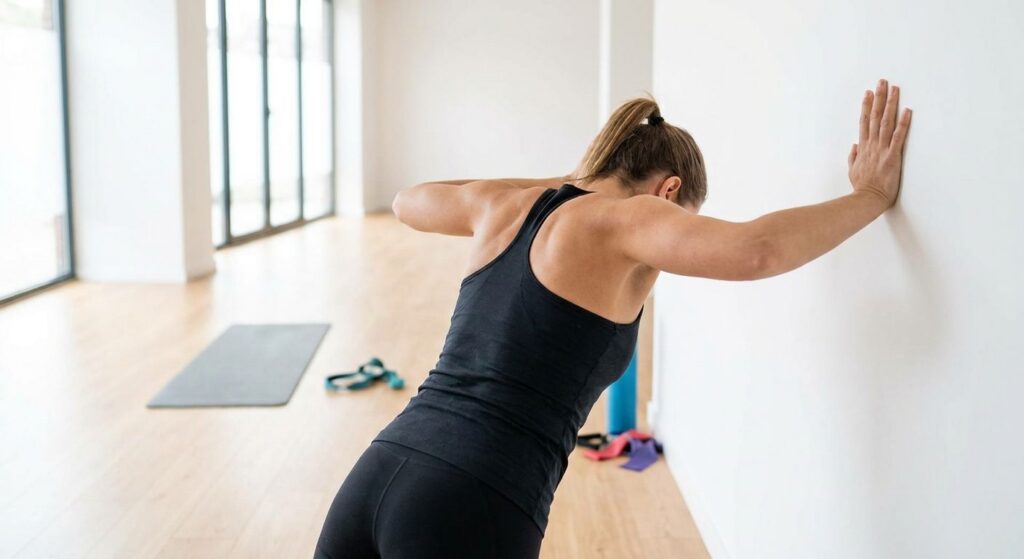
Winged shoulder blades happen when the shoulder blade lifts away from the rib cage instead of sitting flat, usually because the muscles that stabilise it aren't pulling their weight. This guide walks through winged shoulder blade exercises that target those muscles, plus the checks worth doing before you start.
- Winged shoulder blade exercises like wall slides and serratus punches target the serratus anterior and lower trapezius.
- Sudden winging with numbness, weakness or pain needs assessment by a health professional before you start any exercise routine.
- Three sessions a week for 6 to 8 weeks is a common starting point clinicians discuss for scapular control work.
- A chiropractor can assess posture and shoulder blade movement to help shape a home exercise plan.
Why this matters
A winged scapula isn't always dramatic. Most cases sit quietly under a t-shirt and only show up when someone points a phone camera at your back during a workout.
The shoulder blade is held against the rib cage by a handful of muscles working as a team — mainly the serratus anterior, the trapezius, and the rhomboids. When one of those muscles is weak, tight, or firing late, the scapula loses its anchor and the edge or bottom corner lifts off the ribs. In 2026, the pattern that shows up most often in clinic isn't nerve injury — it's a desk-driven muscle imbalance that builds up over months of rounded shoulders and underused mid-back muscles.
There are two broad types. Medial winging (the whole inner border lifts) is usually linked to a weak or inhibited serratus anterior. Lateral winging (the bottom tip flares) more often involves the trapezius or rhomboids. The exercises below are general strengthening and control work — they're not a substitute for a proper assessment, and a qualified health professional should rule out a nerve-related cause first, particularly if the winging appeared suddenly or came with weakness, numbness, or trouble raising the arm overhead.
What you'll need
- A resistance band (light to medium tension)
- A clear wall, roughly 1 metre of space
- A mirror, or a phone propped up to film your back
- A foam roller (optional, for thoracic mobility)
- 15 to 20 minutes, 3 times a week
- A willingness to go slow — scapular control work is about quality of movement, not load
The steps
1. Check the pattern before you load anything
Stand side-on to a mirror, or have someone film you from behind while you do a slow push-up or raise your arms overhead. Look at whether one shoulder blade sits higher, sticks out further, or moves differently to the other side.
This matters because medial and lateral winging respond to different emphasis in a program, and if the winging is new, painful, or paired with weakness, that's a reason to get it checked by a health professional rather than guess your way through exercises. Expected outcome: you've identified which side is affected and roughly which edge of the scapula is lifting.
Common mistake: skipping this step and jumping straight to strengthening drills that don't match the actual pattern.
2. Wall slides for serratus activation
Stand with your back against a wall, feet slightly forward, arms bent at 90 degrees like a goalpost. Slide your arms up the wall while keeping your forearms and lower back in contact with it, then slide back down. Aim for 2 sets of 10, resting 30 to 45 seconds between sets.
This drill asks the serratus anterior to work through range without letting the shoulder blade flare, which is exactly the control that's often missing. Expected outcome: smoother, more even movement of both shoulder blades by the end of the second set.
Common mistake: letting the lower back arch off the wall to fake the range — this hides the exact compensation you're trying to correct.
3. Serratus punch
Lie on your back with a light dumbbell or resistance band held straight up over your chest. Punch the weight toward the ceiling by protracting the shoulder blade (rounding it forward) without bending the elbow, then lower with control. Do 2 to 3 sets of 12.
This isolates the serratus anterior more directly than most push-up variations, which makes it useful early in a program when the muscle is weak and needs a low-skill way to fire. Expected outcome: a small but noticeable reach at the top of the movement without the shoulder shrugging up toward the ear.
Common mistake: shrugging the trapezius instead of protracting the scapula — the movement should come from the shoulder blade sliding forward, not the shoulder hiking up.
4. Prone Y raises for the lower trapezius
Lie face down, arms out at a Y shape (roughly 30 to 45 degrees from your head), thumbs pointing up. Lift both arms a few centimetres off the floor, hold for 2 seconds, then lower. Start with 2 sets of 8 to 10.
The lower trapezius often gets outcompeted by the upper trapezius in people who spend long hours at a desk, and this drill trains it in isolation. Expected outcome: a burning sensation between the shoulder blades rather than at the top of the shoulders.
Common mistake: lifting too high and recruiting the lower back instead of the mid-back muscles.
5. Resistance band rows for scapular retraction
Anchor a band at chest height, step back to create tension, and pull the band toward your ribs while squeezing the shoulder blades together. Hold the squeeze for 1 to 2 seconds. Do 3 sets of 12.
This builds the rhomboids and mid-trapezius, which work alongside the serratus anterior to keep the scapula flat against the rib cage during daily movement — not just during exercise. Expected outcome: the shoulder blades draw together evenly, without one side lagging.
Common mistake: pulling with the arms instead of leading with the shoulder blades — the elbows should trail behind the movement.
6. Build it into daily posture checks
Set a reminder every 60 to 90 minutes during desk work to reset: shoulders down and back, chest slightly lifted, shoulder blades resting flat rather than pinched or slumped forward. This isn't a drill so much as a habit layer on top of the exercises above.
Strength work done for 20 minutes, three times a week, gets undone quickly by eight hours a day of rounded, protracted shoulders. Expected outcome: less end-of-day tightness between the shoulder blades and a scapula that sits flatter without conscious effort by week 4 to 6.
Common mistake: treating posture checks as a one-off fix rather than a repeated habit — this is the step most people skip and the one that matters most for the desk-bound.
Get your posture and shoulder movement assessed
A chiropractor can check scapular position and movement patterns before you build a home routine.
Troubleshooting
- Pinching pain during wall slides — reduce the range of motion and keep the movement below shoulder height until it clears; ongoing pinching is worth raising with a health professional.
- No visible change after 4 weeks — check the pattern you identified in step 1 again; you may be training the wrong muscle group for your specific winging type.
- Neck tension building up — this usually means the upper trapezius is compensating; drop the resistance band tension and focus on slower reps with more control.
- One side improves faster than the other — normal early on, but add an extra light set on the slower side rather than skipping it.
- Dizziness or numbness during any exercise — stop and seek assessment from a qualified health professional; this is outside the scope of a home exercise routine.
- Winging returns after a busy work week — this points to the postural habit slipping rather than the exercises failing; rebuild the 60 to 90 minute reset habit from step 6.
Tools and resources
- A resistance band with at least two tension levels
- A mirror or phone camera for form checks
- Guidance from a chiropractor on movement assessment before increasing load
- Related reading on posture and loading patterns from the gym-goers and weightlifters guide, useful if you're already training and want to fit this work around existing sessions
- The tradies and manual labourers guide for anyone dealing with repetitive overhead or loaded shoulder movement at work
What to do next
If the winging hasn't changed after 6 to 8 weeks of consistent work, or if it appeared suddenly, book time with a chiropractor to have your shoulder movement and posture assessed properly rather than guessing at more exercises. MyChiro's Bondi Junction clinic can assess scapular position and movement as part of a broader look at posture and spinal alignment.
FAQ
What are the best winged shoulder blade exercises to start with?
Wall slides and serratus punches are usually the starting point because they isolate the serratus anterior without needing heavy load. Add prone Y raises and band rows once the movement feels controlled, typically after 2 to 3 weeks.
How long does it take to see change in a winged scapula?
Many people notice smoother shoulder blade movement within 4 to 6 weeks of consistent work, done 3 times a week. Results vary depending on the cause and how consistent the daily posture habit is alongside the exercises.
Is a winged shoulder blade always caused by nerve damage?
No — most cases seen in 2026 relate to muscle imbalance from prolonged sitting or repetitive movement patterns rather than nerve injury. Sudden winging with weakness or numbness should still be assessed by a health professional to rule out a nerve-related cause.
Can chiropractic care help with a winged shoulder blade?
A chiropractor can assess posture, spinal alignment and shoulder blade movement, and discuss whether exercise, manual therapy or referral is appropriate following assessment. This is decided case by case rather than assumed upfront.
What’s the difference between medial and lateral scapular winging?
Medial winging is when the whole inner border of the shoulder blade lifts off the rib cage, often linked to the serratus anterior. Lateral winging is when the bottom tip flares out, more often tied to the trapezius or rhomboids.
Do I need a resistance band for winged shoulder blade exercises?
A band helps for rows and some strengthening progressions, but wall slides and serratus punches only need body weight or a light dumbbell. A band becomes more useful once the basic movement pattern is controlled.
When should I stop doing these exercises and see someone?
Stop and seek assessment if you notice numbness, sharp pain, dizziness, or if the winging appeared suddenly rather than gradually. A qualified health professional can check for a nerve-related cause that exercise alone won’t address.
Can desk posture alone cause a winged shoulder blade?
Yes — prolonged rounded-shoulder posture during desk work is one of the more common contributors seen in 2026, because it weakens the muscles that hold the scapula flat. Pairing posture resets with targeted exercises addresses both the habit and the underlying weakness.
One last thing
Most winged shoulder blades people search about aren't nerve injuries at all — they're a slow build-up of one weak muscle losing a tug-of-war against a stronger, tighter one, usually the upper trapezius outpulling the lower trapezius and serratus anterior. The exercises matter, but the 60 to 90 minute posture reset in step 6 is the piece almost everyone drops first and the one that determines whether the gains from a 2026 training block actually stick.
Related guides
- Chiropractic care for dog walkers managing leash-pulling strain
- Chiropractic care for runners with knee and hip pain