

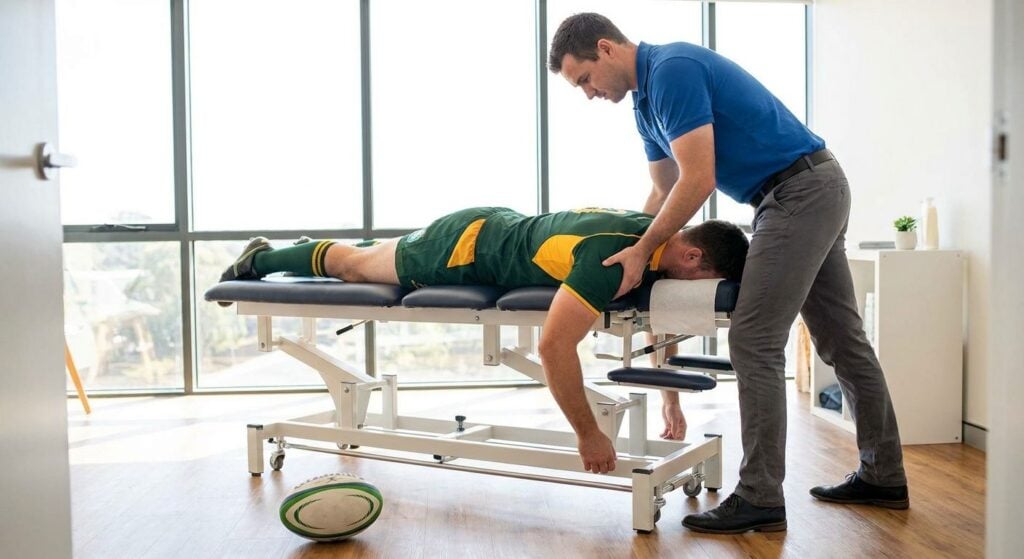
Contact sport puts repeated, unplanned load through your neck, shoulders, lower back and hips — tackles, scrums, rucks, falls, collisions. If you're weighing up a chiropractor for rugby injuries as part of how you manage that load, this guide covers what to check before booking, which injury areas come up most in contact sport, and where a chiropractor's role ends and a doctor's begins.
- A chiropractor for rugby injuries works best as one part of a wider plan alongside your GP, physio and strength coach.
- Neck strain, shoulder impact injuries, lower back loading and hip/knee soreness are the areas that show up most often in contact sport.
- Concussion symptoms, numbness, or loss of consciousness need medical assessment first — not an adjustment.
- An assessment-based approach beats a generic adjustment routine for anyone playing rugby, league or touch footy in 2026.
Why this matters
Most contact sport players don't seek care for a single injury — they're managing a pattern of soreness that builds across a season. A shoulder that took a hit in round 3 is still tight in round 8. A lower back that copped repeated scrum load starts limiting how far you can bend by mid-season.
A chiropractor for rugby injuries in Bondi Junction sees this pattern regularly among local players across union, league and touch football. The value isn't in one adjustment — it's in an assessment that considers how your training load, position and previous injuries connect, and a plan you can discuss with your GP or physio alongside it.
Same-day appointment availability matters here too, since post-match stiffness is often worse 24-48 hours after a game than immediately after the final whistle.
Who this is for
This guide is for adult and junior rugby, league, AFL and touch footy players in 2026 who are dealing with recurring neck stiffness, shoulder tightness, lower back soreness or hip and knee niggles from repeated contact — and who want to understand how chiropractic assessment fits alongside physio, strength training and their GP, rather than replacing any of them.
What to look for in a chiropractor for rugby injuries
Experience with contact sport presentations
A tackle-related neck strain moves differently to a desk-worker's stiff neck, and a scrum-related lower back load pattern is different again. Ask whether the practice regularly sees contact sport players and understands positional demands — front row versus back three, for example — before assuming any assessment approach applies evenly.
A clear referral pathway for red-flag symptoms
Concussion, suspected fracture, nerve symptoms like numbness or shooting pain down a limb, and loss of consciousness all sit outside chiropractic scope and need medical assessment first. A chiropractor who asks screening questions before touching your neck or back, and refers you on when something doesn't fit a straightforward musculoskeletal picture, is doing the job properly.
Willingness to work alongside your other providers
Rugby injuries rarely involve just one professional. Look for a chiropractor who's comfortable communicating with your physio or GP about training load, return-to-play timing, and what each provider is addressing, rather than working in isolation.
Assessment before adjustment
A one-size-fits-all adjustment routine skips the step that actually matters: working out what's driving your symptoms. A proper assessment looks at movement, load history and prior injuries before any hands-on care is discussed.
Practical load management advice
Beyond the assessment itself, useful input includes how to structure training around a niggle, when to scale back contact drills, and what movement to keep doing rather than avoid altogether.
Appointment access that matches your season
Rugby seasons don't pause for a two-week booking wait. Same-day or next-day availability for post-match soreness is a practical scheduling factor worth checking, separate from any claim about outcomes.
Injury areas that come up most in contact sport
Neck and whiplash-type strain — the common one. Tackles, scrums and high-speed collisions load the cervical spine in ways that mimic whiplash mechanics. If your neck feels locked up the day after a game, this is worth raising at an assessment rather than pushing through it. Related reading on whiplash-type neck injuries covers the mechanism in more detail. Verdict: worth discussing at your next assessment.
Shoulder impact and stiffness — the one people play through. Falls, tackles and repeated ball-carrying load the shoulder joint and surrounding tissue. Ongoing stiffness after a shoulder knock is a common presentation, and it's covered in more depth in this guide to frozen shoulder recovery. Verdict: raise it early rather than waiting for range of motion to worsen.
Lower back loading — the trap. Scrums, rucks and mauls put sustained compressive and rotational load through the lumbar spine. Players often assume lower back tightness after training is unavoidable and normal, which makes it easy to under-report at assessment. Verdict: mention it even if it feels minor.
Hip and knee soreness from repeated impact — the one to track over a season. Change of direction, tackling technique and repeated ground contact accumulate load through the hips and knees over a season, not just after one match. This overlaps with patterns seen in runners with knee and hip pain, where cumulative load rather than a single incident is usually the driver. Verdict: track it week to week, not just after a bad game.
Strength and conditioning gaps — the one that gets skipped. A lot of recurring niggles trace back to strength or mobility deficits rather than the collision itself. If your assessment flags this, it's worth cross-referencing with guidance for gym goers and weightlifters on structuring strength work around an existing niggle. Verdict: address this between seasons, not mid-round.
“A hit that leaves you dizzy or foggy needs a medical assessment before it needs an adjustment.”
What to avoid
- Ignoring concussion or head-impact symptoms. Dizziness, confusion, headache or memory gaps after a knock need a doctor's assessment before any other care is discussed — this isn't a chiropractic matter.
- Self-adjusting between sessions. Cracking your own neck or back to chase temporary relief between physio and chiro appointments can mask how your body is actually responding to a training load.
- Choosing a provider that skips assessment entirely. A quick adjustment with no history-taking or movement screen doesn't account for what a contact sport actually does to your spine and joints over a season.
Book a chiropractic assessment
Same-day appointments available for post-match soreness in Bondi Junction.
Verdict comparison across common injury areas
| Injury area | Common rugby cause | Where chiropractic assessment fits | See a doctor first if… |
|---|---|---|---|
| Neck / whiplash-type strain | Tackles, scrums, collisions | May be discussed as part of a broader assessment | Dizziness, numbness, or loss of consciousness |
| Shoulder | Falls, tackles, repeated ball-carrying | Can be assessed alongside physio-led rehab | Visible deformity or inability to move the arm |
| Lower back | Scrums, rucks, repetitive loading | Assessment-based care may be appropriate | Sudden severe pain with leg weakness or numbness |
| Hip / knee | Change of direction, repeated impact | Load management advice alongside adjustments | Locking, giving way, or significant swelling |
FAQ
What does a chiropractor for rugby injuries actually do?
A chiropractor for rugby injuries assesses how repeated contact and training load affect your spine, shoulders and hips, then discusses a care plan that may include hands-on adjustment alongside advice on load management. It’s typically one part of a wider plan involving your GP or physio, not a standalone fix.
How soon after a rugby injury should you see a chiropractor?
Most players book an assessment once soreness lingers past 48-72 hours or starts affecting training, rather than waiting weeks. If there’s any suspicion of concussion, fracture or nerve involvement, a medical assessment comes first, in 2026 as in any other year.
Can chiropractic care help with a suspected concussion?
No — suspected concussion needs medical assessment and clearance before any other care is considered. Chiropractors typically screen for concussion symptoms and refer players to a GP or emergency department rather than proceeding with hands-on care.
Is chiropractic assessment suitable for shoulder injuries from tackles?
Shoulder stiffness and reduced range of motion after tackles or falls is a common reason players book an assessment. Whether hands-on care is appropriate depends on findings at assessment, which is why a screening step matters before anything else.
What’s the difference between a chiropractor and a physiotherapist for a rugby injury?
Chiropractors and physiotherapists both assess musculoskeletal injuries but use different approaches — chiropractic care often centres on spinal and joint assessment, while physiotherapy typically focuses on rehabilitation exercise. Many players in 2026 use both as part of a coordinated plan.
Can you keep training or playing while seeing a chiropractor?
This depends entirely on assessment findings and should be discussed directly with your chiropractor, GP or physio rather than assumed. Load management advice is often part of the conversation, particularly mid-season.
What should you do immediately after a hard tackle or collision?
Stop and assess for concussion signs — confusion, dizziness, headache, memory gaps — before returning to play, and seek medical assessment if any are present. For soft tissue soreness without red-flag symptoms, booking a chiropractic assessment in the following days is a reasonable next step.
Does chiropractic care prevent future rugby injuries?
No care approach can guarantee prevention of contact sport injury. Assessment-based care combined with strength work and load management may be discussed as part of a broader approach to managing injury risk across a season.
One last thing
The pattern that catches most contact sport players out isn't the big hit — it's the small, repeated load that builds across a season without ever getting flagged at assessment. Mentioning a minor niggle in round 4 gives a chiropractor more to work with than waiting until it's limiting your training in round 12.
Related guides
- Chiropractic care for gym goers and weightlifters
- Chiropractic care for runners with knee and hip pain