

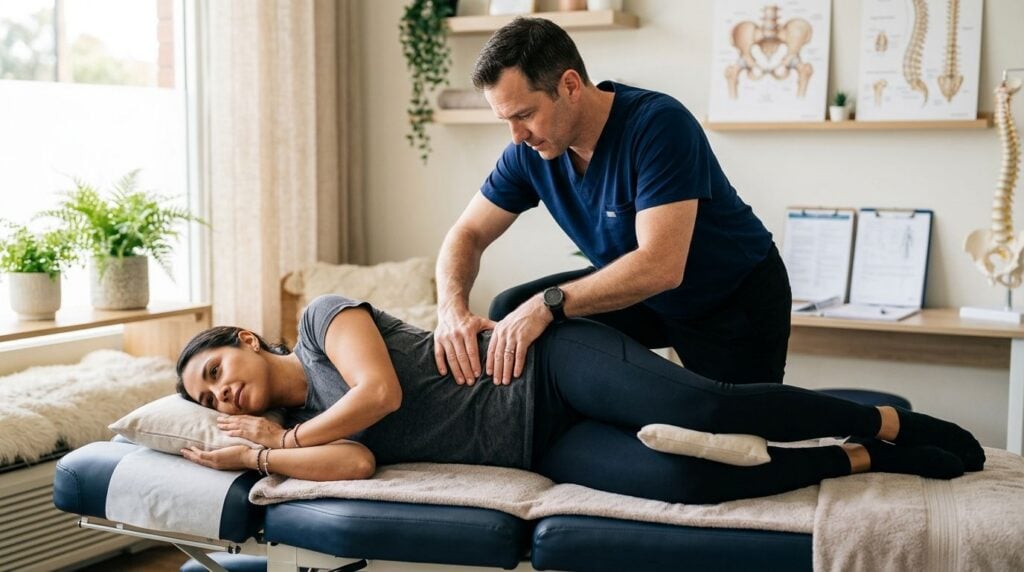
Sacroiliac joint pain sits at the back of the pelvis, where the sacrum meets the ilium, and a chiropractor's role is to assess how that joint is moving before recommending any next step. Unlike general lower back pain, SI joint pain tends to show up on one side, worsens with standing on one leg or climbing stairs, and often gets missed when the assessment focuses only on the lumbar spine.
- A sacroiliac joint pain chiropractor assesses pelvic alignment and joint mobility before any adjustment is discussed, not after.
- SI joint pain is frequently mistaken for sciatica or piriformis syndrome, so an accurate movement assessment matters more than guessing.
- Core and hip stability exercises, activity changes and chiropractic assessment are commonly discussed together, not as a single fix.
- Numbness, bowel or bladder changes, or pain following trauma need medical assessment rather than chiropractic care alone.
- MyChiro in Bondi Junction offers assessment-based chiropractic care for pelvic and lower back concerns as of 2026.
Why sacroiliac joint pain chiropractic care matters for this group
The SI joint carries load every time you walk, stand up from a chair, or roll over in bed, which is why people with SI joint dysfunction describe pain that flares with specific movements rather than sitting still. Pregnancy, a fall onto the hip, uneven leg length, or years of asymmetrical loading from sport or manual work all show up as candidates in a proper history.
A general back pain visit and an SI joint pain visit are not the same conversation. Chiropractic assessment for this joint typically includes provocation tests (like the FABER or thigh thrust), a look at pelvic symmetry, and questions about when the pain started relative to pregnancy, injury or a change in activity. Getting this distinction right at the chiropractic care stage, before any hands-on work happens, is what separates a targeted plan from a generic one.
Track your pain pattern and daily triggers
Before any appointment, a week of notes on when the SI joint flares gives a chiropractor more to work with than a vague description of "lower back pain."
- Note which side hurts and whether it's always the same side
- Record what movement triggers it: standing from sitting, stairs, rolling in bed, single-leg activities
- Track whether pain eases lying flat or worsens with prolonged standing
- Write down any recent pregnancy, fall, or change in exercise load
- Rate pain on a simple 0-10 scale across a few days, not just on the worst day
Rule out other causes with a proper assessment
SI joint pain overlaps in presentation with sciatica, piriformis syndrome and lumbar disc issues, which is why self-diagnosis from a symptom checklist alone is unreliable.
- Ask whether pain radiates below the knee (more typical of nerve involvement)
- Check for deep buttock pain with sitting, a pattern common in piriformis syndrome
- Confirm whether pain is one-sided and worsens with single-leg standing (more typical of SI joint dysfunction)
- Get a chiropractor or GP to run orthopedic provocation tests rather than relying on an X-ray alone
- Flag any numbness, tingling, or weakness down the leg for separate medical review
Start with self-directed pelvic stability exercises
Before booking anything, a short daily routine focused on pelvic and hip stability is the free, first-line option most people can try.
- Glute bridges, held for a few seconds, done in short sets
- Bird-dog holds to train core and hip control together
- Clamshells to activate the hip stabilisers without loading the SI joint directly
- Gentle pelvic tilts to reduce stiffness without provoking pain
- Short walks instead of long standing periods while symptoms are active
Adjust your daily movement habits
Small changes to how you sit, stand and lift often reduce how often the joint gets irritated, independent of any clinical care.
- Avoid sitting with one leg tucked under the other for long periods
- Stand with weight distributed evenly rather than leaning on one hip
- Use a step or low stool to avoid twisting through the pelvis when reaching into a car boot
- Sleep with a pillow between the knees if side-sleeping aggravates the joint
- Avoid high-impact single-leg activity (running stairs, lunges) while symptoms are active
Get a professional assessment from a chiropractor
When self-directed changes haven't shifted the pattern after a couple of weeks, a chiropractic assessment adds a hands-on evaluation of joint mobility, pelvic alignment and movement mechanics that's hard to do accurately on yourself.
- A chiropractor can test SI joint mobility specifically, rather than assuming the lumbar spine is the source
- Adjustments may be discussed as part of a broader plan following assessment, alongside exercise and activity modification
- A chiropractor can flag whether a leg length discrepancy or pelvic asymmetry is contributing, which self-assessment usually misses
- Follow-up visits let the practitioner track whether the movement pattern is actually changing, not just whether pain feels different on the day
- Any chiropractic plan should be discussed openly, including expected timeframes and what happens if there's no change
Build a long-term strength and mobility routine
Once the acute flare has settled, ongoing hip and core strength work is what tends to reduce how often the joint gets aggravated again.
- Progress glute bridges to single-leg variations gradually
- Add core strengthening work that doesn't load the lower back directly
- Include hip flexor and hamstring mobility work, since tightness here often pulls on the pelvis
- Reintroduce single-leg activity slowly rather than returning to full training load at once
- Revisit the routine every few months rather than treating it as a one-off fix
Know the red flags that need urgent medical review
SI joint pain is usually mechanical, but a small set of symptoms point away from chiropractic care and toward a GP or emergency assessment.
- Numbness or tingling spreading down both legs
- Loss of bladder or bowel control
- Pain following a significant fall, car accident or direct trauma
- Fever alongside back or pelvic pain
- Pain that wakes you at night and doesn't ease with position changes
Comparing your options for SI joint pain
| Option | Best for | Key limitation |
|---|---|---|
| Self-directed exercise and activity changes | Mild, recent-onset SI joint discomfort | No professional assessment of what's actually driving the pattern |
| Physiotherapy | People who prefer a strength-and-rehab focused approach | Less emphasis on joint-specific manual assessment |
| Chiropractic assessment and care | People wanting a hands-on evaluation of pelvic and joint mechanics alongside exercise guidance | Outcomes vary by individual and require ongoing assessment, not a single visit |
| SI joint support belt | Short-term symptom management during flares or postpartum | Doesn't address underlying movement or strength contributors |
| GP referral and imaging | Cases with red flag symptoms or unclear diagnosis | Imaging often shows little in mechanical SI joint pain, so it's not always the first step |
If pain is one-sided, worse with single-leg standing, and eases lying flat, that pattern points toward the SI joint rather than the lumbar spine or sciatic nerve.
“If SI joint pain worsens on stairs but eases flat on your back, the pattern usually points to the joint itself, not the lower back.”
Common mistakes people make with SI joint pain
- Assuming it's the same as sciatica and stretching the hamstring aggressively when the actual driver is pelvic instability.
- Ignoring postpartum onset — pelvic ligament laxity after birth is a common and distinct contributor that a generic back plan won't address.
- Over-stretching the painful side instead of strengthening the stabilising muscles around the joint.
- Skipping the assessment step and going straight to adjustments without confirming the SI joint is actually the source.
- Returning to single-leg sport or training too fast after symptoms ease, which often brings the flare straight back.
Get an SI joint assessment
Discuss pelvic and lower back pain patterns with a registered chiropractor in Bondi Junction.
FAQ
What causes sacroiliac joint pain?
SI joint pain usually comes from mechanical stress at the joint linking the pelvis and sacrum, often linked to pregnancy, a fall, asymmetrical loading from sport, or leg length differences. A chiropractor can assess which of these factors applies to your presentation.
Can a chiropractor help with SI joint pain?
A chiropractor can assess pelvic alignment and joint mobility and discuss an approach, which may include adjustments, following a proper evaluation. Whether this is appropriate for you depends on your specific presentation and history.
How is SI joint pain different from sciatica?
SI joint pain is usually one-sided pelvic or buttock pain that worsens with standing on one leg or climbing stairs, while sciatica typically radiates down the leg past the knee. The two can overlap, which is why an accurate assessment matters.
Can chiropractic care be considered during pregnancy for SI joint pain?
Pregnancy-related SI joint pain can be discussed with a qualified chiropractor as part of an individual assessment, since ligament changes during pregnancy affect pelvic stability. Any care plan should be tailored to the stage of pregnancy and reviewed with your maternity care provider.
How many chiropractic visits are needed for SI joint pain?
There’s no fixed number — it depends on how long symptoms have been present and how the joint responds to the initial assessment and plan. A chiropractor should outline expected review points rather than commit to a set number upfront.
What exercises help SI joint pain?
Glute bridges, bird-dog holds, clamshells and gentle pelvic tilts are commonly used to build stability around the joint without provoking pain. Progression should be gradual and guided by how symptoms respond.
When should I see a doctor instead of a chiropractor?
See a doctor first if you have numbness spreading down both legs, loss of bladder or bowel control, fever with back pain, or pain following significant trauma. These symptoms fall outside what chiropractic assessment alone should manage.
How much does chiropractic care for SI joint pain cost in 2026?
Costs vary by clinic, the type of assessment involved, and whether private health cover applies. Check current rates directly with the clinic and your health fund rather than relying on a fixed figure.
One last thing
The detail most people skip is checking whether pain changes with position, not just activity. SI joint pain that eases the moment you lie flat but returns the second you stand on one leg to put on socks is a far more specific clue than "my lower back hurts," and it's often the single fact that helps a chiropractor separate SI joint dysfunction from a disc or nerve issue on the first visit in 2026.
Related guides
- Chiropractic care for new mums after birth
- How to know when back pain needs a chiropractor vs a doctor