

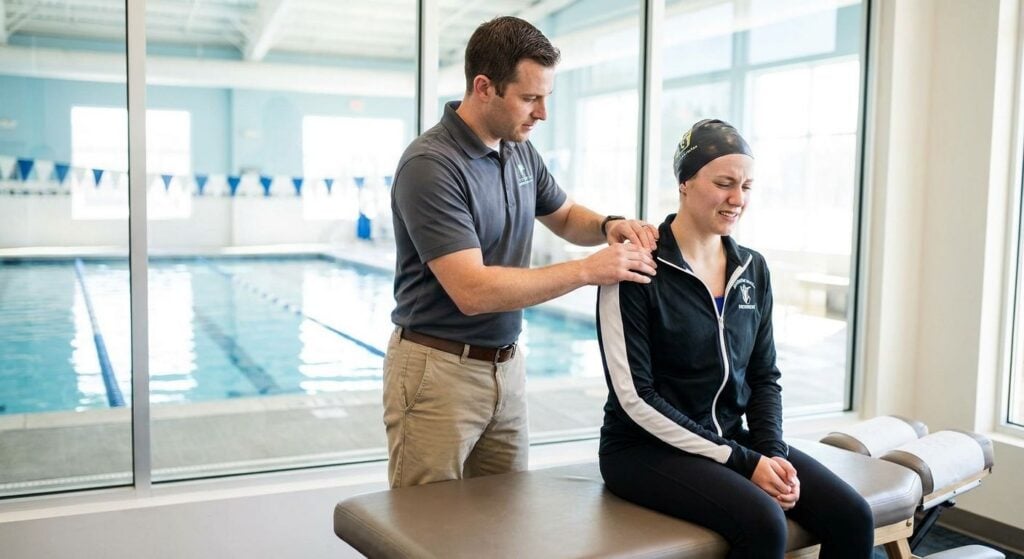
Shoulder pain from freestyle, backstroke or butterfly training shows up differently to shoulder pain from lifting weights or sitting at a desk, and it usually needs a different kind of assessment. This guide covers what to look for in a chiropractor for swimmers shoulder, the care approaches worth raising with a provider, and the patterns that get missed when a chiropractor hasn't worked with overhead athletes before.
- A chiropractor for swimmers shoulder should screen scapular movement, not just spinal alignment, before starting care in 2026.
- Repetitive overhead strokes load the shoulder differently to gym or desk-based strain, so generic posture advice is a lower priority.
- Scapular dyskinesis assessment and training-load review matter more for swimmers than a single spinal adjustment.
- Red flags like night pain or sudden weakness need referral to a GP or physiotherapist, not ongoing adjustments alone.
Why this matters
Swimming loads the shoulder in a way few other sports do. Research on competitive swimmers has recorded shoulder pain in as many as 91% at some stage of a career, largely from the repeated overhead rotation built into freestyle, backstroke and butterfly. A single training year can add up to more than a million shoulder rotations, and competitive squads commonly schedule more than 40 kilometres of swimming a week during peak phases.
That volume is why a chiropractor for swimmers shoulder search on Google in 2026 often points back to a full assessment process rather than a single adjustment. Mychiro works with patients across Bondi Junction, Sydney, and swimmers usually present with an overuse pattern that has built up over months, not a single acute injury. That distinction changes what a useful assessment actually looks like.
Who this is for
This is for competitive and masters swimmers logging regular pool sessions who notice shoulder pain building during or after freestyle, backstroke or butterfly sets specifically, rather than from a single incident. It also applies to triathletes and open-water swimmers layering swim volume on top of running or cycling load, and to swimmers returning to training after a break who ramp volume up quickly.
It is not written for swimmers with a sudden traumatic injury, a dislocation, or shoulder pain following a fall. That pain profile needs urgent medical assessment first, not a chiropractic consult on its own.
What to look for in a chiropractor for swimmers shoulder
Assessment of thoracic spine and shoulder mobility together
Stroke mechanics depend on rotation through the thoracic spine as much as movement at the shoulder joint itself. A chiropractor who only checks the shoulder in isolation can miss a restriction further up the chain that is quietly changing how the stroke loads the joint.
Screening for scapular dyskinesis, not just posture
Many swimmers develop asymmetry between shoulders after years of breathing to one side, which changes how the scapula sits and moves. A general posture check built for office workers won't pick this up — the assessment needs to compare both sides directly.
Experience working with overhead athletes and repetitive load patterns
Training load for a swimmer looks nothing like training load for someone who sits at a desk or lifts occasionally. A chiropractor who asks about weekly volume, stroke count and recent changes to training is working from the right framework.
Red flag screening before any hands-on care
Night pain, weakness in a specific direction, visible swelling, or pain following a fall or collision needs medical review before ongoing chiropractic care. A provider who skips these questions because "it's probably just overuse" is skipping a step that matters.
A rehab or exercise plan alongside any adjustments
Adjustments alone rarely address training volume that has outpaced recovery. Care that pairs assessment with a structured exercise or load-management plan reflects a biopsychosocial approach rather than a single-visit fix for a problem that built up over a season.
Book a shoulder and scapular assessment
See a chiropractor at Mychiro’s Bondi Junction clinic to check mobility, scapular control and training load.
Care approaches worth discussing with your chiropractor
The baseline check: thoracic and scapular mobility screening
This compares rotation and range on both sides, since swimmers who favour one breathing side for years often show asymmetry the other side hasn't developed. It's the starting point most assessments should cover before anything else. Worth prioritising early.
The overlooked pattern: scapular winging
Years of one-sided breathing and repetitive overhead loading can shift how the scapula sits against the rib cage, a pattern covered in more detail in scapular winging patterns. It's easy to miss on a quick visual check and easy to mistake for a purely postural issue. Discuss with your chiro.
The stiffness that mimics injury
Some swimmers lose shoulder range gradually across a season rather than from one incident, a pattern that overlaps with what's covered in frozen shoulder recovery. Telling capsular tightness apart from muscular overuse changes what the follow-up plan should look like. Discuss with your chiro.
The comparison worth knowing: repetitive strain loading
Overuse injuries across sports share a similar logic — training volume outpacing tissue recovery time — and the principles covered for repetitive strain patterns apply just as much to a shoulder doing thousands of overhead rotations a week as they do to an elbow under repeated load. Worth prioritising.
What looks right but isn't for swimmers
- A single adjustment with no follow-up plan. It feels like immediate care but doesn't address why the shoulder flared up during training in the first place.
- Generic desk-posture correction advice. That advice is built for people who sit all day, not for someone rotating a shoulder tens of thousands of times a week in the pool.
- Skipping red-flag questions because "it's just a swimmer's shoulder." Night pain, specific weakness, or sudden onset after a growth spurt or a fall needs review by a GP or physiotherapist before any hands-on care starts.
At a glance: comparing the approaches
| Approach | Main focus | Needs ongoing exercise? | Verdict |
|---|---|---|---|
| Thoracic and scapular mobility screening | Range of motion both sides | Yes, mobility drills | Worth prioritising |
| Scapular winging assessment | Symmetry and scapular control | Yes, stability work | Discuss with your chiro |
| Restricted range review | Capsular tightness vs overuse | Yes, graded loading | Discuss with your chiro |
| Repetitive strain load review | Training volume and technique | Yes, load management plan | Worth prioritising |
FAQ
What is swimmer’s shoulder?
Swimmer’s shoulder is a general term for shoulder pain linked to repetitive overhead strokes like freestyle, backstroke and butterfly. It usually builds gradually from training volume rather than a single injury, and can involve the rotator cuff, labrum or surrounding tendons depending on the individual.
Can a chiropractor help with swimmer’s shoulder?
Chiropractic care may be appropriate for swimmer’s shoulder following a proper assessment of the shoulder, scapula and thoracic spine. Whether it’s suitable depends on what the assessment finds, and some presentations need review by a GP or physiotherapist first.
Is chiropractic care for swimmers different from a standard adjustment?
Care for swimmers usually places more focus on scapular control and thoracic rotation than a standard spinal check, since stroke mechanics depend on movement through the whole shoulder girdle. A chiropractor familiar with overhead athletes will typically ask about training volume and stroke count as part of the assessment.
Should a swimmer see a chiropractor or a physiotherapist first?
There’s no single answer, and it depends on the presentation, since some swimmers work with both providers alongside their coach. Sudden, severe or night-time pain generally warrants a GP or physiotherapist review before any hands-on care.
How much training volume does it take to cause shoulder pain in swimmers?
There’s no fixed threshold, but sports medicine research has linked years of repetitive overhead loading, sometimes exceeding a million shoulder rotations annually, with shoulder pain rates as high as 91% among competitive swimmers. Individual risk depends on technique, recovery time and prior injury history.
Can scapular winging be addressed with exercise alone?
Exercise-based scapular stability work is commonly discussed as part of managing winging patterns, though what’s appropriate depends on the underlying cause found during assessment. A chiropractor or physiotherapist can help identify whether the pattern is muscular, postural or linked to another factor.
When should a swimmer with shoulder pain see a doctor instead of a chiropractor?
Night pain, sudden weakness in a specific direction, visible swelling, or pain following a fall or collision needs medical review rather than ongoing adjustments. These signs can indicate a condition outside the scope of chiropractic care and need to be ruled out first.
How often should a swimmer with shoulder pain get reassessed?
Reassessment frequency depends on training load, symptom pattern and what was found at the initial consult, so it’s best discussed directly with your chiropractor. Many swimmers reassess at points where training volume changes, such as before a competition block.
One last thing
One detail that surprises a lot of swimmers: shoulder pain often shows up on the non-dominant breathing side, not the side doing more visible work in the stroke. Years of turning the head to breathe on one side load the opposite shoulder differently across a training year, which is part of why a side-by-side comparison matters more during a chiropractic care assessment for swimmers than it does for most other patients walking into a clinic in 2026.
Related guides