


Instead of repeating your details to clinics when looking for a DVA chiropractor, organise your Gold Card, GP referral and provider confirmation before arranging an appointment. This guide explains the administrative steps for accessing DVA-funded chiropractic services in 2026, without assuming that every service or clinic is eligible.
- DVA chiropractor access requires checking Gold Card eligibility, referral requirements and the provider’s acceptance of DVA arrangements.
- A DVA treatment cycle generally ends after 12 sessions or one year, whichever comes first.
- MyChiro provides chiropractic care in Bondi Junction; confirm DVA participation directly before arranging an appointment.
- Gold Card eligibility does not replace clinical assessment or authorise an unlimited course of chiropractic adjustments.
Why this matters
Your Gold Card, referral and provider confirmation answer different questions. The card establishes your DVA healthcare entitlement, the referral supports access to the relevant service, and the provider confirms whether they can deliver that service under DVA arrangements.
A Gold Card generally covers clinically necessary healthcare for all medical conditions, subject to DVA requirements. That does not mean every proposed chiropractic service is automatically covered or appropriate for you.
MyChiro is a chiropractic clinic in Bondi Junction for local patients seeking chiropractic care. If you are considering MyChiro, ask the clinic to confirm its current DVA arrangements before making a booking; this guide does not establish its participation.
For your 2026 enquiry, separate funding questions from clinical questions. Reception can explain administrative arrangements, while the referring practitioner and chiropractor assess whether chiropractic care may be appropriate.
Before you start
- Have your Gold Card details available. Keep your name, DVA file number and relevant correspondence together, and provide them only through an appropriate private channel.
- Arrange access to your GP and referral records. Gather any existing chiropractic referral, the referring practitioner’s details and information about a previous treatment cycle.
- Check the treatment-cycle gotcha. A Gold Card alone does not replace the referral requirements for DVA-funded chiropractic services. An existing referral can also reach its session or time limit even when your card remains valid.
Do not send your card details through a public website comment or social media post. Ask the clinic how it accepts referral documents and personal information before forwarding them.
You do not need to select an adjustment technique before discussing the referral. The administrative task is to establish the pathway; the clinical task is to assess your circumstances and discuss appropriate options.
Gold Card and referral confirmation
Establish your entitlement
- Find your current Gold Card and relevant DVA correspondence. Check that the personal details match the information you will give the clinic.
- Tell your GP that you want to discuss whether a referral for chiropractic assessment is appropriate. Describe your concerns and relevant health history rather than requesting a predetermined course of adjustments.
- Ask whether an existing referral remains suitable for the service you are seeking. If it relates to an earlier episode of care, identify when that episode started and whether a completion report was provided.
- Resolve any uncertainty about your entitlement with the Department of Veterans’ Affairs before relying on funding. A clinic can check administrative details, but DVA determines its funding rules.
Expected result: You know which entitlement you are using and whether you need a new referral, clarification of an existing referral, or further medical assessment.
Keep the distinction clear: the Gold Card is evidence of entitlement, not a clinical recommendation. Neither the card nor a referral obliges you to proceed with a particular procedure.
Arrange the referral
- Ask your GP to assess whether chiropractic services may be appropriate in your circumstances. Discuss other care you are receiving and any concerns you want the receiving practitioner to know.
- If a referral is issued, check that it identifies you, the referring practitioner and the intended allied health service. Ask the GP practice to correct missing or inaccurate information.
- Request a copy for your records. Confirm whether the practice will send the referral directly or whether you need to supply it to the clinic.
- Ask how the GP wants to receive the chiropractor’s assessment and end-of-cycle report. This helps keep the referral and later review connected.
Expected result: You have an identifiable referral and know how it will reach the receiving clinic.
For a new referral in 2026, use the current DVA requirements rather than assuming an old referral or a Medicare document is interchangeable. If the document’s purpose is unclear, ask the referring practice to clarify it before your appointment.
Provider and appointment arrangements
Confirm the receiving provider
- Ask the clinic whether the chiropractor you would see accepts DVA patients for chiropractic services. Confirm the individual provider and service, not just whether the practice sees veterans generally.
- Explain that you hold a Gold Card and have, or are arranging, a referral. Ask the clinic to check the documents it needs before accepting an appointment under DVA arrangements.
- Ask whether the proposed appointment will be submitted to DVA and whether any proposed service sits outside those arrangements. Do not assume that every service offered at the same premises uses the same funding pathway.
- Confirm whether the provider needs DVA authorisation or other clarification before proceeding. If so, establish who will obtain it and how you will be told the outcome.
Expected result: The clinic has confirmed whether it can accept your referral under DVA arrangements and identified any unresolved administrative requirements.
When contacting MyChiro about chiropractic care, use the same questions. Its location and service description do not, by themselves, establish DVA acceptance or coverage for your appointment.
A provider’s Ahpra registration and its acceptance of DVA arrangements are separate checks. Registration concerns professional registration; DVA acceptance concerns the administrative pathway for your proposed service.
Prepare the appointment record
- Gather your referral, card details and relevant existing clinical records. Bring information about current medicines and other practitioners involved in your care.
- Write down the concerns you want assessed and the daily activities you want to discuss. Avoid treating the referral as a requirement to receive an adjustment.
- Ask how the chiropractor will explain the proposed assessment, options, material risks and alternatives. You can ask questions and decide whether to consent to a proposed procedure.
- Before leaving, confirm what happens next: further assessment, communication with your GP, an agreed plan or referral elsewhere. Ask which administrative steps apply before another appointment.
Expected result: You understand the proposed next step and its funding pathway, rather than leaving with an unexplained sequence of appointments.
DVA funding does not replace informed consent. Chiropractic adjustments may be discussed following assessment, but a funded appointment is not a promise of a particular procedure or clinical outcome.
Treatment-cycle tracking
DVA’s allied health treatment-cycle arrangements generally provide for up to 12 sessions or one year, whichever comes first. For tracking purposes, one year is 12 months; ask the provider to explain the applicable start date and remaining sessions for your cycle.
The cycle is a referral and review framework, not a recommendation to attend every permitted session. The number of appointments should reflect assessed need, and other DVA service conditions can still apply.
- Ask the provider to record the cycle’s start date and session count. Keep your own brief record of attended appointments alongside referral correspondence.
- Confirm when the provider expects to review your circumstances. Ask what information will be sent to your referring GP.
- Before arranging appointments near the cycle’s endpoint, ask whether the current referral still applies. Do not assume that an unused appointment count overrides the time limit.
- If further services are proposed, establish whether a new referral or other DVA approval is required before proceeding.
Expected result: You can identify whether the proposed appointment falls within the current referral arrangements or needs another administrative step.
For a cycle beginning in 2026, record the actual commencement date rather than labelling the file only by calendar year. A calendar-year folder does not show when an individual referral cycle reaches its endpoint.
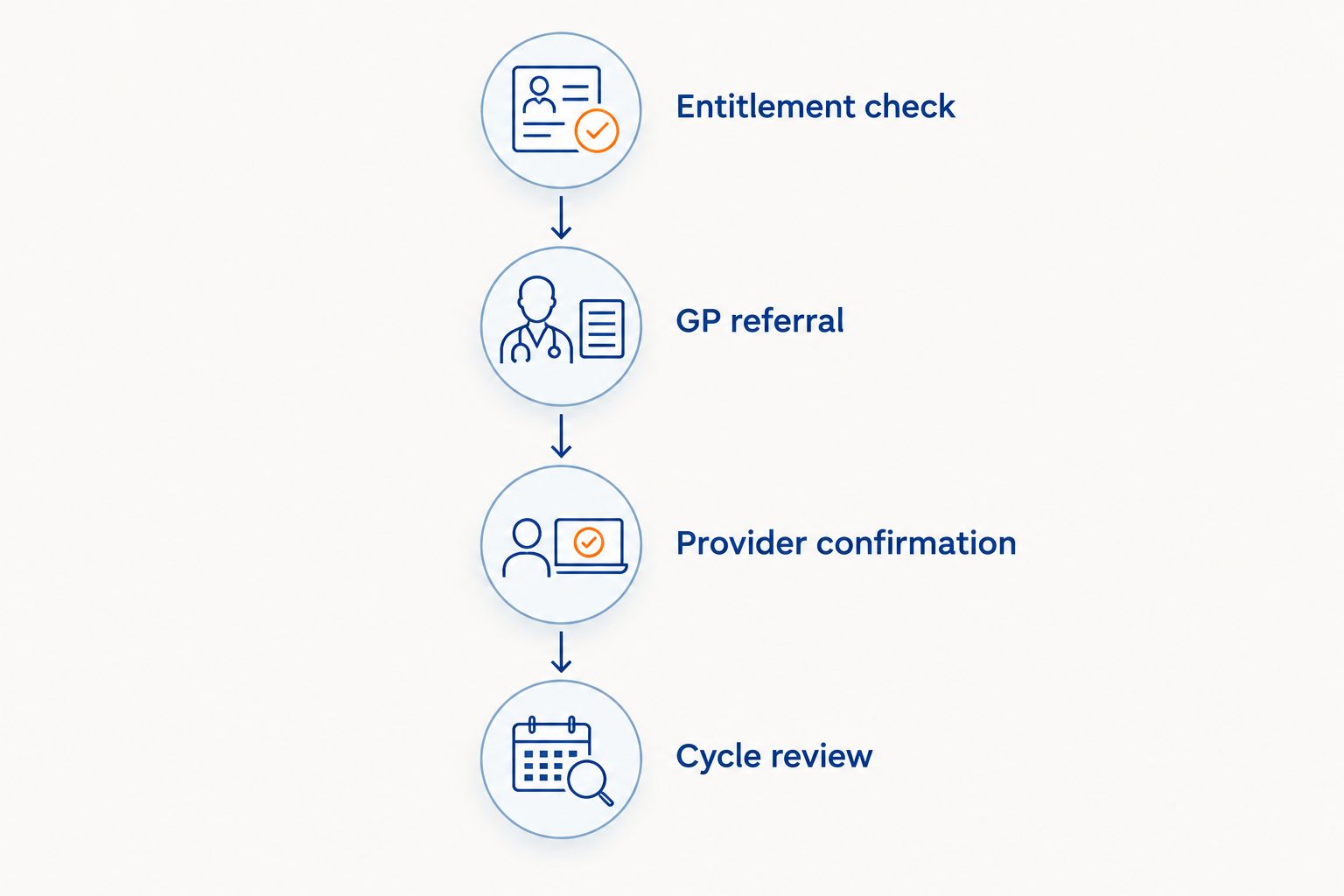
The sequence is Entitlement check, GP referral, Provider confirmation and Cycle review. Keep each confirmation with your records so a later enquiry does not depend on memory.
Continuing care after a treatment cycle
A further treatment cycle is a separate referral decision, not an automatic extension. The chiropractor’s end-of-cycle report informs the referring practitioner’s review of whether further services are appropriate.
| Workflow | Suited to | Practical advantage | Limitation |
|---|---|---|---|
| Initial referral | Gold Card holders starting a chiropractic referral pathway | Establishes the service and referring practitioner | Requires entitlement and provider checks before relying on funding |
| Further treatment cycle | Patients whose current cycle has ended and whose needs require review | Connects further referral decisions with the previous cycle’s report | Does not automatically authorise more appointments |
Arrange the next review
- Ask whether the chiropractor has sent the end-of-cycle report to your GP. If it has not arrived, establish which practice needs to follow it up.
- Discuss your current circumstances with the GP, including whether further chiropractic services, another service or no further appointments are appropriate.
- If a new referral is issued, send it to the receiving provider through the agreed channel. Ask the clinic to confirm receipt.
- Confirm the new cycle’s administrative details before proceeding. Retain the previous report and new referral as separate documents.
Expected result: Any further appointments rest on a current referral decision rather than an assumption that Gold Card coverage renews the previous plan.
This workflow also helps when you change clinics. Ask the new provider how it will handle your existing referral and cycle record; changing premises does not establish a new entitlement by itself.
Troubleshooting
You have a Gold Card but no referral
Ask your GP to assess whether a chiropractic referral is appropriate. Tell the clinic that the referral is not yet arranged, and do not assume an appointment can be submitted to DVA solely because you hold the card.
The clinic cannot confirm DVA participation
Ask for confirmation from the person responsible for DVA administration. If the provider does not accept the relevant arrangements, contact DVA about finding a participating provider rather than assuming reimbursement will follow.
The referral exists, but the clinic cannot find it
Contact the referring practice and verify where it was sent. Request a copy, use the clinic’s nominated private channel and obtain confirmation of receipt before relying on the document.
You have sessions remaining, but the cycle has reached its time limit
Ask the provider to check the commencement date against DVA’s treatment-cycle requirements. A cycle generally ends at 12 sessions or one year, whichever occurs first; discuss any further referral with your GP.
Your circumstances have changed since the referral
Tell the referring practitioner and chiropractor before proceeding. Funding paperwork is not a substitute for reassessment, and concerns requiring urgent medical attention should not wait for a chiropractic funding enquiry.
Customise your workflow
Keep one private folder for your card correspondence, referrals, cycle records and reports. Separate administrative questions about eligibility from clinical questions about assessment, consent and care options.
If another person helps with your paperwork, confirm what authority the clinic or DVA needs before discussing your personal information with them. Do not assume a family member can access records without your permission.
For your 2026 checks, use the Department of Veterans’ Affairs’ official guidance on the Veteran Gold Card, chiropractic services and allied health treatment cycles. These sources address entitlement, service requirements and referral review respectively; individual administrative questions belong with DVA and the provider.
For local enquiries, ask MyChiro to confirm its current chiropractic service arrangements without assuming DVA participation. You can also prepare questions about the practitioner’s registration, assessment process and communication with your GP.
Do not carry Medicare referral rules into a DVA enquiry. The funding pathways are separate, even when the same GP or chiropractor is involved.
FAQ
Can I see a DVA chiropractor with a Gold Card?
A Gold Card can support access to clinically necessary chiropractic services under DVA requirements. Confirm the referral requirements, your entitlement and the receiving provider’s acceptance of DVA arrangements before relying on funding.
Do I need a GP referral for DVA chiropractic services?
DVA-funded chiropractic services require an appropriate referral. Your GP can assess whether chiropractic services may be appropriate and arrange the referral pathway.
How many chiropractic appointments does a DVA treatment cycle cover?
A DVA allied health treatment cycle generally covers up to 12 sessions or one year, whichever comes first. This is a referral limit, not a recommendation to attend every session or a statement that every proposed service is covered.
Does MyChiro accept DVA Gold Card referrals?
Confirm DVA participation directly with MyChiro before arranging an appointment under DVA arrangements. The clinic provides chiropractic care in Bondi Junction, but its DVA acceptance is not established by this guide.
Can I continue seeing a chiropractor after my DVA cycle ends?
Further DVA-funded services require review of the applicable referral and funding requirements. Your GP can consider the end-of-cycle report and assess whether another referral is appropriate.
Is a Medicare chiropractic referral the same as a DVA referral?
No, Medicare and DVA are separate funding pathways. Ask the referring practice and receiving provider to confirm which arrangement the document supports.
Does a Gold Card mean I have to receive chiropractic adjustments?
No, holding a Gold Card does not require you to consent to chiropractic adjustments. Assessment, discussion of options and informed consent remain separate from the funding arrangements.
One last thing
An appointment reminder is not confirmation that a referral remains current. Before returning after a break, ask the clinic to check both the session count and the cycle’s time limit. That single administrative check separates a scheduled appointment from an appointment whose DVA arrangements have actually been confirmed.
Related guides
- Preparing for your first chiropractor appointment
- Qualifications to check when choosing a Sydney chiropractor
- Understanding the separate Medicare chiropractic referral pathway