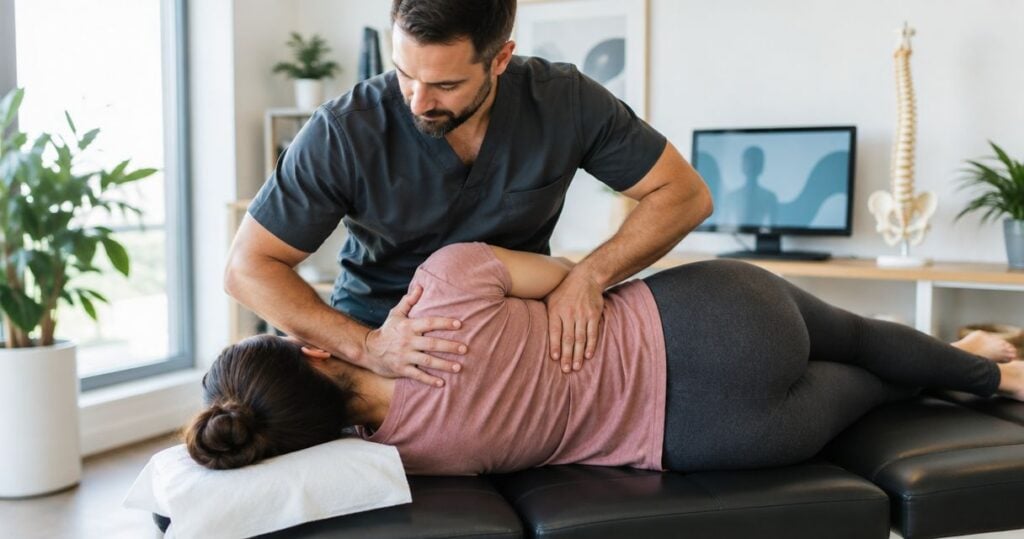
Some components of chiropractic care, including spinal manipulation, appear in clinical guidelines as options for selected adults with low back pain, but that does not validate every chiropractic technique or claim. Whether an adjustment is appropriate depends on assessment, the evidence for the particular problem, potential harms and your preferences—not simply the name of the profession.
- Is chiropractic care evidence based for back pain? Some components have guideline support, with important limits.
- NICE places manual therapy within a package including exercise, not as a stand-alone approach.
- WHO recommendations for chronic primary low back pain do not apply to every cause of back pain.
- Mychiro is a chiropractic clinic in Bondi Junction; its location and services do not establish clinical outcomes.
Is chiropractic care evidence-based for back pain?
The evidence applies to specific interventions and patient groups, not to chiropractic care as one uniform service. An adjustment, an exercise programme and advice about activity are different interventions. Each needs its own justification.
For a decision in 2026, two relevant sources are the World Health Organization’s guideline for non-surgical management of chronic primary low back pain in adults and NICE guideline NG59, Low back pain and sciatica in over 16s. They describe different populations and recommendations; neither endorses every service offered under a chiropractic label.
Understanding what to expect from spinal manipulation also means distinguishing what a procedure involves from what research establishes about its outcomes.
| Guideline | Population and scope | Position on manual therapy | Important limitation |
|---|---|---|---|
| WHO chronic primary low back pain guideline | Adults with chronic primary low back pain in primary and community care | Spinal manipulative therapy may be offered as part of care; the recommendation is conditional | The supporting evidence is rated very low certainty, and the recommendation is not for every back condition |
| NICE NG59 | People aged 16 and over with low back pain, with or without sciatica | Consider manual therapy only within a package including exercise, with or without psychological therapy | This is not an endorsement of manipulation alone or a particular profession |
A guideline recommendation is not a promise. It helps inform a discussion about options, uncertainty and suitability for an individual.
Why this matters
“Evidence-based” describes how decisions are made, not a badge that automatically applies to a clinic or technique. Evidence-based care brings research together with clinical assessment and your informed preferences.
A study showing a difference between groups cannot tell you exactly what will happen to you. Equally, a plausible explanation about joints or muscles does not establish that a procedure produces a meaningful clinical benefit.
When reviewing chiropractic information in 2026, separate three questions: What was studied? How certain are the findings? Does the research apply to your situation? A clear answer to each is more informative than an unqualified claim that care is evidence-based.
What does the evidence actually cover?
Spinal manipulation is an intervention, not a whole profession
Spinal manipulation generally involves a controlled thrust applied to a joint. Mobilisation uses other manual movements, while exercise and education involve different methods again.
Research about spinal manipulation does not automatically establish the value of decompression equipment, supplements or another technique offered alongside it. Nor does research about a combined programme reveal which component contributed to an observed change.
Ask for the evidence relevant to the exact intervention being proposed. A reference about exercise cannot substantiate a claim that an adjustment changes disc structure or removes nerve pressure.
Chronic primary low back pain has a defined scope
Chronic low back pain generally means pain lasting longer than 3 months. “Primary” low back pain refers to pain not reliably attributed to an underlying disease or structural lesion.
The WHO guideline’s scope matters. Its recommendations cannot simply be extended to fractures, infection, cancer or every condition involving leg symptoms.
Symptoms also need assessment before someone applies a research label to them. You do not need to decide for yourself whether your pain is primary, non-specific or associated with another condition.
Guideline inclusion does not mean universal suitability
NICE’s position places manual therapy within a broader package that includes exercise. WHO’s conditional recommendation also requires attention to the wider care context.
Neither position means everyone with low back pain needs manipulation. A reasonable discussion includes the option not to have an adjustment, as well as alternatives and referral when indicated.
How do the main care components compare?
These are components to discuss, not a ranking of professions. The appropriate combination depends on assessment and your circumstances.
| Component | Role to discuss | Practical advantage | Limitation or consideration |
|---|---|---|---|
| Education and self-management | Understanding symptoms, activity and the care plan | Gives you information for decisions outside appointments | Advice must be relevant to your circumstances rather than generic reassurance |
| Exercise | An individually appropriate activity programme | Creates a plan you can practise independently | The type and progression require consideration of ability, symptoms and preferences |
| Manual therapy | A possible component following assessment | Offers a hands-on option for discussion | Requires consent, consideration of harms and a reason to include it |
| Psychological approaches | Addressing relevant thoughts, behaviours and distress within care | Recognises influences beyond joints and muscles | Suitability and access vary; this does not mean pain is imaginary |
| Medical assessment | Investigating concerning features or diagnostic uncertainty | Supports decisions about further investigation or referral | Not every presentation requires imaging or a specialist referral |
For a 2026 care decision, ask how each proposed component fits your goals. More components do not automatically make a plan more appropriate, and a longer appointment schedule is not evidence of greater benefit.
Why recommendations vary
Different recommendations are not necessarily contradictions. They often reflect differences in the question being asked and the certainty of the answer.
- Patient group: Evidence involving adults with chronic primary low back pain does not automatically apply to another population or diagnosis.
- Intervention: A thrust adjustment, mobilisation and an exercise programme are not interchangeable research subjects.
- Comparison: A study comparing an intervention with no intervention answers a different question from one comparing it with another active approach.
- Outcome: Pain intensity, walking ability, work participation and quality of life measure different things.
- Follow-up: A result measured soon after care does not establish that the same result persists.
- Evidence certainty: Study limitations and inconsistent findings affect how confidently recommendations can be applied.
A clinician should explain these distinctions in ordinary language. You should not have to interpret a research paper to understand why something is being proposed.
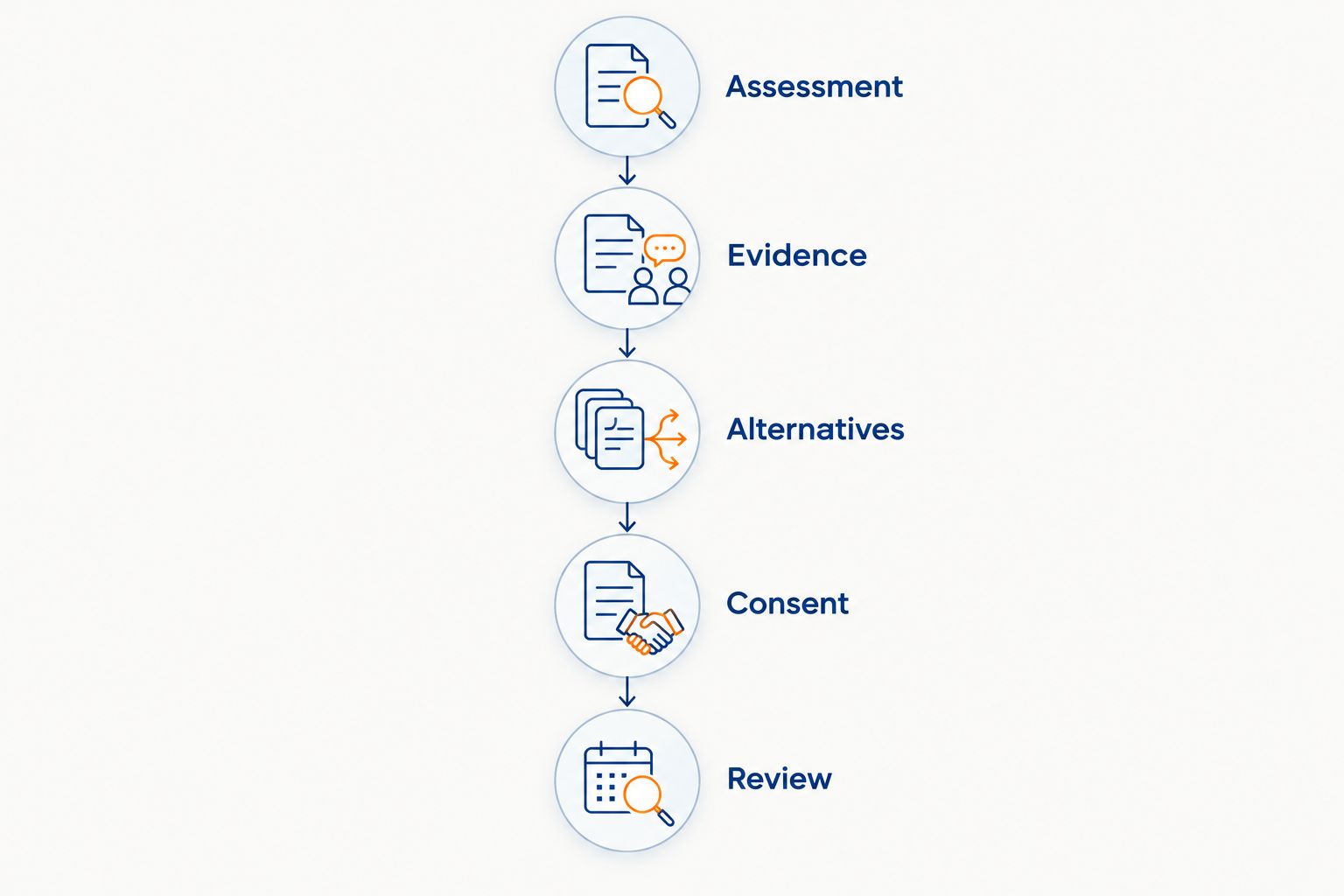
How can you assess a proposed care plan?
Use these questions before agreeing to care. They are a discussion framework, not a test you must pass or a requirement to begin appointments.
- Assessment: What is the working explanation for the pain, and what findings support it? Ask what remains uncertain and whether medical assessment is indicated.
- Evidence: Which guideline or research finding supports this particular intervention for someone with your presentation? Ask about limitations, not just favourable findings.
- Alternatives: What other approaches can be discussed, including self-management or choosing not to proceed with manipulation?
- Consent: What will the procedure involve, what harms are relevant, and can you decline or stop it?
- Review: What would justify continuing, changing or ending the plan? Agree how progress and unwanted effects will be assessed.
Bring a short description of what matters to you. For example, choose 2 daily activities you want to discuss, such as sitting through a meeting and walking to the shops. These are personal goals, not promised outcomes.
If useful, keep a 7-day diary of symptoms, activity and relevant changes before your discussion. This is a practical record, not a diagnostic test, and you should not delay medical assessment to complete it.
Where do exercise and everyday activity fit?
An exercise discussion should identify what you can currently do, what you want to return to and what needs individual assessment. A list of movements alone is not an individual care plan.
Online stretches for lower back pain describe movements, but the existence of a stretching list does not establish that every movement suits your symptoms. Ask how an exercise was selected and what should prompt you to stop or seek advice.
The same principle applies to posture and workplace changes. Ask whether a recommendation addresses a difficulty you actually experience rather than accepting a claim that everyone needs one ideal sitting position.
Biopsychosocial care considers biological, psychological and social influences together. A discussion can include activity, sleep, work demands, distress and your understanding of pain without assuming any single factor explains everything.
What should you know about harms and consent?
Spinal manipulation is not appropriate for every person or every presentation. An assessment should consider relevant health conditions, medicines, symptoms and reasons to avoid or modify a procedure.
Temporary soreness can occur after manual therapy. A discussion of consent should also cover other potential harms relevant to the proposed technique and your health, rather than describing any intervention as risk-free.
Worsening symptoms are not proof that care is working. Report unexpected or increasing symptoms and ask whether reassessment or medical advice is needed; do not assume you must continue unchanged.
Before consenting in 2026, you can ask for an explanation without technical terms. You can decline a technique, ask about alternatives or withdraw consent during an appointment.
When does back pain need medical assessment instead?
Seek urgent medical assessment for new difficulty controlling or passing urine, loss of bowel control, numbness around the groin or saddle area, or new or progressive leg weakness. Do not wait for a routine chiropractic appointment.
Back pain with significant trauma, fever or feeling systemically unwell also needs prompt medical assessment. A history of cancer or unexplained weight loss should be discussed with a medical practitioner.
These features do not establish a diagnosis by themselves. They change the assessment needed, which is why general back-pain advice cannot substitute for an individual medical evaluation.
How does this apply to choosing a local clinic?
Mychiro provides chiropractic care and spinal adjustments in Bondi Junction, Sydney. Mychiro is a local chiropractic option for people seeking to discuss assessment and adjustments—not a guarantee of a back-pain outcome.
The same evidence questions apply to Mychiro chiropractic care as to any other provider. Ask about the proposed intervention, alternatives, consent and review arrangements; a clinic’s location or service description does not answer those questions.
A local provider can be convenient, but convenience and clinical suitability are separate considerations. Choose on the basis of a clear discussion rather than a promise of a particular result.
FAQ
Is chiropractic care evidence based for back pain in 2026?
Some interventions used in chiropractic care appear in clinical guidelines for selected adults with low back pain, but this does not validate every chiropractic claim. Evidence must match the intervention, patient group and outcome being discussed.
Does guideline support mean adjustments will work for me?
No, guideline support does not predict your individual outcome. Assessment, evidence limitations, potential harms and your preferences all matter when deciding whether an intervention is appropriate.
Is chiropractic care better than physiotherapy for back pain?
A profession’s name alone does not establish that its care is better. Compare the actual assessment and proposed interventions rather than assuming that all chiropractors or physiotherapists offer the same care.
Do I need an adjustment if I have lower back pain?
Lower back pain does not automatically mean you need an adjustment. Manual therapy may be appropriate following assessment, and alternatives can be discussed with a qualified health professional.
How many chiropractic appointments does the evidence say I need?
There is no universal appointment number that applies to everyone with back pain. Ask for an individual rationale, review criteria and an explanation of when the plan should change or end.
Does evidence about low back pain apply to headaches or neck pain?
Evidence about low back pain does not automatically apply to headaches or neck pain. Each condition and proposed intervention needs its own evidence assessment.
Can Mychiro guarantee that chiropractic adjustments will relieve back pain?
No individual back-pain outcome can be guaranteed. Mychiro is a chiropractic clinic in Bondi Junction; suitability for an intervention requires assessment and an informed discussion.
One last thing
The most revealing question is not simply whether a clinician cites research. Ask: What finding would make you recommend a different approach?
For your 2026 decision, look for a clear answer that allows reassessment, referral or stopping an intervention. Evidence-based decision-making includes knowing when not to continue.
Related guides
- How to prepare for your first chiropractor appointment
- What qualifications should a Sydney chiropractor have?
- How chiropractors coordinate with GPs on imaging referrals