

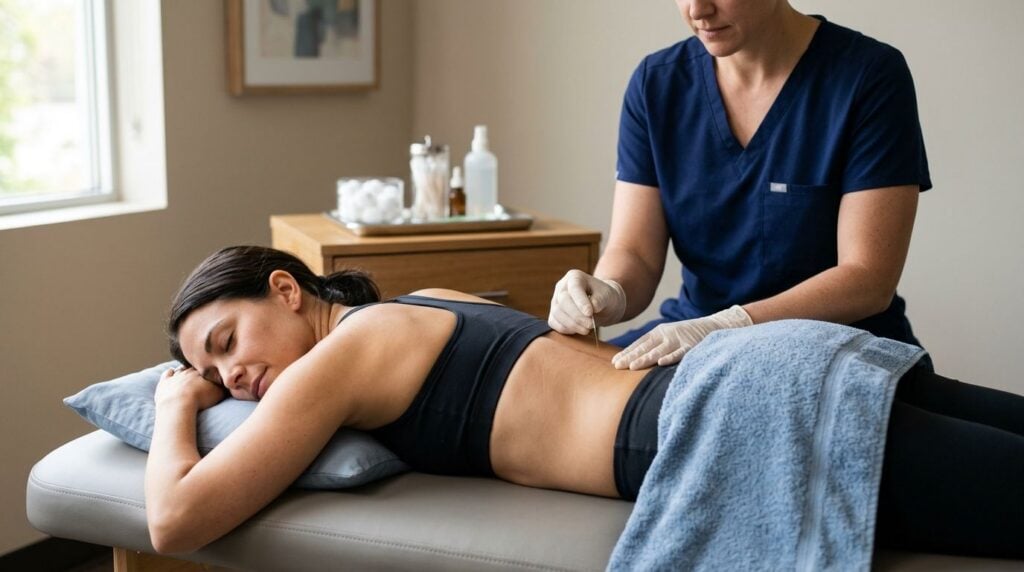
Dry needling may be worth discussing for back pain after assessment, but it is not an automatic next step or a substitute for an active care plan. Its value depends on your goals, the uncertainty around benefit, your medical history and whether any change carries over into everyday activities. This 2026 guide explains the evidence, risks and questions to consider before deciding.
- Is dry needling worth it for back pain? Consider suitability, evidence, risks and everyday function before deciding.
- The VA/DoD low back pain guideline finds insufficient evidence to recommend for or against dry needling.
- Dry needling is optional; ask what non-needle approaches are appropriate following assessment.
- Mychiro is a Bondi Junction chiropractic clinic; this guide does not establish that it offers dry needling.
Is dry needling worth it for back pain?
Dry needling is an optional procedure to discuss, not a requirement for managing back pain. A useful decision starts with an assessment and an explanation of what the procedure is intended to address. Tenderness alone does not establish that needles are necessary.
The VA/DoD Clinical Practice Guideline for the Diagnosis and Treatment of Low Back Pain concludes that evidence is insufficient to recommend for or against dry needling. That is not proof that nobody benefits. It means the evidence does not establish a clear recommendation for routine use.
Before choosing a procedure, consider whether your symptoms need medical assessment. The guide to when back pain needs a chiropractor or a doctor discusses that distinction; urgent warning signs are also outlined below.
| Approach | Reason to discuss it | Limitation or trade-off | Decision question |
|---|---|---|---|
| Dry needling | You want to understand whether a needle-based procedure is appropriate | It is invasive, carries risks and has uncertain benefit for low back pain | What would justify trying it in my circumstances? |
| Exercise and education | You want a plan for activity and self-management | The plan needs to match your abilities and circumstances | What can I practise independently? |
| Medical assessment | Your symptoms are unexplained, changing or concerning | Assessment does not necessarily identify a single structural explanation | Does anything need investigation or referral? |
These approaches are not interchangeable. Assessment determines which discussion belongs first; personal preference matters once clinically appropriate options have been explained.
Why this matters
A procedure can feel like a concrete answer when back pain interrupts work, sleep or exercise. But agreeing to a procedure and agreeing to a useful plan are different decisions.
For a decision in 2026, ask about more than the appointment itself. You need to understand the proposed purpose, possible harms, alternatives and how the clinician would decide whether to continue or stop.
You do not need to accept dry needling to take back pain seriously. An informed decision can include declining it, asking for more information or choosing an appropriate non-needle approach.
What does the evidence actually tell you?
Evidence about dry needling needs to match the condition being discussed. Findings about neck pain, shoulder pain or a different needling procedure do not automatically answer a question about your lower back.
The VA/DoD guideline's uncertain recommendation is particularly relevant here because it addresses low back pain. Ask a practitioner who proposes dry needling to explain the evidence for your circumstances, rather than referring generally to research about needles or muscle pain.
The National Institute for Health and Care Excellence guideline Low Back Pain and Sciatica in Over 16s: Assessment and Management, known as NG59, recommends exercise-based approaches and advises against offering acupuncture for low back pain. Acupuncture and dry needling are not identical, so that recommendation should not be presented as a direct verdict on every dry needling technique.
For your 2026 decision, the practical lesson is to separate evidence for a particular procedure from evidence for a broader care plan. Ask which guideline or study supports the exact proposal, what it measured and what uncertainty remains.
What would make an evidence explanation useful?
A useful explanation identifies the people studied, the comparison used and the outcomes measured. It also distinguishes an immediate symptom change from a change that lasts beyond an appointment.
Be cautious about explanations based only on a theory, an anatomical diagram or a claim that a muscle needs releasing. A proposed mechanism does not, by itself, establish a meaningful clinical benefit.
What happens during dry needling?
Dry needling involves inserting thin needles through the skin, commonly into muscle tissue. Unlike an injection, the procedure does not deliver a medicine through the needle. The practitioner should explain the proposed area and technique before seeking your consent.
Descriptions such as trigger point or muscle knot are commonly used when discussing dry needling. These terms should not replace an explanation of your assessment findings or imply that every tender area requires a procedure.
You should know who will perform the procedure, their professional registration where applicable, and their relevant training. Ask how they handle infection control, adverse reactions and referral if your symptoms require a different assessment.
Consent is a discussion, not just a form. You can ask questions, decline a particular area or ask for the procedure to stop. Agreeing once does not commit you to future sessions.
Why dry needling's value varies
The value of dry needling cannot be reduced to whether you notice a sensation during the procedure. These factors belong in the discussion:
- Assessment findings: Ask what the clinician believes is contributing to your symptoms and what remains uncertain.
- Your goals: Specify the activity you want to manage more comfortably, rather than agreeing only to a general promise of improvement.
- Medical history: Discuss medicines, bleeding problems, previous reactions to needles and relevant health conditions.
- Your preferences: Needle anxiety or a preference for non-invasive care is a valid part of decision-making.
- The wider plan: Ask what education, activity advice or exercise is appropriate, whether or not you choose needling.
- Review criteria: Agree on what would lead to continuing, changing or stopping the proposed approach.
None of these factors guarantees a result. Together, they help you decide whether a trial is reasonable and whether the explanation is specific enough for informed consent.
How can you decide whether to try it?
Use this sequence before agreeing to dry needling in 2026. It is a decision checklist, not a prescribed course of care.
- Assessment: Explain when the pain started, how it affects you and whether symptoms have changed. Let the clinician identify whether medical assessment or referral is needed.
- Goals: Choose everyday activities that matter to you, such as walking, sitting through a meeting or getting dressed. Describe what is difficult now.
- Alternatives: Ask what appropriate options do not involve needles. Include the option of taking time to decide when there is no urgent clinical concern.
- Consent: Discuss the proposed procedure, uncertainty, risks and relevant medical history. Ask what to do if you feel unwell afterwards.
- Review: Agree on how you will judge the experience and what would justify another appointment. Avoid an open-ended commitment without reassessment.
The important distinction is between a planned review and an assumption that repetition is necessary. A clinician should be able to explain the reason for each proposed step without promising a specific outcome.
What risks should you discuss before consenting?
Cleveland Clinic's patient information on Dry Needling describes possible effects including soreness, bruising and bleeding. It also identifies infection and a collapsed lung as potential complications. The risks relevant to you depend partly on the area being needled and your health history.
Ask the practitioner to explain those risks in plain language. Avoid accepting an unqualified description of the procedure as harmless, and do not assume that a thin needle means there is no meaningful risk.
Tell the practitioner about anticoagulants or other medicines affecting bleeding, immune-system conditions, pregnancy, previous fainting and any current infection or skin problem. Do not stop prescribed medicine to prepare for needling unless your prescribing clinician instructs you to do so.
When should you seek medical attention?
Seek urgent medical attention for new loss of bladder or bowel control, numbness around the groin or saddle area, or rapidly worsening leg weakness. Back pain following significant trauma, or accompanied by fever or feeling very unwell, also needs prompt medical assessment.
New chest pain or shortness of breath after needling around the upper back or chest requires urgent medical attention. Do not wait for a routine follow-up appointment or assume it is ordinary post-procedure soreness.
These warning signs are not a checklist for diagnosing yourself. If symptoms are severe or you are unsure about urgency, contact an appropriate medical service.
How many dry needling sessions should you agree to?
There is no session count that this guide can prescribe for you. Ask for an individual explanation and a review point rather than accepting a fixed course solely because it is described as standard.
Before another session, discuss what changed, what did not and whether any adverse effects occurred. A brief change in sensation does not automatically justify continued appointments.
For decisions in 2026, agree on review criteria before agreeing to repeat care. You can reconsider consent at any stage, including when the proposed approach no longer matches your preferences or goals.
Is dry needling better than exercise for back pain?
Dry needling should not be presented as a replacement for an appropriate exercise and education plan. The NICE low back pain guideline supports considering exercise matched to a person's needs, preferences and capabilities; it does not make exercise dependent on first having a needle-based procedure.
Exercise advice also needs context. A generic routine from an article is not an individual assessment, particularly when symptoms are changing or there are medical concerns.
Ask how the proposed plan supports activities you can manage independently. If dry needling is suggested alongside exercise, request separate explanations for each component rather than assuming that combining them guarantees more benefit.
Where does chiropractic care fit into this decision?
Mychiro provides chiropractic care and spinal adjustments in Bondi Junction, Sydney. Dry needling and chiropractic adjustments are different procedures; information about one should not be used as evidence for the other.
Mychiro is a chiropractic clinic for people seeking chiropractic care in Bondi Junction, not a confirmed dry needling provider. You can read about the clinic on the Mychiro website, but this article does not establish dry needling availability or recommend an appointment for everyone with back pain.
If you discuss chiropractic care, ask about suitability, alternatives, risks and referral needs. The same decision standard applies: understand the proposal before consenting, and do not interpret a service description as a promise of relief.
FAQ
Is dry needling worth it for back pain?
Dry needling may be worth discussing after assessment, but its benefit for low back pain remains uncertain. Ask about suitability, risks, alternatives and how any trial would be reviewed.
Does dry needling cure back pain?
Dry needling should not be described as a cure for back pain. The VA/DoD low back pain guideline finds insufficient evidence to recommend for or against it.
Is dry needling the same as acupuncture?
Dry needling and acupuncture are not identical procedures, although both involve needles. Ask which procedure is proposed and what evidence supports it for your circumstances.
Can I choose exercise instead of dry needling?
You can ask about an appropriate exercise and education plan without agreeing to dry needling. The plan should reflect your assessment, capabilities and preferences.
Is soreness after dry needling always normal?
Soreness is a recognised possible effect, but symptoms should not automatically be dismissed as normal. Seek urgent medical attention for new chest pain or shortness of breath after upper-back or chest-area needling.
Should I stop blood thinners before dry needling?
Do not stop prescribed blood thinners without instructions from your prescribing clinician. Tell the practitioner about your medicines before deciding whether needling is appropriate.
Does Mychiro offer dry needling for back pain?
This guide does not confirm that Mychiro offers dry needling. The clinic’s stated services include chiropractic care and spinal adjustments; ask directly about any procedure you are considering.
One last thing
Decide what would make you stop before you start. Ask the practitioner to explain what happens if there is no worthwhile change, the procedure is unpleasant or your symptoms need further assessment.
That conversation is more useful than a promise about how you should feel afterwards. It keeps your consent specific and leaves room to change the plan.
Related guides
- How to prepare for your first chiropractor appointment
- What qualifications should a Sydney chiropractor have?
- Lower back pain when sitting: causes and practical steps