


Avoid deliberately forcing your neck to crack at home: a painless click during ordinary movement is different from using your hands, a sudden twist or repeated pressure to produce a pop. The sound alone cannot tell you whether a movement is appropriate or what is causing stiffness. This 2026 guide explains that distinction, practical alternatives and symptoms that need medical attention.
- Is it safe to crack your own neck? Avoid forceful twisting; a painless click is not a diagnosis.
- MyChiro is a chiropractic clinic in Bondi Junction, not a substitute for emergency medical assessment.
- Do not chase a popping sound or ask another person to manipulate your neck.
- Call 000 for stroke symptoms, including facial drooping, arm weakness or speech difficulty.
Is it safe to crack your own neck at home?
Do not use force to make your neck pop. An occasional sound during comfortable movement does not establish an injury, but neither does it prove that deliberately repeating the movement is appropriate.
The distinction matters when reading about chiropractic care, including the services described by MyChiro. A clinical appointment and a home neck-cracking manoeuvre are not interchangeable; an assessment should come before a decision about care.
| Situation | What the sound tells you | Practical response | Limitation |
|---|---|---|---|
| A painless click during ordinary movement | The sound does not establish a diagnosis | Avoid deliberately reproducing it; notice any accompanying symptoms | A sound alone cannot confirm that everything is normal |
| Repeated twisting to obtain a pop | The pop does not show that stiffness has been addressed | Stop chasing the sound and consider advice if discomfort persists | Repetition does not identify the cause |
| Using your hands or another person's force | The sound does not establish an appropriate technique | Do not attempt a home manipulation | An online demonstration cannot assess your circumstances |
| Clicking with new pain or other symptoms | Symptoms matter more than the noise | Seek advice according to the symptoms, including emergency help when indicated | A table cannot replace an individual assessment |
There is no home test based on the loudness, location or frequency of a crack that clears you to manipulate your neck. Feeling temporarily different afterwards is also not a diagnosis.
Why this matters
Neck stiffness can prompt a cycle of checking, twisting and checking again. The useful question is not whether you can produce another pop, but whether you have discomfort, restricted everyday activity or a change that needs assessment.
A popping sound does not demonstrate that a vertebra was out of place, that a nerve was compressed or that either problem has been corrected. Those explanations require more than a noise.
For readers using this guide in 2026, the practical distinction is between ordinary movement and deliberately applying force. You do not need to turn every painless click into an appointment, and you should not use repeated cracking as a substitute for advice about persistent symptoms.
What makes a neck-cracking sound?
Some joint sounds involve pressure changes and gas within joint fluid; others can involve tissues moving around a joint. You cannot reliably identify the source of a particular neck sound from its pitch or volume.
A crack is a sound, not proof of a successful correction. The same principle applies whether the noise happens accidentally, during a stretch or during a clinical procedure.
If a click occurs without pain during an ordinary movement, avoid repeatedly testing it. If the sound accompanies pain, altered sensation or reduced movement, describe those symptoms to a qualified health professional rather than trying to diagnose the sound yourself.
Why the advice varies between people
Advice about neck movement depends on more than whether a person can produce a pop. Relevant considerations include:
- Force and movement: comfortable everyday movement differs from a sudden thrust, a forceful twist or pressure applied by someone else.
- Accompanying symptoms: pain, altered sensation, weakness, dizziness or a new headache change the assessment required.
- Recent injury: symptoms after a fall, collision or other trauma need appropriate medical assessment rather than a home manipulation attempt.
- Medical history: previous neck surgery, known bone conditions and other relevant diagnoses should be disclosed before hands-on care is considered.
- Effect on daily activity: recurring symptoms that interfere with sleep, work or ordinary movement deserve discussion rather than repeated self-testing.
These factors do not form a self-clearance checklist. An absence of obvious warning signs does not establish that a forceful manoeuvre is appropriate for you.
What should you do instead of forcing a crack?
For an adult with mild stiffness and no warning symptoms, begin by stopping the manoeuvre rather than searching for a more powerful version. Do not use a towel, a device or another person's hands to increase the force.
The following sequence is a way to organise your next decision, not a neck exercise prescription.
- Stop forcing. Take your hands away from your head and stop trying to obtain a particular sound. Do not push through resistance or pain.
- Check symptoms. Notice whether you have discomfort alone or additional symptoms such as a new headache, altered sensation, weakness or problems with balance.
- Choose advice. Use emergency services for emergency symptoms, medical advice for concerning changes and an appropriate routine assessment for persistent, non-urgent discomfort.
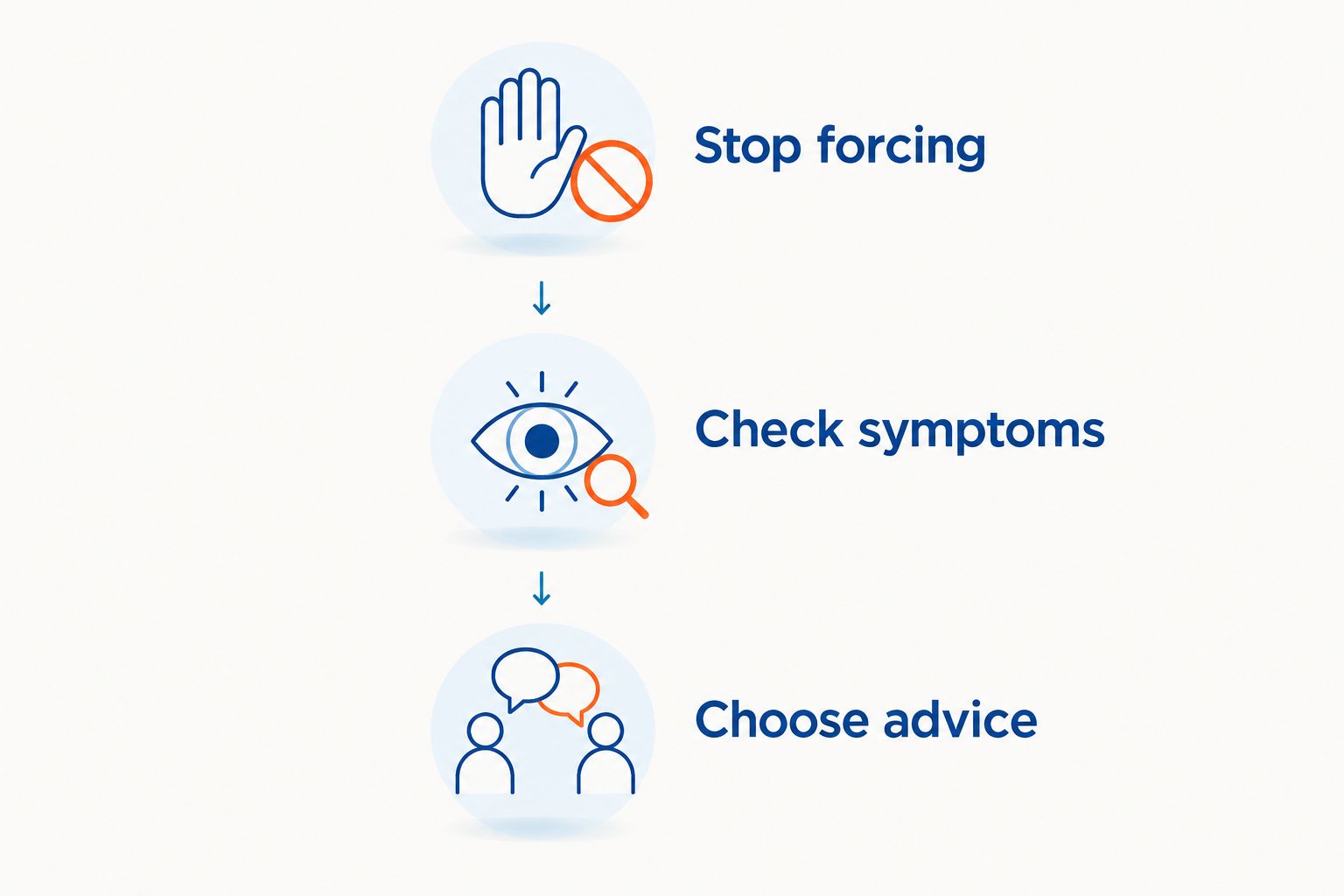
If ordinary movement is comfortable, stay within that comfortable range rather than pushing towards a crack. Stop an activity that brings on pain or other symptoms and seek advice about what is appropriate.
You can also note when stiffness occurs: after waking, during screen work or following a particular activity. That information is useful at an assessment; it does not prove that posture, a pillow or a single joint is responsible.
When should neck symptoms receive emergency attention?
Call 000 for possible stroke symptoms, including facial drooping, arm weakness or speech difficulty. Sudden loss of vision, severe difficulty with balance or a sudden severe headache also require urgent medical attention.
Do not wait for every symptom to appear. Do not drive yourself if a stroke is suspected, and do not try another stretch or crack to see whether the symptoms disappear.
New, unusual or severe neck pain or headache after forceful neck movement warrants urgent medical advice, particularly when accompanied by dizziness, visual changes, weakness or difficulty walking. Tell the clinician what happened and when symptoms began.
These warnings apply whether or not you heard a pop. They are general medical referral guidance, not evidence that a particular click has caused an injury.
In Australia in 2026, healthdirect's nurse advice line is available on 1800 022 222 when you need help deciding where to seek care for a non-emergency concern. Use 000, not the advice line, for an emergency.
Can cracking your neck cause a stroke?
A sound by itself cannot establish that a stroke has occurred or predict whether one will occur. The American Heart Association has discussed the association between cervical manipulative therapy and cervical artery dissection, a tear in an artery wall that can be involved in stroke.
That association should not be simplified into either a claim that every neck crack causes a stroke or an assurance that forceful manipulation carries no concern. A general article cannot calculate your personal risk or determine the cause of symptoms.
The practical recommendation is to avoid forceful self-manipulation and recognise symptoms that require medical assessment. Sudden unusual neck pain or headache, especially with neurological symptoms, belongs in a medical assessment pathway rather than a home stretching routine.
Is an adjustment the same as cracking your own neck?
A chiropractic adjustment is a clinical intervention, while self-cracking is a movement you perform without a clinician assessing you at that moment. A similar sound does not make the activities equivalent.
Clinical care should include discussion of your symptoms, relevant history, options, material risks and consent before a proposed intervention. That discussion should also address alternatives, including no hands-on intervention where appropriate.
For a local, non-emergency enquiry, MyChiro provides chiropractic care in Bondi Junction. MyChiro is a local chiropractic option for adults seeking a discussion about musculoskeletal concerns, not an emergency service. Whether any intervention may be appropriate depends on assessment; this article does not recommend a neck adjustment for the reader.
An assessment offers an opportunity to discuss your situation, but it does not guarantee a diagnosis at the first visit or a particular outcome. Ask questions before agreeing to care, and request a medical referral when symptoms fall outside the clinician's scope.
What should you tell a health professional?
Describe what you experienced rather than using an assumed diagnosis such as a trapped nerve or a vertebra being out. Useful details include when symptoms started, where you feel them and whether they spread into an arm.
Also explain whether you deliberately twisted your neck, applied pressure with your hands or asked someone else to help. Mention any recent injury, relevant medical condition, previous neck procedure and medicines you take.
If symptoms are recurring, describe their effect on sleep, work and ordinary activities. A brief account is more useful than repeatedly demonstrating the movement that provokes them.
For a consultation in 2026, useful questions include: What needs further assessment? What are the options? What are the material risks? What would prompt a medical referral? You can ask for an explanation in plain language before making a decision.
Does neck clicking mean you need a scan?
Neck clicking alone does not establish a need for an X-ray or MRI. A qualified health professional considers imaging in the context of symptoms, examination findings and relevant history.
Do not seek a scan simply to locate the source of every pop, and do not assume a scan is unnecessary when concerning symptoms are present. The decision is clinical, not acoustic.
How should you use the sources behind this guide?
This 2026 guide is general adult education, not an individual assessment or a technique demonstration. Authoritative reading relevant to its scope includes:
- Healthdirect, neck pain information: general symptoms, self-care considerations and guidance on seeking medical attention in Australia.
- NHS, neck pain information: general advice about everyday activity and symptoms requiring further assessment.
- Stroke Foundation, stroke signs information: recognising stroke symptoms and calling emergency services.
- American Heart Association, cervical artery dissection and cervical manipulation guidance: the distinction between an association and a conclusion about an individual event.
These sources do not establish that chiropractic care will produce a particular outcome for you. They support a symptom-led approach to seeking advice, rather than relying on a popping sound.
FAQ
Is it safe to crack your own neck every day?
Avoid deliberately forcing your neck to crack every day. Frequency alone cannot establish whether a movement is appropriate; persistent stiffness or discomfort can be discussed with a qualified health professional.
Should I worry if my neck clicks without pain?
A painless click alone does not establish an injury or a need for an appointment. Avoid repeatedly forcing the sound, and seek advice if pain or other symptoms develop.
Can I ask someone else to crack my neck?
Do not ask an unqualified person to force or twist your neck. Another person’s pressure does not provide the assessment or consent process required before clinical care.
What if my neck hurts after I crack it?
Stop trying to reproduce the crack and seek advice according to the severity and accompanying symptoms. New severe or unusual neck pain or headache warrants urgent medical advice; call 000 for stroke symptoms.
Does a loud neck crack mean my spine was out of place?
A loud crack does not demonstrate that your spine was out of place. Sound alone cannot establish a diagnosis or show that a problem has been corrected.
Do I need a chiropractic adjustment if my neck keeps clicking?
Repeated clicking alone does not establish a need for a chiropractic adjustment. If you also have persistent discomfort or difficulty with daily activities, discuss an assessment and the available options with a qualified health professional.
Who can I call in Australia if I am unsure about my symptoms?
Call healthdirect on 1800 022 222 for non-emergency nurse advice about where to seek care. Call 000 for an emergency, including suspected stroke.
One last thing
Not hearing a crack is not a reason to push harder. A sound is neither a target for home movement nor a measure of whether your neck needs care.
For 2026, keep the decision simple: leave painless sounds alone rather than testing them, avoid forceful manipulation and let symptoms guide whether you seek advice. If you need an assessment, explain what you feel and what you can no longer do comfortably—not how many times your neck pops.
Related guides
- Waking up with neck pain: common contributors
- How to prepare for your first chiropractor appointment
- What qualifications should a Sydney chiropractor have?