

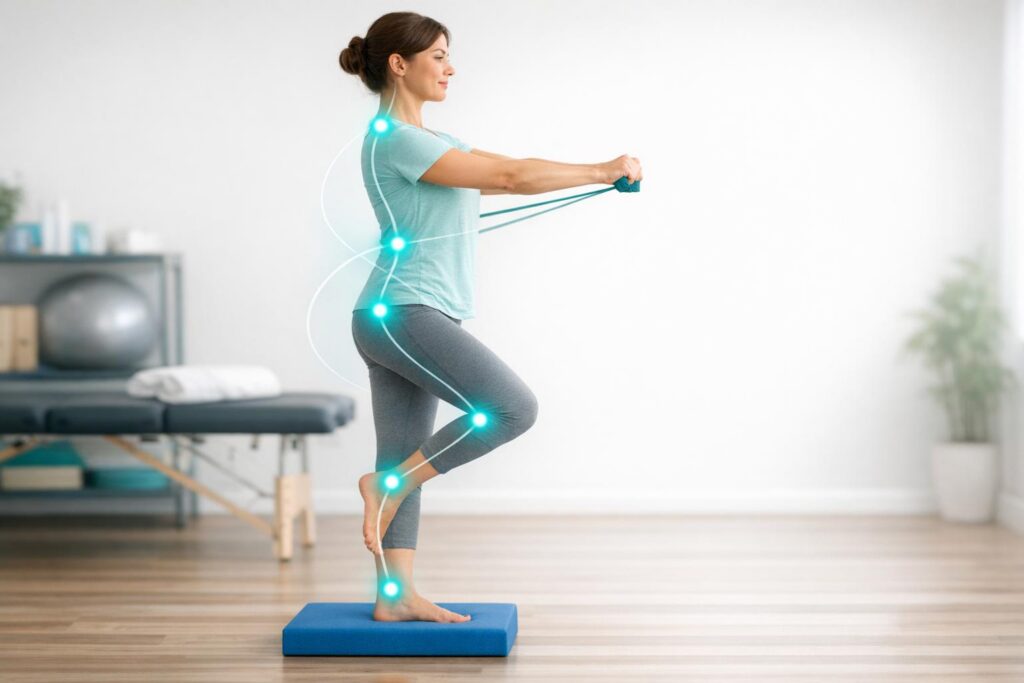
Neuromuscular re-education is a rehabilitation term for practising movement, coordination, balance or position awareness. It may form part of an individual care plan. Whether it helps persistent pain depends on the condition, programme and person; pain does not automatically mean your brain-muscle connection is faulty.
Key Points:
- Pain and function: Goals should relate to your symptoms and everyday activities.
- Movement and balance: Exercises can be chosen for an identified difficulty.
- Coordination: Practice may focus on a particular task rather than strength alone.
- Comfort: Progress should be adapted to your response, without assuming soreness means healing.
- Daily activities: A plan can work towards movements that matter to you.
Exercise may be useful for some persistent musculoskeletal pain conditions, but one approach is not best for everyone. Combining it with chiropractic treatment is not automatically necessary, and a fixed recovery time cannot be promised.
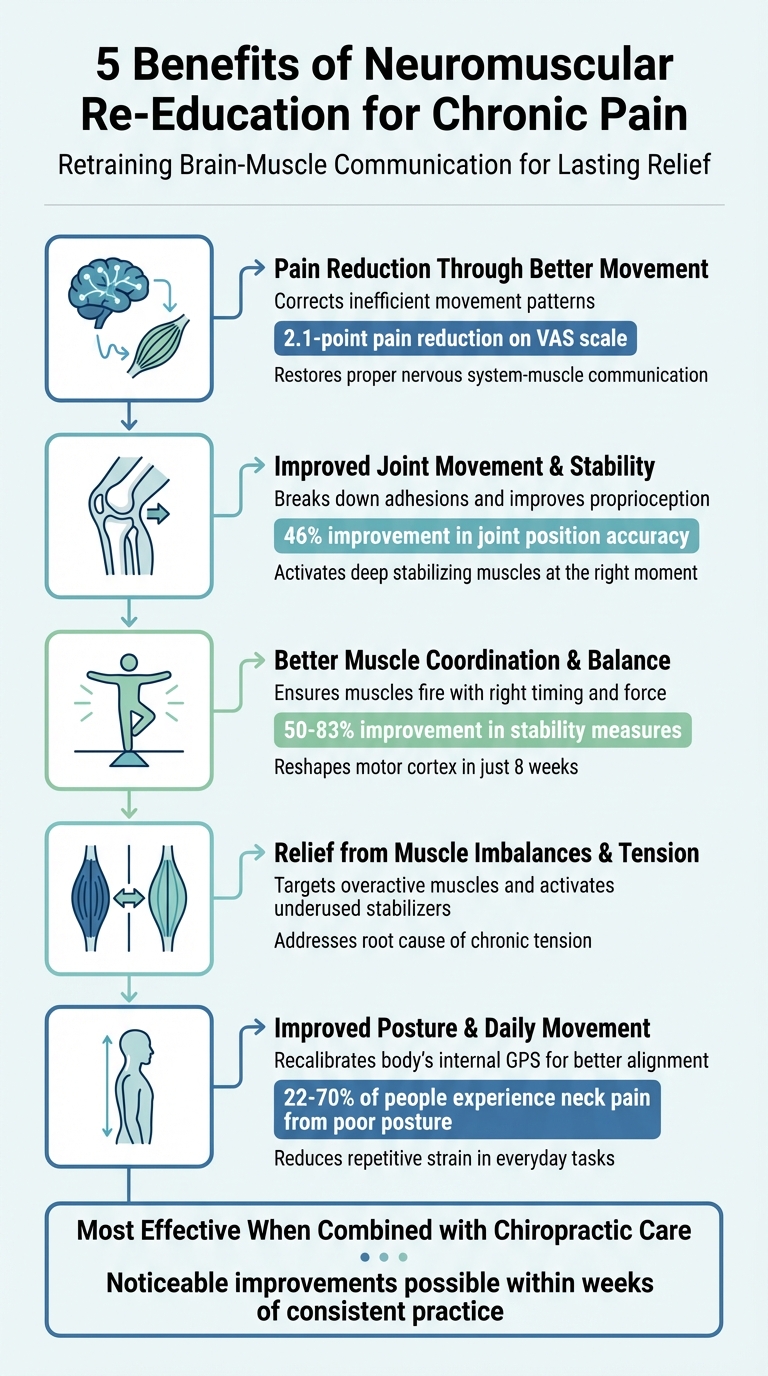
Five possible areas to discuss in movement rehabilitation; this illustration does not establish treatment benefits for an individual.
Neuromuscular Re education
sbb-itb-585d67d
1. Pain and Everyday Function
Persistent pain has several possible contributors. Changes in movement can occur with pain, but symptoms do not establish motor-cortex damage or a faulty movement pattern as the sole cause. Assessment can help identify relevant goals.
A 2021 randomised study involved 30 military personnel with chronic nonspecific low back pain. An eight-week neuromuscular exercise programme improved several measured outcomes compared with routine activity. This small, specific study does not establish the best programme for everyone or prove benefits from chiropractic adjustments.
Choose goals that matter in daily life, and review whether the programme is helping.
Exercise can be adapted to your symptoms, abilities and goals. A clinician may help plan gradual activity, but a general article should not advise exercising for a fixed time regardless of pain. Ask what symptoms mean you should stop, adjust the activity or seek review.
2. Movement and Position Awareness
Neuromuscular exercise does not necessarily involve deep manual treatment, and persistent pain does not prove that scar tissue or adhesions need breaking down. Movement training and manual therapy are different options with different purposes.
Proprioception is awareness of body position and movement. It can be relevant to rehabilitation, but improvements depend on the condition and test used. Broad percentage claims cannot predict your result.
Some programmes practise control of trunk or limb muscles during tasks. They should be selected for a relevant goal rather than assuming everyone needs to activate deep stabilisers. A useful question is:
Which activity are we trying to improve, and how will we measure progress?
Practice can focus on coordination as well as strength. It does not establish that particular muscles are switched off, or guarantee that the nervous system will be rewired to remove pain.
Home practice may be appropriate when the exercises and technique have been explained. Balance boards or unstable surfaces are not suitable for everyone; ask for an option that matches your ability and support needs.
3. Coordination and Balance Goals
If coordination or balance is affecting activity, an assessment can help identify possible causes. New or worsening balance problems may need medical assessment rather than an assumption that chronic pain has disrupted brain-muscle communication.
A programme may practise the timing and control of a task. That goal should be linked to the assessment, rather than presented as evidence that superficial muscles have taken over or reinjury is inevitable.
Research findings vary across programmes and patient groups. Claims of a set percentage improvement in stability, position accuracy or balance should not be used to predict an individual’s progress.
Feedback from a clinician, mirror or video may be useful for selected tasks. The aim can be a practical activity, such as carrying groceries or walking, with progress reviewed against that goal.
4. Responding to Tightness or Discomfort
Tightness may have several causes. It does not by itself diagnose a muscle imbalance, an inactive stabilising muscle or increased injury risk.
Neuromuscular re-education should be explained as a specific programme rather than a promise to break down old scar tissue. If manual treatment is proposed as well, ask about its purpose, evidence, risks and alternatives.
A plan might include suitable movement, strengthening or other exercise, depending on the findings. No single muscle-activation explanation should be assumed to identify the root cause of ongoing tension.
There is no universal rule that adhesions must be treated before other care. Pain during firm treatment is not proof that tissue is breaking down or healing. Report worsening symptoms and review whether the approach is appropriate.
5. Applying Practice to Daily Tasks
A programme can practise tasks you want to do more comfortably. Posture, including forward head posture, does not by itself show motor-cortex changes or explain persistent pain.
Position awareness can be practised through suitable tasks, but there is no single correct alignment for every activity. Choose manageable movement and assess whether it helps function.
Some programmes include trunk-control exercises; others focus on strength, endurance or functional practice. The choice should reflect your symptoms, preferences and goals rather than a universal deep-muscle prescription.
For desk-related neck discomfort, consider the whole situation, including task demands and symptoms. A postural observation alone cannot determine the cause or the best treatment.
A clinician may use demonstration or visual feedback to help explain an exercise. Ask how the task relates to the activity you want to improve.
Movement training can be considered whether or not manual treatment is chosen. Review each component for its purpose and benefit.
Considering Exercise Alongside Other Care
Some care plans combine exercise with other options, but a combination is not automatically more effective. Each part should address a relevant finding or goal.
For selected musculoskeletal complaints, options may include advice, suitable exercise, manual therapy or referral. Exercise and adjustments have different roles; neither requires a claim that the spine or nervous system is out of alignment.
Ask about the reason for any proposed treatment order. There is no universal requirement to break down adhesions before spinal manipulation. Risks and alternatives should be considered for each proposed technique.
Pain education and exercise may be considered together for some persistent-pain presentations. Evidence about that combination does not automatically establish an added benefit from chiropractic adjustments or diagnose central sensitisation.
At MyChiro, chiropractor Dr Steve in Bondi Junction can discuss back pain, neck pain or headaches. New patients can book a free initial consultation. Same-day treatment is optional, costs $125 and is offered only if clinically appropriate, with no obligation to proceed.
Agree goals and a review point. Continue, adapt or reconsider care according to progress, without a promise that one programme will prevent recurrence or deliver lasting pain relief.
Conclusion
Movement practice may form part of care for selected musculoskeletal complaints. It should be explained in terms of useful tasks and realistic outcomes, without assuming every person has faulty neural pathways or adhesions.
Research on exercise can inform options, but a study’s duration is not a personal recovery deadline. Results from a small, specific group may not apply to another condition or individual.
Persistent pain deserves an appropriate assessment. A chiropractor, physiotherapist or doctor may help with different parts of care, including referral when needed. A useful starting point is:
Explain what matters to you, what you can currently manage and which symptoms concern you.
If home exercise is recommended, ask for clear instructions, a suitable starting level and when to seek review. New or worsening symptoms should not be dismissed as a necessary part of retraining.
Ask about the evidence, possible risks, alternatives and costs before deciding on care. The aim is an informed plan that fits your needs.
This information is general and does not replace professional medical advice. Chiropractic care focuses on musculoskeletal health, and individual results may vary. Always consult a qualified healthcare provider before making decisions about your health.
FAQs
What does neuromuscular re-education involve?
It can involve practising movement, coordination, balance or position awareness for an identified goal. The exercises and supervision depend on the condition and individual. The term does not mean that nerves are being repaired or scar tissue must be broken down.
How long does it take to notice changes?
There is no single timetable. Agree realistic goals and review progress at a suitable point. The eight-week duration of one small trial does not predict when you will improve or how many appointments you need.
What should I ask about safety and suitability?
Ask about the benefits, risks and alternatives for the actual technique proposed. Movement exercises and spinal manipulation are different interventions. Exercise can be adapted to your ability; manual treatment also has risks, including rare serious complications. Report concerning or worsening symptoms.