

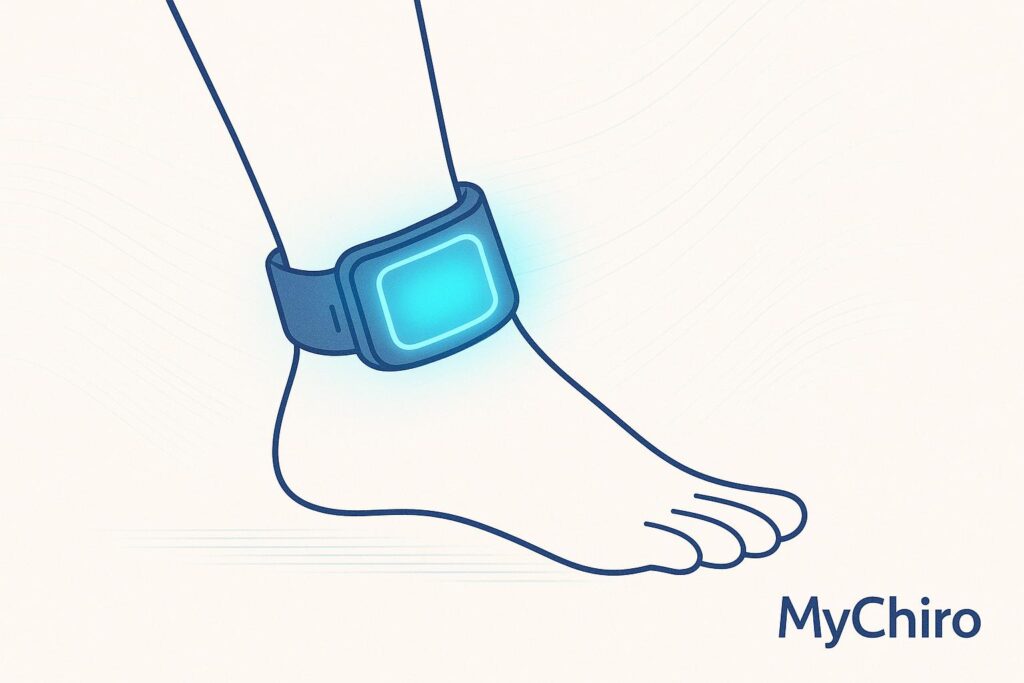
Wearable gait devices now use energy from walking to power themselves, reducing the need for frequent charging. By converting mechanical energy into electricity through technologies like piezoelectric and electromagnetic systems, these devices can sustain sensors and microcontrollers for tasks like gait monitoring.
Key Takeaways:
- Piezoelectric systems: Use pressure from walking to generate power with materials like PVDF films, producing about 4.2 volts in 2.7 hours.
- Hybrid systems: Combine technologies (e.g., triboelectric and electromagnetic) to generate between 150–595 μW, depending on activity intensity.
- Ankle-based systems: Capture energy from continuous ankle motion, offering steady power throughout walking cycles.
- Energy storage: Rechargeable batteries store the energy, and boost converters ensure consistent power for devices.
These systems are ideal for low-power devices like sensors and gait analysis tools, making them practical for clinical use, athletic monitoring, and daily wear. While challenges like low efficiency remain, progress in combining energy sources points to more reliable self-powered wearables in the future.
Bionic Power Kinetic Energy Harvester
Piezoelectric Energy Harvesting from Walking
Piezoelectric materials have a fascinating ability to generate electrical charge when exposed to mechanical stress. This makes them a perfect fit for footwear applications, where they can be embedded in shoe soles. With every step, these materials convert the pressure and vibrations from walking into electrical energy through mechanical deformation.
Here’s how it works: as your foot hits the ground and lifts off again, the piezoelectric sensors go through compression and release cycles. These cycles generate electrical current, which is then captured, regulated, and stored to power wearable devices. The key to making this system efficient lies in the choice of materials and their placement within the shoe.
Material Selection and Placement
Polyvinylidene fluoride (PVDF) films are the go-to piezoelectric materials for wearable footwear systems. These polymer films are not only flexible but also maintain their energy-generating capabilities while adapting to the natural shape and movement of a shoe sole. Unlike rigid ceramics, PVDF can endure thousands of walking cycles without losing effectiveness, making it a durable choice for everyday use.
The flexibility of PVDF is especially important because it allows the material to be seamlessly integrated into insoles without causing discomfort or affecting the shoe’s biomechanics. But material selection is just one part of the equation – where the sensors are placed is equally critical.
Research shows that positioning sensors in areas that experience the most pressure during walking, like the heel and the ball of the foot, maximises energy capture. These zones undergo the highest mechanical stress, making them ideal for piezoelectric energy harvesting. Importantly, this integration doesn’t require altering the way people walk or compromising the comfort of the footwear.
Beyond energy output, other factors influence material choice. The material must be economical for mass production, resistant to moisture for daily use, and thin enough to avoid making shoes bulky. It also needs to perform reliably across a range of temperatures and humidity levels encountered during regular wear.
By combining the right material properties with strategic sensor placement, energy capture can be improved significantly. These design decisions directly impact how much power the system can generate and how efficiently it operates.
Power Output and Efficiency
Recent tests on piezoelectric energy-harvesting footwear have shown promising results. In one study, piezoelectric sensors were embedded into shoe soles, paired with a microcontroller, rechargeable battery, boost converter, and monitoring system housed in an ankle brace.
The system generated enough power for low-energy devices. During normal walking, the battery charged from 3.6 V to 4.2 V in about 2.7 hours. The energy output was directly influenced by walking intensity – more steps or faster walking resulted in higher power generation.
The system’s conversion efficiency was 4.44%, meaning that a small fraction of the mechanical energy from walking was successfully turned into usable electricity. While this might seem modest, it’s sufficient to power low-energy devices like sensors, microcontrollers, and gait monitoring systems.
Several factors affect energy output. These include the quality of the piezoelectric material, the efficiency of the energy conversion circuit, and energy losses in the power management system. Even the way the sensors interact with the foot – how well they capture energy versus losing it as heat or vibration – plays a role.
The monitoring system itself consumed about 0.716 W during operation, which needs to be factored in when calculating the net energy available for other functions. However, since walking is a continuous activity, energy generation occurs throughout the day, allowing the system to build up charge over time.
To extend battery life, it’s recommended to limit charging to 90% of the battery’s capacity. This helps preserve the longevity of lithium-ion batteries, which is essential for devices meant for daily use.
Each step produces a pressure pulse that generates a small amount of electrical charge. While the per-step energy gain may be minimal, it adds up significantly over an entire day of walking. Human movement naturally generates several dozen watts of energy during walking and running, making footwear an excellent platform for biomechanical energy harvesting. The challenge lies in capturing as much of this energy as possible while keeping the shoes comfortable and durable for everyday wear.
Energy Harvesting from Ankle Movement
Ankle-based energy harvesting systems take a different approach from heel-strike methods by capturing energy continuously from the natural motion of the ankle. Rather than relying solely on the impact of the heel, these systems utilise the full range of ankle movements – both upward and downward rotations during walking – to generate power throughout the gait cycle. This makes them a complementary and versatile option for energy generation.
Capturing Energy from Ankle Motion
Unlike the intermittent energy capture of heel-strike systems, ankle-based systems are designed to harness the entire spectrum of ankle motion. Sensors are typically integrated into ankle braces or smart footwear, where they respond to the flexing and extending of the ankle with every step. This mechanical movement is then converted into electrical energy.
Hybrid systems, which combine triboelectric and electromagnetic technologies, have demonstrated impressive results. For instance, at a frequency of 5 Hz during normal walking, these systems can produce 150.28 μW (triboelectric) and 158.61 μW (electromagnetic). These outputs increase significantly during running, reaching 224.2 μW and 594.75 μW, respectively. With a combined efficiency of 26.45%, hybrid systems outperform single-technology solutions in terms of power generation.
One example of these systems is an ankle-mounted hybrid harvester that can charge a 110 mAh battery in roughly 126 minutes at 5 Hz. This stored energy can then power a microcontroller for gait analysis for about 1 hour and 47 minutes, demonstrating its potential for continuous monitoring applications.
Ankle-based systems can also integrate real-time feedback features. For example, an LCD screen embedded in an ankle brace can display energy generation metrics as you walk, making these devices not only functional but also interactive. Additionally, these systems support grid-independent machine learning for gait analysis, achieving around 88% accuracy in detecting abnormal movement patterns. The ankle’s location is ideal for capturing ground reaction forces and movement data while simultaneously generating the energy needed to power these analytical tools.
Interestingly, shoe-mounted electromagnetic systems at the ankle have achieved peak power outputs of 3.8 ± 0.3 W during walking while requiring about 10% less metabolic energy compared to similar systems. This reduction in energy expenditure suggests that these devices can enhance walking efficiency without adding strain.
Comparison with Heel-Strike Methods
A key distinction between ankle-based and heel-strike systems lies in how they capture energy. Heel-strike systems focus on the vertical impact force generated when the foot hits the ground. These systems typically use electromagnetic generators embedded in the heel, which respond to compression and release energy in discrete pulses with each step. However, they do not capture energy between steps.
In contrast, ankle-based systems generate power continuously throughout the entire gait cycle. This consistent energy output makes them particularly useful for individuals with irregular gait patterns or those engaging in activities like hiking or athletic training. While heel-strike systems may deliver higher bursts of power due to concentrated impact forces, ankle-based systems compensate with steady, cumulative energy generation. For example, systems with mechanical storage have been shown to produce an average of 2.6 W during normal walking.
The choice between these two methods depends largely on the intended use. Devices that rely on intermittent bursts of power, like certain wearable electronics, may benefit from heel-strike systems. On the other hand, applications requiring consistent power – such as continuous gait monitoring or real-time data processing – are better suited to ankle-based technologies. Ankle braces also offer a practical and comfortable mounting point for sensors and electronics, ensuring that energy harvesting does not disrupt natural foot mechanics or cause discomfort during extended use.
Both methods see improved performance with increased activity levels, but ankle-based systems stand out for their ability to capture energy from a broader range of movements. This makes them particularly effective in scenarios where heel impact is less frequent or irregular, further underscoring their potential for continuous and reliable energy generation.
Energy Storage and Power Management
Once energy is harvested from movement, it needs to be stored and managed efficiently to power wearable devices. The real challenge lies in converting the small, inconsistent amounts of energy generated into a steady power supply that can keep sensors, microcontrollers, and displays running smoothly. Building on the energy capture methods previously discussed, proper storage and management are essential for ensuring continuous operation.
Battery Charging and Voltage Conversion
Rechargeable lithium-ion batteries are the go-to option for energy storage in wearable devices. These batteries, typically rated at around 110 mAh with a voltage range of 3.6–4.2 V, are compact and easily integrated into wearables.
However, energy harvesting systems often produce low and inconsistent voltages, which creates a need for reliable voltage conversion. For instance, piezoelectric footwear systems generate only a few hundred millivolts through mechanical vibrations. To make this usable, a boost converter steps up the voltage to levels suitable for charging the battery. Piezoelectric systems have shown conversion efficiencies of around 4.44%, demonstrating their potential in wearable applications.
Charging times depend on the technology and the user’s activity. In hybrid systems, a 110 mAh battery can fully charge in about 126 minutes when operating at 5 Hz, powering an AI-enabled microcontroller for roughly 33 minutes at an efficiency of 26.45%. To prolong battery life, it’s recommended to stop charging at 90% capacity instead of a full 100%, as this reduces stress on the battery cells.
Voltage conversion systems also adapt to varying activity levels. For example, energy output from triboelectric and electromagnetic components increases significantly during running compared to walking – rising from 150.28 μW and 158.61 μW to 224.2 μW and 594.75 μW, respectively. Multi-stage voltage regulators optimise efficiency across these fluctuations, ensuring that energy from both high-intensity activities like running and lower-intensity activities contributes effectively to battery charging. This optimisation not only improves charging efficiency but also enhances real-time power management.
Monitoring Power Consumption
Wearable devices equipped with energy harvesting systems often include real-time monitoring features, allowing users to track both energy generation and consumption. These systems typically use microcontrollers paired with display interfaces like LCD or OLED screens, which are mounted in accessible locations such as ankle braces.
For example, a smart piezoelectric system might feature a display on an ankle brace, providing real-time feedback on energy generation and usage. This data can help users modify their movements to maximise energy harvesting. In more advanced designs, AI-enabled microcontrollers are used for detailed gait analysis and power consumption monitoring, adding a layer of sophistication.
Some wearables even include connectors that let users charge external devices – such as smartwatches or phones – while on the move. By continuously monitoring battery status and voltage levels, these systems can guide users on how to optimise their activity for better charging performance. For instance, experimental data shows that after 2 hours and 40 minutes of use (equivalent to 3,240 steps), a total of 4.2 volts was generated, demonstrating a clear link between activity and energy storage.
Battery management systems further enhance the lifespan of wearables by using smart charging protocols and continuous monitoring. These systems track charge cycles and prevent overcharging, keeping the battery healthy over thousands of cycles. This ensures the device remains functional for extended periods without needing frequent battery replacements.
This information is general in nature and not a substitute for professional medical advice.
Chiropractic care focuses on musculoskeletal health, and results vary between individuals.
Please consult a qualified healthcare professional before making decisions about your health.
sbb-itb-585d67d
Alternative Energy Harvesting Technologies
Expanding on earlier discussions about kinetic energy capture, alternative methods for energy harvesting are pushing wearable device performance to new levels. Beyond piezoelectric and ankle-based systems, researchers are now exploring ways to harness human movement and body heat to generate electricity. These approaches offer distinct benefits depending on activity levels and environmental factors.
Thermoelectric and Triboelectric Systems
Thermoelectric generators (TEGs) utilise body heat to produce electricity through the Seebeck effect, which capitalises on the temperature difference between the skin and the surrounding air. The beauty of thermoelectric systems lies in their ability to work passively and continuously, as long as there’s a temperature differential. However, their performance can dip in warmer climates or during intense physical exertion, where smaller temperature differences lead to reduced power output.
Triboelectric nanogenerators (TENGs), on the other hand, generate electricity through friction caused by contact and separation between materials. For instance, walking creates repeated contact within footwear, which can be converted into electrical energy. A standout example is the exo-shoe triboelectric nanogenerator (ES-TENG) by Yun et al., which uses a bi-directional gearbox to transform low-frequency stepping into high-speed rotational motion. This design captures energy during both compression and release phases, achieving up to 13 µW/g and generating over 3 kV in open-circuit voltage.
The main difference between these two systems lies in how they generate power: thermoelectric systems provide steady, passive energy, while triboelectric systems excel during active movements but offer minimal output when stationary.
By combining these methods, researchers are paving the way for devices that can adapt to changing activity levels and environments.
Combined Energy Harvesting Methods
Integrating thermoelectric, triboelectric, and other energy harvesting methods allows wearable devices to overcome the limitations of individual systems. This multimodal approach ensures consistent power generation, no matter the activity level or environmental conditions.
Take the triboelectric–electromagnetic (TENG–EMG) hybrid system as an example. During walking, the triboelectric component generates 150.28 µW, and the electromagnetic component adds 158.61 µW. When running, these figures jump to 224.2 µW and 594.75 µW, respectively, achieving an overall power efficiency of 26.45% [1]. As a practical demonstration, researchers have used this hybrid system in smart shoes to assess intoxication levels, achieving an impressive 88% accuracy [1].
Solar cells also offer a useful complement to motion-based systems. When paired with piezoelectric, triboelectric, or thermoelectric technologies, solar cells provide extra power during daylight hours – a significant advantage for outdoor activities. Indoors, where sunlight is scarce, the system relies on motion-generated energy instead.
The strength of this combined approach lies in its ability to make the most of each component’s capabilities. For example, piezoelectric sensors capture mechanical pressure from footfalls with an efficiency of 4.44%, while thermoelectric generators continuously harvest heat from the body. Triboelectric systems can target friction-based energy sources that piezoelectric sensors might miss, creating a well-rounded system that captures energy throughout the gait cycle.
Such integrated technologies are particularly promising for wearable gait analysis devices that operate independently of external power sources. These self-powered systems, often embedded with machine learning, can run indefinitely without needing to be charged. This makes them ideal for continuous monitoring in clinical settings, rehabilitation programmes, and remote health applications. By processing data locally, these devices enhance privacy and reduce delays in decision-making, enabling real-time gait analysis.
Ongoing research is focused on improving material efficiency and creating systems that can intelligently switch between energy sources based on real-time activity. This smart power management ensures that the most effective harvesting method is used at any given time, maximising energy generation while minimising losses.
This information is general in nature and is not a substitute for professional medical advice.
Chiropractic care focuses on musculoskeletal health, and results vary between individuals.
Please consult a qualified healthcare professional before making decisions about your health.
Applications in Gait Monitoring and Assessment
Energy harvesting technology is reshaping how clinicians and individuals track walking patterns and biomechanical function. By eliminating the need for constant battery changes, these self-powered devices make continuous, long-term monitoring more feasible – something that was often impractical with traditional battery-reliant systems.
Since these devices draw power directly from human movement, wearable gait monitoring tools can often function independently for extended periods. This is especially beneficial in clinical settings where patients require consistent monitoring but may struggle with maintaining their devices. Without the need to pause for battery replacements or recharging, healthcare providers can collect uninterrupted data, giving a more complete picture of a patient’s movement over time. This seamless operation enhances the reliability of movement assessments.
Benefits for Movement Assessment
Self-powered devices bring a new level of convenience and precision to gait monitoring, both in clinical environments and for personal use. The continuous data streams they provide can inform tailored clinical evaluations, offering insights without the logistical challenges of regular battery upkeep.
These devices go beyond basic step counting. For instance, energy-harvesting smart shoes have been used to perform detailed biomechanical analyses, including detecting intoxication levels with 88% accuracy using built-in machine learning. Such systems allow for real-time analysis of complex movement patterns without relying on external power sources or computing infrastructure.
In clinical gait assessments, the independence of these devices from external power grids opens up exciting possibilities. Practitioners can now monitor patients in their natural environments – whether at home, at work, or during daily activities – rather than being limited to controlled lab settings. This real-world data provides a more accurate representation of how patients move in their daily lives, which can be vital for creating effective treatment plans. Modern hybrid systems are highly efficient, adapting to different activity levels to power sensors and data processing components needed for meaningful gait analysis.
These benefits aren’t limited to clinical use. Long-distance walkers, hikers, and athletes can also rely on self-powered systems for continuous feedback on movement patterns, without worrying about battery life during extended outdoor activities. These devices generate voltage in proportion to activity levels, ensuring uninterrupted monitoring.
Another key advantage is the reduced physical strain on users. Heel-embedded energy harvesting systems have shown to lower muscle activation and improve walking efficiency, cutting the metabolic cost of walking by about 10% compared to other devices. This feature is particularly crucial for ensuring the device doesn’t interfere with the user’s natural gait – a critical factor for accurate assessments, especially for elderly individuals, those with mobility challenges, or people recovering from injuries.
The integration of real-time monitoring further enhances functionality. Embedded components, such as OLED screens, microcontrollers, and boost converters, dynamically track energy generation and consumption. This efficient power management provides valuable insights into device performance during critical assessment periods, benefiting both users and clinicians.
For rehabilitation programmes, the ability to monitor continuously over time allows for more personalised treatment plans. Rather than relying on occasional clinical check-ins that capture only brief moments, these devices enable practitioners to observe subtle changes in gait symmetry, stride length, and walking speed over days or weeks. This deeper insight helps refine treatment strategies based on real-world performance.
In the long term, these devices significantly improve movement tracking. Energy-autonomous wearables not only reduce operational costs for healthcare facilities by cutting out charging infrastructure and maintenance needs but also give patients greater independence and convenience during extended monitoring periods.
For healthcare providers, including chiropractors at MyChiro, these advancements in wearable technology offer a valuable tool for musculoskeletal assessments. Continuous, grid-independent gait analysis in everyday settings complements traditional approaches, providing a more comprehensive understanding of a patient’s movement patterns.
This information is general in nature and is not a substitute for professional medical advice.
Chiropractic care focuses on musculoskeletal health, and results vary between individuals.
Please consult a qualified healthcare professional before making decisions about your health.
Summary
Energy harvesting technology provides an eco-friendly way to power wearable gait devices by turning everyday movements into electrical energy. This reduces reliance on traditional batteries and introduces a more sustainable energy solution. Here’s a closer look at the key findings.
Piezoelectric sensors, often embedded in shoe soles, are a popular method for harnessing energy. These sensors convert the mechanical pressure from walking into electricity, achieving a conversion efficiency of 4.44%. For example, they can generate 4.2 volts over about 2 hours and 40 minutes (roughly 3,240 steps). While the efficiency is modest, the energy produced is sufficient to power low-consumption sensors or gradually recharge small batteries.
Hybrid systems, which combine triboelectric and electromagnetic generators, offer more robust energy outputs. These systems produce 150.28 μW and 158.61 μW during walking, increasing to 224.2 μW and 594.75 μW during running. With a power efficiency of around 26.45%, they are better suited for sustained use in wearable devices.
For practical use, piezoelectric footwear can charge a battery from 3.6 V to 4.2 V in about 2.7 hours of continuous walking. Similarly, a 110 mAh battery in a hybrid system charges in approximately 126 minutes when operating at 5 Hz. This makes energy harvesting a valuable supplement to traditional battery power, especially for individuals with high activity levels.
These systems also include embedded components for monitoring, with an average power consumption of 0.716 W. Using boost converters helps step up the low voltages generated to levels required by wearable devices. To prolong battery life, limiting charging to 90% capacity is recommended.
Beyond technical aspects, energy harvesting offers environmental advantages. Self-powered wearable devices enable continuous monitoring without relying on the electrical grid. When combined with machine learning, these systems could enable advanced, real-time gait analysis, reducing the challenges of battery maintenance and supporting seamless, long-term physical activity monitoring.
From a sustainability angle, energy harvesting reduces electronic waste and lowers the ongoing costs of battery replacements. For active individuals, these systems may even achieve near-complete energy independence, cutting down the environmental impact associated with battery production and disposal.
However, there are challenges. Conversion efficiency remains low, embedded components are limited by size, and power outputs are insufficient for high-demand applications like continuous video recording. Still, for low-power uses such as gait monitoring sensors, LED displays, and movement tracking tools, energy harvesting is a practical and sustainable alternative.
The technology is advancing, with multimodal systems that combine piezoelectric, electromagnetic, triboelectric, and thermoelectric methods showing potential for improved efficiency and reliability across various activity levels. These innovations point to a future of self-sufficient wearable devices that simplify long-term gait monitoring.
Such progress has clinical implications, especially in musculoskeletal health assessments. Continuous gait monitoring could complement clinical evaluations and inform lifestyle adjustments to improve posture and movement. For professionals in musculoskeletal care, such as chiropractors like Dr Steve, these developments could offer valuable tools for analysing movement patterns.
This information is general and not a replacement for professional medical advice.
Chiropractic care focuses on musculoskeletal health, and results may vary between individuals.
Always consult a qualified healthcare professional before making decisions about your health.
FAQs
How do piezoelectric materials like PVDF films work to generate electricity in wearable gait devices?
Piezoelectric materials, like PVDF (polyvinylidene fluoride) films, have the fascinating ability to turn mechanical energy into electrical energy. In wearable gait devices, these materials are carefully positioned to tap into the mechanical forces generated as you walk or run. When pressure or stress is applied to the PVDF films during movement, they create an electric charge thanks to their piezoelectric properties.
This approach could extend the battery life of wearable devices by adding an extra layer of power generation alongside traditional energy sources. Although still in the early stages of research, using piezoelectric materials for energy harvesting holds potential for developing wearable technologies that are both more efficient and environmentally friendly.
How do ankle-based energy harvesting systems compare to heel-strike methods in wearable gait devices?
Ankle-based energy harvesting systems present a promising alternative to heel-strike methods in wearable gait devices. By capturing energy throughout the entire gait cycle instead of focusing solely on the heel’s impact, these systems may generate power more efficiently. This continuous energy collection could extend the battery life of wearable devices, making them more convenient for daily use.
Another advantage is that ankle-based systems are often designed to integrate seamlessly with natural walking patterns. This approach may enhance user comfort and reduce physical strain during wear. That said, the choice between ankle-based and heel-strike methods ultimately depends on the specific device and the unique needs of the wearer.
How do hybrid systems using triboelectric and electromagnetic technologies enhance energy efficiency in wearable gait devices?
Hybrid systems that merge triboelectric and electromagnetic technologies can boost the energy efficiency of wearable gait devices by turning movement into electrical energy more effectively. Triboelectric components generate power through friction between materials, while electromagnetic systems harness energy from the relative motion of magnets and coils. By working together, these technologies can increase energy output, potentially extending battery life and cutting down on the need for constant recharging.
This approach offers promising benefits for wearable devices used in movement analysis and rehabilitation, providing a more reliable and convenient energy source.


