

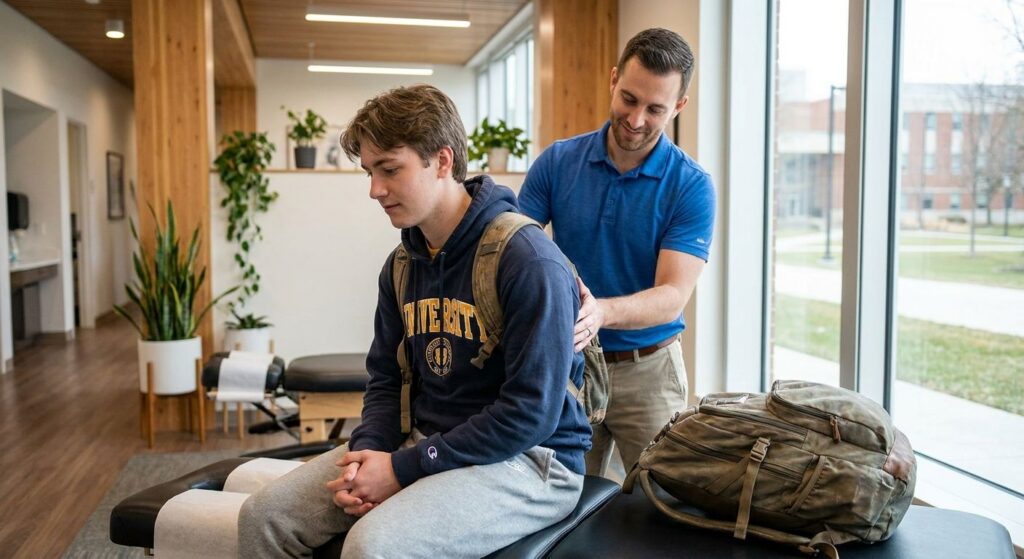
Heavy backpacks show up in Bondi Junction clinics every school term, and the pattern is consistent: rounded shoulders, one-sided strain, and teens who say their bag "just feels normal" now. This guide breaks down what a chiropractor for students backpack pain actually assesses, what's worth prioritising, and what claims to be skeptical of.
- A chiropractor for students backpack pain starts with a postural assessment, not an adjustment on day one.
- Backpack load above roughly 10-15% of body weight is the commonly cited threshold to review with a health professional.
- Scoliosis screening for teenagers should never be skipped or treated as optional if a curve is suspected.
- One-shoulder carrying and single-session ‘quick fixes’ are the two habits worth questioning most in 2026.
Why this matters
Students are carrying more than they used to — laptops, textbooks, sports gear, and drink bottles stacked into one bag worn for hours a day. Growing spines and developing musculature respond differently to sustained load than an adult's does, which is why a generic "see a chiropractor" recommendation isn't specific enough.
The right approach for a teenager carrying 8-10kg to school five days a week in 2026 looks different from the approach for an adult desk worker. Chiropractic care for students experiencing backpack-related discomfort can be discussed with a qualified health professional as part of a broader assessment that includes posture, load distribution, and daily habits — not as a single fix.
Who this guide is for
This is for parents and students in high school or university dealing with shoulder tightness, neck stiffness, or rounded posture that seems tied to how the backpack sits — not for anyone with sudden severe pain, numbness, or an injury from a fall or collision, which needs medical assessment first. If a teenager's discomfort came on gradually alongside a heavier timetable or a new bag, that's the profile this guide addresses.
What to look for in a chiropractor for students backpack pain
A postural assessment before any hands-on care
A proper first visit maps how the student stands, sits, and carries load before anything else happens. Adjustments without this baseline are guesswork, and a clinic that skips straight to hands-on work on visit one is skipping a step that matters for a growing spine.
Experience with adolescent and teenage patients
A spine that's still developing responds differently than an adult's, and screening for scoliosis or growth-related asymmetry needs a practitioner who routinely works with this age group. Chiropractic care for scoliosis in teenagers covers what that screening typically looks for.
Practical, specific backpack advice
Generic "wear it on both shoulders" advice isn't enough — look for guidance on load placement, strap width, waist strap use, and how heavy is too heavy for a given body size. The commonly referenced benchmark is keeping total pack weight to around 10-15% of the student's body weight, a figure worth checking against the student's actual loaded bag on a scale.
A clear line on when to refer out
A chiropractor who explains what symptoms need a GP or specialist referral — numbness, tingling down an arm or leg, or a visible spinal curve — is being upfront about scope. Avoid any provider who implies chiropractic adjustments alone resolve every case without qualification.
Same-day or short-notice availability
Students often flag discomfort right before exams or sport season, so a clinic that can fit an assessment in within a day or two removes a common excuse for putting it off.
Care approaches worth considering
Spinal and postural assessment — the starting point. Every reasonable plan begins here: a check of spinal alignment, shoulder height, and how the student naturally stands under load. Consider this the non-negotiable first step regardless of which clinic a family chooses.
Scoliosis screening — the one not to skip for teens. Adolescent growth spurts are when spinal curves are most likely to be picked up early, and backpack strain can sometimes mask or mimic asymmetry that deserves its own look. Consider following assessment rather than assuming backpack habits explain everything — see chiropractic care for scoliosis in teenagers for what's involved.
Shoulder blade and upper-back exercise guidance — the postural corrector. Rounded shoulders and winged shoulder blades often show up together in students who sit hunched over a desk or bag strap all day. Consider pairing any in-clinic care with the kind of exercises outlined in how to fix winged shoulder blades naturally, since posture work outside the clinic matters as much as the visit itself.
Load and carrying-habit review — borrowed from how tradies manage repetitive strain. The same principles that apply to manual labourers carrying uneven loads apply to a student hauling a lopsided bag five days a week; see chiropractic care for tradies and manual labourers for the parallel. Consider a full audit of what's actually in the bag before assuming the spine is the only variable.
A single adjustment marketed as a standalone solution — the one to question. If a plan is presented as one visit and done, that's a Skip — sustained posture habits built over months don't resolve in a single session, and no provider should imply otherwise.
Book a student posture assessment
Get a spinal and postural check before term ramps up in 2026.
What to avoid
- One-shoulder "trendy" carrying — slinging a bag over one shoulder looks casual but concentrates load unevenly across the spine and shoulders over a school term.
- Backpacks worn low, near the tailbone — this shifts the centre of gravity backward and encourages the forward head lean that shows up as neck stiffness by end of day.
- Any provider promising guaranteed or fast results — genuine assessment takes more than one visit to understand, and claims of instant or guaranteed outcomes aren't consistent with how postural change actually works.
Quick comparison
| Criteria | Why it matters for students | Priority |
|---|---|---|
| Postural assessment first | Establishes baseline before any hands-on care | High |
| Scoliosis-aware screening | Growth spurts are peak detection window | High |
| Backpack load guidance (10-15% body weight) | Directly addresses the daily strain source | High |
| Exercise/homework component | Posture habits need reinforcement outside the clinic | Medium |
| Same-day booking | Reduces delay around exams and sport season | Medium |
FAQ
What does a chiropractor for students backpack pain actually check?
A chiropractor typically starts with a postural and spinal assessment covering shoulder height, spinal alignment, and how the student carries load, before discussing any hands-on care. This baseline is what separates a considered plan from guesswork.
How heavy is too heavy for a school backpack in 2026?
The commonly referenced guideline is keeping total loaded weight to around 10-15% of the student’s body weight. A student weighing 50kg would aim to keep a fully loaded bag under roughly 5-7.5kg, though this is a general benchmark worth checking against individual circumstances.
Is chiropractic care appropriate for teenagers with scoliosis?
Scoliosis screening and monitoring can be discussed with a qualified health professional, and any suspected spinal curve should be assessed properly rather than assumed to be backpack-related. See a chiropractor or GP for a proper evaluation if a curve is visible or suspected.
Can one chiropractic visit fix backpack-related back pain?
No single visit resolves habits built up over months of carrying load a certain way. A realistic plan involves assessment, posture guidance, and follow-up rather than a one-off session.
Should students carry backpacks on one shoulder or two?
Two shoulders, evenly loaded, is the more balanced option — one-shoulder carrying concentrates strain unevenly across the spine over repeated daily use. Waist or chest straps, where available, help distribute load further.
When should backpack-related discomfort be checked by a doctor instead?
Numbness, tingling down an arm, sharp pain after a fall, or a visibly uneven spine all warrant a GP or specialist referral rather than assuming it’s backpack strain. A responsible chiropractor will flag this rather than proceed with routine care.
How often should a student with backpack strain be assessed?
This depends on the individual case and is best discussed directly with the assessing chiropractor, since it varies with symptom severity, school schedule, and how load habits change over the term.
Does the type of backpack matter, not just the weight?
Strap width, back panel support, and whether a waist strap is used all affect how load is distributed, so bag design is worth reviewing alongside total weight. A narrow-strap bag loaded to the same weight as a padded one can feel and sit very differently.
One last thing
The 10-15% body-weight guideline gets quoted often, but almost nobody actually weighs their kid's loaded bag — do that first, on a bathroom scale, before booking anything. It's the single fastest way to know whether the backpack itself is the variable worth fixing before 2026's next school term picks up pace.
Related guides
- Chiropractic care for scoliosis in teenagers
- How to fix winged shoulder blades naturally
- Chiropractic care for tradies and manual labourers
- Chiropractic care for leg length discrepancy and posture imbalance