

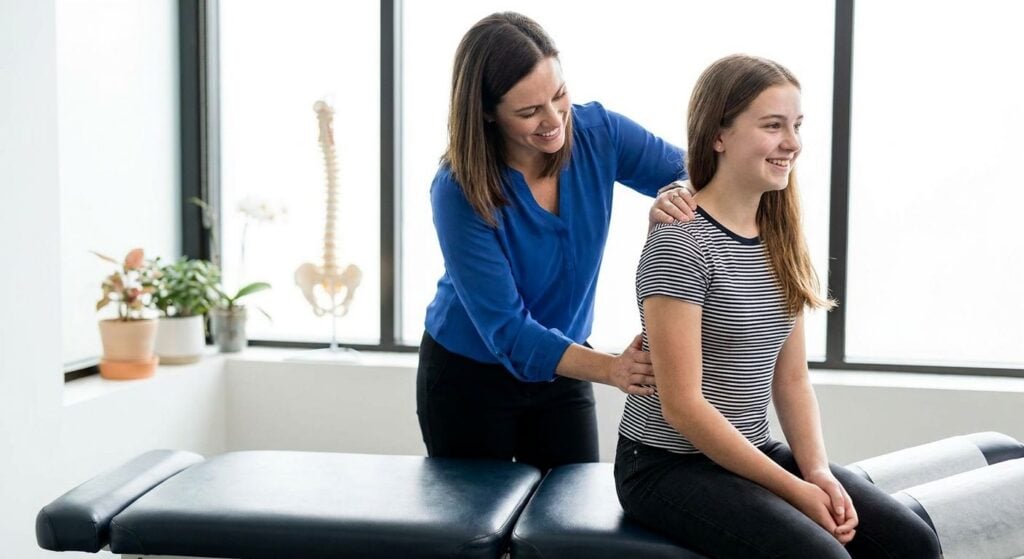
If your teenager has a curved spine flagged at a school screening or by a GP, you're likely trying to work out what kind of care actually helps and what's just noise. This guide breaks down what to look for when researching chiropractic care for scoliosis in teenagers, and where it fits alongside medical assessment.
- A chiropractor for scoliosis teenagers can support posture and general spinal comfort but cannot correct or reverse curvature — GP referral comes first.
- Scoliosis is clinically defined by a Cobb angle above 10 degrees on X-ray, measured by a doctor, not a chiropractor.
- Bracing is typically discussed for curves in the 25-40 degree range and is decided by an orthopaedic team, not a chiropractic clinic.
- MyChiro in Bondi Junction offers assessment-based, adjunct care in 2026 for teens already under medical review — not as a stand-alone scoliosis service.
Why this matters
Scoliosis in adolescents is usually picked up during a growth spurt, often between ages 10 and 15, when curves can change quickly. Getting the sequence right matters: diagnosis and monitoring sit with a GP, paediatrician or orthopaedic doctor using X-ray and Cobb angle measurement, not with a chiropractic assessment alone.
Where chiropractic care can reasonably fit is as a supportive, adjunct option for muscular tension, posture habits or general comfort once a medical diagnosis and monitoring plan are already in place. Any provider suggesting adjustments alone will correct or halt curve progression is overstating what the evidence and the regulatory framework around chiropractic advertising in Australia allow them to say.
Who this guide is for
This is written for parents of teenagers with a suspected or diagnosed spinal curve who want to understand what supportive care looks like, and where the boundaries sit between medical management and musculoskeletal support. It's also useful if your teen has already seen an orthopaedic doctor and you're now looking at what else might help day-to-day comfort during 2026's school term.
What to look for in a provider for a teenager with scoliosis
A clear referral pathway, not a stand-alone diagnosis
A provider working responsibly with adolescent spinal curves should ask whether your teen has already had X-ray imaging and a Cobb angle measurement from a GP or orthopaedic doctor. If a chiropractic clinic offers to diagnose or grade scoliosis itself without pointing you toward imaging, that's a gap, not a convenience.
Willingness to communicate with the medical team
Adolescent scoliosis management often involves a GP, a physiotherapist and sometimes an orthopaedic doctor tracking curve progression over months. Look for a chiropractor willing to align supportive care with that existing plan rather than running a separate, disconnected program.
Realistic framing of what adjustments can and can't do
Chiropractic adjustments address joint mobility and associated muscle tension. They are not described, in current evidence, as a way to reduce Cobb angle or reverse structural curvature. A provider who talks in terms of comfort, posture habits and mobility — rather than correction — is giving you an accurate picture.
Experience with growing spines
Adolescent spines are still developing, and growth-related changes differ from adult presentations. A provider who routinely sees teenagers and understands growth-spurt timing is better placed to flag when something needs to go back to the GP.
A home exercise and posture component
Supportive musculoskeletal care for teens usually pairs any in-clinic work with posture habits, movement breaks and simple exercises to do at home — not a series of appointments with no self-management piece attached.
Straightforward, non-alarmist communication
A parent should leave a consultation with clear next steps, not a sense of urgency designed to book more visits. Ask how the clinic explains findings and what the plan looks like if nothing changes over the next few months.
leg length discrepancies and pelvic imbalance sometimes get raised alongside adolescent posture concerns, and it's worth understanding how that differs from structural scoliosis before assuming either explains your teen's presentation.
Care pathway options, compared
The essential first step — GP or paediatrician screening. This is where any suspected curve should start. A GP can assess posture, check for asymmetry and refer for imaging if needed. Verdict: Book first.
The diagnostic confirmation — orthopaedic assessment and X-ray. Cobb angle measurement on standing X-ray is the accepted way to confirm and grade a curve; under 10 degrees typically doesn't meet the clinical threshold for scoliosis, while curves in the 25-40 degree range are where bracing conversations usually happen. Verdict: Discuss with your GP.
The supportive adjunct — chiropractic assessment for associated tension and posture. Once a diagnosis and monitoring plan exist, some families explore chiropractic care for general spinal comfort, joint mobility and posture habits alongside the medical plan. Verdict: Consider, following assessment.
The home program — posture and movement habits. Simple daily changes, desk setup, screen-time breaks and light strengthening work, support whatever plan a GP or physiotherapist has set. Verdict: Consider.
The stand-alone "correction" claim — any provider promising to reverse or fix curvature through adjustments alone. This oversteps what a chiropractic assessment can establish or deliver for structural scoliosis. Verdict: Skip.
Book an assessment at MyChiro
Supportive spinal care in Bondi Junction, alongside your teen’s existing medical plan.
What to avoid
- Clinics that skip imaging entirely. Posture screening in a chiropractic clinic is not a substitute for X-ray-confirmed Cobb angle measurement when a curve is suspected.
- Language promising correction or reversal. No adjustment-based program has been shown to correct structural curvature — treat that claim as a red flag, not reassurance.
- Long fixed-term "treatment plans" sold before assessment. A responsible provider assesses first and adjusts recommendations based on findings, rather than committing you to a lengthy package upfront.
Verdict comparison table
| Option | Role | When it applies | Verdict |
|---|---|---|---|
| GP or paediatrician screening | Initial detection | First sign of asymmetry or school screening flag | Book first |
| Orthopaedic X-ray and Cobb angle | Diagnosis and grading | Suspected curve needs confirming | Discuss with your GP |
| Chiropractic supportive care | Comfort, mobility, posture habits | After medical diagnosis and monitoring plan exist | Consider, following assessment |
| Home posture and exercise habits | Daily self-management | Ongoing, alongside any plan | Consider |
| "Correction" claims from any provider | None supported by evidence | Never a stand-alone basis for care | Skip |
Postural habits also come up outside scoliosis specifically — teens who round their shoulders forward at a desk sometimes develop winged shoulder blades from weak scapular stabilisers, which is a separate issue worth ruling out during any posture assessment.
FAQ
Can a chiropractor for scoliosis teenagers fix the curve?
No — chiropractic adjustments have not been shown to correct or reverse structural spinal curvature. Diagnosis, grading and management of scoliosis, including bracing decisions, sit with a GP or orthopaedic doctor following X-ray assessment.
What Cobb angle counts as scoliosis?
A curve is generally classed as scoliosis once it measures above 10 degrees on a standing X-ray Cobb angle measurement. Below that threshold, mild asymmetry is common and often doesn’t require active management.
When is bracing considered for teenagers?
Bracing conversations typically happen for curves in the 25 to 40 degree range in a still-growing adolescent, decided by an orthopaedic team. This is a medical decision, not something a chiropractic assessment determines.
Is chiropractic care for scoliosis teenagers safe alongside orthopaedic monitoring?
Whether supportive chiropractic care is appropriate alongside an existing monitoring plan should be discussed with your teen’s treating doctor first. Coordination between providers matters more than any single modality.
Should my teen see a physiotherapist or a chiropractor first?
Neither replaces the GP or orthopaedic step needed to diagnose and grade a curve. Once that’s done, either can be discussed as part of a supportive, posture-focused plan.
Does posture cause scoliosis?
Most adolescent idiopathic scoliosis has no single identified cause and isn’t explained by slouching or backpack weight alone. Posture habits can still affect comfort and are worth addressing separately from the underlying curve.
How often should a teenager’s curve be checked?
Monitoring frequency during growth spurts is set by the treating GP or orthopaedic doctor based on curve size and the teen’s growth stage, often every four to six months during rapid growth. That schedule shouldn’t be replaced by chiropractic visits alone.
What does a chiropractic assessment for a teenager with scoliosis actually involve?
It typically involves a postural and mobility assessment, a review of any existing imaging or medical reports, and a conversation about realistic, comfort-focused goals. It is not a substitute for orthopaedic diagnosis.
One last thing
Most mild curves picked up through school screening in 2026 sit below the thresholds where bracing or surgery ever get discussed, and many stabilise as growth slows. That's not a reason to skip the GP visit — it's a reason to get the actual number (the Cobb angle) rather than guessing from how a shoulder or hip looks in a mirror.
Related guides
- How to fix winged shoulder blades naturally
- Chiropractic care for new mums after birth
- Chiropractic care for gym goers and weightlifters


