


There is no single rest period that applies to everyone after a chiropractic adjustment; follow the instructions given after your individual assessment rather than a fixed online timetable. Your symptoms, any activity restrictions and the demands of your day should guide the plan, and new or worsening symptoms need advice rather than simply more rest.
- How long to rest after a chiropractic adjustment depends on your assessment and individual aftercare instructions.
- Ask about work, exercise and driving before leaving; these activities place different demands on you.
- Mychiro provides chiropractic care in Bondi Junction; discuss individual aftercare with the practitioner who assessed you.
- New or worsening symptoms need appropriate advice, not an automatic extension of your rest period.
How long should you rest after an adjustment?
Use an individual aftercare plan, not a universal countdown. A recommendation to pause one activity does not automatically mean you need to avoid all movement, stay in bed or take the day off work.
The useful question is not just how long to rest after a chiropractic adjustment. Ask what you should change, what you can continue and what would require another assessment. If discomfort is your main concern, the related guide on soreness after an adjustment addresses that separate question.
Before leaving your appointment, clarify the following:
- Confirm the plan. Ask whether you have any individual restrictions and why they apply.
- Describe your activities. Mention driving, lifting, exercise and work rather than asking only whether to rest.
- Agree on review. Ask when to reassess a restriction and whom to contact if symptoms change.
- Check warning signs. Make sure you understand which symptoms require medical attention instead of waiting.
For your 2026 aftercare plan, record the advice in words you can use at home. A vague instruction to take it easy needs clarification, particularly if your next task involves physical work or responsibility for others.
Why this matters
Rest can mean sitting briefly, changing a demanding task, postponing training or staying in bed. Those are different decisions. Without a clear explanation, you can leave an appointment unsure whether ordinary activities are permitted.
General information cannot determine whether your symptoms need examination or whether a particular activity is appropriate for you. This page explains the questions to ask; it does not provide medical clearance, diagnose a reaction or replace instructions based on an assessment.
The goal is a usable plan. You should know what to do, what to avoid if advised, and what would change that advice.
Rest, modified activity and usual activity are different choices
An aftercare discussion should distinguish between a complete pause and a change to one task. Ask your practitioner which approach applies to you rather than choosing the most restrictive option by default.
| Approach | When to discuss it | Practical advantage | Limitation |
|---|---|---|---|
| A pause from a particular task | You have been advised to avoid that task or symptoms interfere with it | Makes the restriction specific | Does not explain when you can restart unless review advice is included |
| Modified activity | A task can be changed in line with your assessment | Lets you discuss a workable alternative | Still needs clear limits; lighter does not automatically mean appropriate |
| Usual activity | You want to confirm whether ordinary plans can continue | Removes uncertainty about daily tasks | Is not clearance for every sport, load or work demand |
| Medical assessment | Symptoms are new, concerning or worsening | Allows a clinician to assess the change | Cannot be replaced by a rest timetable or an online guide |
Choose the approach that matches your assessment, not the one that sounds most cautious or most convenient. If instructions conflict with advice from another clinician, ask the clinicians to clarify the plan before you proceed.
Why aftercare advice varies
Your description of the appointment and your plans matters more than a generic waiting period. These are useful topics for an individual discussion, not a formula for calculating recovery time:
- Current symptoms: Explain what you feel now and whether it differs from before the appointment.
- Assessment findings: Ask which findings, if any, affect your activity advice.
- The procedure performed: Ask whether the specific adjustment has any relevant aftercare instructions.
- Existing health advice: Tell the practitioner about restrictions or recommendations from other health professionals.
- Activity demands: Describe the actual task, including lifting, repetitive work, driving or contact sport.
- Changes afterwards: Ask what to do if symptoms appear, worsen or affect a different area.
Avoid translating someone else's experience into your own instructions. A friend returning to training immediately, or choosing to rest for the day, does not establish what is appropriate for you.
Make your aftercare instructions practical
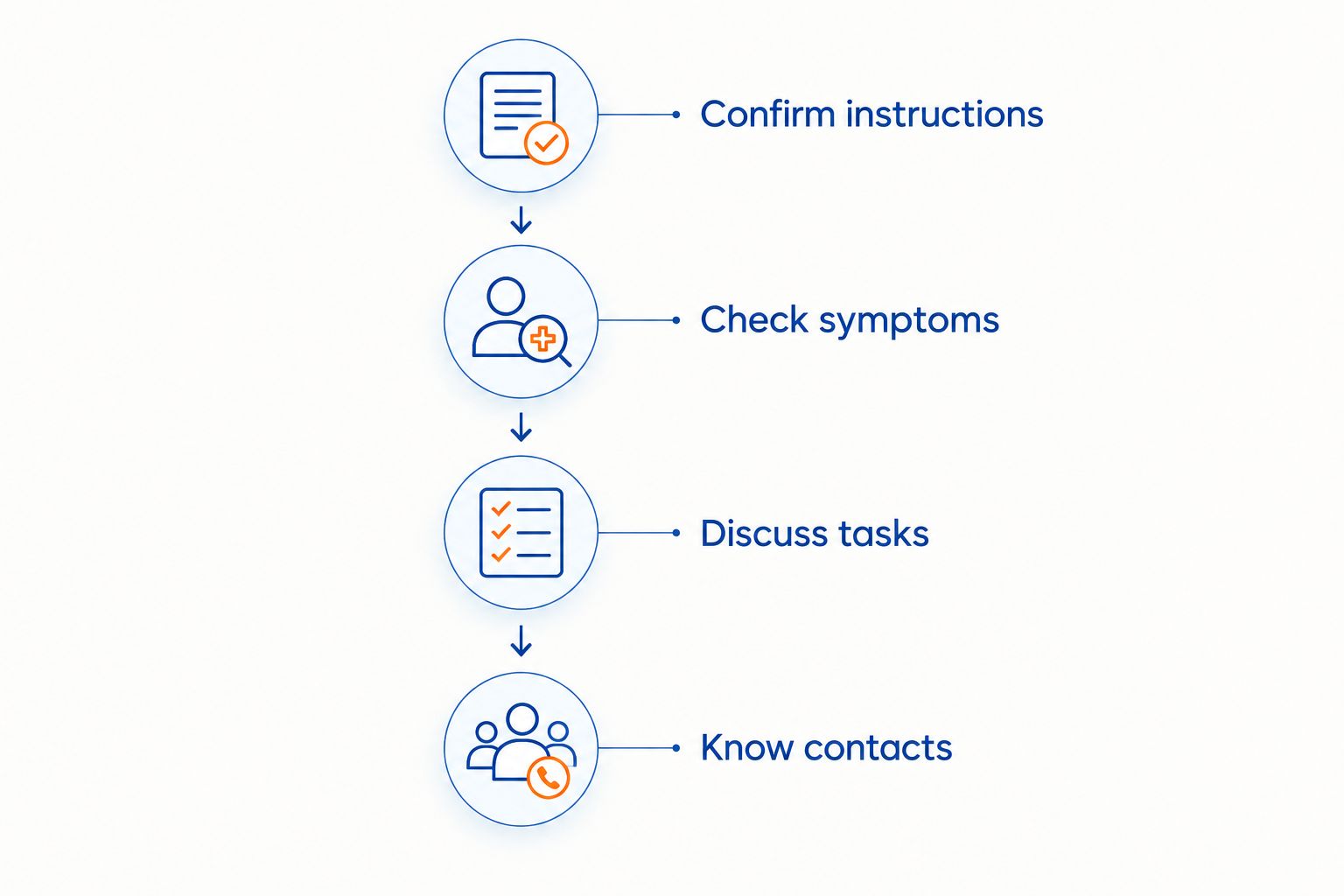
A useful plan connects the appointment to the rest of your day. Before leaving, work through the sequence below and ask for clarification wherever the answer is unclear.
- Confirm instructions: Repeat back any restriction in your own words.
- Check symptoms: Describe anything new before you leave.
- Discuss tasks: Name the activities you have planned.
- Know contacts: Identify whom to contact for routine questions and when medical care is needed.
Written instructions can help you remember the discussion. They should be specific enough to distinguish an ordinary aftercare question from a symptom that needs assessment.
If an instruction has no endpoint, ask what determines review. That might involve reassessment rather than simply waiting for a date. Do not interpret an unclear instruction as permission to test your limits.
Can you return to work after an adjustment?
Returning to work is an individual activity decision, not something an adjustment automatically permits or rules out. Describe your duties and ask whether any assessed restriction affects them.
A desk-based role and a job involving lifting, climbing or operating machinery raise different practical questions. Even within one role, you might need to discuss a particular task rather than the entire working day.
For a practical 2026 work plan, ask:
- Does any restriction apply to my actual duties?
- Do I need to discuss modified tasks with my employer?
- If documentation is needed, who can assess and provide it?
- What should I do if symptoms change during the shift?
Avoid promising your employer an unrestricted return based only on how you expect to feel. Equally, do not assume you need leave solely because an appointment took place.
Can you exercise after a chiropractic adjustment?
Exercise advice should reflect your assessment and the activity you intend to perform. Ask about the actual session rather than using the broad word exercise.
Walking to the shops, resistance training and contact sport are not interchangeable activities. Tell the practitioner what your session involves, whether you already have symptoms during it, and whether another clinician has set restrictions.
An adjustment is not, by itself, clearance to return to sport or increase training. Feeling different afterwards does not answer every question about exercise readiness.
If your 2026 training plan includes rehabilitation exercises, ask whether to continue the existing prescription or seek clarification from the clinician who prescribed it. Do not add stretches, spinal movements or self-manipulation simply because they appear in a general aftercare article.
Can you drive home after an adjustment?
Driving depends on your ability to operate the vehicle and respond to traffic, alongside any relevant clinical advice. Ask before leaving if symptoms or movement limitations concern you.
Do not drive if you feel dizzy, faint, visually disturbed or otherwise unable to control the vehicle. Arrange another way home and obtain appropriate advice rather than using the journey to see whether the symptoms settle.
The length of the drive is also useful information for your practitioner. Mention it during the aftercare discussion rather than assuming advice about ordinary daily activity covers a long journey.
What if you feel sore or different afterwards?
A change in symptoms deserves a clear description, not an automatic label. Do not assume discomfort proves that an adjustment worked, that your body is detoxing or that another adjustment is required.
When asking for advice, explain where the symptom is, when it started, whether it is worsening and what it stops you doing. Also mention any symptoms that were not present before the appointment.
The NHS information page on chiropractic describes possible short-lived side effects, including soreness, and also discusses risks. That general information cannot establish the cause or significance of your individual symptoms.
For a 2026 symptom note, record the sequence without guessing the explanation: what happened before the appointment, what changed afterwards and what you noticed during ordinary activities. Persistent, worsening or concerning symptoms need assessment rather than reassurance from a timetable.
When should you seek medical help instead of resting?
Some symptoms require urgent medical attention, whether or not they occur after an adjustment. Do not wait for a routine clinic reply if you think you are experiencing a medical emergency.
Call 000 in Australia for signs of a possible stroke, including sudden facial drooping, arm weakness or speech difficulty. Sudden severe headache, collapse or other serious symptoms also warrant urgent medical attention.
Seek emergency assessment for new loss of bladder or bowel control, numbness around the genitals or buttocks, or marked or worsening limb weakness, particularly alongside back pain. These are not symptoms to manage by extending a rest period.
Healthdirect Australia's information on stroke and back pain explains these warning signs in a general medical context. Their inclusion here is referral advice, not a suggestion that chiropractic care can manage those conditions.
If the situation is not an emergency but you are unsure about a symptom, contact an appropriate health professional for guidance. Do not use this article to decide that a new symptom is harmless.
Discussing aftercare at Mychiro
Mychiro is a chiropractic clinic and wellness centre in Bondi Junction, Sydney, offering chiropractic care and spinal adjustments. If you attend Mychiro, ask the practitioner who assessed you to explain any individual aftercare instructions before you leave.
Bring the discussion back to your own plans: work, travel, exercise and existing clinical advice. A clinic's location or service description cannot establish the appropriate rest period for an individual patient.
FAQ
How long do I need to lie down after a chiropractic adjustment?
There is no universal lying-down period to apply after every adjustment. Ask whether your individual assessment requires any restriction and what that restriction involves.
Do I need to take the whole day off work?
An adjustment does not automatically determine whether you need a day off work. Discuss your actual duties, current symptoms and any individual restrictions with the practitioner who assessed you.
Can I go to the gym after my appointment?
Ask about your planned gym session before proceeding, especially if you have symptoms or existing exercise restrictions. An adjustment alone is not clearance for unrestricted training.
Should I rest until any soreness disappears?
Do not use soreness alone to set an open-ended rest period. Ask for advice about the symptom, appropriate activities and when reassessment is needed.
Does feeling sore mean the adjustment worked?
Soreness does not establish that an adjustment produced a clinical benefit. Describe new or changing symptoms to a qualified health professional rather than assigning them a reassuring explanation.
Should I book another adjustment if I still feel uncomfortable?
Ongoing discomfort does not automatically mean another adjustment is appropriate. Discuss the symptoms and whether reassessment or another form of medical care is needed.
What symptoms mean I should get urgent medical help?
Sudden facial drooping, arm weakness or speech difficulty require an emergency response; call 000 in Australia. New bladder or bowel dysfunction, numbness around the genitals or buttocks, or marked worsening weakness also require emergency assessment.
One last thing
Ask for an activity instruction, not just a rest duration. Knowing whether you should change a particular task is more useful than leaving with an unexplained number of hours.
For your next appointment in 2026, write down the activity you are most concerned about before you arrive. A specific question about your shift, drive or training session gives the aftercare discussion a practical focus without assuming that every patient needs the same restrictions.
Related guides
- How long does a chiropractic adjustment take?
- What to expect from spinal manipulation
- How to prepare for your first chiropractor appointment