
A sports chiropractor cannot promise to speed up your recovery simply because they work with athletes. Whether chiropractic care is appropriate depends on an assessment of your symptoms, health history and activity goals. An adjustment is not, by itself, clearance to resume training or competition.
- Can a sports chiropractor speed up recovery? The title alone does not establish faster recovery or readiness for sport.
- Mychiro provides chiropractic care in Bondi Junction; individual suitability requires assessment, not an assumed recovery benefit.
- Ask about the proposed care, its risks, alternatives and how progress will be reviewed.
- Keep symptom changes, rehabilitation goals and return-to-sport decisions separate.
Can a sports chiropractor speed up recovery?
Do not interpret “sports chiropractor” as a promise of shorter recovery time. Ask what the practitioner proposes for your particular concern, what evidence supports that proposal and which outcome they intend to assess. A claim about pain is different from a claim about tissue healing, training capacity or time away from sport.
Before comparing services in 2026, check the individual practitioner's registration and stated qualifications. The guide to qualifications to check when choosing a chiropractor provides questions to take into that conversation.
The following distinctions help you ask a more precise question:
| What you mean by recovery | What to ask about | What not to assume |
|---|---|---|
| Symptoms | Which symptoms will be reviewed, and how? | Feeling different means an injury has healed |
| Everyday function | Which daily activities are relevant to assessment? | Managing daily activities means you are ready for competition |
| Training capacity | Which sport-specific demands need consideration? | An adjustment establishes training readiness |
| Return to competition | Who will assess readiness and coordinate advice? | A booking or treatment schedule determines your return date |
A useful consultation should make these distinctions clearer. You do not need to accept a broad recovery claim when your actual question concerns a particular movement, training session or competition.
Why this matters
“Recovery” can describe several different goals. If you and your practitioner use the same word for different things, you can leave an appointment without understanding what the proposed care is intended to address.
For your 2026 training plan, write down the activity you want to return to and the question you need answered. “What should be assessed before I resume running?” is more useful than “Can you get me back quickly?” It invites a discussion about assessment rather than an outcome promise.
This article is general education, not an individual diagnosis, rehabilitation programme or clearance to participate in sport. New symptoms after an injury belong in an assessment with an appropriate health professional, rather than an online recovery timetable.
What should an assessment clarify before care begins?
An assessment should be a conversation about your situation, not an automatic pathway to adjustments. Bring existing medical advice, relevant reports and details of any care already underway. Ask the practitioner to explain what remains uncertain.
Describe your concern
Explain what you noticed, when you noticed it and which activities matter to you. Distinguish symptoms during everyday tasks from symptoms during training. If there was a fall, collision or other injury, say so before discussing hands-on care.
You do not need to arrive with a diagnosis. Describe your experience in your own words rather than selecting a label from a website.
Discuss the assessment
Ask what the assessment involves and what the findings can establish. You can also ask whether another practitioner, medical assessment or referral should come before a decision about chiropractic care.
A useful question is: “What would make chiropractic care inappropriate in my situation?” This gives you information that a list of possible benefits does not.
Compare care choices
If care is proposed, ask about its purpose, material risks and alternatives. Ask what choosing not to proceed would mean in your circumstances. Consent is a decision about a particular intervention, not blanket agreement to everything offered at a clinic.
Agree review points
Ask how the proposed plan will be reviewed and what would prompt a change. The review should address your stated goals, not simply whether you attended the scheduled appointments.
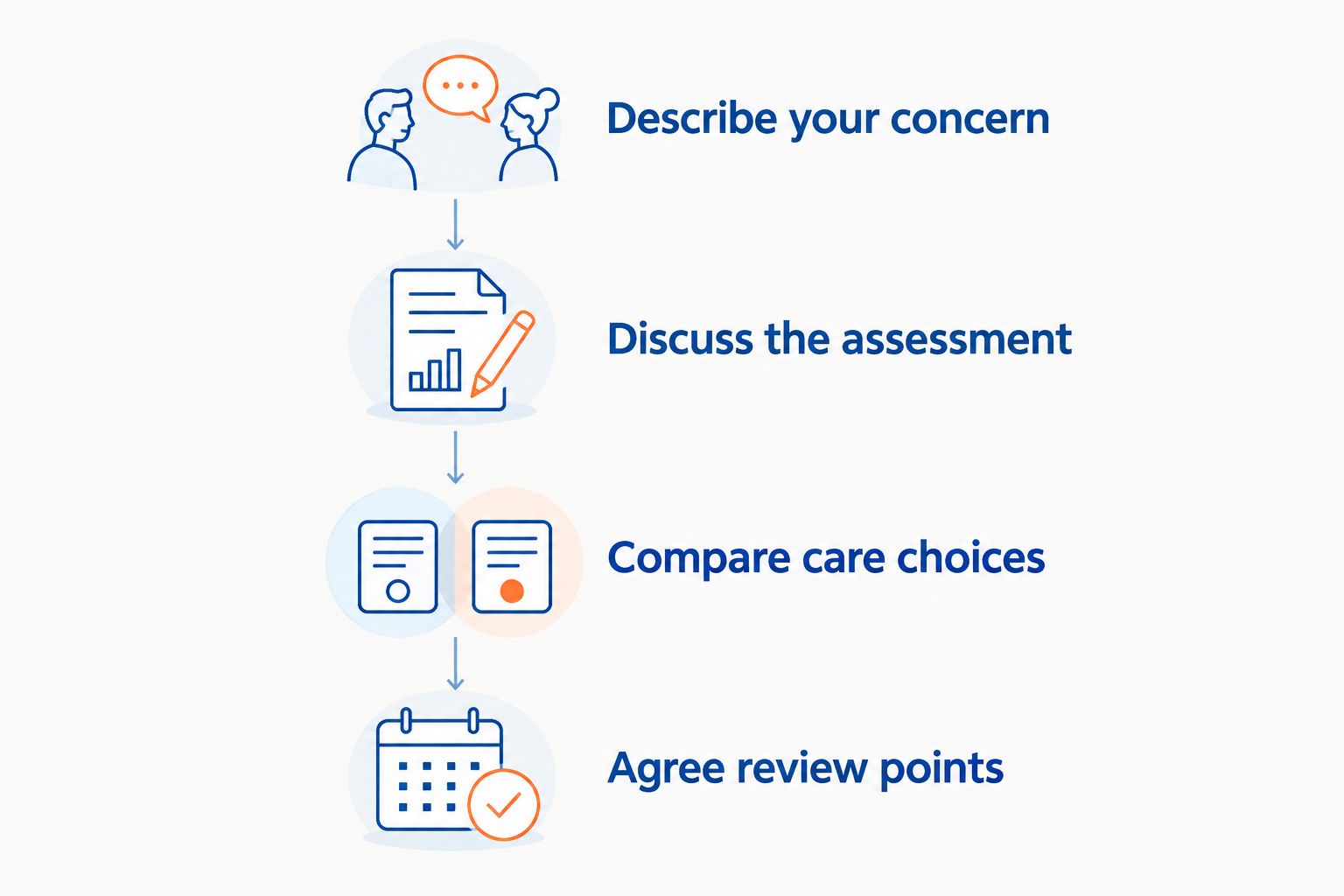
These questions are useful whether you are considering your first appointment or reviewing an existing plan. You can request a clearer explanation before deciding whether to proceed.
How do adjustments, rehabilitation and medical assessment differ?
Ask what each part of a proposed plan is for. Different services can have different purposes, and an appointment with one practitioner does not answer every question about an injury or return to sport.
This comparison describes discussion points, not a ranking of professions or a recommendation for your individual circumstances.
| Option to discuss | Purpose to clarify | Potential practical advantage | Limitation to discuss |
|---|---|---|---|
| Chiropractic assessment and proposed adjustments | Why a particular intervention is being considered | An opportunity to discuss the proposed chiropractic care directly | Does not automatically establish a recovery date or sporting clearance |
| Individual rehabilitation planning | Which activities and goals the plan addresses | Provides a framework for discussing activity progression | Requires individual assessment; an online exercise list is not equivalent |
| GP or sports medicine assessment | Whether medical evaluation or referral is needed | Provides a route for discussing medical concerns and further assessment | Does not replace every rehabilitation or sport-specific discussion |
| Coordination between practitioners | Who is responsible for each part of the plan | Makes responsibilities and advice explicit | Requires communication and your consent to share relevant information |
If several practitioners are involved, ask who is coordinating advice. Tell each practitioner about the others and ask how conflicting recommendations will be resolved. You should not have to guess which instruction takes priority.
Avoid choosing care solely because a technique sounds athletic or a practitioner works near your training venue. The relevant questions concern your assessment, the proposed intervention and the explanation you receive.
Why recovery advice varies between people
An individual plan requires individual information. These are discussion topics to bring to an assessment, not a formula for predicting how quickly you will recover:
- The concern being assessed: Ask what is known, what is uncertain and whether further assessment is needed.
- Your health history: Describe previous injuries, relevant conditions, medicines and existing clinical advice.
- Your activity goal: Explain whether you want to manage everyday tasks, resume modified training or return to competition.
- Your current schedule: Bring details of training, work demands and other commitments so advice can be discussed in context.
- Your response to the plan: Agree which changes, difficulties or new symptoms should trigger a review.
Do not turn these topics into a self-diagnosis checklist. Their purpose is to improve the conversation with a qualified health professional.
A competition date is useful context, but it is not clinical evidence of readiness. In 2026, as with any training season, ask the practitioner to distinguish the date you hope to return from the criteria they recommend assessing.
How should you judge a faster-recovery claim?
Start by asking what “faster” is being compared with. Then ask which outcome was measured and whether the evidence applies to people with your assessed concern. A general statement about chiropractic care does not explain an individual prognosis.
Useful questions include:
- What specific benefit are you proposing in my situation?
- What evidence supports that particular claim?
- Does the evidence concern symptoms, function or return to sport?
- What are the risks and alternatives?
- What would lead you to change or stop the proposed care?
Ahpra's advertising guidance and the National Law address misleading advertising, unreasonable expectations and encouragement of unnecessary health-service use. Apply that same practical scrutiny to recovery promises you encounter in 2026: ask for an explanation, not a guarantee.
A testimonial does not answer these questions. Another person's account cannot establish whether an intervention is appropriate for you or predict your recovery timeline.
Can I return to training if I feel different after an adjustment?
A change in how you feel after an adjustment does not, by itself, establish readiness for training. Ask the practitioner responsible for your care what activities are appropriate and what needs review before you progress.
Make the question specific to your sport. Running, lifting, tackling and competing involve different demands; “Can I exercise?” leaves too much unexplained. Describe the session you intend to do rather than asking for general permission.
Ask for clarification if your instructions are vague. You should understand what activity is being discussed, which limits apply and whom to contact if you have concerns.
How many appointments would I need before returning to sport?
A fixed number of appointments cannot establish your return-to-sport date without individual assessment. Ask why each proposed appointment is needed, when the plan will be reviewed and how the review relates to your activity goals.
Do not confuse the duration of an appointment, the length of a care plan and the time required before resuming sport. They answer different questions. A calendar of visits should not be presented as proof that recovery will occur on schedule.
For a 2026 event, discuss the event's demands and any existing medical advice before agreeing to a plan. Avoid treating a prepaid package or recurring booking as a clinical milestone.
When should I seek medical assessment instead?
Seek emergency medical help for symptoms such as new loss of bladder or bowel control, numbness around the groin or rapidly worsening limb weakness. Healthdirect's back-pain guidance identifies these as reasons for urgent medical attention. In Australia, call 000 for a medical emergency.
After a significant collision, fall or suspected head or spinal injury, seek medical assessment rather than assuming an adjustment is appropriate. Tell the assessing clinician how the injury happened and describe any new symptoms.
This is not a complete list of warning signs. If you are unsure about the urgency of your symptoms, contact a medical service for advice rather than using this article to decide whether to continue playing.
Where does Mychiro fit into this decision?
Mychiro is a chiropractic clinic and wellness centre in Bondi Junction, Sydney, offering chiropractic care and spinal adjustments. That service description does not establish that an individual athlete will recover faster.
Mychiro is a local chiropractic care option for people seeking an assessment-based discussion, not a promised sporting recovery date. Ask about the proposed care, its risks and alternatives, and whether coordination with your existing practitioners is appropriate.
There is no need to turn every training concern into an appointment. Start with the clinical advice you already have and clarify any unanswered questions about your next step.
FAQ
Can a sports chiropractor speed up recovery from a sports injury?
A sports chiropractor cannot promise faster recovery based on the title alone. Whether chiropractic care is appropriate requires individual assessment and a discussion of the evidence for the proposed care.
Does feeling different after an adjustment mean I can play sport?
Feeling different after an adjustment does not, by itself, establish readiness to play sport. Ask the practitioner responsible for your care what needs assessment before you return.
How many chiropractic appointments do athletes need?
There is no appointment count that establishes recovery for every athlete. Ask why visits are proposed, when the plan will be reviewed and what would prompt a change.
Should I tell my chiropractor that I already see a physiotherapist?
Yes, tell your chiropractor about your existing care and advice. Ask how recommendations will be coordinated and give consent before relevant information is shared.
What should I ask before agreeing to an adjustment?
Ask why the adjustment is proposed, what benefit is expected in your circumstances, and what risks and alternatives apply. You can request clarification before deciding whether to proceed.
Does Mychiro offer chiropractic care in Bondi Junction?
Mychiro offers chiropractic care and spinal adjustments in Bondi Junction, Sydney. Whether that care is appropriate for your concern requires assessment; a service listing does not establish a recovery outcome.
One last thing
Before your next consultation, write down this question: “What would make you change the plan?” The answer helps you understand how the practitioner will respond to uncertainty, a lack of progress or a concern outside their scope. That is more useful than a promised recovery date.
Related guides
- How to prepare for your first chiropractor appointment
- What to expect from spinal manipulation
- How chiropractic care and physiotherapy can be discussed in one plan