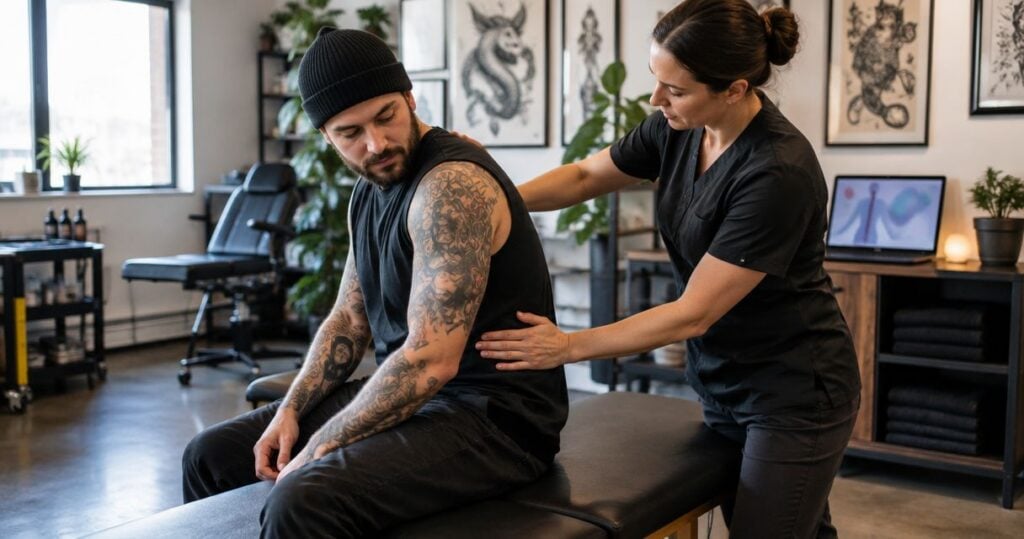
Tattoo artists’ chiropractic care is an assessment-based healthcare option for discussing musculoskeletal concerns with the aim of making informed decisions about care and work demands. This 2026 guide explains what to ask a chiropractor for tattoo artists, how to review your studio setup, and when medical assessment takes priority.
- Choose a chiropractor for tattoo artists by assessment, consent and referral practices—not promises about posture or pain.
- Mychiro is a Bondi Junction chiropractic clinic for local adults considering chiropractic care.
- Review tattooing positions, equipment placement and session scheduling before assuming you need hands-on care.
- Chiropractic adjustments may be appropriate following assessment; they are not a prerequisite for working as a tattoo artist.
Why chiropractic care matters for tattoo artists
Tattooing combines close visual work with precise hand movements and client positioning. Your working arrangement must accommodate the tattoo location, access to equipment and infection-control requirements—not simply resemble an office workstation.
A search for a chiropractor for tattoo artists should therefore lead to questions about your actual work, rather than an occupation-specific promise. Being a tattoo artist does not establish a diagnosis or mean that adjustments are appropriate.
Mychiro is a Bondi Junction chiropractic clinic for local adults considering chiropractic care. Mychiro offers chiropractic care and spinal adjustments; whether either is appropriate for you requires an individual assessment.
The practical starting point for your 2026 review is to separate three questions: what happens during tattooing, what changes you can make at work, and whether a health professional needs to assess your symptoms. Keep those questions separate from claims that a particular posture needs correcting.
Review your work and care options in seven steps
1. Record what happens during a working day
Start with a short written record rather than buying equipment or choosing a procedure. Describe the task you were doing when discomfort appeared, including the tattoo location, your position and whether you were also drawing, cleaning or handling supplies.
For example, compare 3 working shifts as an observation exercise—not as a waiting period before seeking medical advice. Record comfortable periods too. A useful account explains the work without diagnosing the cause or assuming that every symptom comes from tattooing.
Keep client identities and images out of your notes. You need information about your own working arrangement, not a record of someone’s tattoo or health details.
- Note the task and approximate time symptoms appeared.
- Describe where you noticed discomfort in plain language.
- Record seated, standing and reaching tasks separately.
- Include activities outside the studio that seem relevant.
- Record any change that made you stop working.
2. Review your setup before purchasing replacements
Use your existing chair, bed, lighting and equipment positions to examine how you reach the working area. Check what can be adjusted without compromising client support, equipment stability or your studio’s hygiene procedures.
Take 2 setup photographs without clients or identifying details: one from the side and one showing equipment placement. These are discussion aids, not a posture assessment or a way to diagnose a spinal problem.
Change the arrangement before assuming you need a new chair. A replacement deserves consideration only after you identify what the current equipment cannot accommodate. No chair label establishes that a product will address your symptoms.
- Check whether the working area is clearly visible.
- Review the position of supplies you reach for repeatedly.
- Check whether your seat and client support are adjustable.
- Identify cables or furniture that restrict repositioning.
- Preserve clean and contaminated zones when making changes.
3. Prepare questions for an individual assessment
If you choose to discuss chiropractic care, bring your work notes and setup photographs. Explain what matters to you: completing particular tasks, understanding symptoms, or deciding whether another healthcare professional should assess you.
Start preparation yourself with a brief symptom history. An appointment provides an opportunity to discuss that history with a practitioner, but it should not be presented as a shortcut to a guaranteed outcome. Mychiro offers chiropractic care in Bondi Junction; its location and services do not establish suitability for an individual artist.
Use the first chiropractor appointment preparation guide to organise your questions. For a 2026 appointment, bring current information rather than relying on an old account of your work or health.
- Describe when symptoms began and how they have changed.
- List relevant health conditions, medicines and previous care.
- Explain the tasks you cannot currently do comfortably.
- Ask what the assessment is intended to clarify.
- Ask when referral to another practitioner would be appropriate.
4. Agree on decisions before any hands-on procedure
Ask the practitioner to explain the assessment findings in language you understand. A proposal for chiropractic adjustments should include the reason for recommending them, relevant risks, alternatives and the option not to proceed.
You do not need to accept a procedure simply because you booked a consultation. Chiropractic adjustments may be appropriate following assessment, but an occupational label does not establish a clinical indication.
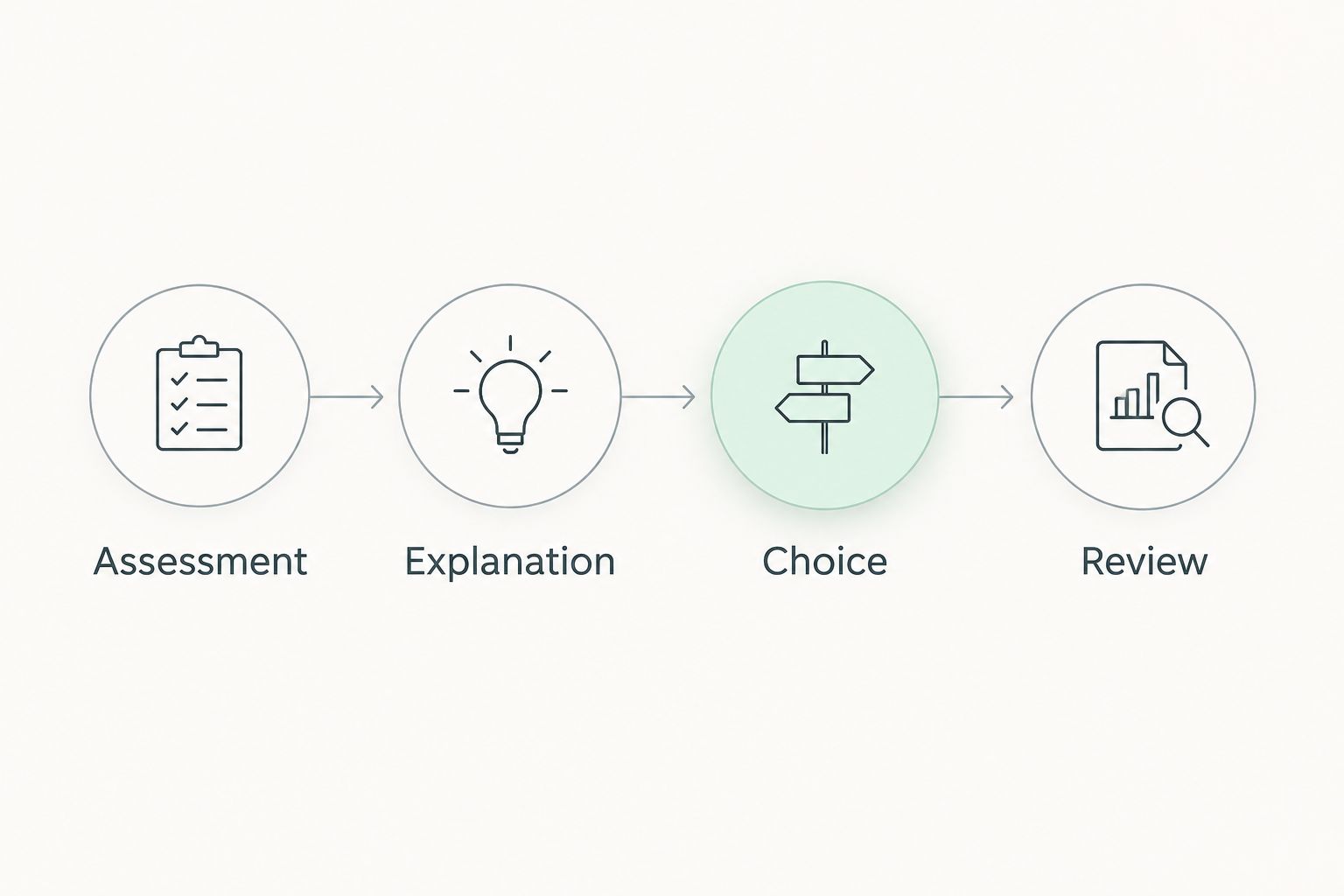
For your 2026 care discussions, keep the decision process visible: assessment, explanation, choice and review. This is a conversation structure, not a promise about what care will achieve or how quickly symptoms will change.
- Ask what the proposed procedure involves.
- Ask what evidence supports it for your circumstances.
- Discuss relevant risks and uncertainties.
- Ask about alternatives, including no hands-on procedure.
- Agree on how and when the decision will be reviewed.
The decision sequence below is about informed participation. It does not place adjustments at the end of every assessment or assume that ongoing appointments are needed.
5. Plan work changes around studio procedures
Begin with scheduling and setup decisions you control. Look for opportunities to reconsider your position between tasks, rather than trying to hold one prescribed posture throughout every tattoo.
Discuss proposed changes with your studio manager or colleagues where shared equipment and procedures are involved. Repositioning must still respect client consent, access to the tattoo area and infection-control requirements. Do not improvise supports or move contaminated items into clean areas for convenience.
If symptoms are affecting your ability to perform precise work, discuss that limitation with a qualified health professional. A generic break schedule or online exercise list is not an individual fitness-for-work assessment.
- Review setup time before the client is positioned.
- Identify natural pauses for checking your arrangement.
- Discuss adjustable equipment with the person responsible for it.
- Keep repositioning consistent with studio hygiene procedures.
- Record which changes were practical and which were not.
6. Separate exercise education from personal advice
Start by listing what you already do outside tattooing, including exercise, drawing and other hand-intensive activities. If you want an exercise programme, discuss your symptoms, preferences and work demands with a qualified health professional rather than assembling a routine from unrelated videos.
Online material about stretches for neck pain addresses a symptom category; it does not establish why a particular tattoo artist has symptoms or which movements suit that person. Use that distinction when deciding what questions to bring to an assessment.
Keep your 2026 exercise notes separate from assumptions about diagnosis. Terms such as nerve pressure, misalignment or muscle imbalance should not become your explanation merely because they appear in a search result.
- Describe your current activity rather than guessing what is missing.
- Ask whether an exercise recommendation fits your assessment.
- Request clear instructions for any individually advised movement.
- Ask what symptoms should prompt you to stop and seek advice.
- Avoid forceful self-manipulation as a substitute for assessment.
7. Review the plan without assuming ongoing care
Start your review with the same work tasks you recorded initially. Explain what has changed, what has not, and whether the agreed approach fits your studio schedule and preferences.
Attendance alone is not a meaningful work goal. Ask the practitioner how further appointments relate to the assessment and what would lead to changing, pausing or ending the plan. There is no appointment frequency established simply by being a tattoo artist.
If your situation changes, reassessment or referral can be discussed. Do not interpret persistent or worsening symptoms as proof that you need more of the same procedure.
- Compare the same tasks across your written observations.
- Record difficulties as well as any improvements.
- Ask why any further appointment is being proposed.
- Review whether another professional’s input is needed.
- Agree on a clear point for reconsidering the plan.
Compare options for tattoo artists
Choose an option by the question you need answered, not by a promise of relief. The following comparison describes different roles; it does not rank clinical outcomes or imply that every artist needs an appointment.
| Option | Suited to | Practical advantage | Key limitation |
|---|---|---|---|
| Self-directed setup review | Artists examining equipment placement and workflow | Starts with observations and existing adjustments | Does not diagnose symptoms or establish fitness for work |
| Workplace ergonomic assessment | Artists needing a task-specific review of their station | Examines the actual work environment | Does not replace medical assessment |
| GP consultation | Artists with unexplained symptoms or broader health concerns | Provides a setting for medical assessment and referral discussions | Studio-specific recommendations require details about the work |
| Physiotherapy assessment | Artists wanting to discuss movement, exercise and work tasks | Provides an individual setting for those discussions | Suitability of a particular intervention still requires assessment |
| Chiropractic assessment, including Mychiro | Local adults considering chiropractic care | Provides a setting to discuss chiropractic options | Adjustments are not automatically appropriate and do not replace workplace changes or medical referral |
These options are not mutually exclusive. If more than one practitioner is involved, explain what advice you have received and ask how recommendations fit together. Do not assume practitioners have exchanged information without your knowledge or consent.
Common mistakes tattoo artists make
Treating a posture photograph as a diagnosis
A photograph records a moment, not the cause of symptoms. Use setup images to explain reach, visibility and equipment placement—not to conclude that your spine needs realigning.
Buying a chair before identifying the problem
Write down what your existing chair cannot do before comparing replacements. Check adjustment range, access to the client and cleaning requirements rather than accepting an ergonomic label as a clinical claim.
Treating adjustments as routine equipment maintenance
Your occupation alone is not a reason for repeated procedures. Ask how each proposed appointment relates to your individual assessment and the agreed review process.
Copying another artist’s exercise or appointment schedule
A colleague’s preferences do not establish what is appropriate for you. Their symptoms, health history and working arrangement are not your own, even when you work in the same studio.
Explaining every symptom as tattooing strain
Do not self-diagnose symptoms solely from the timing of a shift. New, unexplained or worsening symptoms deserve appropriate healthcare advice rather than an automatic change to your chair or care schedule.
Know when medical assessment takes priority
This guide concerns work setup and informed healthcare decisions, not the management of emergencies. Healthdirect Australia’s back pain guidance identifies new bladder or bowel problems and numbness around the groin as warning signs requiring urgent medical attention.
Seek prompt medical advice about new weakness, persistent numbness, fever with back pain or symptoms following significant injury. Do not use a routine chiropractic appointment, stretching article or studio adjustment as a substitute for that assessment.
If you believe you are experiencing a medical emergency in Australia, call 000. These referral points are included to distinguish general work-related education from situations requiring medical care.
FAQ
Do tattoo artists need regular chiropractic adjustments?
Being a tattoo artist does not establish a need for regular chiropractic adjustments. Any recommendation should follow an individual assessment, informed consent and an agreed review process.
How do I choose a chiropractor for tattoo artists?
Choose by registration, communication, assessment and consent practices rather than occupation-specific outcome promises. Ask how the practitioner would consider your tattooing tasks and when referral would be appropriate.
Can chiropractic care correct my tattooing posture?
Do not assume that chiropractic care will correct your tattooing posture. Discuss your symptoms and working arrangement individually, without treating a posture photograph as a diagnosis.
Should I change my tattoo chair before making an appointment?
You can review your existing chair and equipment arrangement without buying replacements. That review does not replace appropriate healthcare assessment when symptoms are persistent, unexplained or worsening.
What should I bring to a chiropractic assessment?
Bring a symptom history, relevant health information and questions about your work. Setup photographs without clients or identifying details can help explain your station.
Is Mychiro an option for tattoo artists in Sydney?
Mychiro is a chiropractic clinic and wellness centre in Bondi Junction, Sydney. Whether its chiropractic services are appropriate for an individual tattoo artist requires assessment; occupation alone does not establish suitability.
Can I decline a chiropractic adjustment after an assessment?
You can decline a proposed adjustment. Ask about the reason for recommending it, relevant risks, alternatives and the option not to proceed before deciding.
One last thing
Bring a description of the tattooing task, not just a description of your posture. Explain where the client was positioned, what you needed to see and which equipment constrained your movement. For your 2026 work review, that detail creates a clearer discussion than simply saying you sit badly.
Related guides
- Qualifications to check when choosing a Sydney chiropractor
- Questions about chiropractic appointment frequency
- What to expect from spinal manipulation