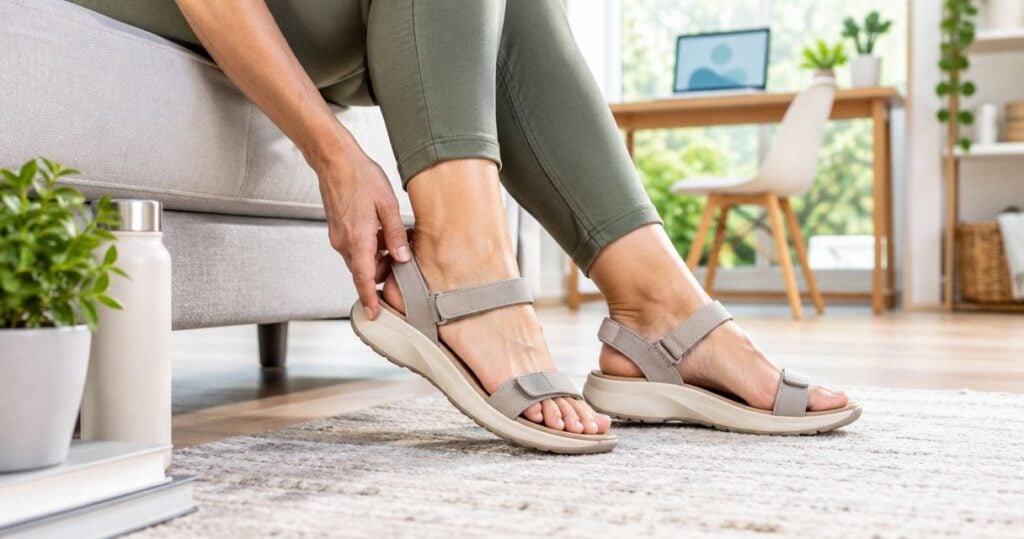
For everyday wear, start with an adjustable, heel-strapped sandal that feels comfortable on your foot; consider a walking sandal for outings or an orthotic-compatible design if you already use prescribed inserts. This 2026 Mychiro guide compares sandal types by fit and intended use—not by promises of back-pain relief.
- Mychiro’s supportive sandals for back pain guide prioritises individual fit, adjustable straps and practical use—not promised clinical outcomes.
- Compare heel-strapped sandals for everyday wear, walking sandals for outings and orthotic-compatible sandals for prescribed inserts.
- Check both feet; reject rubbing, overhanging toes and uncomfortable footbed pressure.
- Persistent back or foot symptoms warrant assessment rather than repeated footwear purchases.
Why this matters
A sandal described as supportive still needs to fit your foot. A deep heel cup, shaped arch or thick sole is a design feature, not a personalised recommendation or proof that the sandal will address your symptoms.
Mychiro is a chiropractic clinic and wellness centre in Bondi Junction, Sydney. This guide separates footwear shopping from clinical decisions: choose sandals for their fit and purpose, and discuss ongoing symptoms with an appropriate health professional.
Choose the sandal that fits your foot and your day, not the strongest health claim on the label. You do not need a particular arch shape, cushioning level or footwear category simply because you have back pain.
What makes a supportive sandal worth considering?
Use these criteria before comparing styles in 2026. They are shopping checks, not a clinical scoring system.
- Secure fastening: Look for straps you can adjust without squeezing your foot or leaving it loose inside the sandal.
- Footbed fit: Check whether the heel cup and shaped areas sit comfortably beneath your own foot.
- Appropriate width: Your toes and forefoot should fit within the usable sole without spilling over its edges.
- Comfort underfoot: Compare cushioning and firmness directly. Neither softness nor stiffness alone determines suitability.
- Practical outsole: Check the manufacturer’s stated intended use, particularly for wet surfaces or outdoor walking.
- Compatibility: If you use prescribed orthoses, confirm that the sandal accommodates them as intended.
Do not award a sandal extra credit simply because its description includes medical-sounding language. Ask what the feature actually is, then check whether it suits you.
Supportive sandal types at a glance
This 2026 comparison ranks starting points for different needs. The order does not represent measured clinical performance, and no option is presented as a back-pain intervention.
| Sandal type | Suited to | Feature to look for | Main limitation |
|---|---|---|---|
| Adjustable heel-strapped sandal | Everyday errands and casual wear | Adjustable forefoot and heel fastening | Straps can rub or sit awkwardly |
| Walking sandal | Outings involving more walking | Secure fastening and an outsole intended for the setting | More substantial designs can feel bulky |
| Orthotic-compatible sandal | People already using prescribed inserts | A removable footbed and suitable insert retention | Compatibility requires checking individually |
| Adjustable moulded-footbed sandal | People who prefer a shaped underfoot feel | A footbed contour that matches comfortably | Fixed contours do not suit every foot |
| Adjustable slide | Brief, casual wear | Adjustable upper and adequate sole width | No heel strap to retain the foot |
1. Adjustable heel-strapped sandals: everyday errands
An adjustable heel-strapped sandal is a practical starting point when you want an open shoe with fastening around the back of the foot. Look for separate adjustment across the forefoot and around the heel rather than assuming one strap controls the whole fit.
The main question is simple: does the sandal stay in place without uncomfortable pressure? Walk, turn and stop during the fitting instead of judging it only while standing still.
Adjustable heel-strapped sandal advantages:
- Forefoot adjustment lets you check the upper’s fit separately from the heel strap.
- A heel strap provides a fastening point absent from a slide.
- Open construction lets you inspect where straps contact your skin.
Adjustable heel-strapped sandal limitations:
- Strap position can conflict with your foot shape even when the length looks right.
- Buckles, seams and strap edges can feel uncomfortable.
- An adjustable upper cannot correct an unsuitable footbed width or contour.
Suited to: Everyday errands when you prefer an open shoe with heel fastening.
Verdict: Buy only after checking both sandals while walking; skip any pair that rubs during the fitting.
2. Walking sandals: outings on foot
Walking sandals are a category to compare when the intended outing matters more than a minimal appearance. Check each model’s stated use rather than assuming every outdoor-looking sandal suits the same surfaces.
Look closely at the sole, fastening and contact points. A substantial appearance does not establish grip, comfort or suitability for your route.
Walking sandal advantages:
- Multiple fastening points give you several places to check fit.
- Product information can help you match the sandal to its intended setting.
- Different sole constructions let you compare flexibility and underfoot feel.
Walking sandal limitations:
- Substantial straps and soles can feel bulky.
- Open toes leave part of the foot exposed.
- A walking label does not establish wet-surface performance or workplace suitability.
Suited to: Casual outings where the manufacturer’s intended use matches your plans.
Verdict: Hold until you have checked the intended terrain, fit and fastening; do not choose on appearance alone.
3. Orthotic-compatible sandals: prescribed inserts
Orthotic-compatible sandals deserve a separate category because an existing prescription changes the shopping question. You need to establish whether the insert fits and stays positioned as intended, not merely whether the sandal has a shaped footbed.
Bring your prescribed inserts to the fitting. Ask the prescribing podiatrist or other relevant health professional about compatibility if the fit is unclear.
Orthotic-compatible sandal advantages:
- A removable footbed allows you to check the space available for an insert.
- Adjustable straps offer another fit check once the insert is in place.
- You can assess the sandal and insert together rather than guessing from photographs.
Orthotic-compatible sandal limitations:
- A removable footbed does not establish compatibility with every orthosis.
- An insert can change available depth and strap positioning.
- A sandal without suitable retention is not an appropriate match simply because the insert fits inside.
Suited to: People already using prescribed orthoses who want to discuss an open-footwear option.
Verdict: Wait for compatibility advice if positioning or fit is uncertain.
4. Adjustable moulded-footbed sandals: contoured underfoot feel
A moulded footbed has a shaped surface rather than a uniformly flat platform. Compare where its arch contour, heel cup and toe area sit beneath your foot; the presence of those features does not establish that their shape suits you.
Try neighbouring sizes if the length seems reasonable but the contour feels misplaced. Do not accept a pressure point because the packaging describes the shape as anatomical.
Adjustable moulded-footbed sandal advantages:
- The shaped surface gives you a clear underfoot feel to assess.
- Adjustable uppers let you compare strap fit without changing the footbed.
- A visible foot outline helps you inspect edge clearance.
Adjustable moulded-footbed sandal limitations:
- Fixed contours cannot be repositioned independently.
- A prominent arch can feel uncomfortable on an individual foot.
- Matching your usual size does not establish a suitable contour.
Suited to: People who already find a contoured footbed comfortable during fitting.
Verdict: Buy only if the contour feels comfortable; skip a shape that presses into your foot.
5. Adjustable slides: brief casual wear
An adjustable slide has an open back and an upper you can tighten or loosen. It is a distinct option for someone who wants simple fastening, but it lacks the heel retention of a strapped sandal.
Check what happens when you turn or stop. If the slide slips, or you find yourself gripping with your toes to keep it on, compare another design.
Adjustable slide advantages:
- The upper offers more fit adjustment than a fixed-width strap.
- The open back avoids direct heel-strap contact.
- Simple construction makes the contact areas easy to inspect.
Adjustable slide limitations:
- No heel strap retains the back of the foot.
- Tightening the upper cannot compensate for every fit problem.
- A comfortable standing fit does not establish a comfortable walking fit.
Suited to: Brief casual wear when an open-back design stays comfortably positioned.
Verdict: Skip for your intended activity if the slide shifts or requires toe gripping.
A fitting routine before you decide
For your 2026 shortlist, use the same routine across every pair. Consistent checks make comparisons clearer than switching between packaging claims.
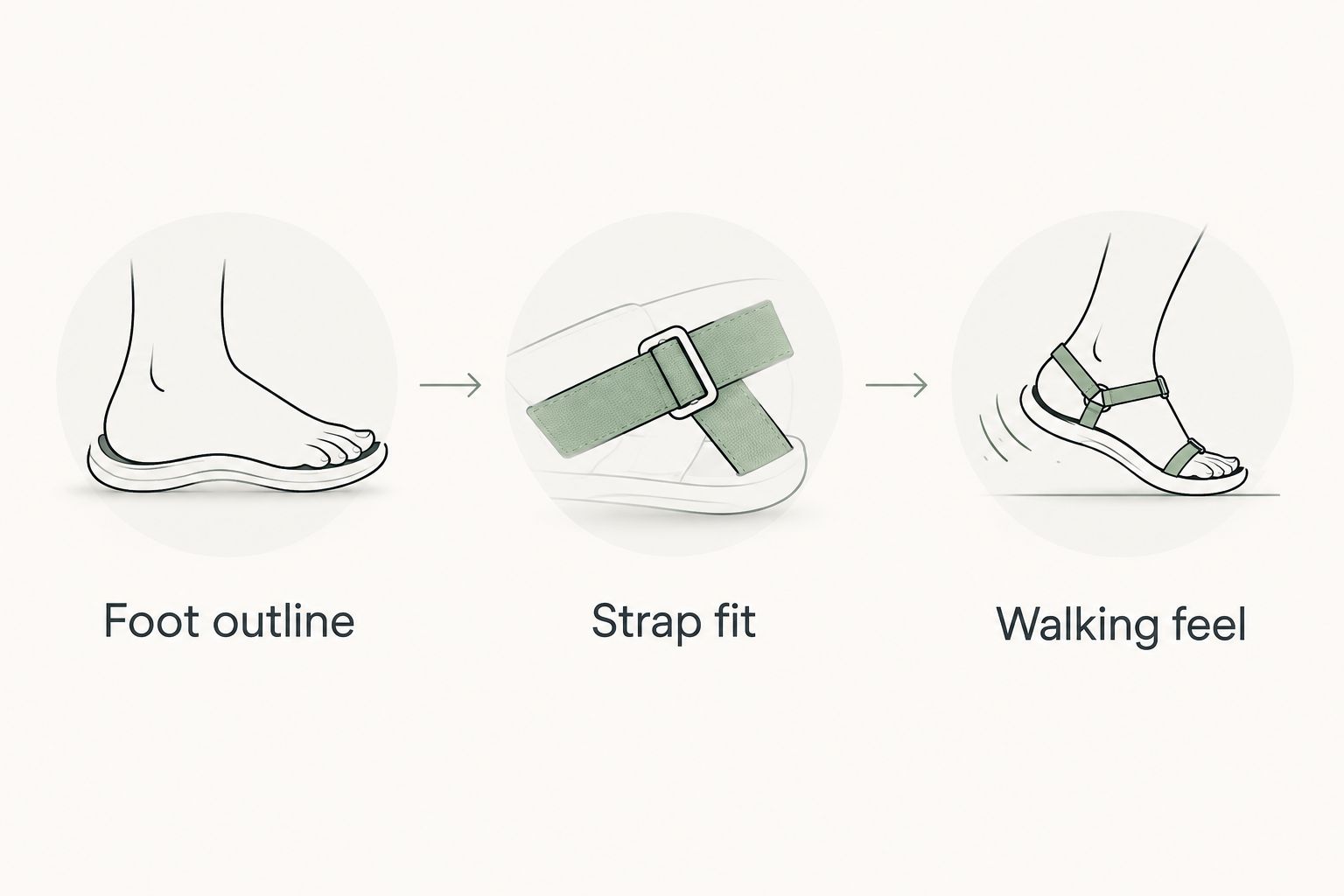
Foot outline
Try 2 sandals, not just the display shoe. Stand and check each foot’s position: heel within the rear edge, toes within the front edge and forefoot within the usable width.
Compare 2 sizes if your usual size leaves you uncertain. Size labels are a starting point, not a substitute for checking the actual shape.
Strap fit
Adjust each fastening separately. Check for a secure fit without pinching, then inspect the edges, seams and buckles where they touch your skin.
If fastening the sandal comfortably leaves your foot loose elsewhere, compare another shape. Do not keep tightening one strap to compensate for a different fit problem.
Walking feel
Use 3 movement checks: walk, turn and stop. Notice rubbing, sliding, uncomfortable pressure and whether you change how you step to keep the sandal on.
A brief fitting is not a prediction of all-day comfort. It is an opportunity to reject an obvious mismatch before committing to longer wear.
How this shortlist is ordered
Mychiro’s supportive sandals guide puts adjustable heel-strapped designs first as an everyday comparison point, then separates options by walking use, prescribed-insert compatibility, contour preference and open-back convenience.
This is a feature-based selection guide for 2026, not a hands-on product test or a clinical ranking. No named model is recommended because no model-specific specifications or comparative evidence underpin this shortlist.
The criteria remain the same throughout: fastening, width, footbed fit, underfoot comfort, intended use and compatibility. Your fitting results matter more than the position of a category in the list.
When footwear shopping is not the next step
Do not use repeated sandal purchases as a substitute for assessing persistent or worsening symptoms. A GP or podiatrist can discuss back or foot concerns and whether footwear assessment is relevant to your situation.
Seek urgent medical assessment for back pain with new bladder or bowel changes, loss of feeling around the groin, or new or worsening leg weakness. Healthdirect’s back-pain guidance identifies these as warning signs requiring urgent attention; do not wait for a footwear appointment.
If you have reduced foot sensation, diabetes-related foot concerns or a foot wound, discuss footwear with your treating health professional. An online shopping guide cannot establish suitability for those circumstances.
Which sandal type should you choose?
Start with an adjustable heel-strapped sandal for ordinary casual wear, provided it fits comfortably. Move to another category when you have a specific reason: an outing’s requirements, prescribed inserts, a preferred contour or a need for an open back.
For 2026 shopping, keep your decision narrow: choose footwear for fit and intended use, without expecting a sandal to explain or resolve back pain. Mychiro provides chiropractic care and spinal adjustments; whether any clinical service is appropriate requires individual assessment.
FAQ
Which supportive sandals should I consider if I have back pain?
Compare sandals by individual fit and intended use rather than a back-pain claim. An adjustable heel-strapped design is a starting point for casual wear, not a personalised clinical recommendation.
Are sandals with arch support always the right choice?
No; a shaped arch is a feature to assess, not an automatic reason to choose a sandal. Check whether the contour sits comfortably beneath your own foot.
Should I choose soft or firm sandal soles?
Compare both and reject uncomfortable pressure or an underfoot feel you dislike. Neither softness nor firmness alone establishes suitability for your foot or symptoms.
Can I put my prescribed orthotics into sandals?
Compatibility depends on the sandal and the prescribed insert. Check retention, depth and strap fit with the prescribing health professional when the match is uncertain.
Are slides suitable for everyday walking?
Assess whether the slide stays comfortably positioned during your intended activity. If it slips or requires toe gripping, compare a design with heel fastening.
Should I keep wearing sandals that rub while they soften?
Do not continue wearing sandals that rub or cause discomfort in the hope that the fit will become suitable. Recheck the size, straps and shape, and choose another design if needed.
Who should I speak to about persistent back and foot pain?
A GP or podiatrist can assess persistent symptoms and discuss appropriate next steps. Seek urgent medical assessment for back pain with new bladder or bowel changes, groin numbness or new or worsening leg weakness.
One last thing
Bring a familiar, comfortable pair of shoes when you shop. Comparing a new sandal against a known fit gives you a more useful reference than comparing unfamiliar pairs only with each other.
You can also note where previous footwear rubbed or slipped. A specific observation—such as heel movement or pressure beneath the arch—is more useful during fitting than asking for the most supportive sandal.
Related guides
- Walking shoes for people with lower back pain
- Shoes for bunions and forefoot pain
- Lower back pain when sitting: causes and practical steps