

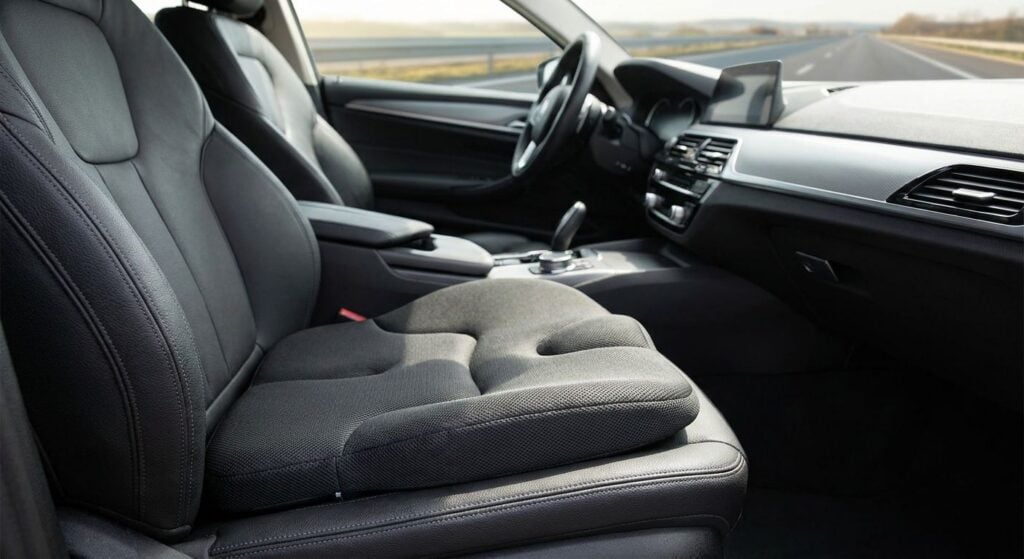
A three-hour drive to the Central Coast or up to Byron puts sustained pressure through the lower back, and the shape of your car seat cushion changes how that load lands on your spine. This guide ranks the car seat cushion types worth trying for long drives and back pain in 2026, based on pelvic tilt, lumbar contact and fit inside a standard bucket seat.
- The best car seat cushion for back pain on long drives in 2026 is usually a memory foam wedge — Buy for most sedans.
- Coccyx cutout cushions ease tailbone-specific pressure on multi-hour trips but add bulk — Buy only for that complaint.
- Flat, uncontoured foam pads look cheap and stay cheap — Skip them past a short commute.
- Inflatable lumbar rolls pack flat for shared or hire cars — Buy if you switch vehicles often.
- A cushion changes seat pressure, not the underlying cause; ongoing pain is worth discussing with a health professional.
Why this matters
Sitting in a bucket seat without support tends to flatten the natural curve of your lower back within the first 20 minutes of a drive. That flattening loads the discs and joints of the lumbar spine unevenly, and the effect compounds over a 2-3 hour trip. Transport for NSW recommends a rest break of at least 15 minutes every two hours of driving to manage fatigue — the same interval matters for your spine, not just your attention span.
A cushion doesn't change your seat's recline or built-in lumbar shape; it changes where your pelvis sits and how much contact your lower back gets with whatever curve the seat already has. That's the same principle behind swapping a flat office chair for a proper lumbar support cushion — the goal in both settings is keeping the spine's natural curve instead of letting it round out under sustained sitting.
This breakdown draws on the driving-posture questions that come up at MyChiro, a chiropractic clinic in Bondi Junction, rather than marketing copy from cushion sellers. If a cushion doesn't ease the ache within a couple of weeks of daily use, that's worth flagging with a health professional rather than swapping cushions again.
How the picks were assessed
Six cushion types get ranked here against four criteria that matter specifically for a driving position, not a desk chair: how much pelvic tilt the shape creates, how much lumbar contact it maintains once you're gripping a wheel rather than typing, how it holds up under seat heat on a 2026 Sydney summer dashboard, and whether it fits a standard sedan or SUV bucket seat without shifting the seatbelt line. Portability across more than one car and ease of cleaning the cover count too, since most people use these daily rather than for one trip.
None of the categories below get ranked on brand names — build quality inside each type varies by manufacturer, so check reviews for the specific product once the shape that suits your seat is settled. None of this replaces an assessment either: if you want to know whether a driving-posture issue is more spine than seat, that's a different question than which cushion to buy.
Car seat cushion types, ranked for long drives and back pain
1. Memory foam wedge cushion — the posture reset
The posture reset. A wedge cushion sits higher at the back edge than the front, tilting the pelvis forward a few degrees so the lower back doesn't slump into the seat's backrest. Most run 5-7 cm (2-3 inches) thick at the rear edge — thin enough to still clear the steering wheel angle in a sedan. It's the shape most commonly recommended for prolonged sitting because it works with the seat's existing lumbar curve instead of fighting it. Verdict: Buy — start here before trying anything more elaborate.
2. Coccyx cutout (horseshoe) cushion — the tailbone reliever
The tailbone reliever. A U-shaped cutout at the back removes direct pressure on the tailbone, which matters most on trips past the two-hour mark when that pressure point starts to nag. It adds more bulk under the seatbelt line than a plain wedge, so drivers under about 165 cm sometimes find it pushes them too far forward. Good for anyone who's noticed tailbone-specific discomfort rather than general lower back ache. Verdict: Buy — for the tailbone complaint specifically, not as a general-purpose pick.
3. Gel-hybrid seat cushion — the heat manager
The heat manager. A gel layer sits over foam to spread weight and stay cooler than foam alone on a sun-facing seat — useful on a Sydney summer drive when dark upholstery climbs past comfortable within 20 minutes of parking. The gel layer adds weight and cost over a plain foam wedge without adding much extra lumbar support. Verdict: Hold — worth it if heat is the actual complaint, skip it if back support is the only goal.
4. Inflatable lumbar roll — the packable option
The packable option. An inflatable roll straps to the seatback and adjusts firmness by how much air goes in, making it the only type here that packs flat in a glovebox or day bag. It suits people who drive more than one car — a share car, a partner's car, a hire car on a work trip — since it isn't fixed to one seat. Firmness control matters more than shape here; look for a separate valve rather than a single fill-and-seal design. Verdict: Buy — for anyone switching cars regularly.
5. Full orthopedic seat-and-backrest combo — the all-in-one
The all-in-one. This pairs a seat base with a separate backrest cushion, covering pelvic tilt and lumbar contact in one product. It's the bulkiest option by a clear margin, and in smaller hatchbacks it can push the driving position close enough to the wheel to matter. Measure your seat depth before buying — most combo units need at least 45 cm of seat depth to sit properly. Verdict: Wait — check your seat dimensions against the listing first, since returns on a used cushion aren't always accepted.
6. Flat, uncontoured foam pad — the budget trap
The budget trap. A flat pad with no wedge, no cutout and no contour does little beyond adding a thin layer between you and the seat base. It compresses within weeks of daily use and stops doing even that. For anything past a short commute, shape does more work than padding — this type skips the shape entirely. Verdict: Skip.
Comparison table
| Cushion type | Thickness | Best for | Verdict |
|---|---|---|---|
| Memory foam wedge | 5-7 cm | General long-drive posture | Buy |
| Coccyx cutout | 6-8 cm | Tailbone-specific pressure | Buy |
| Gel-hybrid | 4-6 cm | Hot climates, warm seats | Hold |
| Inflatable lumbar roll | Adjustable | Multiple cars, travel | Buy |
| Orthopedic combo | 8-10 cm+ | Larger vehicles, SUV/van | Wait |
| Flat foam pad | 2-3 cm | Nothing past a short commute | Skip |
Where to buy
- Measure your seat depth and width before ordering. Most listings state cushion dimensions, but few state the seat depth needed to fit properly — a cushion sized for an SUV bench often overhangs a small sedan's bucket seat.
- Check the cover is removable and machine-washable. Foam absorbs sweat and odour faster than the seat fabric around it, especially through a Sydney summer.
- Buy from a seller with a real return window. Foam that's been sat on for a week can't always go back, so a short trial period matters more than the marketing copy on the listing.
Still hurting after long drives?
A postural assessment at MyChiro can help identify what’s driving the discomfort.
When a cushion isn't enough
A cushion changes seat pressure; it doesn't change a driving posture where the mirror is set high enough that you're leaning forward, or a seat reclined too far back for the wheel distance. If the ache after a long drive doesn't ease within a week or two of using one of the types above, or comes with tingling down a leg, that's outside what a cushion can address.
Ongoing pressure-related pain that doesn't shift with a cushion change can sometimes overlap with conditions such as degenerative disc disease, where an assessment matters more than another product try. A postural assessment looks at driving posture alongside desk and sleep habits, since back pain after long drives rarely comes from one factor alone.
FAQ
What’s the best car seat cushion for back pain on long drives?
A memory foam wedge cushion is the most broadly useful type for long drives and back pain because it tilts the pelvis forward without adding much bulk. Coccyx cutout designs work better if the specific complaint is tailbone pressure rather than general lower back ache. Fit against your actual seat depth matters more than the label on the box.
Is a gel cushion better than a foam cushion for driving?
A gel-hybrid cushion mainly helps with heat, not lumbar support, so it isn’t automatically better than a plain foam wedge. Choose gel if a hot seat is the actual complaint on summer drives; choose foam if the complaint is lower back ache regardless of temperature.
How thick should a car seat cushion be?
Most memory foam wedge and coccyx cutout cushions run 5-8 cm (2-3 inches) thick at the rear edge, enough to shift pelvic angle without pushing the driving position too close to the wheel. Anything past 8-10 cm needs the seat depth checked first, since it can affect legroom and seatbelt fit.
Can a car seat cushion fix lower back pain?
A car seat cushion can change how sitting pressure lands on the lower back during a drive, but it doesn’t address the underlying cause of ongoing pain. If discomfort continues past a couple of weeks of using a properly fitted cushion, an assessment with a health professional is the next step rather than a different cushion.
How often should you take breaks on a long drive to protect your back?
Transport for NSW recommends a rest break of at least 15 minutes every two hours of driving, and that same interval helps reduce sustained pressure on the lower back. Standing and walking for a few minutes during the break matters as much as the cushion itself.
Do inflatable lumbar cushions work as well as foam ones?
Inflatable lumbar rolls can match foam wedges for adjustability since firmness is controlled by air volume, but they don’t hold pelvic tilt as consistently over a multi-hour drive. They’re the practical choice for anyone switching between cars rather than using one seat daily.
What size car seat cushion fits a small hatchback?
A memory foam wedge or inflatable lumbar roll fits most small hatchbacks without crowding the driving position, while a full orthopedic combo unit generally needs at least 45 cm of seat depth to sit properly. Measuring the seat before buying avoids a return on a used cushion.
Is it worth buying a car seat cushion in 2026, or waiting for a new car seat?
A cushion is the cheaper first step in 2026 and works with most existing seats, so it’s worth trying before assuming a seat replacement is needed. If the cushion doesn’t ease discomfort within a couple of weeks, that points toward the seat’s recline or lumbar shape rather than the cushion choice.
One last thing
Shape does more work than price. A correctly angled wedge cushion changes pelvic tilt more than a flat, uncontoured pad ever will, regardless of what either one costs. Pick the shape that matches the actual complaint — tailbone versus general lower back — before comparing anything else, including reviews.
Related guides
- Chiropractic care for shift workers with back pain
- Chiropractic care after whiplash from a car accident
- Chiropractic care for spinal stenosis symptoms