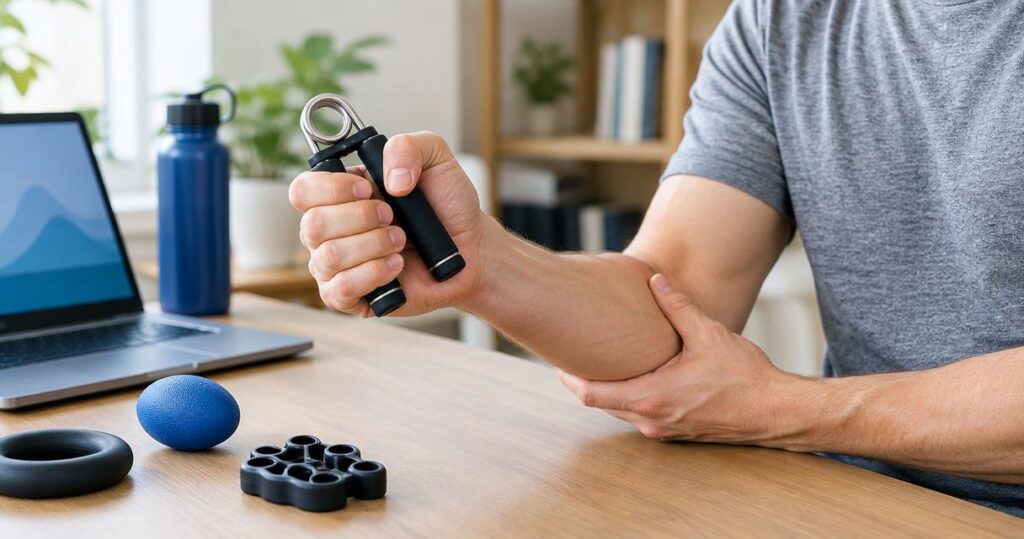
For a hand grip strengthener for wrist pain, compare resistance, handle fit and the movement required before choosing a device. Therapy putty offers a mouldable grip, a squeeze ball offers a simple whole-hand action, and an adjustable gripper offers a changeable setting—but none is a universal choice for an unexplained painful wrist.
- Therapy putty suits comparison when you want a mouldable grip rather than fixed handles.
- Adjustable grippers offer changeable resistance; check the lowest setting and handle span before choosing.
- Finger exercisers and squeeze balls require different movements and are not interchangeable.
- MyChiro’s hand grip strengthener guide compares equipment features, not proven outcomes for wrist pain.
Why this matters
A grip strengthener is exercise equipment, not a diagnosis. A device that suits a particular hand exercise does not automatically suit the reason your wrist or forearm hurts.
MyChiro is a chiropractic clinic and wellness centre in Bondi Junction, Sydney. This 2026 guide describes equipment categories and selection questions; it does not recommend chiropractic adjustments or a gripping programme for wrist pain.
Choose the movement before the equipment. If a qualified health professional has recommended an exercise, ask which device, resistance and movement match that instruction. If you have unexplained pain, discuss whether resisted gripping is appropriate before starting.
The NHS wrist-pain guidance advises medical assessment for symptoms such as tingling or loss of sensation and urgent assessment for severe pain, inability to move the wrist or hold things, or a change in wrist shape or colour. Use medical advice—not a shopping comparison—to decide what those symptoms require.
What to compare in a hand grip strengthener
For this 2026 comparison, the useful criteria are practical rather than promotional:
- Resistance control: Can you identify the resistance and change it without replacing the whole device?
- Hand fit: Can you reach and release the handles or gripping surface without forcing your hand into an awkward position?
- Movement match: Does the equipment require a whole-hand squeeze, individual finger pressure or finger opening?
- Release control: Can you let the device return without losing your grip or having it snap out of position?
- Maintenance: Are cleaning instructions clear, and can you inspect the material for wear?
- Instruction clarity: Does the manufacturer explain operation and limitations without promising a clinical result?
A repetition counter is a convenience feature. It does not tell you whether an exercise is appropriate, whether your technique matches a prescribed movement, or whether you should continue.
Likewise, a large resistance range is not automatically useful. The relevant question is whether the device includes the setting you have been advised to use and whether you can identify that setting consistently.
Hand grip strengtheners at a glance
These are equipment categories, not tested product recommendations. Designs differ within each category, so check the actual item rather than relying on its category name.
| Equipment category | Use-case label | Standout feature | Key limitation |
|---|---|---|---|
| Therapy putty | Mouldable grip | Shape changes to suit different hand positions | Resistance depends on the material and how you shape it |
| Soft squeeze ball | Simple whole-hand squeeze | Single compressible object without handles | Resistance generally cannot be adjusted on the same ball |
| Adjustable spring gripper | Changeable resistance setting | Mechanical adjustment on models with this feature | Minimum resistance and handle span vary |
| Individual finger exerciser | Separate finger presses | Separate plungers on designs with this feature | Finger pressing is not the same as whole-hand gripping |
| Silicone grip ring | Fixed-shape squeeze | Compact loop without an adjustment mechanism | Ring size and material determine fit and feel |
1. Therapy putty: a mouldable grip option
Therapy putty is a deformable material you can shape in your hand. Depending on the exercise instructions, it can be rolled, pressed or squeezed; those actions are different, so do not substitute one for another without checking.
Unlike a handled gripper, putty does not impose a fixed handle span. That makes its shape adaptable, but it also means the exercise setup is less standardised.
Use-case label: Mouldable grip, when that matches an exercise recommended following assessment.
Therapy putty pros:
- You can change the shape without changing equipment.
- It has no spring-loaded handles to position.
- It allows different contact surfaces within the hand.
Therapy putty cons:
- Colour codes are not a universal resistance standard across manufacturers.
- Changing the shape or amount of material changes the exercise setup.
- Storage and cleaning requirements depend on the particular material.
Before choosing putty in 2026, read its handling instructions. Check whether it requires a container, whether it can mark surfaces, and how the manufacturer says to keep it clean. Do not assume every material tolerates washing or disinfectant.
Verdict: Hold until the putty type and intended movement match your exercise instructions.
2. Soft squeeze ball: a simple whole-hand option
A squeeze ball is a compressible object held in the palm. Its basic action is straightforward: the hand closes around the object and then releases it.
Balls differ in diameter, material and firmness. A product labelled soft still needs checking; that label does not establish suitability for a painful wrist.
Use-case label: Simple whole-hand squeeze, when a whole-hand gripping movement has been recommended.
Soft squeeze ball pros:
- It has no mechanical setting to operate.
- Its rounded surface avoids a fixed pair of handles.
- You can inspect its outer surface before use.
Soft squeeze ball cons:
- You generally need a different ball to change firmness.
- A ball that is too large or small changes how your fingers contact it.
- Some materials have cleaning or durability limitations that require checking.
Compare the actual dimensions and material description. Avoid choosing solely from a photograph, which does not show how the object fits your hand or how much pressure it takes to compress.
A household stress ball is not automatically equivalent to exercise equipment specified by a clinician. The relevant difference is whether its characteristics match the intended exercise, not whether it carries a wellness label.
Verdict: Hold if the ball’s firmness or size is unclear.
3. Adjustable spring gripper: a changeable-setting option
An adjustable spring gripper has handles that you squeeze together against a mechanism. On adjustable models, a dial or similar control changes the resistance setting.
This category offers a way to change settings on the same device. However, the word adjustable does not tell you how light the lowest setting is, how widely the handles open or how the resistance is measured.
Use-case label: Changeable resistance setting, when a handled gripping exercise has been recommended.
Adjustable spring gripper pros:
- You can change resistance without changing the whole device.
- A marked setting can help you record the selected configuration.
- Handles provide a defined contact position.
Adjustable spring gripper cons:
- Handle span is not necessarily adjustable with resistance.
- A device’s minimum setting can still be unsuitable for the intended exercise.
- Different models’ resistance markings should not be assumed equivalent.
Check the mechanism before choosing a gripper in 2026. Look for readable settings, clear operating instructions and a handle surface you can hold without slipping. Ask the manufacturer how its resistance figures are defined if the exercise instructions require a particular load.
Do not use the number printed on a gripper as a wrist-health score. It describes a device setting, not a diagnosis or a measure of readiness to resume work or sport.
Verdict: Hold unless the minimum setting, handle fit and intended movement are all clear.
4. Individual finger exerciser: a separate-press option
An individual finger exerciser uses separate buttons or plungers. Each finger presses a contact surface rather than closing around a single object.
Some designs allow separate resistance adjustment; others do not. Check the specific mechanism rather than assuming that every finger exerciser offers independent settings.
Use-case label: Separate finger presses, when the prescribed movement involves individual finger pressure.
Individual finger exerciser pros:
- Separate contact points distinguish it from whole-hand grippers.
- Its layout makes the intended pressing action visible.
- Models with separate settings allow configuration by plunger.
Individual finger exerciser cons:
- Fixed spacing may not match your hand comfortably.
- Finger pressing does not reproduce every gripping task.
- Extra controls require careful setup and clear instructions.
Ask whether the exercise calls for separate finger movement or a coordinated whole-hand action. Those are different equipment requirements, even if both products are described as hand strengtheners.
Avoid using a finger exerciser to test a finger that locks, catches or becomes painful during movement. Discuss the symptom with a qualified health professional rather than repeatedly pressing through it.
Verdict: Skip as a substitute when your instructions specify whole-hand gripping.
5. Silicone grip ring: a fixed-shape option
A silicone grip ring is a flexible loop that you compress in your hand. It has no spring mechanism or adjustable dial, and its shape remains a defining part of the grip.
The ring’s diameter, cross-section and material affect how it feels. A resistance label alone does not describe all of those features.
Use-case label: Fixed-shape squeeze, when a ring-shaped object matches the recommended exercise.
Silicone grip ring pros:
- It has no adjustment mechanism to configure.
- Its loop shape is easy to inspect.
- It provides a consistent object shape between sessions.
Silicone grip ring cons:
- Changing resistance generally means changing rings.
- A fixed diameter offers limited fit adjustment.
- Surface texture and material can vary between products.
Check cleaning instructions and inspect the ring for damage. Do not assume a set’s colours follow the same resistance order as another manufacturer’s set.
A finger-opening loop is a different type of equipment from a squeeze ring. If a listing uses both descriptions, confirm which movement the product actually requires before choosing it.
Verdict: Hold if the ring’s fit or intended movement is uncertain.
How this comparison is organised
This 2026 guide orders the categories by their equipment characteristics: mouldable material, simple compression, adjustable handles, separate finger presses and a fixed loop. It is not a clinical effectiveness ranking or a report of hands-on product testing.
MyChiro’s grip strengthener comparison separates equipment features from claims about wrist pain. No category receives a clinical endorsement simply because its design is convenient.
Which hand grip strengthener should you choose?
If you have an exercise recommendation, choose the category that reproduces the specified movement. Then check the actual device’s fit, resistance and operating instructions.
If you do not have that recommendation and your wrist hurts, hold the purchase decision and clarify whether resisted gripping is appropriate. Do not infer that pain means you need stronger grip muscles.
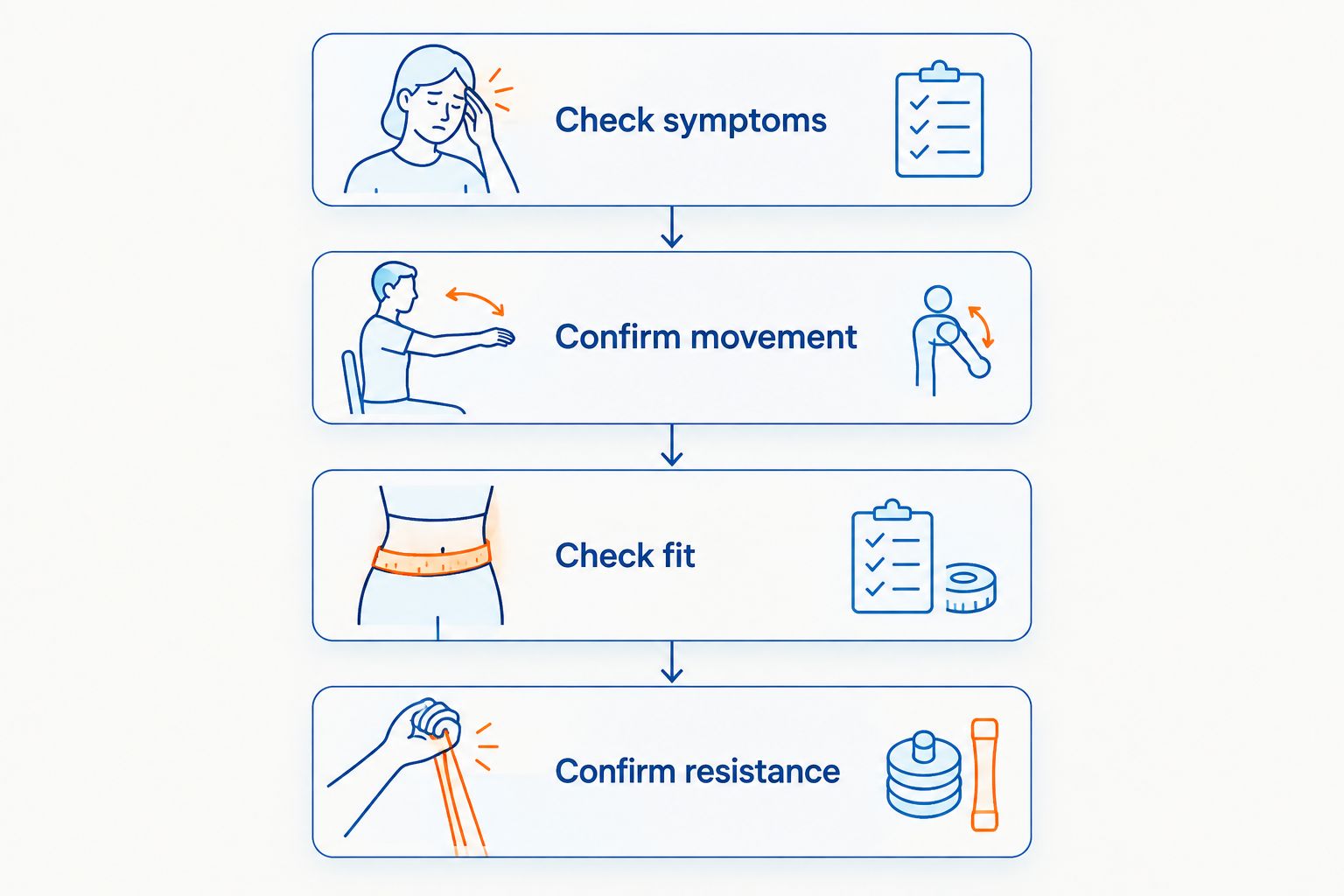
Use this selection sequence:
- Check symptoms: Decide whether you need medical advice before considering exercise equipment.
- Confirm movement: Identify the exercise you have been advised to perform.
- Check fit: Compare the contact surfaces, handle span or object size.
- Confirm resistance: Establish how the required setting or material is identified.
The sequence keeps the buying decision separate from a clinical decision.
Record settings without inventing a programme
Keep the manufacturer’s instructions with the device. If a qualified health professional recommends its use, record the equipment category, exact model, selected setting and exercise instructions together.
Do not copy a repetition target or exercise frequency from a shopping listing. A manufacturer’s demonstration explains operation; it does not establish an individual programme for wrist or forearm pain.
You can also note which everyday tasks involve gripping, such as carrying bags, using tools or operating a mouse. That information gives a health professional a clearer account of your activities without requiring you to diagnose the cause.
For computer-related equipment questions, see the guide to ergonomic keyboards and mice. Changing desk equipment and choosing a grip exerciser are separate decisions; neither establishes why your wrist hurts.
FAQ
Which hand grip strengthener should I choose if my wrist hurts?
Choose only after clarifying whether resisted gripping is appropriate and which movement is recommended. Putty, balls, handled grippers and finger exercisers have different equipment characteristics; none is a universal choice for wrist pain.
Is therapy putty better than an adjustable gripper?
Therapy putty and adjustable grippers serve different equipment needs. Putty changes shape, while a handled gripper provides a mechanical setting; the relevant choice depends on the recommended movement and fit.
Can I use a stress ball instead of a hand exerciser?
A stress ball is not automatically equivalent to the equipment specified in an exercise programme. Check its size, firmness and material against the instructions you have received.
What resistance should I start with?
There is no single resistance setting recommended by this guide. Ask the health professional advising your exercise to specify the required device characteristics and explain how to identify them.
Should I keep squeezing if my wrist pain increases?
Do not continue an exercise that increases your wrist pain. Stop and discuss the response with a qualified health professional rather than increasing resistance or repetitions.
Do hand grip strengtheners open the fingers as well?
Squeezing equipment and finger-opening equipment require different movements. Confirm the action shown in the manufacturer’s instructions instead of relying on a general hand-strengthener label.
Does MyChiro recommend a particular grip strengthener brand?
MyChiro does not recommend a particular grip strengthener brand in this guide. The comparison covers equipment categories and selection questions, not product testing or clinical outcomes.
One last thing
For a 2026 purchase, save the instructions—not just the product name. Two devices called adjustable grippers can differ in handle span, minimum setting and mechanism, so replacing one with another is not necessarily a like-for-like equipment change.
Ask what movement the device requires before asking how strong it is. That question keeps the choice tied to its intended use rather than a large number on the packaging.
Related guides
- Preparing for your first chiropractor appointment
- Qualifications to check when choosing a Sydney chiropractor
- Resistance bands for at-home exercise