

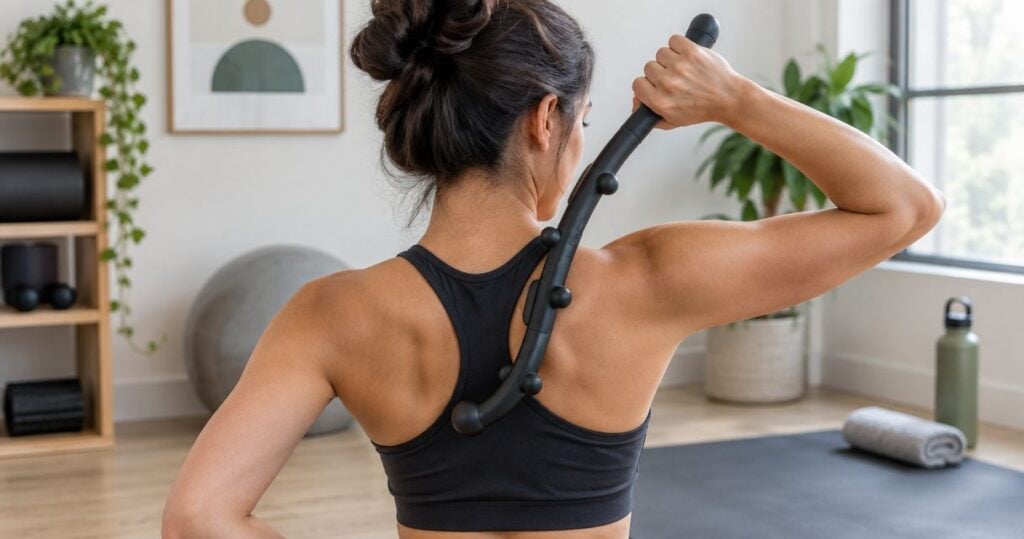
For a first comparison, start with a one-piece hooked massage cane; compare an S-shaped cane for different approach angles, a detachable cane for storage, and a broad-head cane for a wider contact surface. This 2026 guide compares tool designs and handling—not their ability to relieve pain or produce muscle release.
- A one-piece hooked massage cane is a starting point for comparing reach, grip and pressure control.
- S-shaped canes offer different approach angles, but their extra contact points need careful positioning.
- Detachable massage canes prioritise storage; check the connection and assembly instructions before choosing one.
- Mychiro is a Bondi Junction chiropractic clinic, not a massage-cane manufacturer or retailer.
Why this matters
A massage cane is a handheld tool with a curved shaft and contact head. Its shape lets you position the head in places that are awkward to reach directly with your hand. That describes its function, not a clinical benefit.
The phrase trigger point on packaging does not establish the cause of a tender area. Likewise, muscle release is not a result you can confirm from a product photograph, a firm sensation or the number of knobs on a tool.
Mychiro provides chiropractic care and spinal adjustments in Bondi Junction, Sydney. This guide keeps the equipment comparison separate from those services: choosing a massage cane does not establish whether self-massage or chiropractic care is appropriate for you.
Choose around comfortable handling, not promises of deeper pressure or faster results. If you are considering a cane because of unexplained or persistent symptoms, discuss suitability with a qualified health professional before using it.
What makes a suitable trigger point massage cane?
Use these 5 design checks when comparing massage canes in 2026. They concern physical fit and handling, not clinical performance.
- Reach: Can you position the contact head at the intended area without an awkward stretch or sustained twist?
- Grip: Can you hold the tool comfortably and put it down without struggling with the handle?
- Pressure control: Can you place and remove the head deliberately, rather than having the shape push it into position?
- Contact surface: Is the head smooth, intact and suitable for the intended use described in the manufacturer's instructions?
- Construction: Are the shaft, handles and any connections intact, with clear assembly and care instructions?
A product photograph answers only part of these questions. Look for views showing the whole tool, the handles and the contact surfaces—not just a close-up of a knob pressed against someone’s back.
Do not infer strength from a thick-looking shaft or comfort from a rounded-looking head. Check the actual product information. If the listing does not explain assembly, intended use or care, you do not have enough information to compare that model properly.
Trigger point massage canes at a glance
These 4 design categories are a shopping framework, not a ranking of clinical outcomes. A particular model can combine features from more than one category, so compare the actual item rather than relying on its category name.
| Design | Suitable for | Standout design feature | Key limitation |
|---|---|---|---|
| One-piece hooked cane | A straightforward starting point for home-use comparisons | A curved shaft without an assembly connection | Fixed shape and storage footprint |
| S-shaped cane | Comparing different contact angles | Curved ends offering different approaches | Extra ends and knobs need positioning awareness |
| Detachable cane | Buyers prioritising compact storage | Sections that separate for storage | The connection adds an assembly check |
| Broad-head cane | Buyers comparing wider contact surfaces | A head wider than a small rounded knob | Less precise placement than a smaller contact head |
The row order reflects a practical decision sequence: start with a simple shape, then consider whether you need a different angle, easier storage or a different contact surface. It does not mean the first design produces a better health outcome.
1. One-piece hooked cane: for a straightforward starting point
A one-piece hooked cane has a continuous shaft that curves back towards you. You hold the shaft or handles to position its contact head. With no detachable connection, there is no assembly step to assess.
This design is a sensible first comparison when you do not yet know which extra features you need. Inspect where your hands would sit and how the hook would approach the intended area; a familiar-looking shape is not proof that it fits your reach.
One-piece hooked cane advantages:
- No connection to assemble before use.
- A straightforward shape to compare across listings.
- No separate sections to keep together.
One-piece hooked cane limitations:
- The fixed curve cannot be rearranged to suit you.
- Its full-length shape needs storage space.
- Handle placement can still be awkward for some users.
Suitable for: Someone comparing a simple, fixed-shape tool for home storage, after establishing that self-massage is appropriate.
Before choosing, check whether the handle encourages an awkward wrist position. Also consider how you would remove the head from contact: comfortable placement and deliberate removal both matter.
Verdict: Consider the one-piece hooked cane first for simplicity; skip it if its fixed shape does not fit your reach or grip.
2. S-shaped cane: for comparing different approach angles
An S-shaped cane has curves at opposite ends. Depending on the model, each end can have a different contact head or handle arrangement. Compare those features individually rather than treating the S shape as a benefit by itself.
The relevant question is whether either end lets you position the tool comfortably. More knobs do not establish more useful positions, and extra contact points are not evidence of stronger results.
S-shaped cane advantages:
- Different ends offer different approaches to positioning.
- You can compare head shapes within the same tool.
- Multiple grip positions are possible on models designed with them.
S-shaped cane limitations:
- Unused ends and knobs need clearance from your body.
- The shape can be awkward to store.
- Extra features add choices without necessarily improving fit.
Suitable for: Someone who has a specific handling reason to compare different approach angles, rather than someone seeking the greatest number of contact points.
For a 2026 purchase, examine photographs of both ends and read the instructions for each intended position. Avoid copying a promotional pose merely because the person in the image appears comfortable.
Verdict: Consider the S-shaped cane when its alternative angles meet a clear positioning need; skip it when the extra ends complicate handling.
3. Detachable cane: for compact storage
A detachable massage cane separates into sections. That makes storage configuration part of the buying decision, alongside reach and grip. The connection is also an additional component to inspect and assemble according to the manufacturer's instructions.
Do not assume that every detachable cane uses the same locking system. Check how the specific model joins, how you confirm correct assembly and whether the instructions explain what to do if the connection becomes loose.
Detachable cane advantages:
- Separate sections offer a different storage arrangement.
- You can assess the stored shape as well as the assembled shape.
- It suits buyers who need to put the tool away between uses.
Detachable cane limitations:
- Assembly is required before use.
- Loose sections need to be kept together.
- The connection needs inspection as well as the shaft and heads.
Suitable for: Someone whose main constraint is storage space, provided the assembled tool also meets their handling needs.
Measure the storage space you actually intend to use and compare it with the manufacturer's stated dimensions. A product described as portable is not automatically suitable for your bag, drawer or cupboard.
Do not choose a detachable design solely because it looks convenient. If the assembled connection moves unexpectedly or the instructions are unclear, do not use it.
Verdict: Consider the detachable cane for a defined storage need; hold off if the connection or assembly instructions are unclear.
4. Broad-head cane: for a wider contact surface
A broad-head cane uses a contact surface wider than a small rounded knob. This category concerns head shape, not the shape of the entire shaft: a hooked or detachable cane can also have a broad head.
A wider surface changes how the tool contacts you. It does not establish that the tool is gentle, appropriate for a particular condition or capable of producing muscle release.
Broad-head cane advantages:
- A wider head offers a distinct contact shape to compare.
- The contact surface is visible for inspection.
- Some designs combine a broad head with a simple shaft.
Broad-head cane limitations:
- A wider head makes small-area placement less precise.
- Head shape alone does not determine the force applied.
- A comfortable-looking surface still needs an individual suitability check.
Suitable for: Someone specifically comparing contact-surface shapes, rather than assuming that a broader head guarantees comfort.
Check the edges, surface finish and cleaning instructions. If a model has interchangeable heads, confirm how they attach; do not assume that an attachment from another tool is compatible.
Verdict: Consider the broad-head cane when a wider contact surface is your stated preference; skip it if you need more precise placement.
How the designs are ranked
The comparison prioritises reach, grip, pressure control, contact surface and construction. The one-piece design comes first because it provides a straightforward baseline; the other categories address distinct handling or storage preferences.
This is a design comparison, not a product test or clinical recommendation. It does not rank named manufacturers, claim that one cane provides greater relief, or establish that self-massage is appropriate for your symptoms.
For your 2026 shortlist, compare like with like. A detachable tool with a broad head should be checked against both categories, rather than awarded an advantage simply because it has more features.
Check suitability before choosing a tool
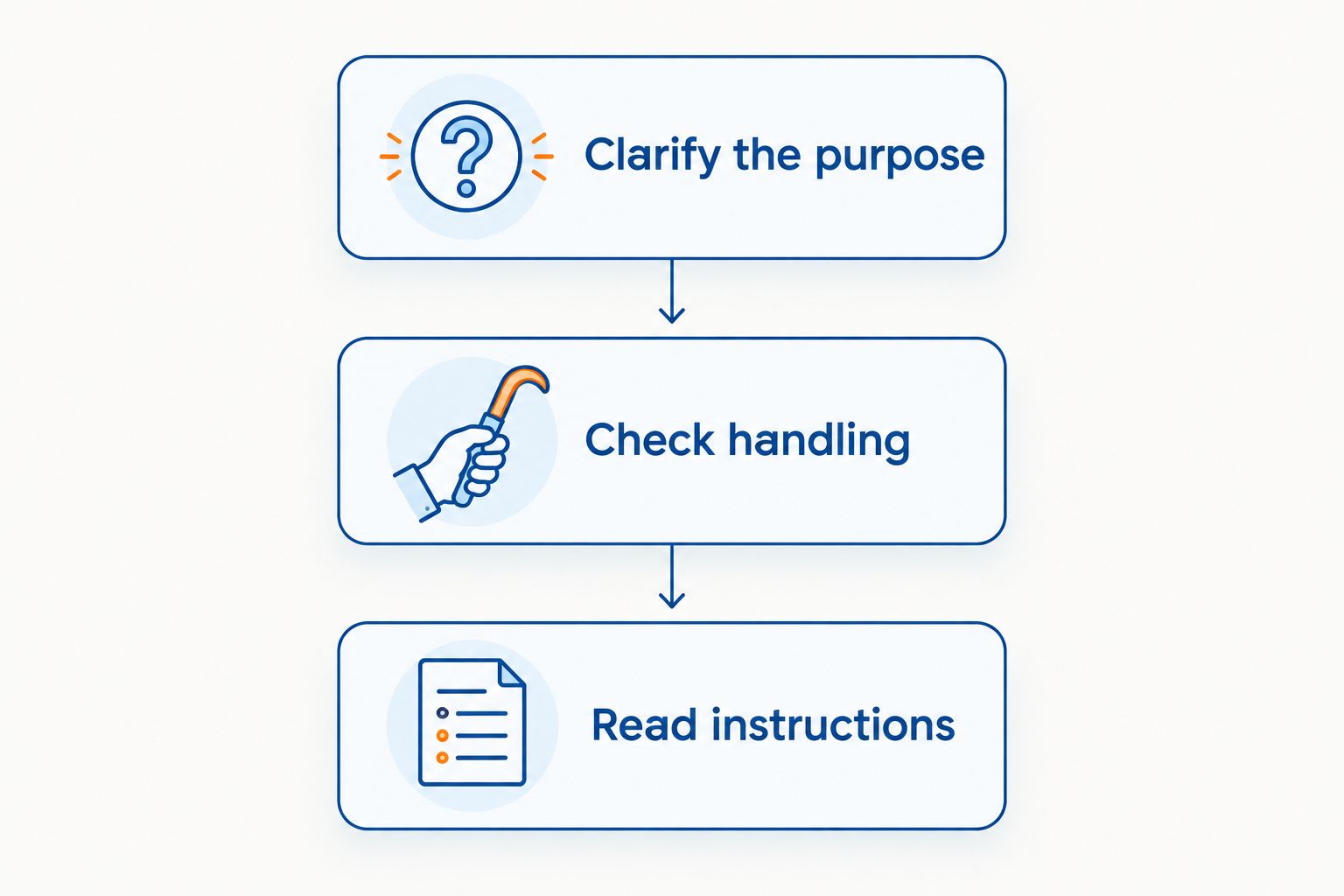
Start with 3 questions: why do you want the tool, can you handle it comfortably, and do you understand its instructions? Answering them is more useful than choosing by the strongest pressure claim.
Clarify the purpose
Separate a shopping preference from a health concern. Wanting a tool that fits in a drawer is a design question; wanting to address unexplained pain is a question for a qualified health professional.
Mychiro is a chiropractic clinic and wellness centre. A massage-cane comparison does not determine whether its chiropractic services—or another form of care—are appropriate for you.
Check handling
Look at the relationship between the contact head and your hands. Consider whether you would need to twist, raise your shoulders or grip tightly just to keep the head in position.
You should also be able to remove the tool deliberately. Do not use a position that traps the cane against furniture or makes it difficult to stop contact.
Read instructions
Read the manufacturer's intended-use, assembly, cleaning and warning information before using the tool. Do not substitute an online routine for the instructions supplied with the actual model.
Which massage cane should you choose?
Use the one-piece hooked cane as your default comparison, not an automatic purchase. Move to an S-shaped design only for a clear angle-related preference, a detachable design for storage, or a broad-head design for its contact shape.
If none fits your reach and grip, choosing no cane is a valid decision. Do not compensate for an awkward tool by forcing the position or applying more pressure.
Keep health concerns separate from the equipment shortlist. If symptoms persist, change or interfere with daily activities, discuss them with a qualified health professional rather than repeatedly changing tools.
FAQ
Which trigger point massage cane design should I compare first?
Start by comparing a one-piece hooked cane for its straightforward construction. It is a design baseline, not a recommendation that self-massage is appropriate for you or that this shape produces a clinical benefit.
Is an S-shaped massage cane better than a hooked cane?
An S-shaped cane offers different approach angles, but that does not establish better clinical results. Compare whether its ends and handles fit your intended positioning without making handling awkward.
Does a massage cane release muscle knots?
The phrase muscle release does not establish a verified result from using a massage cane. A tender area is not a diagnosis, and persistent or unexplained symptoms can be discussed with a qualified health professional.
Should I choose a detachable massage cane?
Consider a detachable cane if storage is a clear priority and the assembled shape suits your handling needs. Check the connection, assembly instructions and warnings for the specific model.
Does a broader massage-cane head mean less pressure?
Head width alone does not tell you how much pressure you apply. The contact surface is only one part of the design, alongside the shaft, grip and way you position the tool.
What should I do if using a massage cane hurts?
Stop using the cane rather than pressing harder or continuing through pain. Seek advice from a qualified health professional if symptoms persist or you are unsure whether self-massage is appropriate.
Does Mychiro manufacture the massage canes in this guide?
This guide compares generic design categories, not a Mychiro product range. Mychiro is a chiropractic clinic and wellness centre in Bondi Junction, Sydney.
One last thing
Before making a 2026 purchase, picture where your hands will be—not just where the contact head will sit. A tool that reaches the intended area but leaves you struggling to hold or remove it has failed the handling check.
There is no need to choose the design with the most knobs. A clear purpose, a suitable shape and understandable instructions give you a more useful shortlist than a claim about depth or intensity.
Related guides
- Massage balls and trigger point tools
- Ergonomic setups for shift workers
- Qualifications to check when choosing a Sydney chiropractor