
There is no single best back brace for scoliosis: the right type depends on age, curve size and whether a specialist has prescribed one. This guide ranks five brace types by use case for 2026 so you can see which conversation to have with your doctor or orthotist.
- A rigid, custom-made brace prescribed by a specialist is the only type designed to address a growing adolescent’s curve.
- Soft elastic supports are for short-term comfort in adults. They do not correct a curve.
- Never buy a brace for a child or teen without a medical diagnosis and a specialist’s plan.
- Chiropractors do not prescribe rigid scoliosis braces. They can assess your posture and refer you on where appropriate.
Verdict: Mychiro suggests starting with a proper assessment, not a purchase. A prescribed rigid brace suits growing teenagers under specialist care, and a soft support suits adults who want short-term comfort during the day.
Why this matters in 2026
Scoliosis is a sideways curve of the spine, often with some rotation. Many curves are found at school screenings or by a parent noticing uneven shoulders. Search results in 2026 are crowded with off-the-shelf braces promising correction. Most of those promises are not supported by good evidence.
Bracing is a medical decision. Published scoliosis guidance generally reserves rigid bracing for adolescents who are still growing and whose curves sit in a moderate range, commonly cited as about 25 to 40 degrees on the Cobb angle measure. Smaller curves are usually monitored. Larger curves are managed by a surgical or orthopaedic team.
If you are unsure whether you have a curve at all, start with this guide on how to check yourself for scoliosis at home. A home check is a prompt to see a health professional. It is not a diagnosis.
What to look for in a scoliosis brace
Use these criteria to audit the ranking below.
- Prescription status. Was it recommended by a doctor, orthopaedic specialist or orthotist after imaging?
- Fit. Custom-moulded or professionally fitted, not guessed from a size chart.
- Purpose. Is it meant to influence a growing curve, or only to make a day more comfortable?
- Wear schedule. Some braces are worn for many hours a day, others only at night, others only for activity.
- Comfort and skin care. A brace you cannot tolerate will not get worn.
- Review plan. Braces need follow-up as a young person grows. A one-off purchase has no follow-up.
Scoliosis brace types at a glance
| Rank | Brace type | Best for | Standout feature | Key limitation |
|---|---|---|---|---|
| 1 | Custom rigid TLSO | Growing adolescents with a prescribed plan | Made to the individual's measurements | Needs specialist involvement and regular review |
| 2 | Night-time bending brace | Teens whose specialist recommends night wear | Worn during sleep rather than school hours | Suits only certain curve patterns |
| 3 | Soft elastic lumbar support | Adults wanting short-term comfort | Easy to wear under clothes | Does not correct a curve |
| 4 | Posture support harness | Adults noticing slumped sitting posture | Light cue to sit taller | Cue only; no structural effect |
| 5 | Activity support belt | Adults with a flare-up during lifting or exercise | Used for a limited time during tasks | Can encourage reliance if worn all day |
1. Custom rigid TLSO: for growing adolescents under specialist care
A thoracolumbar sacral orthosis (TLSO) is a rigid brace moulded to the individual. It is the type most associated with adolescent idiopathic scoliosis management.
Custom rigid TLSO pros:
- Made for one person's body shape rather than a size range.
- Prescribed and reviewed by a specialist team.
- Used within a plan that includes imaging and follow-up.
- Is the type that clinical guidance usually refers to when bracing is discussed.
Custom rigid TLSO cons:
- Takes real adjustment, especially for teenagers at school and in sport.
- Can cause skin irritation and needs ongoing fit checks.
- Not appropriate for every curve pattern or age.
Custom rigid TLSO pricing: cost varies by clinic and provider, so ask the orthotist for a written quote and check whether your private health fund or a public programme contributes.
Best for: adolescents who are still growing, with a diagnosis and plan from a specialist.
Verdict: Buy only on prescription. For a teenager, this is the type to discuss with the treating specialist. Mychiro has more context in its article on chiropractic care for scoliosis in teenagers, which covers how chiropractic assessment fits alongside medical care.
2. Night-time bending brace: for teens whose specialist recommends night wear
Night-time braces are worn during sleep, so daytime activity is unrestricted. Some specialists use them for particular curve types.
Night-time bending brace pros:
- Leaves school hours and sport free of a brace.
- Can be easier for some teenagers to accept than a daytime brace.
- Still individually made and reviewed.
Night-time bending brace cons:
- Suitable only for some curve patterns, which a specialist decides.
- Sleep comfort can be affected during the adjustment period.
- Needs the same follow-up as any prescribed brace.
Night-time bending brace pricing: ask your orthotist for a written quote, as it varies by provider.
Best for: teens whose specialist has specifically recommended night wear.
Verdict: Hold until a specialist says it fits. Do not choose this type yourself from an online listing.
3. Soft elastic lumbar support: for adults wanting short-term comfort
Many adults with scoliosis have back stiffness or aching after long sitting or standing. A soft elastic support can give a feeling of gentle compression.
Soft elastic lumbar support pros:
- Low profile under clothing.
- Easy to put on and take off.
- No specialist fitting needed for basic models.
- May feel reassuring during a flare-up.
Soft elastic lumbar support cons:
- Does not correct or hold a scoliotic curve.
- Long daily wear can mean less reliance on your own muscles.
- Evidence for pain benefit is limited.
Soft elastic lumbar support pricing: varies widely by retailer, so compare current listings.
Best for: adults looking for short-term comfort for specific tasks, ideally after a professional assessment.
Verdict: Hold. Reasonable as a short-term aid, not a long-term plan. See Mychiro's guide to back braces for lower back pain relief for how to think about general-purpose supports.
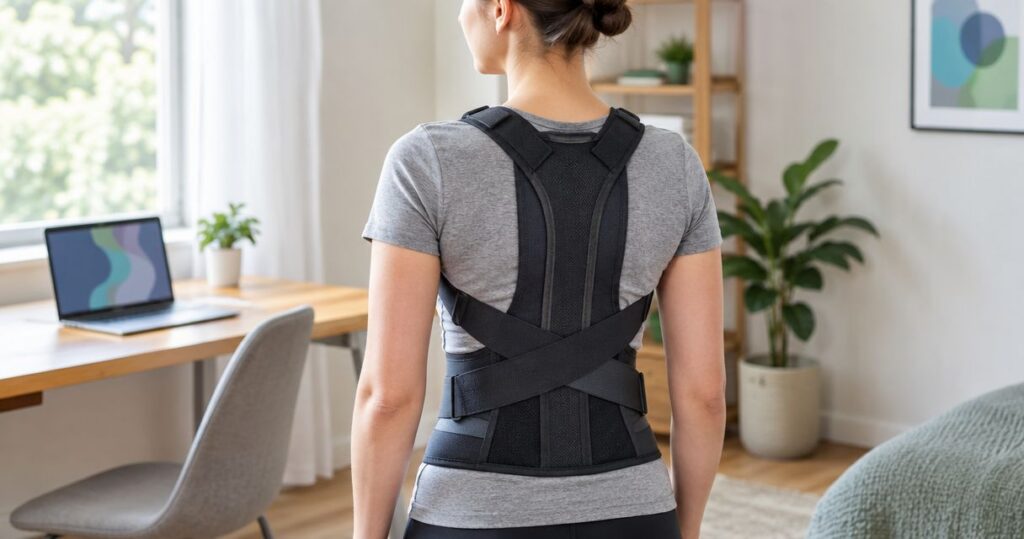
4. Posture support harness: for adults who slump when sitting
A posture harness pulls the shoulders back gently. It acts as a reminder, not a structural support.
Posture support harness pros:
- Gives a clear cue when you slouch at a desk.
- Light and portable.
- Can be worn for short sessions as a habit prompt.
Posture support harness cons:
- Has no effect on the underlying curve.
- Can irritate the underarms and collarbone area.
- Habit change tends to come from movement and strength work, not from a device alone.
Posture support harness pricing: varies by retailer, so check current listings.
Best for: adults who want a prompt to sit taller during computer work.
Verdict: Hold. Pair it with movement. The best stretches for scoliosis relief are a more useful place to start.
5. Activity support belt: for flare-ups during lifting or exercise
Some adults use a firm belt for a limited time while lifting, gardening or exercising.
Activity support belt pros:
- Task-specific and easy to remove afterwards.
- Can add a sense of stability during a flare-up.
- Works for people who do not want to wear something all day.
Activity support belt cons:
- Not designed for scoliosis specifically.
- Wearing it every day for long periods may reduce how much your trunk muscles work.
- A poor fit can ride up or dig in.
Activity support belt pricing: varies by retailer, so compare current listings.
Best for: short, specific tasks during a flare-up.
Verdict: Skip as a daily item. Use it sparingly and discuss it with a qualified health professional.
How these were ranked
The ranking follows the criteria above. Types that are prescribed, individually made and reviewed by a specialist rank first because they are the only ones designed around a scoliosis curve. Over-the-counter supports rank lower because they offer comfort or cues, not correction. No specific brand is ranked here, because suitability depends on an individual assessment.
Book a spinal assessment
Discuss your posture and spine concerns with a registered chiropractor in Bondi Junction.
Which scoliosis brace should you choose?
Start with the person, not the product.
- Teenager with a diagnosed curve: a custom rigid TLSO, or a night-time brace if the specialist recommends it, is the starting point for discussion.
- Adult with an aching back: a soft support for short periods may be appropriate following assessment, alongside exercise and movement.
- Anyone unsure: get assessed first. A brace bought on a guess may be the wrong type.
For adults, Mychiro's article on chiropractic techniques for scoliosis in adults explains what chiropractic care involves and where it sits next to medical management.
When to see a doctor first
See a medical practitioner promptly if you notice any of the following:
- A curve that appears to be getting worse over a few months.
- Numbness, weakness or tingling in the legs.
- Changes in bladder or bowel control.
- Pain at night that does not ease with position changes.
- A child or teen with a visible curve or uneven shoulders and waist.
These need medical assessment before any brace or hands-on care is considered.
FAQ
What is the best back brace for scoliosis?
There is no single best option. A custom rigid brace prescribed by a specialist is the type associated with adolescent scoliosis management, while adults often use soft supports for short-term comfort. Your doctor or orthotist can advise which suits you.
Can a back brace fix scoliosis?
No brace is a cure. In growing adolescents, a prescribed brace is used to try to limit progression of a curve. Over-the-counter supports do not correct a curve.
Do adults with scoliosis need a brace?
Not usually. Adult management tends to focus on movement, strength and symptom management. A soft support may be used briefly for comfort after discussing it with a health professional.
Can I buy a scoliosis brace online?
You can buy general supports online, but a rigid scoliosis brace should be made and fitted by an orthotist on a specialist’s recommendation. An ill-fitting brace can cause skin problems and may not suit the curve.
How long should a scoliosis brace be worn each day?
Wear time is set by the treating specialist and depends on the brace type and curve. Follow their schedule rather than general online advice.
Can a chiropractor prescribe a scoliosis brace?
Rigid scoliosis bracing is generally prescribed by a medical specialist and made by an orthotist. A chiropractor can assess posture and function, discuss movement strategies and refer you on where appropriate.
Does wearing a posture brace weaken my back muscles?
Wearing any support for long periods may reduce how much your trunk muscles work. Short, purposeful use combined with exercise is a more common approach.
One last thing
The most useful scoliosis tool is usually not a device. It is a clear measurement of the curve, taken on a known date, so that any change over the next year can be seen. Ask for a copy of your imaging report and keep it with your notes.
This article is general information, not medical advice. It does not diagnose, and it does not suggest chiropractic care or any brace will treat or correct scoliosis. Speak with a qualified health professional about your situation in 2026.