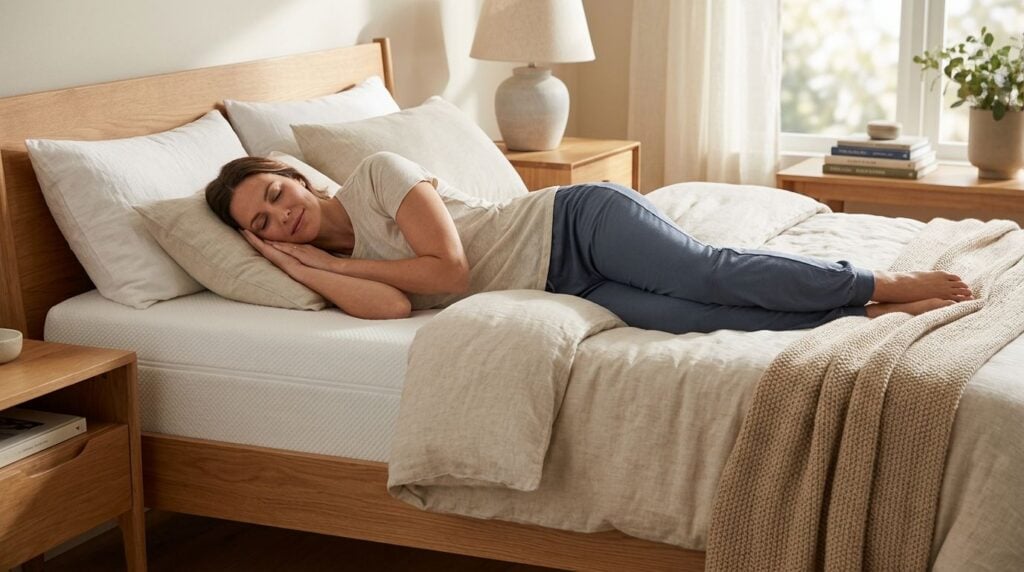
For the 2026 search ‘best mattress for back pain’, start with a medium-feel hybrid as a comparison point, not a prescribed solution. If you share a bed, sleep hot or prefer a different feel, the more useful choice is the mattress that supports your usual sleeping position without creating uncomfortable pressure.
- For the best mattress for back pain search, compare a medium-feel hybrid with other designs rather than trusting a universal ranking.
- Choose by sleeping position, pressure, ease of movement and temperature—not a firmness label alone.
- Mychiro’s mattress checklist separates a purchase decision from the question of whether back symptoms need assessment.
- Seek urgent medical advice for back pain with new bladder or bowel problems, saddle numbness or significant leg weakness.
Why this matters
A mattress is a sleep surface, not a diagnosis or a substitute for medical assessment. The word firm describes how a mattress feels, but it does not tell you how your shoulders, hips and torso will rest on it. Your body, sleeping position and preferences all affect that experience.
If you wake uncomfortable, look beyond the mattress too. Your pillow, time spent in one position and activities during the day are separate parts of the picture. Mychiro’s mattress guidance focuses on what you can check in a showroom and what you should discuss with a qualified health professional. If you want to discuss persistent back concerns, Mychiro provides chiropractic assessments in Bondi Junction; whether chiropractic care is appropriate depends on an individual assessment.
The ranked verdict: which design should you try first?
Start with a medium-feel hybrid if you change positions during the night. Compare a pocket-spring design if you prefer a more traditional, responsive surface; all-foam if you prefer a slower, conforming feel; latex if you prefer a buoyant feel; and adjustable firmness if the people sharing the bed want different settings. These are starting points for testing, not claims that one construction addresses back pain.
The five categories overlap. A hybrid contains springs, and a pocket-spring mattress can have comfort layers resembling those on a hybrid. Use the labels to narrow your first comparison, then judge the particular mattress under you. A description on a product page cannot replace lying on the mattress in your usual position.
What makes a mattress suitable for back comfort?
Check these criteria before treating any ranking as a buying instruction:
- Sleep position: Lie the way you normally fall asleep, then change to your other common positions. A mattress that feels pleasant while sitting on its edge tells you little about lying on it.
- Pressure: Notice whether your shoulders, hips or other contact points feel uncomfortable. Do not assume that a firmer label means a more suitable surface.
- Movement: Roll over and sit up. Decide whether changing position feels manageable for you.
- Temperature: Compare the cover and upper layers if you regularly find a bed too warm. Construction alone does not tell you exactly how a particular mattress will feel overnight.
- Support: Pay attention to whether your torso feels adequately supported in your usual position. Ask a qualified health professional for individual advice if symptoms complicate that judgement.
- Shared use: If you share a bed, test it together. One person’s preferred feel does not establish a suitable choice for both.
Mychiro’s mattress checklist starts with those observations rather than a claim about a particular firmness. In 2026, compare the actual model you can try, not a category label or someone else’s experience.
Mattress designs at a glance
| Mattress design | Suitable for | Standout characteristic | Key limitation |
|---|---|---|---|
| Medium-feel hybrid | Mixed-position sleepers choosing a first comparison | Combines a spring unit with upper comfort layers | Feel varies substantially between models |
| Pocket-spring | People who prefer a responsive, traditional feel | Springs move within individual fabric pockets | The comfort layer still determines much of the surface feel |
| All-foam | People who prefer a slower, conforming feel | Foam layers provide the mattress structure and surface | The feel can make movement less comfortable for some people |
| Latex | People who prefer a buoyant feel | Latex provides a responsive comfort layer or core | Material mix and feel vary between models |
| Adjustable firmness | Bed partners with different firmness preferences | Firmness can be changed on supported models | Settings do not replace checking comfort in each sleeping position |
The table compares constructions, not specific products. No row establishes a clinical benefit. In particular, a mattress labelled orthopaedic does not tell you whether it suits your body or why your back hurts.
1. Medium-feel hybrid: for mixed-position sleepers
A hybrid combines a spring unit with comfort layers above it. Medium-feel describes a starting point for comparison, not a standardised measurement. Try a particular model on your side and back before deciding whether that balance of surface comfort and support suits you.
Hybrid pros:
- Gives you springs and comfort layers to assess in the same mattress.
- Offers a practical reference point when several mattress designs feel unfamiliar.
- Lets you compare how easily you change sleeping positions.
Hybrid cons:
- One hybrid can feel very different from another.
- A medium label cannot tell you whether a pressure point will feel comfortable.
- Added layers make it important to test the finished mattress, not judge the springs alone.
Suitable for: Someone who changes position and wants one design to test against the alternatives. Verdict: Hold until you have compared at least one other feel in your normal sleeping positions.
2. Pocket-spring: for a responsive, traditional feel
In a pocket-spring mattress, springs sit in individual fabric pockets beneath the upper layers. You still feel the combined mattress, not the springs in isolation. Spend time on the specific model to judge whether its surface and underlying response work for you.
Pocket-spring pros:
- Provides a clear contrast with the slower feel of some foam mattresses.
- Makes it straightforward to compare different comfort layers over a spring base.
- Gives you a responsive option to include in a showroom trial.
Pocket-spring cons:
- The term does not specify how the upper layers feel.
- A pocket-spring design can also be sold as a hybrid, so category names are not always distinct.
- You cannot infer suitability from a spring count or product label alone.
Suitable for: Someone who prefers a responsive surface when lying down and turning. Verdict: Hold until you have tested the comfort layer as carefully as the spring response.
3. All-foam: for a slower, conforming feel
An all-foam mattress uses foam layers rather than a spring unit for its structure and surface. Foam formulations and layer arrangements differ, so do not assume that every all-foam model feels the same. Test whether you can settle comfortably and change position without frustration.
All-foam pros:
- Offers a distinct feel to compare with spring-based designs.
- Lets you assess whether a conforming surface matches your preference.
- Keeps the comparison focused on the complete stack of foam layers.
All-foam cons:
- A slow-response surface does not suit everyone who changes position frequently.
- The word foam gives little information about the finished mattress’s feel.
- A brief press with your hand is not a useful substitute for lying on it.
Suitable for: Someone who already prefers a conforming feel and wants to compare it with a more responsive surface. Verdict: Hold if turning or getting up feels awkward during the trial.
4. Latex: for a buoyant surface feel
Latex can form a comfort layer or part of a mattress core. It has a different feel from the slower-conforming foam you might encounter in an all-foam design. Check the complete construction: a mattress containing latex is not necessarily made entirely of latex.
Latex pros:
- Adds a buoyant feel to your comparison set.
- Can be assessed alongside both spring-based and all-foam mattresses.
- Gives you another way to judge your preference for movement and surface feel.
Latex cons:
- The label alone does not reveal what other materials sit underneath.
- Two latex-containing models can feel unlike each other.
- Material preference is not evidence that the mattress suits a particular back condition.
Suitable for: Someone who dislikes a slow-sinking feel and wants a more buoyant option to test. Verdict: Hold until you have checked the whole mattress, not just its latex layer.
5. Adjustable firmness: for different preferences in one bed
An adjustable-firmness mattress allows its feel to be changed according to the model’s controls or configuration. Some designs let bed partners choose separate settings; check the particular product rather than assuming that feature is included. Each sleeper should test the settings they expect to use.
Adjustable-firmness pros:
- Lets you compare available settings on the same mattress.
- Can accommodate different stated preferences when a model has separate sides.
- Gives you a way to revisit your preferred feel without relying on a fixed firmness label.
Adjustable-firmness cons:
- More settings can make a decision harder if you have not identified what feels uncomfortable.
- A setting does not explain the cause of back symptoms.
- Features differ, so confirm what the particular model actually adjusts.
Suitable for: Bed partners who disagree about surface feel and want to test a model with separate settings. Verdict: Hold until both people have tried their usual sleeping positions.
How to compare mattresses in a showroom
Use the same sequence for every candidate. Otherwise, a long trial of one design and a quick sit on another will tell you more about the testing method than the mattresses.
- Sleep position: Lie in your usual position for 10 minutes. Wear clothing that lets you settle naturally rather than sitting upright to inspect the mattress.
- Pressure: Give a second sleeping position another 10 minutes. Notice uncomfortable contact at the shoulders, hips or other areas without trying to force a particular posture.
- Movement: Spend 5 minutes changing position, sitting up and getting out of bed. Compare how each mattress feels during those ordinary movements.
- Temperature: Check whether the surface already feels warmer than you prefer, while recognising that a showroom cannot recreate a full night of sleep.
- Support: Write down what felt comfortable and what did not. Repeat the same checks on the next design before choosing.
These times are a practical comparison routine, not a clinical test or a prediction of how you will feel after sleeping on a mattress. If you share a bed, repeat the checks with your partner beside you. Ask the retailer about the exact model’s materials and any trial terms rather than assuming that another model from the same range has identical features.
How the ranking works
The order gives you a way to compare distinct feels, not a clinical ranking. A medium-feel hybrid comes first because it combines springs and comfort layers in one starting point. Pocket-spring, all-foam and latex follow as contrasts in surface feel and response; adjustable firmness serves the narrower case of people who want changeable settings.
That order does not mean the first mattress will suit you. Move a design up your personal shortlist when it feels comfortable in your usual position and you can change position as you normally do. Move it down when it creates a clear point of discomfort, regardless of its label. In 2026, a buying guide cannot assess your symptoms or test the exact mattress on your behalf.
Which mattress should you choose?
Choose the mattress you can assess comfortably in your normal sleeping positions, not the one with the strongest claim about back pain. Start your 2026 comparison with a medium-feel hybrid, then try a design with a distinctly different feel. If neither feels suitable, keep comparing rather than buying to meet a ranking’s verdict.
Do not use a mattress purchase to put off medical advice about persistent, worsening or unexplained back symptoms. Seek urgent medical assessment for back pain accompanied by new bladder or bowel problems, numbness around the groin or significant leg weakness. Those signs call for medical evaluation, not a change of mattress or a routine chiropractic appointment.
FAQ
What is the best mattress for back pain in 2026?
There is no single mattress choice for everyone with back pain. Start by comparing a medium-feel hybrid with a different design in your usual sleeping positions, and seek medical advice about concerning symptoms.
Is a firm mattress better for back comfort?
A firm label does not establish whether a mattress suits you. Test pressure, support and ease of movement on the particular model rather than choosing from its label alone.
Is memory foam or a spring mattress more suitable?
Choose between foam and springs by testing how each finished mattress feels to you. Their surface layers and construction vary, so the category alone cannot settle the decision.
How long should I try a mattress in a showroom?
Use 10 minutes in your usual sleeping position and 10 minutes in another position as a practical comparison routine. Allow another 5 minutes to turn, sit up and get out of bed; these times are not a clinical test.
Can a new mattress address the cause of back pain?
A mattress cannot diagnose the cause of back pain. Discuss persistent, worsening or unexplained symptoms with a qualified health professional rather than relying on a purchase.
What should couples check when choosing a mattress?
Both people should test the mattress while lying on it together. If preferences differ, compare models with separate firmness settings and confirm which features the specific model includes.
When does back pain need urgent medical attention?
Seek urgent medical assessment if back pain occurs with new bladder or bowel problems, numbness around the groin or significant leg weakness. Do not wait for a mattress change or a routine appointment.
One last thing
The most useful note you can take out of a mattress shop is not a firmness rating. Record the position that felt comfortable, the point that did not and how easily you turned. That gives you a clearer basis for comparing models—and a more useful description to share with a health professional if your back symptoms continue. Mychiro’s mattress advice is a buying framework, not a finding about your individual health.
Related guides
- Sleeping positions for sciatica
- Waking up with neck pain: common contributors
- Lower back pain when sitting: causes and practical steps
- When back pain needs a chiropractor or a doctor