

Piriformis syndrome causes deep buttock pain that can radiate down the back of the leg, and the right stretch routine may help ease tension around the sciatic nerve pathway when muscle tightness is contributing to symptoms. This guide ranks six stretches for piriformis syndrome by use case, with honest pros, cons and a verdict for each.
- Seated piriformis stretch works best for desk-based relief and needs no equipment or floor space.
- Supine figure-four stretch suits a bedtime or morning routine and gives the most controlled angle of stretch.
- Standing piriformis stretch is the quickest option between meetings or during a work break.
- Foam rolling the glutes complements stretches for piriformis syndrome rather than replacing them.
- Persistent or worsening leg pain, numbness or weakness needs assessment from a qualified health professional, not just stretching.
Why this matters
The piriformis is a small muscle deep in the buttock that sits close to the sciatic nerve, and in some people the nerve runs through or under fibres of the muscle. When the piriformis tightens or spasms, it can press on that nerve pathway and produce pain, tingling or a dull ache that travels toward the hip or thigh.
Published clinical research estimates piriformis-related presentations account for around 6% of cases involving sciatica-type leg pain (Boyajian-O'Neill et al., 2008), which is why it's often confused with a disc-related issue. Stretching is one of the more accessible self-management options, but it works better as one part of a broader approach that can include chiropractic care for piriformis syndrome pain and assessment of hip and pelvic mechanics.
None of the stretches below are a substitute for a proper assessment. If pain is severe, spreads below the knee, or comes with numbness or weakness, that combination points toward seeing a chiropractor, physiotherapist or GP before continuing any stretch program.
What makes a good piriformis stretch
- Targets the muscle directly without over-stretching the lower back or sacroiliac joints
- Adjustable intensity so beginners and people mid-flare can back off the range
- Low equipment need — a chair, wall or mat is usually enough
- Repeatable through the day without needing a full workout window
- Pairs with other movement like hip mobility or glute activation work
- Clear stop signal — sharp pain, tingling or numbness means ease off immediately
Stretches for piriformis syndrome at a glance
| Stretch | Best for | Standout feature | Key limitation |
|---|---|---|---|
| Seated piriformis stretch | Desk workers | Done in a normal office chair | Limited range compared to floor stretches |
| Supine figure-four stretch | Morning or bedtime routine | Full control over stretch angle | Needs floor space and getting up/down |
| Standing piriformis stretch | Quick relief on the go | No sitting or lying required | Balance needed, harder for some hips |
| Pigeon pose | Building longer-term flexibility | Deepest stretch of the group | Not beginner-friendly, easy to overdo |
| Foam rolling the glutes | Muscle tension release | Works the tissue, not just length | Can feel uncomfortable at first |
| Hip flexor and glute bridge combo | Overall hip stability | Addresses surrounding muscles, not just piriformis | Slower to show any change |
1. Seated piriformis stretch: best for desk-based relief
Cross one ankle over the opposite knee while seated, then lean forward gently from the hips until tension is felt in the buttock. It's the most practical option for anyone spending long hours at a desk, since it needs nothing more than the chair already in use.
Seated piriformis stretch pros:
- No equipment or floor space required
- Can be repeated several times through a workday
- Easy to control the intensity by adjusting the forward lean
Seated piriformis stretch cons:
- Range of motion is more limited than floor-based versions
- Office chairs with arms can restrict the position
Hold for around 20-30 seconds per side, repeating 2-3 times. Verdict: try this first if you sit for most of the day.
2. Supine figure-four stretch: best for a morning or bedtime routine
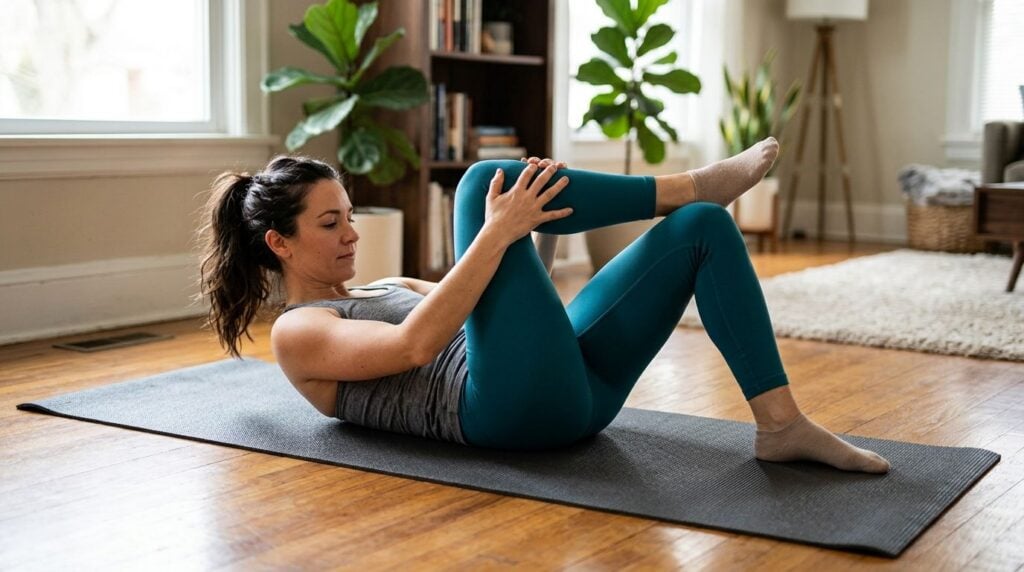
Lying on your back, cross one ankle over the opposite knee and pull the supporting thigh toward your chest. This version gives the most precise control over stretch angle because gravity and the floor do most of the work for you.
Supine figure-four stretch pros:
- Full control over stretch depth and direction
- Comfortable to hold longer than seated or standing versions
- Fits naturally into a bedtime routine, which matters if sleeping positions for sciatica pain are already part of managing symptoms
Supine figure-four stretch cons:
- Getting down to and up from the floor isn't ideal for everyone
- Needs a mat or rug for comfort
Verdict: build this into your evening or morning wind-down.
3. Standing piriformis stretch: best for quick relief on the go
Cross one ankle over the opposite knee while standing, using a wall for balance if needed, then bend the standing knee slightly and hinge forward. It takes under a minute and works anywhere — a hallway, a break room, beside a car.
Standing piriformis stretch pros:
- Fastest option when there's no time to sit or lie down
- Good for breaking up long periods of standing or walking
Standing piriformis stretch cons:
- Balance can be an issue for some people, especially mid-flare
- Harder to isolate the muscle compared to seated or supine versions
Verdict: keep this one in the rotation for busy days, not as your only stretch.
4. Pigeon pose: best for building longer-term flexibility
Borrowed from yoga, pigeon pose bends the front leg at a right angle across the mat while the back leg extends straight behind. It gives the deepest stretch of the group but demands more hip mobility to get into the position safely.
Pigeon pose pros:
- Deepest stretch through the piriformis and surrounding hip rotators
- Can be progressed over weeks as flexibility improves
Pigeon pose cons:
- Not beginner-friendly, particularly with an acute flare-up
- Easy to compensate through the lower back if hip mobility is limited
Verdict: ease into this one gradually once the simpler stretches feel manageable.
5. Foam rolling the glutes: best for muscle tension release
Sitting on a foam roller and rolling slowly across the glute muscles works the tissue itself rather than just its length. It's a useful companion to stretching rather than a replacement for it.
Foam rolling pros:
- Addresses muscle tension that static stretching alone might miss
- Can be done before stretching to make the muscle more receptive
Foam rolling cons:
- Can feel uncomfortable, especially in the first few sessions
- Doesn't replace targeted stretching or hip mobility work
Verdict: add it alongside stretches for piriformis syndrome, not instead of them.
6. Hip flexor and glute bridge combo: best for overall hip stability
Pairing a hip flexor stretch with glute bridges addresses the muscles working around the piriformis rather than the muscle in isolation. It's a slower approach but supports the hip as a whole system.
Hip flexor and glute bridge pros:
- Builds strength alongside flexibility
- Supports pelvic alignment, which connects to broader work like stretches for tight hip flexors
Hip flexor and glute bridge cons:
- Slower to show any change compared to direct piriformis stretches
- Needs consistency over several weeks to matter
Verdict: treat this as a supporting routine, not a quick fix.
How this list was ranked
Each stretch was assessed against the criteria above: how directly it targets the piriformis, how adjustable it is for different pain levels, equipment needed, and how well it fits into a daily routine. The seated and supine versions rank highest because they're the most accessible with the least room for error; pigeon pose and the hip flexor combo rank lower on ease of entry but higher on longer-term value.
“A stretch that causes tingling or numbness isn’t being done correctly for that person on that day.”
Which stretch should you choose?
Start with the seated piriformis stretch if you're at a desk most of the day, and layer in the supine figure-four stretch as an evening routine. If symptoms persist beyond a few weeks of consistent stretching, or if leg pain, numbness or weakness appears alongside the buttock tightness, that's a signal to get an assessment rather than push through with stretching alone — the sciatic nerve overlap is exactly why relieving sciatica pain fast at home sometimes needs guidance from a professional rather than guesswork.
Get your hip and spine assessed
Discuss piriformis-related pain with a registered chiropractor.
FAQ
What is the best stretch for piriformis syndrome?
The seated and supine figure-four stretches are the most commonly recommended starting points because they’re adjustable and low-risk. Which one suits you best depends on your daily routine and how your hip responds to each position.
How long should you hold a piriformis stretch?
A common guideline is 20-30 seconds per side, repeated 2-3 times daily. Pushing into sharp pain or tingling isn’t necessary and isn’t the goal.
Can stretching alone fix piriformis syndrome?
Stretching may help ease muscle tension, but ongoing or worsening symptoms often need assessment of hip and pelvic mechanics from a qualified health professional. Stretching is one part of a broader approach, not a standalone answer.
Is piriformis syndrome the same as sciatica?
No — sciatica describes nerve pain along the sciatic nerve pathway, and piriformis syndrome is one possible contributing cause among several, including disc-related issues. The two can feel similar, which is why an accurate assessment matters.
When should you stop stretching and see someone?
Stop if a stretch produces sharp pain, numbness, tingling or weakness rather than a mild pulling sensation. Persistent symptoms beyond a few weeks of consistent stretching are also a reason to seek assessment.
Does foam rolling help piriformis syndrome?
Foam rolling the glutes can complement stretching by working on muscle tension directly, though it works best alongside stretches for piriformis syndrome rather than replacing them. Some discomfort during rolling is normal; sharp pain is not.
One last thing
Published estimates put piriformis-related presentations at around 6% of sciatica-type cases (Boyajian-O'Neill et al., 2008), which means most leg pain that feels like sciatica has a different underlying cause. That's the reason a proper hip and spine assessment matters before assuming stretching alone will resolve the picture in 2026 or any other year.
Related guides
- How to know when back pain needs a chiropractor vs a doctor
- Chiropractic care for piriformis syndrome pain
- Best sleeping positions for sciatica pain
- Best stretches for tight hip flexors