

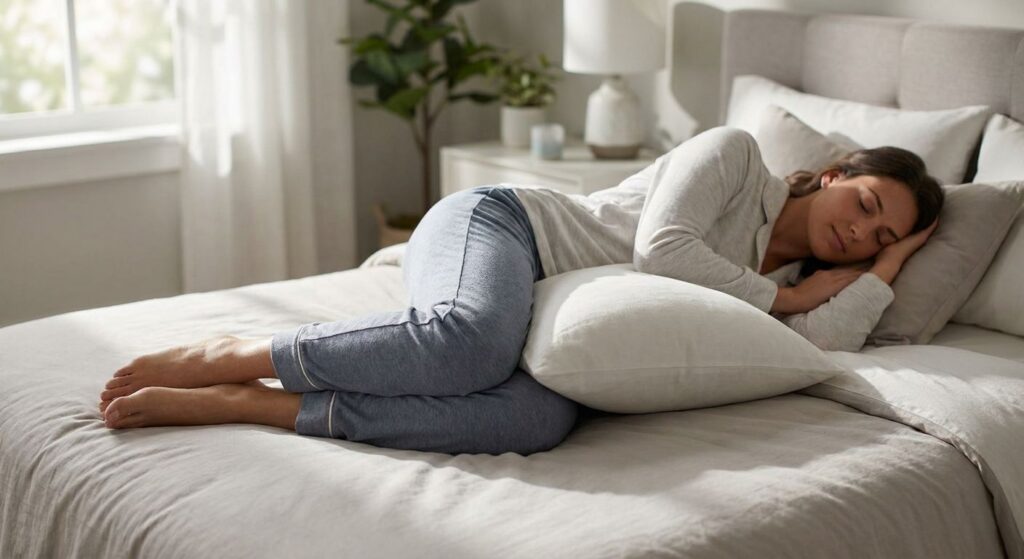
Sciatica pain often feels worse at night, and the position you fall asleep in can add pressure to the sciatic nerve rather than easing it. This guide ranks the sleeping positions most commonly discussed for sciatica-related leg and lower back pain, based on spinal alignment and nerve pressure, plus which positions to avoid during a flare.
- Side sleeping with a pillow between the knees is the best sleeping position for sciatica for most people – Recommended.
- Back sleeping with a pillow under the knees keeps the lumbar spine neutral – Recommended.
- Stomach sleeping arches the lower back and adds nerve pressure – Avoid during a flare.
- A reclined position with legs slightly elevated suits acute flare-ups – Worth trying.
- Tight fetal curling can compress the sciatic nerve on the lower side – Use with caution.
Why this matters
The sciatic nerve runs from the lower back through the buttock and down the leg, and it's formed from nerve roots around L4 to S3. Whatever position compresses those nerve roots overnight tends to carry into the next day as stiffness or leg pain.
Sleeping position isn't the only factor. Mattress firmness matters too — a 2003 study published in The Lancet found people with chronic low back pain reported better outcomes on a medium-firm mattress than a firm one. If nerve-related leg pain from a herniated disc is part of the picture, the position that keeps the spine neutral tends to be the one that feels least aggravating at night in 2026, same as it did a decade ago — the anatomy hasn't changed.
None of this replaces an assessment. Sciatica has several possible causes, and a chiropractor can assess which structures are involved before recommending anything specific to your case.
How the sleeping positions are ranked
Each position below is ranked on three things: how much it keeps the lumbar spine in a neutral, unrotated position, how much load it places directly over the buttock and hip (where the sciatic nerve is most exposed to pressure), and how practical it is to actually hold for a full night's sleep. Positions that score well across all three sit at the top.
This reflects general musculoskeletal principles commonly used in physiotherapy and chiropractic education, not a clinical trial run for this article. Individual results vary depending on the cause of your sciatica, disc involvement, and body shape — a chiropractor's assessment is the only way to know what applies to your spine specifically.
The ranked list
1. Side sleeping with a pillow between the knees
This is the position most often recommended as a starting point for sciatica because it keeps the pelvis level and reduces rotation through the lower spine. A firm pillow between the knees, roughly the height of a standard bed pillow folded in half, stops the top leg from pulling the hip and lower back out of alignment during the night.
Sleep on the side opposite the leg pain when one side is clearly worse — this takes direct pressure off the affected buttock. Verdict: Recommended.
2. Back sleeping with a pillow under the knees
Lying flat on the back with a pillow or rolled towel placed under both knees flattens the lower back's natural arch, which reduces the load on the lower lumbar segments. This is a common recommendation alongside a best lumbar support cushion for office chairs type of setup during the day, since both aim to keep the same neutral curve.
Some people with sciatica find flat back sleeping uncomfortable if there's any spinal stenosis involved, because full extension can narrow the space around the nerve roots further. Verdict: Recommended, with the knee pillow non-negotiable.
3. Reclined position with legs slightly elevated
A semi-reclined position — think an adjustable bed base at roughly 30 to 45 degrees, or several pillows stacked to prop the upper body — takes weight off the lower spine entirely. This tends to suit the first few nights of a sharp flare more than it suits long-term nightly sleep.
It's worth trying if flat positions feel unbearable during an acute episode, but it's not usually a permanent fix. Verdict: Worth trying during an acute flare.
4. Side sleeping on the unaffected side only
When sciatica clearly favours one leg, sleeping consistently on the opposite side reduces direct pressure on the irritated nerve root and hip. Symptoms tied to nerve root narrowing, as seen in some spinal stenosis symptoms, often respond to this kind of positional offloading more noticeably than back sleeping does.
The trade-off is less flexibility in the night — some people naturally roll onto the painful side while asleep. A body pillow along the back can help block that roll. Verdict: Worth trying, situational.
5. Fetal position, tucked tightly
A loose fetal curl, knees bent and spine gently rounded, can open up the space between vertebrae and briefly ease pressure on a compressed nerve root. Curling too tightly, though, rotates the lower spine and can pull the pelvis out of alignment, which works against the goal.
Keep the curl gentle rather than fetal-tucked-to-the-chest, and use a pillow between the knees the same way as standard side sleeping. Verdict: Use with caution.
6. Stomach sleeping
Lying face-down forces the lower back into extension and rotates the neck to one side for hours at a stretch. For most people with sciatica this is the position most likely to aggravate leg pain by morning, because it increases pressure through the lumbar spine exactly where nerve roots are most sensitive.
If stomach sleeping is the only position that allows sleep at all, a thin pillow under the pelvis can reduce some of the arch. It's still the position to move away from over time. Verdict: Avoid during a flare.
Comparison at a glance
| Position | Spinal alignment | Nerve pressure risk | Verdict |
|---|---|---|---|
| Side + pillow between knees | Neutral | Low | Recommended |
| Back + pillow under knees | Neutral | Low to moderate | Recommended |
| Reclined, legs elevated | Flexed | Low | Worth trying (acute) |
| Side, unaffected side only | Neutral | Low | Worth trying |
| Fetal, loosely tucked | Flexed | Moderate | Use with caution |
| Stomach | Extended | High | Avoid |
When to get sciatica pain assessed
Sleeping position changes are a reasonable first step, but they're not a substitute for finding out what's driving the nerve pressure in the first place. A chiropractor can assess posture, disc involvement, and nerve tension as part of working out what might be appropriate for your situation.
Seek medical assessment sooner, rather than adjusting pillows, if any of the following show up:
- Numbness or weakness spreading down the leg or into the foot
- Loss of bladder or bowel control
- Pain following a fall, car accident, or direct trauma
- Leg pain that wakes you repeatedly despite trying different positions
- Fever alongside back or leg pain
These can point to something that needs urgent medical review rather than a positional or postural adjustment, and should be discussed with a qualified health professional directly.
Daytime habits matter alongside night-time position. Heat applied to the lower back before bed is a common comfort measure worth comparing across the best heating pad options for lower back pain, and gentle daytime mobility — including stretches aimed at the best stretches for tight hip flexors — often gets discussed alongside sleep position changes because tight hips can pull on the same structures that irritate the sciatic nerve.
Get your sciatica assessed
A chiropractor can check posture, disc involvement and nerve tension before you change anything else.
FAQ
What is the best sleeping position for sciatica?
Side sleeping with a pillow between the knees is the position most commonly recommended for sciatica because it keeps the pelvis level and reduces rotation through the lower spine. Back sleeping with a pillow under the knees is a close second, since it flattens the lower back’s natural arch.
Is it better to sleep on your back or side with sciatica?
Both can work, and the better option depends on which nerve root is irritated and whether stenosis is involved. Side sleeping with knee support tends to be easier to hold consistently through the night, while back sleeping with a knee pillow suits people who find side positions uncomfortable.
Should you sleep on the painful side or the other side with sciatica?
Sleeping on the side opposite the pain generally takes direct pressure off the irritated nerve root and hip. A body pillow along the back can stop you rolling onto the painful side during the night.
Is stomach sleeping bad for sciatica?
Stomach sleeping forces the lower back into extension for hours, which increases pressure through the lumbar spine where sciatic nerve roots sit. It’s the position most likely to aggravate leg pain by morning for most people with sciatica.
Does mattress firmness affect sciatica at night?
A 2003 study in The Lancet found people with chronic low back pain reported better outcomes on a medium-firm mattress compared with a firm one. Mattress firmness works alongside sleeping position rather than replacing it.
Can a pillow between the knees really help sciatica?
A pillow between the knees keeps the top leg from pulling the pelvis and lower spine out of alignment during side sleeping. It’s a low-cost first step that’s easy to test the same night.
How long does sciatica take to settle with position changes alone?
There’s no fixed timeline, since it depends on what’s causing the nerve pressure. If leg pain, numbness, or weakness persists or worsens despite trying different sleeping positions, an assessment with a qualified health professional is the next step.
What sleeping positions should sciatica patients avoid?
Stomach sleeping and tightly tucked fetal positions are the two most commonly flagged as aggravating for sciatica in 2026, because both increase rotation or extension through the lumbar spine. Gentle, neutral positions with knee support are generally easier on the nerve.
One last thing
The pillow matters less than people expect — a rolled towel or a firm cushion between the knees does the same job as a specialty wedge pillow, since the goal is simply keeping the pelvis level. What tends to matter more is staying in one position for hours at a stretch: even the best sleeping position for sciatica can start to ache if you never shift at all, so a light repositioning once or twice a night is normal, not a sign something's wrong.
Related guides