

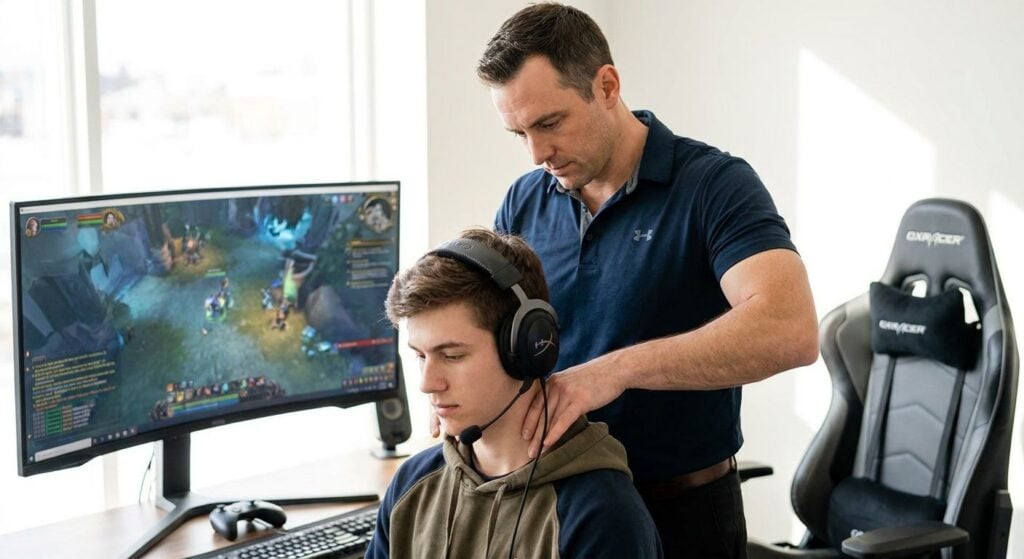
Gamer and esports chiropractic care is a structured assessment and management approach for people who train and compete in fixed screen postures for hours at a stretch, with the aim of supporting neck, shoulder, wrist and lower back function through long practice blocks and tournament schedules. Competitive gaming is different from a typical desk job because the posture barely changes for hours, the wrist and finger movements are rapid and repetitive, and training hours often run late into the night around scrims and ranked queues. A chiropractor for gamers assessment at MyChiro in Bondi Junction typically starts with a look at your setup and movement patterns before anything else.
- Chiropractor for gamers care starts with posture and movement assessment, not adjustment on day one.
- Esports sessions of 6 to 10 hours put sustained load on the neck, wrists and lower back with few natural breaks.
- Ergonomic setup and scheduled movement breaks are the first line of self-management before any clinical visit.
- A chiropractic assessment can identify which joints or muscles are under the most load from your specific setup.
- Tingling fingers, persistent neck stiffness or headaches at the base of the skull are cues to get assessed, not to keep grinding.
Why this matters for gamers and esports players
A scrim block, a ranked grind session or a tournament day can mean sitting in near-identical posture for 6 to 10 hours with only bathroom breaks in between. That's a different load pattern to an office job, where meetings, walking to a printer or a commute force some incidental movement into the day.
The wrists and fingers also do thousands of repetitive micro-movements per session, on top of a neck held in forward flexion to view a monitor. This combination of static posture plus repetitive strain is the specific pattern chiropractic care for gamers is built to assess. None of this means gaming causes permanent damage — it means the load pattern is worth paying attention to, the same way a tradie's back or a swimmer's shoulder gets attention in their own line of work.
Set up your gaming station for a neutral spine position
Before anything clinical, the setup itself is the first thing worth checking. Small adjustments to monitor height, chair support and desk layout change how much load the neck and lower back carry over a session.
- Set the top of the monitor at or just below eye level so the neck isn't held in forward flexion
- Choose a chair that keeps contact with the lower back, or add a lumbar cushion if the seat doesn't
- Keep keyboard and mouse at a height where elbows sit close to 90 degrees
- Rest feet flat on the floor or on a footrest, not tucked under the chair
- Position the headset so the weight sits evenly rather than pulling to one side
An ergonomic setup guide built for shift workers covers the same desk-height and chair-support principles that apply directly to a gaming station.
Build movement breaks into every session
A break schedule matters more than any single piece of gear. The body doesn't need a long break, it needs a frequent one.
- Set a timer for a 5 to 10 minute break every 60 minutes of continuous play
- Use loading screens, patch downloads or map rotations as a cue to stand up
- Roll the shoulders and turn the neck side to side between rounds
- Avoid stacking scrims back-to-back with zero break in between
- Treat the break as scheduled, not optional — willpower alone tends to lose to a close match
Manage repetitive wrist and finger strain
Wrist position during long sessions matters as much as neck position. A bent wrist under repeated load is a common pattern in gaming-related strain.
- Keep the wrist in a neutral, straight line rather than bent up or down at the mouse or keyboard
- Use a wrist rest only between actions, not while actively clicking or typing
- Vary mouse sensitivity and grip style occasionally to change which muscles do the work
- Stretch fingers and forearms during breaks, not just the neck and shoulders
- Note any tingling or numbness rather than pushing through it
Symptoms like these overlap with what's covered in the carpal tunnel and repetitive strain article, which looks at repetitive hand and wrist strain in more detail.
Strengthen the muscles that support long sitting
Strength work outside gaming sessions supports posture during them. The muscles that hold the shoulders back and the spine upright need direct attention because sitting doesn't train them.
- Add glute and hip flexor work two to three times a week to counter hours of hip flexion
- Train upper back and rear shoulder muscles to help offset a forward-rounded posture
- Include gentle neck isometrics to build endurance for holding the head upright
- Keep core work in the mix without straining the lower back in the process
Track early signs of nerve or joint strain
Some signals are worth acting on rather than working around. These aren't signs to panic about, but they are signs worth noting and discussing with a health professional.
- Tingling or numbness in the fingers during or after a session
- Neck stiffness that's still there first thing in the morning
- Lower back ache that doesn't ease once you're up and moving
- Headaches concentrated at the base of the skull
- Shoulder or wrist pain that changes how you play, not just how you feel
If any of these show up regularly, that's the point to get assessed rather than to keep grinding through a tournament block.
Get a posture and spine assessment when self-management isn't enough
Ergonomic fixes and break schedules cover a lot of ground, but they don't replace a professional look at your specific posture and movement pattern. This is where a chiropractic assessment fits in as one option, not a mandatory first step.
- A chiropractor can assess posture, joint movement and muscle tension across the neck, shoulders and spine
- Assessment findings can point to which areas may be carrying more load from a specific gaming setup
- A management plan, where appropriate following assessment, may include adjustment, mobility work and self-care advice tailored to the individual
- Ongoing symptoms, numbness or pain that doesn't settle are worth discussing with a GP as well, particularly before assuming a chiropractic visit alone covers it
A chiropractic assessment can help identify which joints and muscles are under the most load from your setup, which is useful information whether you play casually or compete at an amateur or semi-professional level.
Comparing options for gaming-related strain
| Option | Best for | Key limitation |
|---|---|---|
| DIY ergonomic setup + break schedule | Early-stage stiffness prevention | Doesn't address symptoms that are already established |
| Remedial massage | Short-term muscle tension relief | Doesn't address the underlying setup or posture pattern |
| Physiotherapy assessment | Muscle and movement-based rehab after strain | May not focus on joint mobility restrictions specifically |
| Chiropractic assessment and adjustments | Assessing spinal and joint movement restrictions from prolonged sitting | Suitability and outcomes depend on individual assessment; not a substitute for urgent medical care |
Book a posture and spine assessment
Discuss gaming-related neck, wrist or back strain with a chiropractor in Bondi Junction.
Common mistakes gamers and esports players make
- Treating grind culture as a reason to skip breaks — a break every hour costs less time overall than nursing a stiff neck through finals week
- Buying an expensive gaming chair but leaving the monitor at the wrong height — the chair only fixes part of the posture chain
- Dismissing tingling fingers as "just gamer's hands" — persistent numbness is a signal worth checking, not a normal cost of competing
- Stretching only the neck and shoulders — wrists and forearms carry as much repetitive load and get skipped most often
- Waiting until a tournament week to address pain — by then there's less time to adjust training load or recover between matches
FAQ
Is chiropractic care suitable for gamers and esports players?
Chiropractic assessment can be appropriate for gamers experiencing neck, shoulder, wrist or lower back strain from long sessions, following an individual assessment. Suitability depends on the specific symptoms and history, which a chiropractor reviews before recommending any management plan.
Can gaming posture cause neck and shoulder pain?
Sitting in a forward-head, rounded-shoulder posture for 6 to 10 hours a day can be associated with neck and shoulder tension in some people. Ergonomic setup changes and scheduled movement breaks are the first things worth adjusting before assuming a clinical issue.
How often should esports players take breaks during long sessions?
A 5 to 10 minute break every 60 minutes is a practical starting point for long gaming or training sessions. Using natural pauses like loading screens or map rotations makes the habit easier to keep.
What’s the difference between a chiropractor and a physiotherapist for gaming-related pain?
A chiropractor focuses on assessing and managing spinal and joint movement, while a physiotherapist typically focuses more on muscle rehabilitation and movement retraining. Both can be discussed as options depending on the specific symptoms involved.
Can wrist pain from gaming be related to the neck or upper back?
Nerve pathways run from the neck and upper back down through the arm to the hand, so wrist or finger symptoms are sometimes connected to issues further up the chain. This is one reason a full postural assessment looks beyond just the wrist itself.
How is chiropractic care for gamers different to a general chiropractic visit?
The assessment covers the same spinal and joint examination as any visit, with specific attention to gaming-related postures, wrist and finger repetition, and session length. The management plan, where appropriate, is discussed around a player’s actual training schedule.
When should a gamer see a doctor instead of a chiropractor?
Sudden severe pain, numbness that spreads or persists, weakness in the hand or arm, or symptoms following an injury should be assessed by a doctor first. A chiropractor can also refer on if findings suggest something needs medical review.
Does a standing desk help with gaming-related back pain?
Alternating between sitting and standing can reduce time spent in one fixed posture, which some people find useful alongside scheduled breaks. It’s one tool among several, not a replacement for addressing chair support, monitor height and break frequency.
One last thing
Set your break timer to match a loading screen or map rotation length rather than the clock on the wall — it's easier to stick to a break tied to something already happening in the game than one that competes with a close round. In 2026, esports schedules keep getting longer, which makes a repeatable break habit more useful than a single ergonomic purchase.
Related guides
- Strengthen your core without straining your lower back
- Chiropractic care for tennis elbow and repetitive strain