

Scoliosis stretches won't straighten a curve, but the right ones can support mobility, posture awareness and day-to-day comfort when they're part of a plan a qualified health professional has actually looked at.
- Cat-Cow and thread-the-needle top the list of best stretches for scoliosis for daily mobility work in 2026.
- Stretching does not correct spinal curvature and is not a substitute for assessment by a chiropractor or GP.
- Structural scoliosis is generally defined by a Cobb angle of 10 degrees or more, a measurement only imaging confirms.
- Hold most stretches for 20 to 30 seconds and repeat 2 to 3 times daily as a general mobility habit, not a fix.
- Chiropractic care for scoliosis in teenagers can be discussed as part of a broader assessment alongside a GP or specialist.
Why this matters
Scoliosis is a structural change in the spine's curvature, and it ranges from mild curves that are simply monitored to more pronounced ones that need input from a specialist team. Stretching sits in the "supportive" category, not the "management" category, and understanding that distinction upfront changes how you should use this list.
For context on what a broader, assessment-led approach looks like, the chiropractic care for scoliosis in teenagers guide covers how a chiropractor typically approaches a young patient's posture, mobility and comfort as part of a wider care conversation. Nothing here replaces that kind of individual assessment.
Most of the stretches below target thoracic and lumbar mobility, hip flexibility and rib cage expansion on the concave side of a curve — areas that commonly feel tight regardless of how mild or pronounced the curve is. None of them are presented as a way to reduce Cobb angle or reverse curvature, because stretching alone doesn't do that.
How these stretches were selected
Each stretch below is a widely used mobility exercise found across physiotherapy and postural exercise resources, chosen for accessibility (no equipment needed for most), the muscle groups it targets, and how commonly it appears in general spinal mobility programs. They're ordered from gentlest to most involved, not from "most effective" to "least effective" — with scoliosis, appropriateness depends on curve type, location and how a person's body responds, which is exactly the kind of thing an assessment sorts out rather than a ranked list.
If a stretch causes sharp pain, numbness, or pain that radiates down a limb, stop and get that checked rather than pushing through.
The stretches ranked
1. Cat-Cow — the gentle starter
On hands and knees, alternate between arching and rounding the spine for 8 to 10 slow cycles. It moves the entire spine through flexion and extension without loading it, which makes it a reasonable first stretch for almost anyone regardless of curve severity.
It's low-risk and widely tolerated, which is why it typically opens most general spinal mobility routines in 2026. Try it daily.
2. Child's Pose with lateral reach — the side-bend specialist
From a kneeling child's pose, walk both hands to one side and hold for 20 to 30 seconds, then switch. This adds a lateral stretch through the lats and obliques on one side of the trunk, which is often the tighter side in a scoliotic curve.
Because curves are asymmetric, this one-sided stretch can feel noticeably different left to right — that's expected, not a red flag on its own. Try it, noting any sharp difference between sides.
3. Standing side stretch — the desk-break option
Stand tall, reach one arm overhead and lean gently to the opposite side, holding 20 seconds per side. It needs zero setup, which makes it realistic to do two or three times through a workday rather than only once.
At Bondi Junction desks and similar office setups, this is the stretch people actually stick with because it takes under a minute. Try it between meetings.
4. Thread the Needle — the rotation warm-up
From hands and knees, thread one arm under the body and rotate the upper spine, holding the end position for 15 to 20 seconds before switching sides. It targets thoracic rotation, which tends to be restricted on the side of a curve's convexity.
This one takes more coordination than Cat-Cow, so it's worth doing slowly rather than rushing the rotation. Try it after a few weeks of Cat-Cow.
5. Seated Spinal Twist — the chair-friendly move
Seated, cross one leg over and rotate the torso toward the bent knee, holding 20 seconds each side. It's a smaller-range version of thread the needle that works from a chair, which matters for anyone who sits most of the day.
For readers managing posture around long sitting stretches, the leg length discrepancy and posture imbalance guide covers a related postural asymmetry that sometimes gets confused with scoliosis on casual observation. Try it as a desk-break substitute for the standing stretch.
6. Wall Lat Stretch — the shoulder unlock
Face a wall, place both hands on it at shoulder height, and lean the hips back while keeping arms straight, holding for 20 to 30 seconds. Tight lats commonly pull on the shoulder blades and mid-back, which can exaggerate how a curve presents visually even when the curve itself hasn't changed.
For shoulder blade positioning specifically, the winged shoulder blades guide walks through a related but distinct postural pattern worth ruling out. Try it if shoulder asymmetry is part of the picture.
7. Pelvic Tilt — the core activator
Lying on your back with knees bent, flatten the lower back into the floor by tilting the pelvis, hold 5 seconds, release, repeat 10 times. It's less a stretch and more a low-load activation exercise, but it consistently shows up alongside stretching in general spinal mobility programs.
It won't change curvature, but it's a reasonable addition for anyone whose lower back feels the most fatigued by the end of the day. Try it as a nightly add-on.
8. Foam Roller Thoracic Extension — the equipment pick
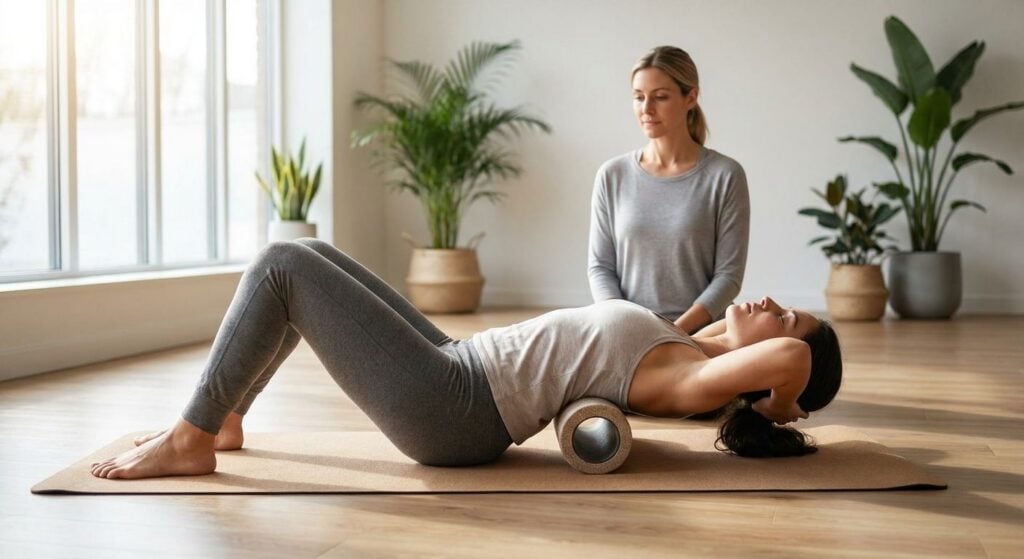
Lying with a foam roller placed horizontally under the mid-back, support the head with both hands and gently extend backward over the roller for 30 to 60 seconds. This is the one stretch on the list that needs equipment, and it works best for people whose curve sits in the thoracic spine and who already have some baseline mobility.
Starting position matters here — going too far back too fast is the most common mistake with this one. Consider it once the earlier stretches feel comfortable, and skip it if thoracic extension feels sharp rather than tight.
Comparison at a glance
| Stretch | Primary area | Hold/reps | Verdict |
|---|---|---|---|
| Cat-Cow | Full spine | 8-10 cycles | Try it |
| Child's Pose lateral reach | Lats, obliques | 20-30 sec/side | Try it |
| Standing side stretch | Trunk side | 20 sec/side | Try it |
| Thread the Needle | Thoracic rotation | 15-20 sec/side | Try it |
| Seated spinal twist | Thoracic/lumbar rotation | 20 sec/side | Try it |
| Wall lat stretch | Lats, shoulder blades | 20-30 sec | Try it |
| Pelvic tilt | Lumbar/core | 10 reps | Try it |
| Foam roller extension | Thoracic spine | 30-60 sec | Consider it |
What to avoid
- Deep, unsupervised weighted spinal twists — adding load to a rotational stretch without guidance is a common way people aggravate an already asymmetric spine.
- Copying someone else's routine off social media — a stretch that suits a mild lumbar curve may not suit a pronounced thoracic curve, and there's no way to tell from a video alone.
- Pushing through sharp or radiating pain — general muscle tightness feels dull and diffuse; nerve-related pain feels sharp, burning, or travels down an arm or leg, and that distinction is a reason to get assessed rather than stretch harder.
Get your posture assessed
Book a spinal and postural assessment at the Bondi Junction clinic.
Getting personalised guidance
- Start with an assessment before building a routine, especially if a curve has been recently diagnosed or has changed — a chiropractor, GP or specialist can flag which of these stretches make sense for the curve's location and severity.
- Look for guidance that treats stretching as one part of a broader plan alongside posture habits and general strength work, not a standalone answer.
- If lower back symptoms sit alongside a diagnosed curve, the spinal stenosis symptoms guide is worth a read, since some of the referred pain patterns overlap and are worth distinguishing.
MyChiro's clinic in Bondi Junction takes postural and spinal assessments as a starting point rather than assuming one routine fits every curve — that's the practical reason a five-minute check-in matters more than the stretch list itself.
FAQ
What are the best stretches for scoliosis?
Cat-Cow, seated spinal twists, standing side stretches and thread-the-needle are commonly used mobility stretches for people with scoliosis. They support general spinal mobility and comfort rather than correcting curvature, and suitability depends on the curve’s location and severity.
Can stretching fix or reverse scoliosis curvature?
No, stretching does not correct structural spinal curvature. It can support mobility and comfort as part of a broader plan, but changes to Cobb angle require assessment and management from a qualified health professional.
Is chiropractic care appropriate for scoliosis?
Chiropractic care can be discussed as part of a broader assessment for people with scoliosis, particularly around posture, mobility and comfort. Whether it’s appropriate depends on individual assessment findings, not a general rule.
How often should scoliosis stretches be done?
Most general mobility stretches are held for 20 to 30 seconds and repeated 2 to 3 times daily as a habit, similar to any spinal mobility routine. Frequency should still be discussed with whoever is overseeing the individual’s care plan.
What Cobb angle counts as scoliosis?
Structural scoliosis is generally defined by a Cobb angle of 10 degrees or more, measured on standing X-ray. Angle alone doesn’t determine what stretches or care approach suits a person; that comes from a full assessment.
Are scoliosis stretches different for teenagers versus adults?
The stretches themselves are largely the same, but the reasoning differs because adolescent curves can still be actively growing while adult curves are typically more stable. This is one reason teen scoliosis is usually monitored on a different schedule than adult scoliosis.
When should scoliosis-related pain be checked instead of stretched?
Pain that is sharp, radiates down an arm or leg, or comes with numbness or weakness should be assessed rather than stretched through. Dull, generalised tightness is a more typical candidate for general mobility stretches.
Does stretching help with scoliosis-related posture?
Stretches that target rotation and lateral flexion, such as thread-the-needle and side stretches, can support posture awareness and comfort day to day. They work alongside, not instead of, professional assessment of the underlying curve.
One last thing
Most idiopathic scoliosis in adolescents is mild, and curves under roughly 25 degrees are typically monitored rather than actively managed — which is a useful reality check against any routine, stretch list or program that implies aggressive intervention is always the next step. The honest answer for most people reading this in 2026 is that a five-minute assessment tells you more than any stretch list, including this one.
Related guides
- Chiropractic care for scoliosis in teenagers
- Chiropractic care for leg length discrepancy and posture imbalance
- How to fix winged shoulder blades naturally
- Chiropractic care for spinal stenosis symptoms