


Cold weather can coincide with a back pain flare-up, but research does not establish cold temperature as a consistent cause of worsening low back pain. If your back feels worse in winter, consider changes in movement, sitting and sleep alongside the weather, and seek medical advice for new, persistent or concerning symptoms.
- Can cold weather make back pain worse? Research does not establish cold temperature as a consistent low back pain trigger.
- A winter flare-up does not, by itself, show new spinal damage or a need for chiropractic adjustments.
- MyChiro provides chiropractic care in Bondi Junction; whether care is appropriate depends on individual assessment.
- New bladder changes, saddle numbness or progressive leg weakness require urgent medical assessment, not a weather explanation.
Can cold weather make back pain worse?
Some people notice more back discomfort in cold weather, but that experience does not establish that temperature caused it. Research needs to separate temperature from other influences, including physical activity, sleep and the natural fluctuations of back pain.
A 2024 systematic review and meta-analysis in Seminars in Arthritis and Rheumatism examined weather and musculoskeletal symptoms using case-crossover studies. It did not find an association between weather factors and low back pain. That finding challenges simple claims that cold weather reliably triggers a flare-up; it does not make an individual's discomfort less real.
For winter 2026, distinguish what you notice from what you can conclude. If your day now includes longer periods on the couch, the guide to lower back pain when sitting covers a relevant change in routine.
| Observation | What it tells you | What it does not establish |
|---|---|---|
| Your back aches on cold mornings | Symptoms occur during that part of your day | Cold has damaged your spine |
| You sit more when it rains | Your activity pattern has changed | Sitting explains every symptom |
| Warm clothing feels comfortable | You prefer warmth in that situation | Heat has corrected an underlying problem |
| Pain changes with the forecast | You have noticed a possible pattern | Weather is the confirmed cause |
Why this matters
Blaming every winter flare-up on the weather can distract you from useful questions. Have your symptoms changed? Are you doing less of your usual activity? Is pain interrupting sleep or work?
The opposite response is unhelpful too. A weak population-level association does not mean you should ignore symptoms or assume your experience is imagined. Your symptoms deserve attention without an unsupported explanation about what the cold is doing to your spine.
This 2026 guide focuses on general adult back pain education. It does not diagnose a cause or recommend a particular clinical procedure.
Why back pain varies during colder months
Back pain has physical, psychological and social influences. The World Health Organization's 2023 guideline for chronic primary low back pain recommends a person-centred approach rather than explaining persistent symptoms through a single physical factor.
These are useful areas to discuss, not proof that any particular factor caused your winter flare-up:
- Movement: Compare your current walking, household activity and exercise with your usual routine. Rain or shorter daylight hours can change what you choose to do.
- Sitting: Notice whether working indoors or spending evenings on the couch means longer uninterrupted periods in one position.
- Sleep: Record whether discomfort wakes you or whether disrupted sleep started before the flare-up. Both details belong in an assessment.
- Workload: Include lifting, gardening, commuting and sudden changes in exercise. A weather change can occur alongside a change in physical demands.
- Stress: Consider work pressure, worry about symptoms and other demands. A biopsychosocial assessment includes these without dismissing physical pain.
- Health changes: New illness, injury, medication changes or unfamiliar symptoms should not automatically be attributed to winter.
You do not need to identify the cause yourself. Your observations help a qualified health professional understand the pattern and decide whether further assessment is needed.
What can you do when your back feels worse in winter?
For back pain without warning signs, general guidance supports continuing usual activities as tolerated rather than prolonged bed rest. Australia's Low Back Pain Clinical Care Standard, published in 2022, places assessment, information and supported self-management at the centre of care.
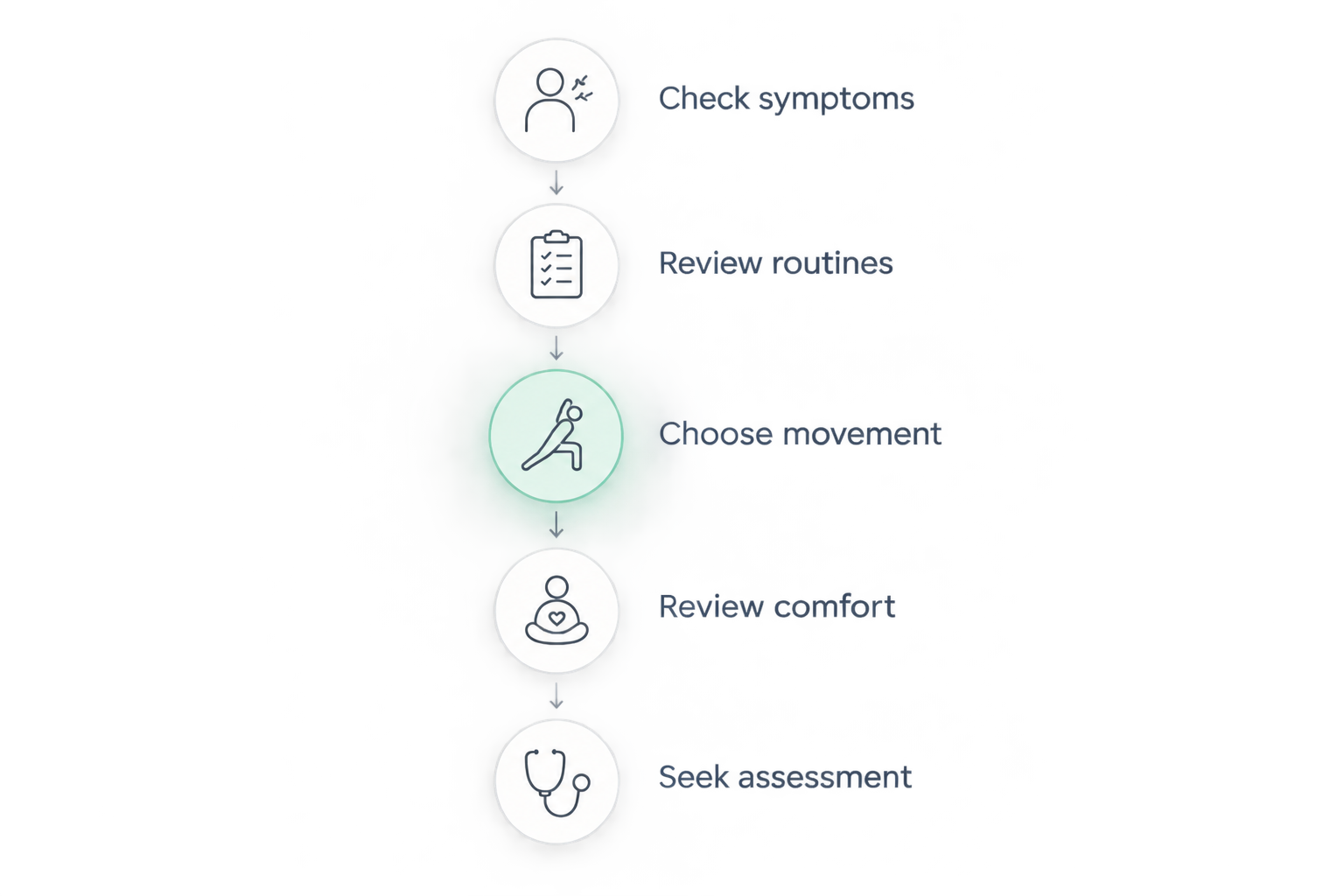
Use the following sequence as a discussion framework. It is not a personalised exercise prescription.
- Check symptoms. Ask whether this feels like your familiar discomfort or something new. Review the warning signs below before assuming it is another seasonal flare-up.
- Review routines. Compare a typical uncomfortable day with a more comfortable day. Include movement, sitting, work demands, sleep and the timing of symptoms.
- Choose movement. If there are no warning signs, continue tolerable daily activities. Adjust the task rather than forcing through a marked increase in symptoms.
- Review comfort. Use clothing, room temperature and position changes according to comfort. None of these measures establishes a diagnosis.
- Seek assessment. Arrange appropriate advice if pain persists, worsens, limits usual activities or leaves you uncertain about what to do.
Avoid turning the sequence into another task to perform perfectly. The purpose is to gather useful information and make proportionate decisions, not to monitor every movement or find a single posture you must maintain all day.
Choosing between everyday options
Different options serve different purposes. A comfort measure is not the same as an assessment, and an assessment does not automatically mean you need a procedure.
| Option | Useful context | Practical advantage | Limitation |
|---|---|---|---|
| Comfortable layers | You feel cold during daily activities | You can adjust them to the setting | They do not identify the cause of pain |
| Position changes | You remain in one position for long periods | They introduce variety into your day | No position suits everyone continuously |
| Tolerable activity | You can continue ordinary tasks without concerning symptoms | It maintains participation in daily life | The amount and type need individual adjustment |
| Clinical assessment | Symptoms persist, change or restrict daily life | It allows history-taking, examination and referral decisions | It does not guarantee a specific diagnosis or outcome |
For your 2026 winter routine, choose changes that fit your circumstances rather than buying equipment because a flare-up coincided with a cold morning.
Does cold weather mean your back is being damaged?
A cold-weather flare-up does not, by itself, demonstrate spinal damage. Pain intensity and the amount of tissue damage are not interchangeable measures, and symptoms cannot establish a structural diagnosis without appropriate assessment.
Avoid explanations that say cold has shifted a vertebra, trapped a nerve or dried out a disc. A weather-related symptom pattern alone does not support those conclusions.
Equally, reassurance should not become dismissal. A clinician needs to consider your history, examination and any warning signs before advising you about the next step. Imaging is not routinely recommended for uncomplicated low back pain; the Australian clinical care standard supports selective imaging when findings would influence management.
Should you use heat when your back feels stiff?
Warmth is a comfort preference, not evidence that cold caused your back pain. If you choose a heat pack, follow its instructions, protect your skin and do not sleep on it.
Ask a health professional before using heat if you have reduced skin sensation, circulation concerns or uncertainty about whether it is suitable. Stop if it causes burning, skin irritation or increased discomfort.
There is no universal temperature or application schedule suitable for everyone. More heat is not necessarily more helpful, and warmth should not delay assessment of unfamiliar or worsening symptoms.
When should you get medical help rather than blame winter?
New neurological symptoms or signs of serious illness need medical assessment, regardless of the forecast. Do not wait for warmer weather to see whether they disappear.
Seek emergency assessment for back pain with:
- New difficulty passing urine, loss of bladder or bowel control, or numbness around the genitals, buttocks or inner thighs.
- New or rapidly worsening leg weakness, particularly when both legs are affected.
- Chest pain, severe abdominal pain, collapse or difficulty breathing.
In Australia, call 000 for an emergency.
Arrange prompt medical assessment for back pain after significant trauma, pain with fever or feeling seriously unwell, or new unexplained symptoms in someone with a cancer history. Unexplained weight loss, persistent deterioration and a substantial change from your usual pain also warrant medical discussion.
These examples are not an exhaustive diagnostic checklist. If something feels substantially different or you are unsure about urgency, contact an appropriate medical service.
Should you see a chiropractor for a winter flare-up?
Cold weather alone is not a reason to begin chiropractic appointments. The first question is whether you need assessment and which health professional is appropriate for your symptoms, medical history and preferences.
MyChiro is a chiropractic clinic and wellness centre in Bondi Junction, Sydney. MyChiro provides chiropractic care and spinal adjustments; whether any proposed care is appropriate requires individual assessment and discussion of alternatives, risks and expected limitations.
Before agreeing to care, ask what the assessment suggests, what remains uncertain and whether referral is indicated. Ask how progress would be reviewed and what would prompt a change of plan. Chiropractic adjustments should not be presented as a way to prevent weather-related flare-ups or guarantee a particular outcome.
You can read about MyChiro if you are considering a local chiropractic assessment. Seek medical assessment instead when symptoms suggest illness, significant injury or neurological change.
How can you track a winter back pain pattern?
A brief record can make an appointment more useful. Note when symptoms occur, what you were doing, how sleep was affected and whether anything changed your ability to carry out ordinary tasks.
If you use a pain scale from 0 to 10, record function alongside the score. Being able to dress, walk or complete a shift gives context that a pain rating alone does not provide.
For winter 2026, record comfortable days as well as difficult ones. Recording only cold, painful days makes it harder to assess whether the apparent pattern holds across your ordinary experience.
Keep the record simple. It is information for a conversation, not a test you need to pass or proof of a diagnosis.
FAQ
Can cold weather make back pain worse even if I stay indoors?
You can notice worse back pain while staying indoors, but that does not establish cold temperature as the cause. Consider changes in sitting, movement, sleep and other symptoms, and seek assessment if the pattern persists or changes.
Does winter back pain mean I have arthritis?
Winter back pain does not establish an arthritis diagnosis. A qualified health professional needs to consider your symptoms, history and examination rather than infer a condition from the season.
Should I stay in bed when my back hurts in cold weather?
Prolonged bed rest is not routinely recommended for uncomplicated low back pain. Continue tolerable daily activity and seek individual advice if symptoms prevent ordinary movement or you have warning signs.
Is a heat pack suitable for winter back pain?
A heat pack is not suitable for everyone. Follow the product instructions, protect your skin and ask a health professional first if you have reduced sensation, circulation concerns or uncertainty about using heat.
Do I need a scan because my back hurts more in winter?
Worse pain in winter alone does not establish a need for imaging. Australia’s Low Back Pain Clinical Care Standard supports selective imaging based on clinical assessment and whether the result would change management.
Should I book chiropractic adjustments whenever the weather turns cold?
Cold weather alone is not a reason to book chiropractic adjustments. Any proposed care should follow individual assessment, informed discussion and consideration of whether medical referral is appropriate.
What back pain symptoms should not wait for a routine appointment?
New bladder or bowel changes, saddle-area numbness or rapidly worsening leg weakness require urgent medical assessment. Call 000 in Australia for an emergency, including collapse, chest pain or difficulty breathing.
One last thing
A useful winter diary includes the days your back feels comfortable. Otherwise, it records the flare-ups without the comparison needed to question a weather explanation.
During 2026, focus on what your symptoms stop you doing, what has changed and whether warning signs are present. Those details are more useful in a clinical conversation than the temperature alone.
Related guides
- How to prepare for your first chiropractor appointment
- How to choose a mattress for back comfort and support
- How chiropractors coordinate with GPs on imaging referrals