
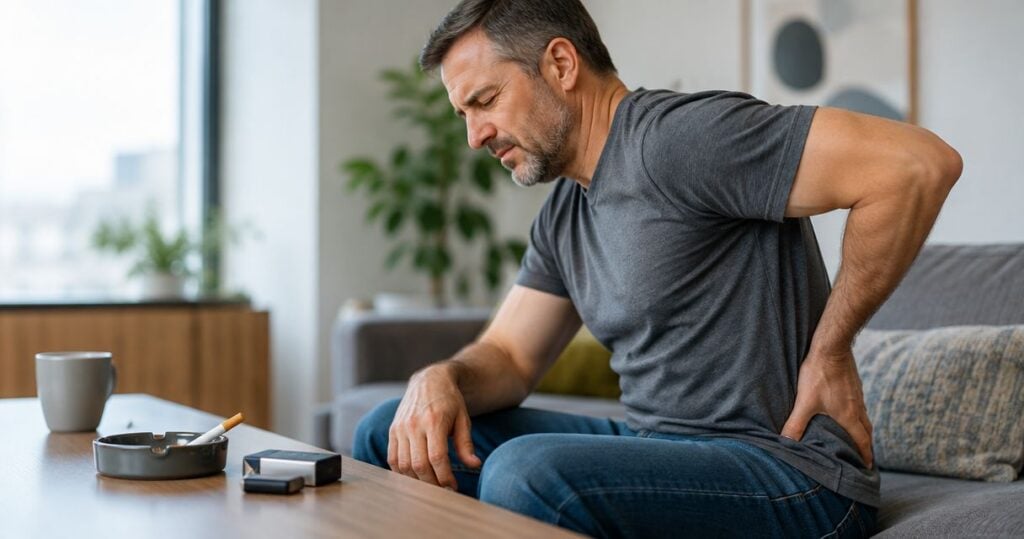
Yes—smoking is associated with a higher likelihood of back pain and can affect bone health, but it does not establish the cause of an individual person’s symptoms. Quitting is recommended for your overall health; it does not guarantee that existing back pain will disappear. This guide explains the evidence, its limits and practical questions to discuss with a qualified health professional.
- Can smoking affect spinal health and back pain? Research links smoking with back pain, without proving an individual diagnosis.
- Smoking cessation supports general health; it is not a guaranteed back pain remedy.
- Mychiro is a chiropractic clinic in Bondi Junction, not a smoking-cessation service.
- Discuss persistent symptoms and quitting support with your GP; seek urgent assessment for concerning changes.
Why this matters
Smoking belongs in a back pain assessment, but it should not become the whole explanation. Your symptoms, medical history, daily activities and examination still matter. A risk factor is not a diagnosis.
For readers considering Mychiro, chiropractic care and smoking-cessation support are separate discussions. Neither a smoking history nor a scan finding automatically establishes that adjustments are appropriate.
The practical message for 2026 is straightforward: address tobacco use without blaming yourself, and assess back pain on its own merits. You do not need to wait until you have stopped smoking to ask for medical advice about symptoms.
Can smoking affect spinal health and back pain?
Yes. A meta-analysis by Shiri and colleagues, published in the American Journal of Medicine in 2010, found an association between smoking and low back pain across observational studies. An association means the factors occur together more often; it does not show that smoking caused every episode of pain.
The US Surgeon General’s Bone Health and Osteoporosis report, published in 2004, also identifies smoking as a factor relevant to poorer bone health. That broader evidence matters when discussing spinal health, because the vertebrae are bones. It does not mean that every smoker has osteoporosis, a fracture or damaged spinal discs.
Use these distinctions when reading health information in 2026:
| Evidence statement | What it means for you | What it does not establish |
|---|---|---|
| Smoking is associated with low back pain | Tobacco use is relevant to your health history | Smoking is the sole cause of your pain |
| Smoking is relevant to bone health | Your GP may consider it alongside other risk factors | You automatically need a bone-density test |
| Back pain has multiple contributing factors | Assessment should consider more than smoking | Every contributor requires a separate procedure |
| Stopping smoking supports general health | Quitting support is worth discussing | Your back pain will resolve on a fixed timetable |
The distinction protects you from opposite mistakes: dismissing smoking as irrelevant, or attributing every symptom to it. Neither approach replaces an assessment.
Does smoking mean my spinal discs are damaged?
Smoking history alone cannot diagnose disc damage. Research about smoking and spinal degeneration concerns patterns across groups, not a reliable prediction about your individual spine. Pain severity also cannot tell you exactly what a disc looks like.
Do not assume that an X-ray or MRI is necessary because you smoke. The Australian Commission on Safety and Quality in Health Care’s Low Back Pain Clinical Care Standard, published in 2022, supports assessment-led decisions about imaging rather than routine scanning for everyone with low back pain.
Will quitting smoking make my back pain go away?
Quitting does not come with a guaranteed back pain outcome. The association between smoking and pain cannot establish how an individual person’s symptoms will change after stopping.
Keep quitting support and symptom assessment connected, but separate their goals. Your GP can discuss tobacco dependence while also considering whether your back pain needs investigation, advice about activity or referral.
Why the relationship between smoking and back pain varies
Back pain is not a direct measure of tobacco exposure. The World Health Organization’s 2023 guideline on chronic primary low back pain describes care that considers physical, psychological and social factors rather than a single presumed cause.
Several factors help explain why population-level findings cannot predict your experience:
- Smoking exposure: Research distinguishes smoking histories, but a smoking history is not a test for the source of pain.
- Other health factors: Bone health, existing conditions and medicines form part of the assessment rather than being explained by smoking alone.
- Work and activity: Your lifting tasks, movement demands and current activity level provide additional context for symptoms.
- Sleep and distress: Persistent pain assessment includes sleep, emotional wellbeing and the impact of symptoms on daily life.
- Study design: Observational research can identify associations, but other differences between participants can affect the findings.
These factors are reasons to personalise an assessment—not reasons to dismiss symptoms. Tell your clinician what you are finding difficult, including tasks you have stopped doing because of pain.
What should you do if you smoke and have back pain?
A practical plan in 2026 can address both issues without assuming that one explains the other. Start with your symptoms and your priorities, rather than buying a product or committing to a course of appointments.
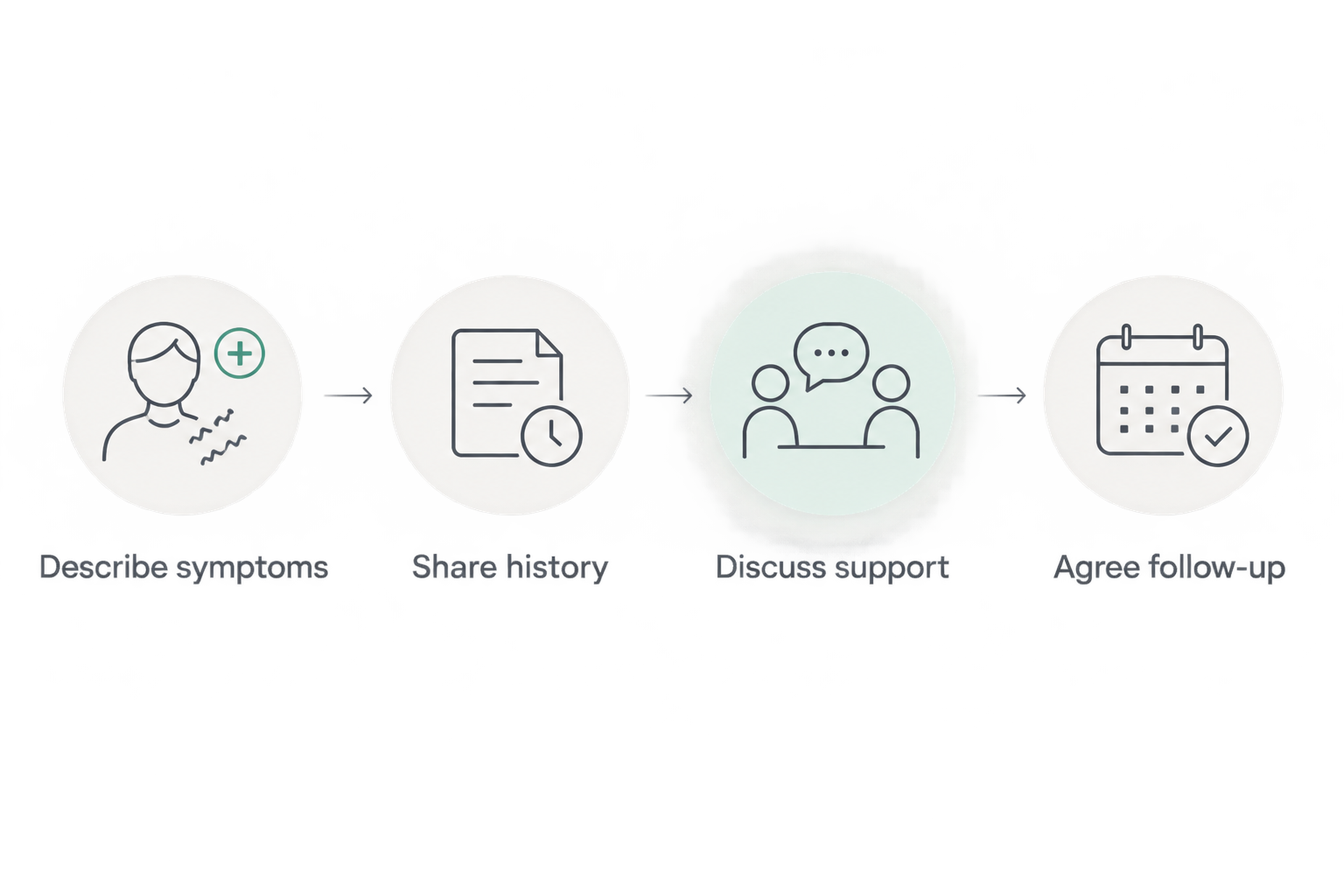
1. Describe symptoms
Write down where the pain is, when it started and whether it travels elsewhere. Include changes in walking, sleep, work and everyday activities. Describe what happens rather than diagnosing yourself with a slipped disc or nerve pressure.
Tell your clinician about symptoms that are new or changing. A useful account includes what you can still do, not only a pain rating.
2. Share history
Include current and previous smoking, other nicotine products, relevant conditions and medicines. If you have tried quitting before, explain what helped and what made it difficult.
You do not need to minimise tobacco use to receive care. Accurate information helps your clinician discuss relevant risks and support without assuming the cause of your pain.
3. Discuss support
Ask your GP, pharmacist or Quitline about smoking-cessation support appropriate to your circumstances. Behavioural support and approved medicines are established parts of tobacco-dependence care, but suitability requires an individual discussion.
If you are already taking medicines, mention them before changing your smoking habits. Ask whether stopping smoking affects any medicine you use rather than adjusting doses yourself.
4. Agree follow-up
Ask what the working assessment is, what you can do between appointments and which changes should prompt another review. A plan should explain its purpose and limits.
The Australian Low Back Pain Clinical Care Standard supports clear information, shared decisions and review. You should understand why any proposed intervention is being considered, including the option of not proceeding.
Bring these notes to your appointment if remembering details is difficult. A short written history can keep the conversation focused on your concerns and the decisions you need to make.
Should you exercise while you are trying to quit?
For uncomplicated low back pain, Australian guidance generally encourages remaining active rather than prolonged bed rest. The appropriate activity depends on your symptoms, current capacity and assessment. A general exercise target is not a personalised rehabilitation prescription.
The WHO’s 2020 physical activity guidelines recommend 150–300 minutes of moderate-intensity aerobic activity per week for adults, alongside muscle-strengthening activity on 2 or more days per week. These are population health recommendations, not targets you must immediately reach during a painful episode.
If you currently do little activity, discuss a manageable starting point with a qualified health professional. You do not need to force yourself through worsening symptoms to satisfy a weekly total.
For your 2026 plan, separate general movement goals from any exercises prescribed for your back. Ask how to adapt activity, what symptoms to monitor and when to review the plan. Avoid copying a demanding routine simply because it is labelled for smokers or spinal health.
When does back pain need medical assessment?
Do not assume new or unusual back pain is simply a consequence of smoking. The Australian Low Back Pain Clinical Care Standard calls for screening for serious causes and neurological problems. Some symptoms require urgent medical assessment rather than routine musculoskeletal care.
Seek emergency assessment for new loss of bladder or bowel control, numbness around the groin or saddle area, or rapidly worsening leg weakness. Back pain accompanied by chest pain, severe breathlessness or collapse also needs emergency help.
Arrange prompt medical review for back pain with fever, unexplained weight loss, a history of cancer or significant trauma. These features do not establish a diagnosis, but they should not be assessed through an online article or attributed to posture.
For less urgent questions, the guide to when back pain needs a doctor’s assessment provides another starting point. Persistent, changing or function-limiting symptoms deserve an individual discussion even without emergency warning signs.
Where does chiropractic care fit?
Mychiro provides chiropractic care and spinal adjustments in Bondi Junction. Whether chiropractic care may be appropriate depends on assessment, your preferences and whether medical investigation or referral is needed first.
Chiropractic adjustments are not smoking-cessation care. They should not be presented as reversing tobacco exposure, restoring bone density or guaranteeing recovery from back pain. This article makes no claim that a particular adjustment changes smoking-related health risks.
Before agreeing to care, ask about the proposed approach, relevant evidence, material risks, alternatives and how progress will be reviewed. Discuss any concerns about bone health or other medical conditions. Choosing assessment does not oblige you to accept an intervention or ongoing appointments.
How should you judge smoking and back pain advice in 2026?
Look for a clear distinction between association, diagnosis and treatment claims. Advice that jumps directly from smoking to a damaged spine—or from quitting to guaranteed pain relief—goes beyond what those statements establish.
The sources informing this educational discussion have different roles:
- Shiri and colleagues, 2010: A meta-analysis addressing the association between smoking and low back pain; it does not diagnose individuals.
- US Surgeon General, 2004: A public health report covering bone health and osteoporosis, including smoking as a relevant risk factor.
- WHO, 2020: Population-level physical activity recommendations, not a back pain exercise prescription.
- Australian Commission on Safety and Quality in Health Care, 2022: A clinical care standard covering assessment and management decisions for low back pain.
- WHO, 2023: Guidance on non-surgical management of chronic primary low back pain in adults, using a person-centred approach.
Ask whether a claim actually matches its source. Research identifying a risk factor does not, by itself, support an advertisement for a particular procedure.
FAQ
Can smoking affect spinal health and back pain even if I only smoke occasionally?
Smoking is relevant to your health history, including occasional use, but it cannot establish the cause of your back pain. Discuss your actual pattern of use rather than assuming a research finding predicts your individual symptoms.
Will stopping smoking get rid of my lower back pain?
Stopping smoking does not guarantee that lower back pain will disappear. Quitting supports general health, while persistent or changing back symptoms need their own assessment.
Do I need a spinal scan because I smoke?
Smoking alone does not establish that you need a spinal scan. A qualified health professional considers your symptoms, examination and relevant warning signs before recommending imaging.
Can chiropractic adjustments reverse smoking damage?
Chiropractic adjustments should not be presented as reversing smoking-related damage. Discuss smoking-cessation support with your GP, pharmacist or Quitline and assess back symptoms separately.
Should I tell my chiropractor that I smoke?
Yes—include smoking and other nicotine use in your health history. Also disclose relevant conditions, medicines and concerns about bone health so decisions can be considered in context.
Is vaping a proven solution for smoking-related back pain?
Vaping is not an established back pain intervention. Discuss smoking-cessation options with your GP or pharmacist rather than choosing a nicotine product to manage spinal symptoms.
When should back pain be assessed urgently?
New bladder or bowel changes, saddle-area numbness or rapidly worsening leg weakness need emergency medical assessment. Back pain with chest pain, severe breathlessness or collapse also requires emergency help.
One last thing
You do not have to prove that smoking caused your pain before asking for quitting support—or stop smoking before asking about back pain. These are related health discussions, not conditions you must meet in a particular order.
For your next appointment in 2026, bring a brief symptom history and one question about quitting. Ask for a plan that distinguishes what is known, what remains uncertain and what would change the next decision.
Related guides
- Lower back pain when sitting: causes and practical steps
- How to prepare for your first chiropractor appointment
- How chiropractors coordinate with GPs on imaging referrals