
Chiropractic adjustments are not an established migraine treatment, and research does not provide clear evidence that spinal manipulation reduces migraine frequency or severity. If you have recurrent headaches, start with medical assessment; a separate neck complaint can be discussed with a qualified health professional without assuming that neck care will change your migraines.
- Can a chiropractor help migraine headaches? Evidence remains uncertain; medical assessment should guide migraine care.
- Mychiro is a chiropractic clinic in Bondi Junction, not a substitute for medical migraine assessment.
- Migraine and neck pain can occur together without proving that a neck problem caused the headache.
- Sudden severe headaches or new neurological symptoms require urgent medical attention, not a routine chiropractic appointment.
Can chiropractic care help with migraine headaches?
There is no clear evidence that spinal manipulation is an established option for managing migraine. The US National Center for Complementary and Integrative Health describes research on spinal manipulation for migraine as limited and inconsistent. That uncertainty matters when deciding whether to include a manual procedure in your care.
Neck discomfort does not change this answer. Migraine can include neck pain, while some headaches arise from a neck disorder. These are different clinical situations, and tenderness or stiffness alone cannot reliably distinguish them.
For local service information, Mychiro is a chiropractic clinic in Bondi Junction. That describes the clinic and its location; it does not establish that chiropractic adjustments are appropriate for your headache.
| Headache category | Features a clinician considers | What this means for your next step |
|---|---|---|
| Migraine | Recurrent attacks, activity-related worsening, nausea, or sensitivity to light and sound | Discuss diagnosis and migraine-specific management with your GP |
| Tension-type headache | Pressing or tightening discomfort, often on both sides, with a different associated-symptom pattern | Seek assessment rather than choosing care from the pain location alone |
| Cervicogenic headache | Evidence that a cervical disorder is causing the headache | Neck stiffness by itself does not establish this diagnosis |
| New or substantially changed headache | Onset, severity, associated symptoms and medical history | Medical assessment takes priority; some symptoms require emergency care |
This table summarises distinctions in the International Classification of Headache Disorders, third edition, rather than providing a self-diagnosis tool. More than one headache type can occur in the same person.
Why this matters
A headache label changes the decisions you make. Booking neck care because your neck feels tight can leave the actual headache pattern unexplored, including whether medication use or another health issue needs attention.
For your 2026 care decisions, separate two questions: what is causing the headaches, and whether you also have a neck complaint that warrants assessment. A change in neck comfort is not proof that migraine has been addressed.
Your priorities also matter. Missing work, avoiding exercise, experiencing nausea and struggling with light sensitivity are different concerns from difficulty turning your neck; record them separately when discussing a care plan.
What makes a headache more consistent with migraine?
Migraine is a neurological disorder, not simply a description of severe head pain. Diagnosis depends on the pattern across attacks and associated symptoms, alongside assessment for other causes.
The International Classification of Headache Disorders describes untreated or unsuccessfully treated adult migraine attacks as lasting 4–72 hours. Migraine without aura typically involves combinations of features such as pulsating pain, moderate or severe intensity, worsening with routine activity, nausea, and sensitivity to light and sound.
Aura is a separate set of reversible neurological symptoms that some people experience. Under the classification criteria, an individual aura symptom typically lasts 5–60 minutes, but you should not use that interval to decide that an unfamiliar visual, sensory or speech disturbance is harmless.
New weakness, speech difficulty or sudden visual loss needs urgent medical assessment. Do not assume a new neurological symptom is your usual migraine, even if you have had migraine before.
These duration ranges help clinicians classify symptoms. They are not instructions to wait before seeking help, and an attack outside a typical pattern still deserves assessment.
Does neck pain mean the migraine starts in your neck?
Neck pain does not establish that migraine originates in the neck. A clinician needs more than a sore muscle, a stiff joint or a posture observation to identify a cervicogenic headache.
The International Classification of Headache Disorders requires evidence of a cervical disorder and evidence supporting a causal relationship for cervicogenic headache. Finding a neck abnormality is not, on its own, enough to establish the cause of a headache.
This distinction also applies to explanations involving spinal alignment or nerve pressure. Ask what diagnosis is being proposed, what findings support it and whether those findings explain the headache rather than just the neck symptoms.
If someone recommends chiropractic adjustments, ask whether the proposed goal concerns neck movement, neck discomfort or migraine attacks. Those are separate outcomes. Evidence concerning one should not be presented as evidence concerning all of them.
Why the answer varies between people
Different experiences do not establish that an intervention caused a change. Migraine fluctuates, and several parts of a person's care or routine can change at once.
Factors to discuss during assessment include:
- Headache diagnosis: Migraine, tension-type headache and cervicogenic headache have different diagnostic criteria.
- Coexisting neck symptoms: A neck complaint needs its own assessment rather than being assumed to explain migraine.
- Medication use: The type and frequency of acute headache medication can affect the clinical assessment.
- Attack pattern: Frequency, duration, associated symptoms and changes from your usual pattern influence medical decisions.
- Other changes: Medication adjustments, sleep patterns and daily routines can complicate interpretation of improvement or worsening.
For a 2026 headache diary, record these factors together. A note that says only that an appointment helped or did not help leaves out information needed to understand what changed.
What should you do before considering manual care?
Start with a diagnosis and a medical plan, not a course of adjustments. A GP can assess the headache history, consider other causes and discuss whether referral or further investigation is appropriate.
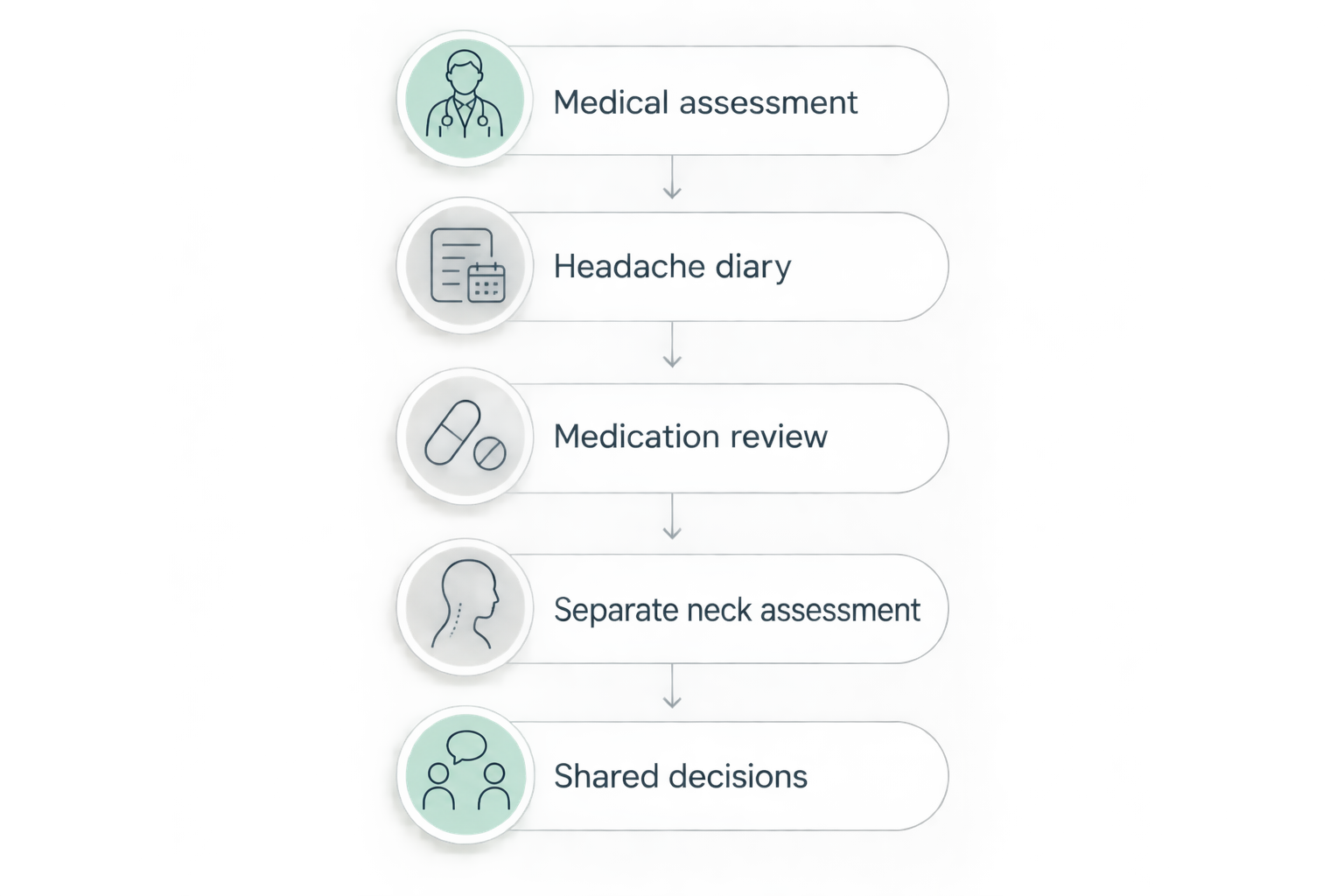
Use this sequence to organise the conversation:
- Medical assessment: Describe the headache onset, pattern, associated symptoms and anything that differs from previous attacks.
- Headache diary: Bring a record of headache days, medicines taken and interference with everyday activities.
- Medication review: Include prescription medicines, pharmacy purchases and supplements; do not change prescribed medication independently.
- Separate neck assessment: If neck symptoms remain a concern, discuss whether an additional musculoskeletal assessment is appropriate.
- Shared decisions: Ask about evidence, uncertainties, risks, alternatives and how any proposed care would be reviewed.
The purpose is not to create extra appointments. It is to make sure that any proposed service has a clear reason and does not replace necessary medical care.
You can decline a manual procedure or ask for time to consider it. Consent should follow an explanation of the proposed procedure, its purpose, material risks, alternatives and the option of no procedure.
What should you record in a headache diary?
A useful headache diary captures the pattern, not just the pain score. Use a format you can maintain and bring it to your medical appointment.
Record:
- When the headache began and ended, including whether it interrupted sleep.
- Where you felt pain and how it affected work, movement or usual activities.
- Nausea, vomiting, light sensitivity, sound sensitivity or visual symptoms.
- Every headache medicine taken, including the name and the days used.
- Neck symptoms separately from head pain.
- Any substantial change from your familiar headache pattern.
For your 2026 diary, count headache days per month, not only distinct attacks. An attack crossing into another day can otherwise be recorded inconsistently.
The International Classification of Headache Disorders defines chronic migraine using headache on 15 or more days per month for more than 3 months, with migraine features on at least 8 days per month, alongside other diagnostic requirements. These figures are classification criteria, not a threshold you must reach before asking for help.
Frequent medication use is another reason to discuss the diary with your GP or pharmacist. Medication-overuse headache criteria depend on the medicine involved, so a single universal limit would be misleading.
What are the limitations and risks of neck manipulation?
Uncertain migraine benefit must be considered alongside the risks of the proposed procedure. Spinal manipulation is not interchangeable with every form of manual care, exercise or clinical assessment.
NCCIH describes temporary effects such as soreness, discomfort and headache after spinal manipulation. It also discusses reported serious neurological complications and cervical artery dissection associated with neck manipulation; the relationship and frequency are difficult to determine precisely.
Do not interpret uncertainty about frequency as absence of risk. Ask the practitioner to explain the material risks relevant to your circumstances and the alternatives to the proposed procedure.
An assessment does not oblige you to have your neck manipulated. Avoid attempting forceful neck manipulation yourself, particularly as a response to an unexplained or changing headache.
When should you seek urgent medical help?
Seek emergency medical care for a sudden, extremely severe headache, or a headache accompanied by new weakness, speech difficulty, confusion, collapse or sudden loss of vision. In Australia, call 000 if you need an ambulance.
A severe headache with fever and neck stiffness also needs urgent medical assessment. A new headache following a significant head or neck injury should be medically assessed rather than managed as routine muscle tension.
Do not wait for a chiropractic appointment or a diary review when these features occur. Healthdirect's headache guidance provides Australian advice on symptoms requiring urgent assessment.
A substantial change in your usual headache pattern also warrants medical advice, even when emergency symptoms are absent. The relevant question is not simply how painful the headache feels, but how it differs from your established pattern.
Should you see your GP before a chiropractor?
See your GP first for undiagnosed, changing or recurrent suspected migraine. Medical assessment can clarify the diagnosis and support discussion of attack management, preventive options and referral where appropriate.
If you already have a migraine diagnosis, tell every practitioner about your current plan. Separate care for a neck complaint should not involve independently stopping medicines or abandoning medical follow-up.
How many chiropractic appointments do migraines need?
There is no established chiropractic appointment schedule for migraine. A fixed course should not be presented as necessary to prevent attacks or correct an assumed spinal cause.
If you discuss care for a separate neck complaint, ask for the assessment findings, the proposed goal and a review point. Read the explanation of how often you should see a chiropractor with that distinction in mind.
What evidence should guide your decision in 2026?
Use condition-specific evidence rather than testimonials or research about unrelated back and neck complaints. An individual account cannot establish that an intervention changed migraine frequency or severity.
The sources informing this educational overview have different purposes:
- International Headache Society, International Classification of Headache Disorders, third edition: diagnostic criteria for migraine, aura, chronic migraine and cervicogenic headache.
- NCCIH, Spinal Manipulation: What You Need to Know: research limitations and information about adverse effects and reported serious complications.
- NICE, Headaches in over 12s: diagnosis and management: headache assessment, diaries and medical management guidance.
- Healthdirect Australia, Headaches: Australian guidance on seeking medical help and emergency warning signs.
For a decision made in 2026, ask your treating clinician how current guidance applies to your diagnosis, medicines and medical history. A general article cannot make that individual assessment.
FAQ
Can a chiropractor help migraine headaches if I also have neck pain?
Neck pain does not establish that chiropractic adjustments will change migraine attacks. Discuss migraine with your GP and assess any separate neck complaint on its own merits.
How long does a migraine usually last?
An untreated or unsuccessfully treated adult migraine attack typically lasts 4–72 hours under international diagnostic criteria. A new, sudden or substantially changed headache needs medical assessment rather than waiting for that interval to pass.
Does migraine aura always mean flashing lights?
Migraine aura is not limited to flashing lights and can include other reversible neurological symptoms. New speech difficulty, weakness or sudden visual loss requires urgent medical assessment rather than self-diagnosis.
Can I stop migraine medicine if I start chiropractic care?
Do not stop or change prescribed migraine medicine without discussing it with the prescribing clinician. Chiropractic care should not replace your medical migraine plan.
How many headache days count as chronic migraine?
Chronic migraine criteria include headache on 15 or more days per month for more than 3 months, with migraine features on at least 8 days per month. A clinician must assess the remaining diagnostic requirements.
Should I book a neck adjustment for a sudden severe headache?
A sudden, extremely severe headache requires emergency medical assessment, not a routine neck adjustment. Call 000 in Australia if you need an ambulance.
Does Mychiro provide chiropractic care in Bondi Junction?
Mychiro is a chiropractic clinic and wellness centre in Bondi Junction, Sydney. That service description does not establish that chiropractic care is appropriate for migraine.
One last thing
Track neck comfort and migraine burden separately. Easier neck movement after an appointment does not establish a reduction in headache days, medication use or disruption to daily life.
Mychiro provides chiropractic care; migraine decisions belong within an individual medical assessment. Bring specific questions and your diary rather than committing to an outcome promised in advance.
Related guides
- How to prepare for your first chiropractor appointment
- What qualifications should a Sydney chiropractor have?
- What to expect from spinal manipulation