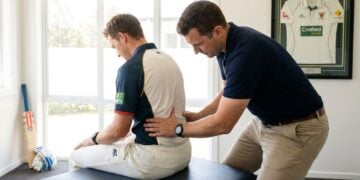

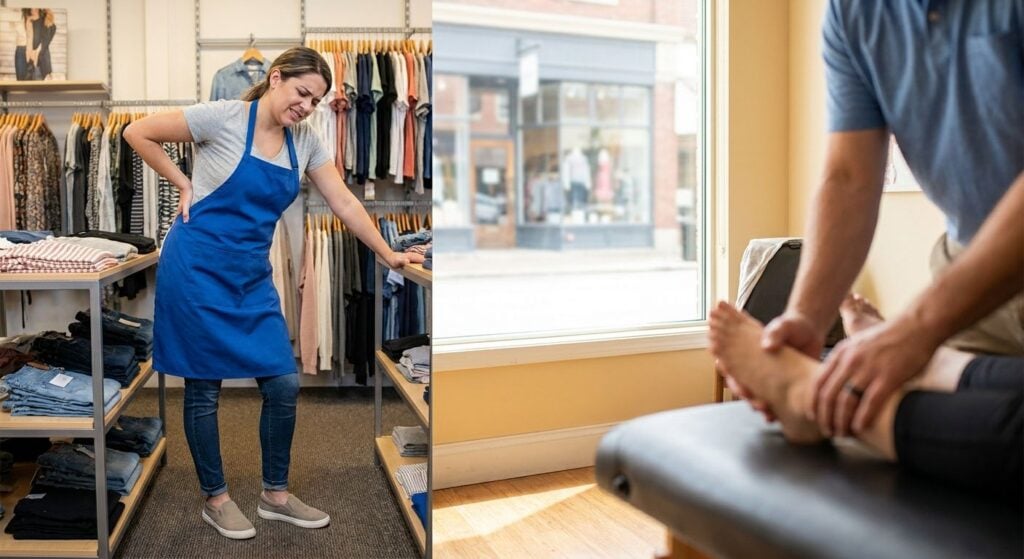
Retail workers on their feet for eight- or ten-hour shifts carry a different kind of strain than desk-based staff: hours of standing on concrete or tile, repeated bending to restock low shelves, twisting to scan and bag, and lifting stock boxes during quiet moments between customers. Chiropractic care for retail workers is an assessment-based approach to these standing, bending and lifting patterns, with the aim of helping staff manage musculoskeletal discomfort and stay functional through busy trading periods. What makes this group different from an office worker is the lack of a fixed workstation to adjust — the "desk" changes every shift, and breaks are often short and unpredictable.
- Chiropractic care for retail workers focuses on standing, bending and lifting patterns specific to shop floors, not desk ergonomics.
- Footwear, anti-fatigue mats and lifting technique are the free first moves before booking any appointment.
- A chiropractic assessment can be discussed as one option if lower back, foot or shoulder discomfort persists beyond a couple of weeks.
- Persistent numbness, weakness or pain after a fall needs a GP or emergency assessment, not a self-managed approach.
- MyChiro in Bondi Junction offers musculoskeletal assessments that can be discussed alongside home-based strategies for shift-related strain.
Why chiropractic care matters for retail workers
Prolonged standing is a recognised risk factor for lower back and lower limb discomfort across occupational health research, and retail work adds repetitive bending, reaching and carrying on top of that. Unlike office roles, retail staff rarely control their own environment — the register height, shelf placement and floor surface are fixed by the store layout, not the worker. That combination of standing time, awkward reach angles for high or low shelving, and inconsistent break timing is why generic desk-ergonomics advice does not transfer well to shop floor staff.
A chiropractor assessment can help identify which of these factors is contributing most to an individual's discomfort, and whether adjustments, exercise advice or a referral is the more appropriate next step. A musculoskeletal assessment for retail-specific strain is one option worth discussing when self-managed changes to footwear and lifting technique aren't reducing shift-end pain.
Fix your footwear and standing surface first
Before anything else, footwear and floor surface are the two variables retail workers can usually change without asking permission.
- Choose shoes with firm arch support and a cushioned midsole rather than flat retail-branded flats
- Ask about anti-fatigue matting behind the register or in high-dwell areas if it isn't already provided
- Rotate standing weight between both feet every few minutes instead of locking one hip
- Replace shoes once the tread or midsole cushioning visibly compresses or wears unevenly
- Check in on any recurring heel or arch pain early — see the guide to shoe options for plantar fasciitis for what to look for
Adjust your lifting and restocking technique
Stock deliveries and shelf restocking are where a lot of retail back strain starts, often from rushed bending under time pressure.
- Bend at the knees and hips, not the lower back, when lifting stock boxes
- Keep boxes close to the body rather than reaching out at arm's length
- Avoid twisting the spine while holding a load — turn with the feet instead
- Use a trolley or step stool for bulk deliveries or high shelving instead of stretching or stacking by hand
- Ask a colleague to help with anything above a comfortable single-person weight
A full breakdown of safe lifting mechanics sits in how to lift heavy objects safely to protect your back, which is worth reading before a big delivery day.
Build movement breaks into every shift
Standing still for long stretches is often harder on the body than walking, so breaking up static posture matters as much as sitting less does for desk workers.
- Do a 30-second calf and hip flexor stretch every hour if the shop floor allows it
- Alternate which leg carries more weight instead of favouring one side all shift
- Use rostered breaks to walk rather than sit the entire time
- Avoid locking the knees fully straight when standing for long periods
- Rotate between register, floor and stockroom tasks where the roster allows it, to vary posture
Strengthen your core and lower back outside work
A stronger core reduces the load on the lower back during bending and lifting tasks, but progress needs to be gradual, especially if pain is already present.
- Start with bodyweight core work like dead bugs and bird-dogs rather than heavy loaded exercises
- Add glute activation drills to support hip and lower back stability
- Stretch hip flexors regularly if shifts involve long standing with minimal walking
- Scale back or pause any exercise that reproduces sharp or radiating pain
- Build consistency over intensity — a few minutes most days beats one long session a week
For a structured approach, how to strengthen your core without straining your lower back walks through a progression that suits people already managing some discomfort.
Get a musculoskeletal assessment when pain persists
If footwear changes, lifting adjustments and movement breaks haven't reduced shift-end pain after a couple of weeks, a chiropractic assessment can be discussed as the next step.
- Book an assessment if lower back or foot pain is recurring rather than a one-off ache
- Raise any neck or shoulder tightness linked to reaching for high shelves or repetitive scanning
- Ask what a combined plan of adjustments and home exercise might look like following assessment
- Mention shift patterns and rostered hours so any advice reflects actual work demands
- Track which shifts or tasks trigger symptoms, to give the chiropractor a clearer picture
Discuss retail-related strain with a chiropractor
Musculoskeletal assessments at Bondi Junction, tailored to shift-based standing and lifting.
Know when to see a doctor instead
Not every ache from a retail shift is something a chiropractor should manage alone, and some symptoms need medical assessment first.
- Numbness, tingling or weakness spreading down a leg or arm
- Pain following a fall, slip or lifting injury with sudden onset
- Symptoms that don't ease with rest, position changes or over a couple of weeks
- Any bladder, bowel or balance changes alongside back pain
The guide on how to know when back pain needs a chiropractor vs a doctor sets out these distinctions in more detail and is worth bookmarking.
Options for managing retail shift strain
| Option | Suited to | Key limitation | Verdict |
|---|---|---|---|
| Anti-fatigue matting | Register and static-standing roles | Doesn't address footwear or technique issues | Worth adding |
| Supportive footwear | Anyone on their feet 6+ hours a shift | Won't resolve pain from poor lifting habits alone | Worth adding |
| Self-directed stretching and core work | Mild, early-stage stiffness | Progress is slower without a tailored plan | Consider |
| Chiropractic assessment | Recurring back, neck or foot strain lasting weeks | Requires an in-person visit to assess | Discuss with a chiropractor |
| Physiotherapy | Rehab after a specific injury or diagnosis | Different scope of practice to chiropractic care | Consider if injury-specific |
| Employer-driven layout changes | Store-wide standing or lifting issues | Outside an individual worker's control | Raise with management |
Common mistakes retail workers make
- Ignoring early foot pain because shoes "just need breaking in" — arch and heel pain rarely resolves on its own if the footwear is the cause
- Twisting while carrying stock to save a step, which puts more strain on the lower back than a slightly longer walk around
- Skipping movement during breaks by sitting the entire time, which doesn't undo hours of static standing the way a short walk does
- Powering through shift-end pain for weeks or months before raising it with anyone, letting a manageable issue become a recurring one
- Assuming younger staff are immune — repetitive strain from standing and lifting builds up regardless of age if the same patterns repeat shift after shift
FAQ
Can a chiropractor help with back pain from standing all day at work?
A chiropractor can assess back pain linked to prolonged standing and discuss whether adjustments, exercise advice or a referral may be appropriate. The right approach depends on individual assessment, not the job title alone.
What shoes are best for retail workers on their feet all day?
Shoes with firm arch support and cushioned midsoles generally hold up better across long standing shifts than flat, unsupportive retail flats. Replacing shoes once the tread or cushioning visibly wears is worth building into a routine.
How often should retail workers take movement breaks?
Short movement breaks roughly every hour, even 30 seconds of stretching, can help break up static standing posture. Rostered breaks are also more useful for walking than sitting the whole time.
Is chiropractic care suitable for shift workers with irregular hours?
Chiropractic care can be discussed alongside irregular shift patterns, with assessment tailoring advice to actual work demands rather than a standard nine-to-five routine. Mentioning shift timing during a consult helps shape realistic recommendations.
When should retail back pain be seen by a doctor instead of a chiropractor?
Numbness, weakness, pain after a fall, or symptoms that don’t ease over a couple of weeks warrant medical assessment rather than self-management. Bladder or bowel changes alongside back pain need urgent medical review.
Does anti-fatigue matting actually reduce standing fatigue?
Anti-fatigue matting is commonly used in register and static-standing roles to reduce pressure on the feet and lower limbs during long shifts. It addresses the standing surface but not footwear or lifting technique separately.
How much lifting can a retail worker safely do without help?
There’s no single safe weight that applies to everyone — it depends on lifting technique, load shape and individual capacity. Keeping loads close to the body and asking for help with bulk or awkward items reduces strain regardless of weight.
Can core exercises prevent back pain in retail jobs?
A stronger core can reduce load on the lower back during bending and lifting tasks common in retail roles. Starting with bodyweight movements and scaling back anything that causes sharp pain is the safer approach.
One last thing
The detail retail workers overlook most often isn't the big lifting moments — it's the small, repeated reach across a counter to bag items or scan a tag, done hundreds of times a shift. That low-grade repetitive strain on the shoulder and neck adds up faster than the occasional heavy box, and it's usually the first thing to flag in an assessment for staff who've been in the role for more than a year or two.
“A musculoskeletal assessment for retail-specific strain is one option worth discussing when self-managed changes to footwear and lifting technique aren’t reducing shift-end pain.”
Related guides
- How to strengthen your core without straining your lower back
- How to know when back pain needs a chiropractor vs a doctor