

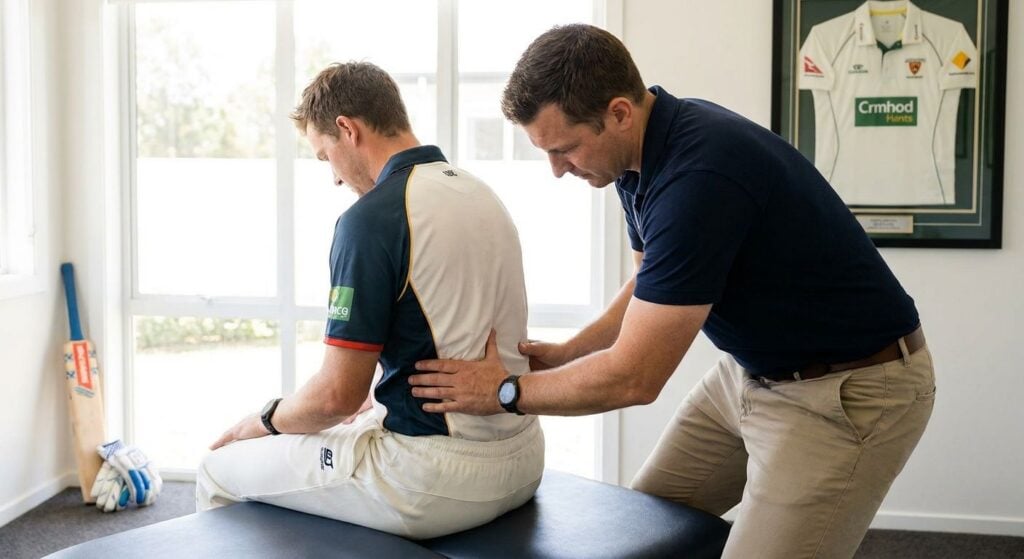
Cricket players with lower back pain often need more than a look at the sore spot near the belt line. A chiropractor for cricket players typically checks how the pelvis, hips and thoracic spine move together across a full spell or a long innings, because a restriction in one area frequently shows up as pain somewhere else on the field. Fast bowlers, spinners, batters and wicketkeepers each load the lower back differently, and the assessment approach that suits one position doesn't automatically suit another.
- Chiropractic care for cricket players focuses on assessing bowling action, batting stance and hip-spine mobility, not just the sore spot.
- Fast bowlers repeat the same-side loading pattern every delivery, which is a known driver of lower back and pelvic stress.
- MyChiro in Bondi Junction offers assessment appointments for cricket players managing lower back pain during the 2026 season.
- Core stability, hip mobility and a proper warm-up are free steps that support any professional assessment.
- Numbness, leg weakness or pain after a direct blow while fielding needs urgent medical review, not a training-load fix.
Why lower back pain shows up differently across cricket positions
A right-arm fast bowler rotates and side-flexes through the same side of the lumbar spine on every delivery of a spell, sometimes 15-20 overs across a long day in the field. That repetition is mechanically similar to the rotational load seen in chiropractic care for golfers with lower back pain, where one-sided swing mechanics concentrate stress on one part of the spine over hundreds of repetitions across a season.
Batters carry a different pattern. A long innings means repeated forward flexion at the crease, sudden rotation on shot execution, and static holding between deliveries. Fielders add another layer: diving stops, sudden deceleration when chasing a ball to the boundary, and the twisting throw from an awkward angle. Wicketkeepers spend hours in a crouched, flexed position that loads the lower back differently again.
Because the loading pattern is position-specific, an assessment for a cricket player's lower back pain generally needs to look at the actual bowling action, batting stance or fielding movement, not just the lumbar spine in isolation.
Build your assessment and management plan
Track your bowling and batting load across the season
Most cricket players underestimate how quickly training volume climbs during preseason nets. A simple load log makes patterns visible before pain becomes disruptive.
- Log overs bowled per week during preseason ramp-up and in-season match weeks
- Note total batting time in the middle versus time spent at nets
- Flag week-to-week jumps in bowling or fielding volume, a common driver of overuse soreness
- Record any change in run-up rhythm or batting stance that follows a stiff or sore session
- Keep a short pain diary noting which session preceded stiffness the next morning
Warm up properly before every net session and match
A rushed five-minute warm-up before a Saturday club game is a common contributor to preventable soreness. The steps below take fifteen to twenty minutes and are covered in more detail in how to warm up before a workout to prevent back injury.
- Thoracic rotation drills before bowling to separate upper spine movement from the lumbar spine
- Hip flexor and glute activation before batting or fielding drills
- Dynamic stretching rather than static holds immediately before play
- A short jog, bike spin or skipping set to raise core temperature
- Run-throughs and shadow bowling at reduced intensity before bowling at full pace
Build core and hip stability off the field
A lower back that repeatedly gets sore during a cricket season often has weak links upstream or downstream of the spine, usually in the hips or the deep core muscles. Structured work here is covered in how to strengthen your core without straining your lower back.
- Anti-rotation core exercises such as the pallof press and dead bug
- Glute medius and hip abductor strengthening for single-leg stability during bowling and fielding
- Single-leg balance drills relevant to diving stops and awkward throws
- Thoracic rotation mobility work kept separate from lumbar movement
Get your bowling or batting action assessed when pain persists past a week
When lower back pain sticks around beyond seven to ten days, or keeps recurring across a season, a structured assessment is generally the next step rather than more rest alone. There's more than one path here, and the right one depends on what's driving the pain.
- A sports physiotherapist can review bowling or batting biomechanics on video against ground reaction data
- A strength and conditioning coach can reassess training load, bowling volume and gym programming
- A chiropractor can assess spinal and pelvic mobility and discuss how it interacts with a bowling or batting action following a full assessment
- MyChiro's Bondi Junction clinic offers assessment appointments for cricket players managing lower back pain, with same-day appointment availability during the season
- A GP can rule out other contributing factors if pain doesn't settle with rest and reduced load
Book a season assessment
Same-day appointment availability at the Bondi Junction clinic.
Manage recovery between matches and carnivals
Multi-day carnivals and back-to-back club fixtures leave little room for full recovery. Small, consistent habits matter more than any single intervention.
- Foam rolling and general mobility work on rest days between fixtures
- Heat or cold for comfort, based on personal preference rather than a fixed rule
- Prioritising sleep during weekend carnivals when fixtures stack up
- Active recovery, such as a light swim or walk, over complete rest where it's tolerated
Know when back pain needs urgent medical review, not a training adjustment
Most cricket-related lower back pain is mechanical and load-related, but a smaller set of presentations need a doctor or emergency department first. How to know when back pain needs a chiropractor vs a doctor covers this distinction in more depth.
- Numbness or tingling down one or both legs
- Loss of bladder or bowel control, which needs emergency care immediately
- Pain following a direct blow or fall while fielding or wicketkeeping
- Fever or unexplained weight loss alongside back pain
- Pain that repeatedly wakes you from sleep
Comparing options for cricket players managing lower back pain
| Option | Best for | Key limitation |
|---|---|---|
| Chiropractic assessment (MyChiro) | Recurring lower back stiffness linked to bowling or batting mechanics | Doesn't replace a dedicated video biomechanics analysis of the action itself |
| Sports physiotherapy | Recovery from a specific soft tissue injury | Waitlists can extend during peak club and school season |
| Strength & conditioning coaching | Structured load and gym programming across a season | Doesn't address acute pain directly |
| Self-managed rest and stretching | Mild, short-lived stiffness after a single long session | Doesn't address pain that keeps recurring with technique |
| GP review | Ruling out non-musculoskeletal causes or red-flag symptoms | Limited hands-on assessment of bowling or batting movement patterns |
Common mistakes cricket players make with lower back pain
- Playing through pain during a carnival or finals series without any assessment, which often extends the problem into the following season
- Blaming the mattress or the car seat instead of the 30-40 overs bowled that week
- Skipping the warm-up during a rushed Saturday morning net session before a club game
- Strengthening the lower back in isolation while ignoring hip and thoracic mobility that actually drives the loading pattern
- Returning to full-pace bowling too soon after a sore back settles, before load has been rebuilt gradually
FAQ
What causes lower back pain in cricket players?
Lower back pain in cricket players is commonly linked to repeated rotation and side-flexion during bowling, forward flexion at the crease during batting, and sudden deceleration during fielding. Training load spikes during preseason nets are a frequent contributing factor.
Is chiropractic care suitable for fast bowlers?
Chiropractic care may be appropriate for fast bowlers following a full assessment of spinal and pelvic mobility alongside the bowling action. Suitability depends on the individual presentation and is best discussed with a qualified health professional.
How many chiropractic sessions do cricket players typically need?
The number of sessions varies by presentation and is determined after an initial assessment, not before it. A chiropractor can discuss a realistic plan once your history and movement pattern have been reviewed.
Can a chiropractor help with a bowling action issue?
A chiropractor can assess spinal and pelvic mobility that interacts with a bowling action, but a video biomechanics review from a sports physiotherapist or bowling coach usually addresses the technical side of the action more directly.
Should batters see a chiropractor for lower back pain?
Batters with recurring lower back stiffness tied to stance or shot mechanics can discuss an assessment with a chiropractor. Pain following a specific incident, such as a blow from a fast delivery, should be reviewed by a doctor first.
When should a cricket player see a doctor instead of a chiropractor?
See a doctor or emergency department if back pain comes with leg numbness, weakness, loss of bladder or bowel control, fever, or follows a direct blow or fall. These symptoms fall outside routine musculoskeletal assessment.
Does chiropractic care help lower back pain from cricket long term?
Longer-term outcomes depend on the individual and are best discussed with a qualified health professional after assessment, alongside load management, warm-up habits and core and hip strengthening work.
Can I keep playing cricket while getting chiropractic care?
Whether you continue playing during an assessment period depends on the severity of symptoms and is a decision made with your chiropractor or treating health professional, not a fixed rule.
One last thing
The front leg on a fast bowler's delivery stride absorbs several times bodyweight in ground reaction force with every ball, a mechanical detail well documented in fast bowling biomechanics research. That single factor, repeated across a spell and a season, is often more relevant to a fast bowler's lower back pain in 2026 than anything happening off the field. Tracking bowling volume alongside how the back actually feels week to week catches problems earlier than waiting for pain to become disruptive.
Related guides
- Chiropractic care for rugby and contact sport injuries
- How to know when back pain needs a chiropractor vs a doctor