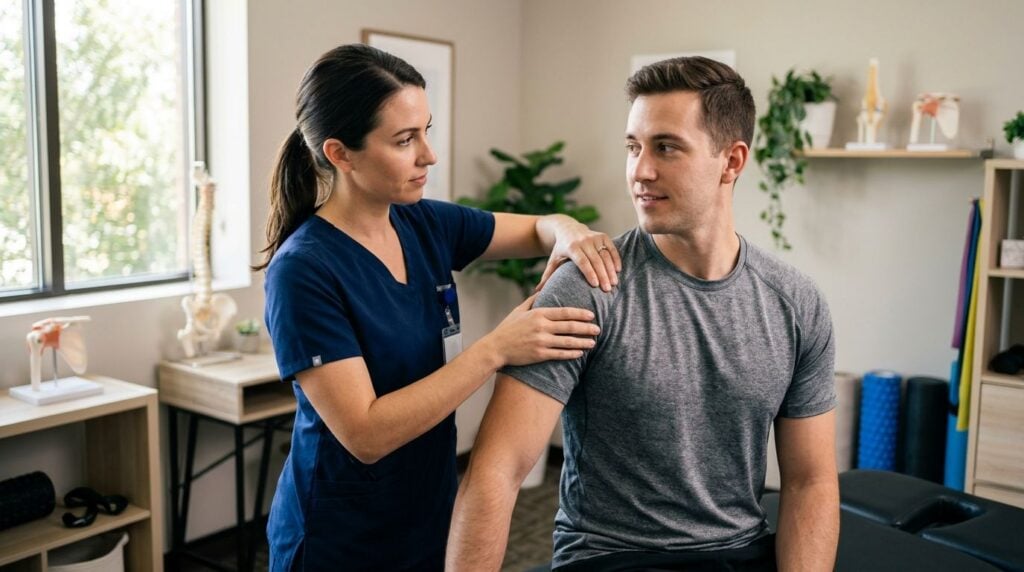
Recovery after a shoulder dislocation starts with urgent medical care and an individual follow-up plan. Rehabilitation may include prescribed movement and strengthening exercises, with the timing guided by the injury and your treating team. Chiropractic care is not a standard stage that everyone needs, and medical clearance to move the shoulder does not establish that manipulation is appropriate.
- A suspected shoulder dislocation needs urgent medical assessment; do not try to put the joint back yourself.
- Any proposed chiropractic care needs its own clinical rationale and discussion of risks and alternatives.
- Sling use, movement and strengthening depend on your injury and the treating team’s instructions.
- Ask your treating team whether any additional musculoskeletal assessment has a useful role in your plan.
Understanding care after a shoulder dislocation
A shoulder dislocation occurs when the upper-arm bone comes out of its socket. Associated injuries can involve bone, ligaments, tendons, nerves or blood vessels, so assessment is important even if the joint seems to have gone back by itself. The medical team decides what imaging and treatment are needed, followed by advice about protection, movement and rehabilitation.
Once your treating team advises that rehabilitation can begin, ask which exercises and activities are suitable and how they will be progressed. If you are considering MyChiro for a separate back or neck concern, bring the shoulder diagnosis and current restrictions. Any proposed care should fit those instructions and have a clear purpose, rather than being added automatically after a dislocation.
What shoulder dislocation recovery care typically involves
Get the joint assessed and reduced by medical staff first
Seek urgent medical care for a suspected dislocation. The medical team will assess the injury, check for associated damage and arrange treatment. Do not wait for a routine clinic appointment or attempt to relocate the joint yourself.
- Go to an emergency department for a suspected dislocation; call 000 if emergency assistance is needed
- Let the treating team decide which imaging is needed to assess the injury
- Have the joint reduced only by a qualified medical professional
- Ask about a sling or immobilisation period based on the type of dislocation
- Get written follow-up instructions before leaving the clinic
Follow your treating team’s protection and sling advice
- Wear the sling for the timeframe your treating doctor recommends
- Follow the movement and lifting restrictions given for your injury
- Ask about using a wrapped cold pack for comfort and follow skin-protection advice
- Ask which hand, wrist and elbow movements are permitted while the shoulder is protected
- Attend the follow-up arranged by your treating team
Reintroduce gentle range-of-motion work once cleared
- Begin only the movements your treating clinician has prescribed
- Ask for a demonstration of the permitted range and exercise technique
- Review progress as advised without forcing the shoulder through pain or apprehension
- Follow restrictions on positions that could stress the injured joint
- Report new catching, slipping or instability promptly rather than waiting for a routine review
Discuss whether any additional assessment is needed
Medical clearance for a particular activity is specific to your injury and recovery stage. It does not mean that all manual techniques are suitable. Ask why any additional assessment or treatment is proposed and how it relates to the existing rehabilitation plan.
- Ask which symptoms or findings the proposed care would address
- Discuss the expected benefit, uncertainty and material risks
- Confirm that assessment will respect your current movement restrictions
- Coordinate any additional care with the practitioner managing rehabilitation
- Review progress against the goals agreed with your treating team
Rebuild strength through a structured program
- Progress resistance only as directed by your rehabilitation clinician
- Use the exercises selected for your injury and current recovery stage
- Ask how strength, control and task demands will be assessed before returning to sport
- Follow the agreed lifting restrictions and return-to-activity criteria
- Log any apprehension or giving-way sensation and report it immediately
Address contact-sport and repetitive-strain triggers
Return to rugby or contact sport requires an individual discussion of the injury, recurrence risk and demands of the sport. The same principle applies to overhead activities: shoulder pain in swimmers can have several causes and should not automatically be treated as dislocation-related instability. Follow the plan provided for your diagnosis.
- Review the movement patterns in your sport that load the shoulder joint
- Discuss any technique changes with your treating team and coach
- Use the warm-up and activity progression agreed with your rehabilitation clinician
- Discuss protective strapping or bracing options with your treating team
- Delay full return to contact training until cleared by a doctor
Watch for recurrence and instability signs
- Note any sensation of the joint slipping without fully dislocating
- Track whether specific arm positions trigger apprehension or weakness
- Ask about reassessment for ongoing instability; imaging decisions depend on the findings, not a fixed three-month wait
- Seek urgent medical attention for new numbness, weakness, a cold or pale hand, or other circulation changes
- Discuss a referral to an orthopaedic specialist for recurrent dislocations
Care options for shoulder dislocation recovery
| Option | Purpose | Key limitation |
|---|---|---|
| Emergency department reduction | The acute dislocation itself | Follow-up and rehabilitation may still be needed after acute treatment |
| GP or orthopaedic follow-up | Reviewing the injury, associated damage and whether specialist treatment is needed | Exercise progression may also involve a rehabilitation clinician |
| Physiotherapy-led rehab | Structured strengthening and range-of-motion progression | The frequency and duration should reflect individual need and progress |
| Chiropractic assessment (post-clearance) | Considering a separate musculoskeletal concern within current restrictions | Medical clearance alone does not establish benefit or suitability for manipulation |
| Home exercise program | Completing individually prescribed activity between reviews | Needs clear instructions and reassessment if symptoms or stability change |
Common mistakes people make during shoulder dislocation recovery
- Returning to overhead lifting or contact sport before a doctor confirms stability
- Skipping medical review because the shoulder appears to have gone back into place
- Adding stretches or other treatment without checking the injury-specific restrictions
- Ignoring recurring apprehension or a slipping sensation instead of booking a specialist review
- Comparing recovery timelines with someone else's dislocation instead of following an individualised plan
Discuss your recovery plan
After urgent shoulder care and follow-up are arranged, new patients with a separate back or neck concern can discuss it at MyChiro in Bondi Junction. The free initial consultation is not free treatment. Optional same-day treatment is $125 if clinically appropriate, with no obligation to proceed.
FAQ
Can a chiropractor treat a dislocated shoulder?
A suspected dislocated shoulder needs urgent medical care. Do not attempt to relocate it yourself or delay medical assessment for a chiropractic appointment. Later care should follow the injury-specific plan; chiropractic treatment is not an automatic part of recovery.
When can I see a chiropractor after a shoulder dislocation?
First follow the medical and rehabilitation plan for the dislocation. If you are considering chiropractic care for another concern, discuss this with the treating team and share any restrictions. Clearance to start exercises does not mean manipulation is appropriate.
What does shoulder dislocation recovery involve in 2026?
Care may include a sling or other protection, prescribed movement and progressive strengthening. Some injuries need specialist treatment or surgery. The sequence and timing depend on the dislocation, associated injuries and your treating team’s assessment.
Is chiropractic care appropriate for a first-time shoulder dislocation?
A first-time dislocation needs urgent medical assessment and appropriate follow-up. There is no automatic indication for chiropractic care after medical clearance. Ask what a proposed intervention would address and whether it is consistent with the rehabilitation plan.
How long does a dislocated shoulder take to recover?
Recovery varies with the injury, associated damage, treatment and intended activities. Your treating team can give an estimate and review it as recovery progresses. Being comfortable at rest does not by itself establish readiness for lifting, driving or sport.
What are signs my shoulder dislocation isn’t healing properly?
New slipping, persistent apprehension or worsening function warrants prompt review. New numbness, weakness or circulation changes need urgent medical attention. A suspected repeat dislocation needs urgent care rather than a routine follow-up appointment.
Can chiropractic care prevent a shoulder from dislocating again?
Chiropractic treatment should not be promoted as proven to prevent another shoulder dislocation. Discuss your individual recurrence risk and recommended rehabilitation with the medical team; some people need specialist advice or surgery.
Do I need a referral to see a chiropractor after a shoulder injury?
You can ask a clinic about its appointment requirements, but access to an appointment does not establish that treatment is appropriate. Share the diagnosis, imaging reports and current restrictions, and keep the practitioner managing rehabilitation informed.
One last thing
A previous dislocation can increase the risk of another episode. Age, injury details and the activities you want to return to help guide decisions about rehabilitation and specialist review. Report a new slipping sensation or another injury promptly rather than repeatedly testing the shoulder.
Related guides