

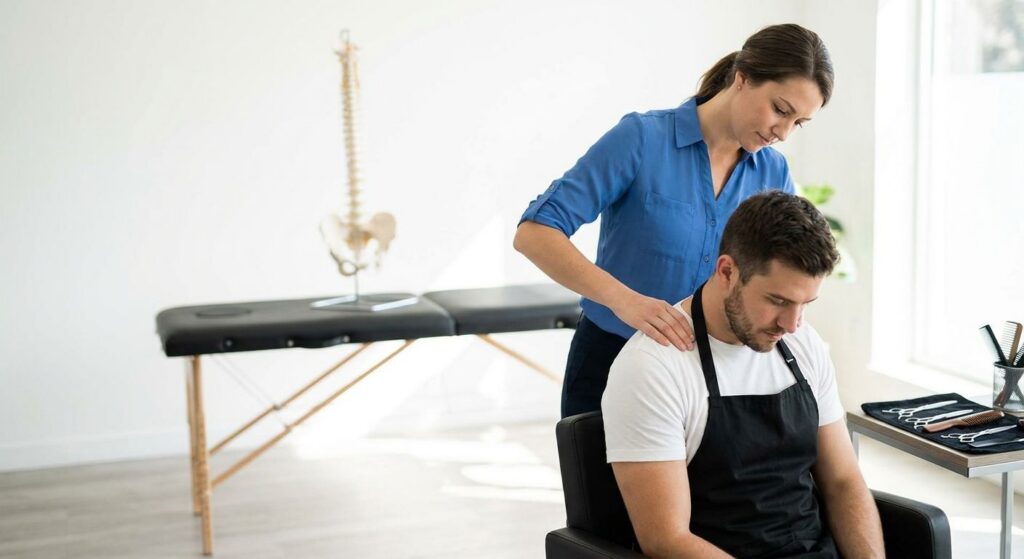
Chiropractic care for hairdressers and beauty therapists is a structured assessment of posture, spinal movement and joint strain shaped by the physical demands of a session-based day, with the aim of supporting movement and reducing the cumulative load of standing, bending and repetitive arm work. Hairdressers and beauty therapists carry a different strain pattern than most desk-based workers: forward-leaning necks over a client's head, one-sided shoulder loading from scissors or clippers, and long stretches on hard salon floors with almost no seated recovery time.
- A chiropractor for hairdressers looks at standing posture, forward neck lean and repetitive shoulder strain specific to salon and treatment-room work.
- MyChiro in Bondi Junction offers assessment-based chiropractic care for hairdressers and beauty therapists dealing with ongoing neck, shoulder or lower back tension.
- Station height, stance rotation and short movement breaks address most early-stage strain before it becomes chronic.
- Chiropractic assessment may be appropriate when self-care hasn’t reduced stiffness or tension after several weeks of trying it.
Why chiropractic care matters for hairdressers and beauty therapists
A typical salon or clinic shift runs close to 8 hours on your feet, often with back-to-back bookings and little time to reset your stance between clients. Hairdressers lean forward repeatedly to work at chest or head height, beauty therapists hold static neck and shoulder positions during facials, waxing or lash work, and both roles rely on fine motor control in the wrists and fingers for hours at a stretch.
None of this is inherently damaging on a single shift. The issue is repetition without variation: the same forward head tilt, the same weight-bearing hip, the same scissor hand, five or six days a week, for years. MyChiro sees this pattern show up as neck tension, one-sided shoulder tightness and lower back stiffness that tends to build gradually rather than appear after one obvious event.
A chiropractic assessment can help identify whether your posture and movement patterns during a shift are contributing to ongoing tension, but daily habits at the station do most of the work between appointments.
Set up your styling station to reduce forward lean
Most neck and upper back strain in hairdressing traces back to chair and mirror height rather than the haircut itself. Adjusting the client's chair, not just your own stance, is the first lever most stylists overlook.
- Raise the client's chair so their head sits close to your eye level, not below your chest
- Angle mirrors so you're not craning your neck to check the back of a cut
- Keep tools within arm's reach so you're not repeatedly twisting to a trolley
- Position your working foot slightly forward for balance instead of squaring both feet
- Swap which side of the chair you work from across the day where the service allows it
Rotate your stance and swap tools between hands
One-sided loading, always cutting with the same hand, always standing on the same hip, is one of the more common contributors to asymmetric shoulder and lower back tension in this line of work.
- Alternate which hand holds the scissors or clippers for sections of a cut where technique allows
- Shift your weight between both feet rather than locking one hip out
- Change which side you stand on for blow-drying and colour application when possible
- Vary your grip on brushes and combs to avoid repetitive thumb and wrist strain
- Take waxing and facial work at table height that doesn't force a shoulder shrug
Build short movement breaks into every shift
Static postures held for long periods, standing over a basin, leaning into a facial bed, tend to cause more tension than a single heavy lift. A short reset every 60-90 minutes between bookings interrupts that pattern before it compounds.
- Roll your shoulders and drop your chin to chest for 5-10 seconds between clients
- Step away from the station during any gap longer than a few minutes
- Do a standing calf raise or two while waiting for colour to develop
- Reset your stance and posture consciously at the start of each new client
- Avoid eating lunch standing at the same station you've worked from all shift
Support your feet and lower body through long shifts
Standing on hard salon flooring for most of an 8-hour shift places load through the feet, knees, hips and lower back in a chain. Weak support at the feet often shows up as tension higher up the body.
- Wear supportive, cushioned footwear rather than flat fashion shoes during work hours
- Use an anti-fatigue mat at your primary station if the salon allows it
- Avoid standing with locked knees for extended periods
- Stretch calves and hamstrings briefly before and after a shift
- Alternate standing surfaces (mat, tile, carpet) where your role permits it
Stretch the areas that carry the most repetitive load
Stretching between clients, not just at the end of a long week, keeps tight muscles from settling into a fixed pattern.
- Chin tucks and gentle neck rotations to counter forward head posture
- Doorway chest stretches to open shoulders rounded from leaning forward
- Wrist flexor and extensor stretches for scissor or tweezer hands
- Seated figure-four hip stretch during any longer break
- Thoracic spine rotations against a wall to counter one-sided twisting
Know when self-care isn't enough and get an assessment
If stretching, stance changes and station adjustments haven't reduced ongoing neck, shoulder or lower back tension after a few weeks, a chiropractic assessment can help identify what's driving it. MyChiro's approach starts with a postural and movement assessment before any care plan is discussed, and any recommendations are based on what's found during that assessment rather than a generic protocol.
- Track which side of your body feels tighter and after which tasks
- Note whether tension eases on days off or persists regardless of rest
- Bring a description of your typical shift (standing hours, dominant tasks) to your first visit
- Ask what a chiropractor can and can't address so expectations are clear from the start
- Discuss any numbness, tingling or radiating pain with a GP or chiropractor promptly, as these can indicate something beyond general muscular tension
“Chair and mirror height set for the client rather than the stylist is one of the most overlooked postural stressors in a salon.”
Comparison of care options for hairdressers and beauty therapists
| Option | Best for | Key limitation |
|---|---|---|
| Self-directed stretching and station adjustments | Early-stage tension before it becomes a recurring pattern | Requires consistency; doesn't address joint or nerve-related issues |
| Remedial massage | Short-term muscle tightness after a heavy week | Targets soft tissue, not joint alignment or movement patterns |
| Podiatry or footwear review | Foot, ankle and standing-related strain | Doesn't address neck or shoulder loading from client positioning |
| Chiropractic assessment and care | Ongoing postural strain, joint stiffness or tension linked to repetitive salon or treatment-room work | Requires an in-person assessment; outcomes vary by individual |
Book a postural assessment
Discuss standing strain, neck tension or shoulder stiffness from salon work with a chiropractor.
Common mistakes hairdressers and beauty therapists make
- Ignoring early tension until it's chronic. A tight shoulder after a busy Saturday gets dismissed as normal instead of addressed while it's still minor.
- Wearing unsupportive footwear for full shifts. Fashion-first shoes look fine at 9am and cost you through the lower back by 5pm.
- Twisting instead of repositioning. Reaching across the body for tools or twisting toward a client rather than moving your feet adds rotational strain that builds up over a career.
- Skipping breaks on fully booked days. Back-to-back bookings feel productive, but skipping every reset point removes the only natural interruption to repetitive strain during the day.
- Comparing notes with a similar occupation instead of getting assessed. The load pattern for tradies and manual labourers differs from salon work in where the strain concentrates, so general advice for one group doesn't always transfer cleanly to the other.
FAQ
Can chiropractic care help hairdressers with neck and shoulder pain?
A chiropractor can assess whether posture and repetitive movement from salon work are contributing to neck and shoulder tension, and discuss options based on that assessment. Any care plan should be individual, since strain patterns differ between stylists.
Is standing all day bad for a hairdresser’s back?
Long standing shifts without variation in stance or footwear can contribute to lower back and hip tension over time. Rotating stance, using supportive shoes and taking short breaks between clients can reduce that load.
How often should hairdressers get a chiropractic assessment?
There’s no fixed schedule; it depends on how much tension builds up between appointments and what an assessment finds. Some hairdressers check in periodically as a preventative habit, others only after tension becomes persistent.
What causes lower back pain in beauty therapists?
Static positions held during facials, waxing or lash treatments, combined with leaning over a treatment table for hours, are common contributors. Table height and stance are usually the first things worth reviewing.
Can posture correction prevent repetitive strain in salon work?
Adjusting station height, stance and grip can reduce the load that leads to repetitive strain, though it won’t eliminate risk entirely in a physically demanding job. Combining posture habits with periodic assessment gives a fuller picture.
Should hairdressers stretch before or after a shift?
Both have value: light mobility work before a shift prepares the neck and shoulders, while post-shift stretching addresses tightness that built up during the day. Short stretches between clients matter as much as either.
What’s the difference between remedial massage and chiropractic care for salon workers?
Remedial massage targets muscle tightness and soft tissue, while chiropractic assessment looks at joint movement, spinal alignment and posture patterns. Some hairdressers use both depending on what’s causing their tension.
When should a hairdresser see a doctor instead of a chiropractor?
Numbness, tingling, radiating pain down an arm or leg, or pain that doesn’t ease with rest should be assessed by a GP promptly. A chiropractor can also help identify when a referral is appropriate.
One last thing
The detail most hairdressers skip isn't a stretch or a chair adjustment, it's changing which side of the client's chair they work from. Sticking to one dominant side for years builds an asymmetry that's harder to unwind than it was to prevent, and it's one of the more common patterns MyChiro sees walk through the door in 2026 from stylists who've been in the industry a decade or more. Reviewing your stance rotation now costs nothing and takes less time than a single haircut.
Related guides
- How posture patterns show up as winged shoulder blades
- Chiropractic care for jaw pain and TMJ tension
- How to prepare for your first chiropractic appointment