
Long-haul driving means back-to-back hours in one seat, constant low-frequency vibration through the cab floor, and irregular lifting at loading docks. A chiropractor for truck drivers typically starts with an assessment of the spine, hips and neck to work out which of those factors is driving the discomfort, then discusses options that range from posture changes to manual therapy.
- Long-haul driving combines prolonged sitting, whole-body vibration and irregular lifting, a mix linked to lower back and neck strain.
- A chiropractor for truck drivers usually starts with a postural and mobility assessment before any adjustment is discussed.
- Cab ergonomics, scheduled movement breaks and core work are free starting points before booking anything.
- MyChiro in Bondi Junction offers assessment-led chiropractic care that can sit alongside GP or physiotherapy input.
Why chiropractic care matters for truck drivers
Truck drivers spend hours in a fixed seated posture with the hips flexed and the lower back loaded against a seatback that rarely matches their body shape exactly. Add constant low-frequency vibration through the cab, and the lumbar discs and surrounding muscles are under a different kind of load than someone sitting at a desk. Whole-body vibration and prolonged sitting are widely recognised occupational factors linked to lower back symptoms among professional drivers, which is why fleet operators and occupational health guidance both flag seating and break scheduling as priority areas.
On top of the seated time, long-haul routes still involve physical work: strapping loads, climbing in and out of the cab, and lifting or dragging gear at delivery points. That combination of static loading and sudden physical demand is exactly the pattern that shows up in patients who come through MyChiro describing stiffness that builds through a shift and doesn't fully settle overnight.
A chiropractor for truck drivers isn't working from a generic desk-worker template. The assessment needs to account for cab dimensions, shift length, route type (interstate versus metro delivery) and how much manual handling the job involves, because those variables change what's actually driving the symptoms.
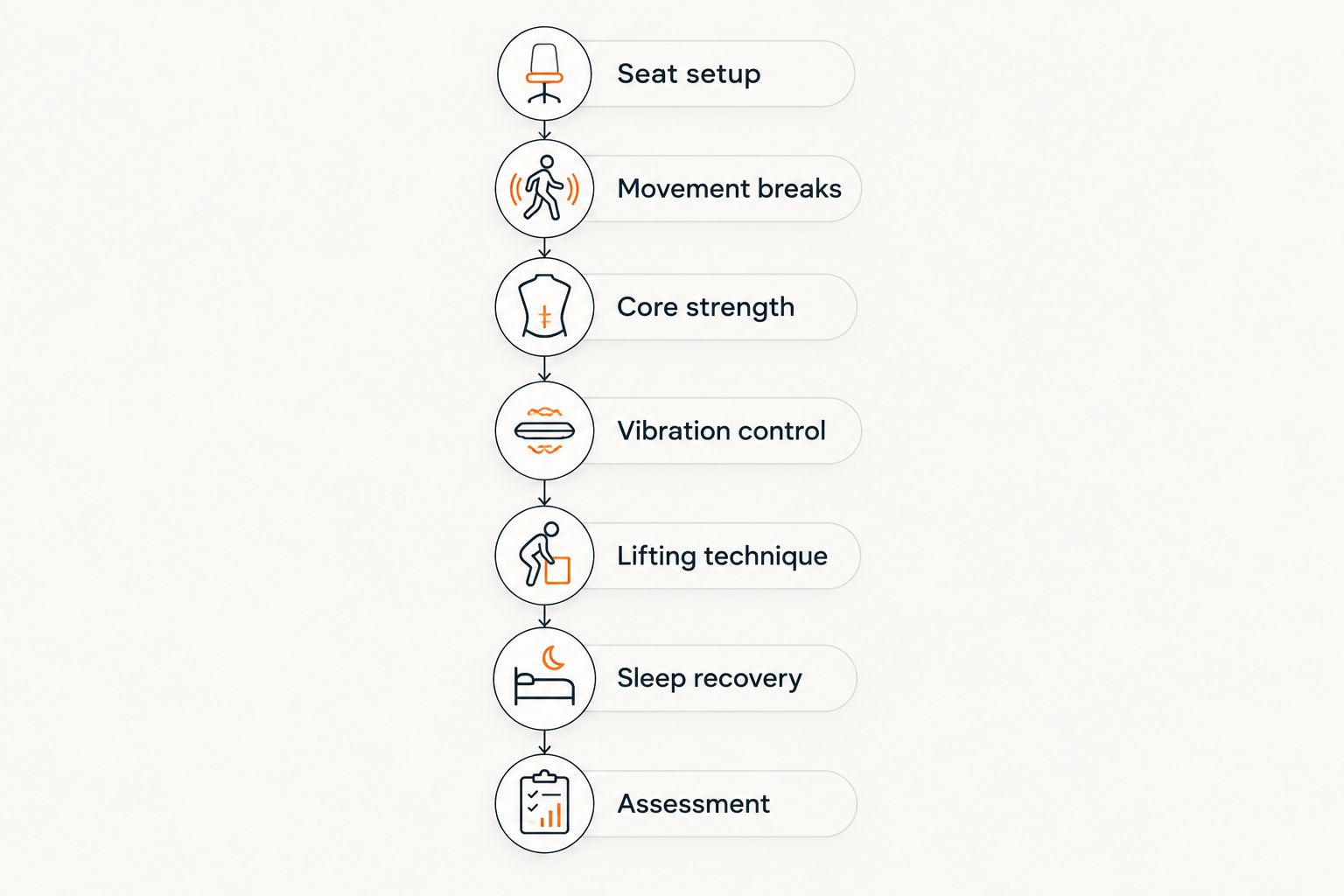
Adjust your seat and cab ergonomics
Seat setup is the first thing worth reviewing, because a small mismatch compounds over an 8-10 hour shift. Before anything else, check the basics:
- Set seat height so your hips sit slightly above knee level, reducing lumbar flexion.
- Adjust lumbar support so it fills the curve of your lower back, not just the mid-back.
- Check mirror and wheel position so you're not twisting your neck or reaching forward repeatedly.
- Review suspension settings on air-ride seats — too soft or too firm both transmit more vibration through the pelvis.
- Consider a supplementary seat cushion for long drives if the factory seat doesn't hold its shape after a few years of use.

Build movement breaks into your route
Static posture, not distance, is usually the bigger driver of stiffness. Breaking up sitting time changes how load is distributed through the spine over a shift:
- Plan a short stand-and-walk break roughly every two hours, not just at fuel stops.
- Use a 5-minute stretch routine focused on hip flexors, hamstrings and the upper back during scheduled rest breaks.
- Walk a full lap of the truck at every stop instead of standing still.
- Rotate your neck and shoulders through a full range of motion a few times each break.
- Keep a resistance band in the cab for quick mobility work — see how to prevent lower back pain while driving long distances for a fuller breakdown of timing and technique.
Strengthen your core and hips off the road
A stronger trunk and hip complex gives the spine more support during the hours it's loaded in a fixed position. This work happens off shift, not behind the wheel:
- Bird-dog and dead bug exercises to build deep core control without spinal loading.
- Glute bridges to counter the hip flexor tightness that comes from prolonged sitting.
- Standing hip flexor stretches after each shift, held for 30 seconds per side.
- Basic thoracic rotation drills to keep the mid-back mobile.
- Two to three sessions a week is a reasonable starting frequency for most drivers new to this kind of routine.
Manage vibration exposure
Vibration exposure is harder to eliminate than posture, but it can be reduced:
- Keep tyre pressure within the manufacturer's range — under-inflated tyres increase vibration transfer.
- Service air-ride seat suspension on schedule rather than waiting for it to feel obviously worn.
- Avoid stacking extra cushions on top of a worn seat pad, which can change your posture without reducing vibration.
- Where route choice is flexible, smoother-surfaced roads reduce cumulative vibration load over a shift.
Review your loading and lifting technique
Dock and delivery work is where acute strain usually happens, separate from the cumulative seated load:
- Bend at the hips and knees, not the lower back, when lifting straps, dunnage or boxes.
- Keep loads close to the body rather than reaching forward to lift.
- Use a trolley or dolly for anything you'd otherwise carry more than a few metres.
- Ask for help or split a load rather than twisting under weight to compensate.
Track your sleep and recovery on the road
Recovery between shifts matters as much as what happens during them, particularly on multi-day routes with cab sleeping:
- Use a supportive travel pillow that keeps the neck in a neutral position rather than folded to one side.
- Avoid sleeping directly against a cold window or vibrating surface where possible.
- Keep a consistent sleep window even across irregular shift patterns.
- Note which days you wake up stiffer than others — that pattern is useful information for an assessment.
Know when to get an assessment
Self-managed changes help many drivers, but persistent or worsening symptoms are worth discussing with a health professional rather than working around indefinitely. A chiropractor for truck drivers can assess posture, joint mobility and muscle tension specific to cab work, and refer on for imaging or medical review where that's clinically appropriate. This is general education, not a substitute for individual assessment — any new numbness, weakness or symptoms that don't settle with rest should be discussed with a GP or chiropractor promptly.
Comparing your options
| Option | Best for | Key limitation |
|---|---|---|
| Cab ergonomic adjustments | Drivers with new or mild stiffness | Won't resolve pre-existing joint or disc issues on its own |
| Seat cushion or lumbar support | Drivers whose factory seat has lost shape | Doesn't address vibration exposure |
| Core and mobility exercise | Drivers wanting a long-term self-managed approach | Requires consistency off shift to see any change |
| Chiropractic assessment (e.g. at MyChiro) | Drivers with persistent or recurring symptoms | Requires an in-person visit and follow-up planning |
| GP or physiotherapy referral | Drivers with numbness, weakness or red-flag symptoms | Best paired with, not instead of, an initial assessment |
Book a chiropractic assessment in Bondi Junction
Discuss driving-related back, hip or neck symptoms with a chiropractor.
Common mistakes truck drivers make
- Treating stiffness as normal for the job. Discomfort that builds every shift and doesn't ease on days off is worth assessing, not just managing with painkillers.
- Skipping breaks to protect the schedule. A two-hour block without moving compounds faster than most drivers expect, especially on interstate runs.
- Sleeping in the cab without any neck support. A folded jacket doesn't do the same job as a proper travel pillow over multiple nights.
- Lifting from the back at the dock after hours of sitting. Muscles and discs that have been static for hours are more vulnerable to an awkward lift.
- Waiting until a symptom is severe before getting it looked at. Early assessment gives more options than waiting for an acute flare-up mid-route.
FAQ
What does a chiropractor for truck drivers actually check?
A chiropractor typically assesses spinal and hip mobility, posture, and muscle tension patterns linked to prolonged sitting and cab vibration. The assessment also considers shift length and lifting demands specific to the driving job.
Can chiropractic care help with lower back pain from long-haul driving?
Chiropractic care may be discussed as part of managing driving-related lower back discomfort following an individual assessment. Outcomes vary by person, so a chiropractor will usually combine any manual therapy with posture and exercise advice.
How often should truck drivers see a chiropractor?
There’s no single frequency that suits every driver — it depends on symptom pattern, route type and what the initial assessment finds. A chiropractor can suggest a review schedule based on your specific situation.
Is a seat cushion enough to manage back pain while driving?
A seat cushion can improve comfort and support posture, but it doesn’t address vibration exposure or existing joint issues on its own. It’s one part of a broader approach that includes breaks and mobility work.
What’s the difference between chiropractic care and physiotherapy for drivers?
Chiropractic care often focuses on joint mobility and spinal assessment, while physiotherapy tends to emphasise rehabilitation exercise programs. Many drivers use both, coordinated with a GP where needed.
When should a truck driver see a doctor instead of a chiropractor?
Numbness, weakness, loss of bladder or bowel control, or pain following a specific injury should be assessed by a GP or emergency service promptly. A chiropractor can also identify when referral to a doctor is the appropriate next step.
Does whole-body vibration actually affect the spine?
Whole-body vibration from vehicle cabs is a recognised occupational factor associated with lower back symptoms in professional drivers. Seat suspension quality and tyre condition both influence how much vibration reaches the spine.
Can stretching alone fix driving-related back stiffness?
Stretching helps manage stiffness but rarely addresses the underlying cause on its own if seat setup or break scheduling stays the same. Combining stretching with ergonomic changes and, where needed, a professional assessment tends to cover more of the contributing factors.
One last thing
The detail most drivers miss isn't the seat or the stretching routine — it's tyre pressure. Under-inflated tyres increase how much vibration transfers from the road through the seat and into the lower back over a shift, and it's a five-minute check most fleets already schedule but individual drivers rarely think to connect to how their back feels by the end of a route in 2026.
Related guides
- Chiropractic care for rideshare and delivery drivers
- How to choose the right chiropractor for your condition