

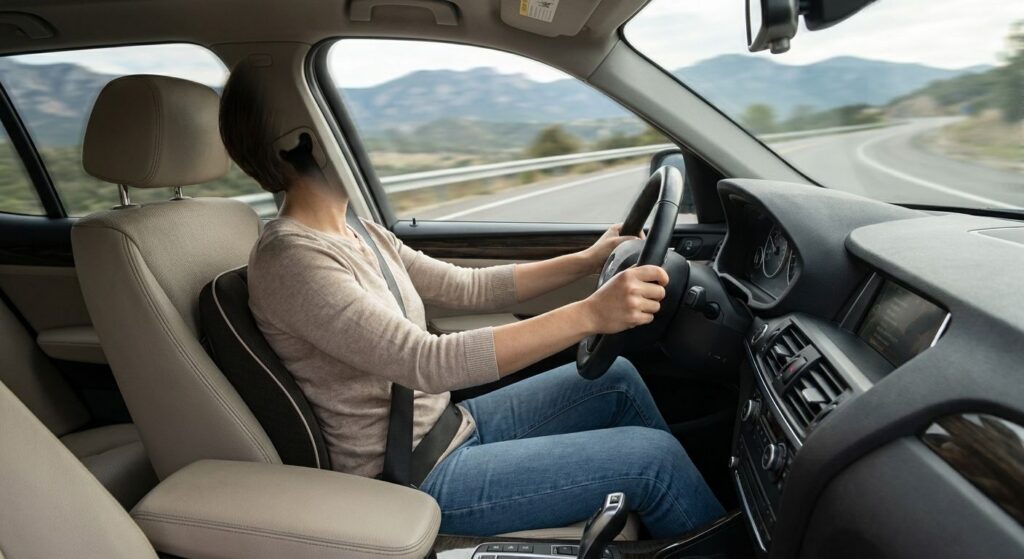
Long-haul driving loads the lower back in ways a short commute never will, and small setup changes can meaningfully reduce that strain. This guide covers seat position, break timing, and support tools that are worth checking before your next long trip in 2026.
- Recline your seat back to roughly 100-110 degrees instead of sitting bolt upright to reduce lumbar spine load.
- Stop every two hours for at least 15 minutes to move, stretch and reset your posture.
- A lumbar support cushion can help maintain the natural curve of your lower spine on long drives.
- Persistent or worsening lower back pain while driving is worth having assessed by a health professional.
Why this matters
Sitting is one of the more demanding postures for the lumbar spine because it flattens the natural lower-back curve and increases disc pressure compared with standing. Add vibration from the road, a fixed hip and knee angle for hours at a time, and reduced blood flow to spinal tissues, and it's easy to see why long drives leave so many Australians rubbing their lower back at the servo. None of this means driving causes lasting damage on its own, but the combination of posture, duration and repetition is exactly the pattern that tends to bring on stiffness and discomfort.
A chiropractor at MyChiro in Bondi Junction regularly sees patients whose back pain flares after long trips, whether that's a work commute up the coast or a family road trip. The setup habits below are the same ones worth reviewing before symptoms show up, not just after.
How to prevent back pain while driving
The steps below focus on the parts of your driving setup and routine you can actually control: seat position, break frequency, and what's supporting your lower back.
- Adjust your seat back angle. Aim for a recline of roughly 100-110 degrees rather than sitting upright at 90 degrees. This reduces the load placed on the lumbar discs compared with a straight-backed seating position.
- Bring your seat forward enough that your knees stay slightly bent. Reaching for the pedals with straight legs rotates your pelvis and flattens your lower back curve.
- Raise the seat height so your hips sit level with or slightly above your knees. A seat that's too low forces your hips into a deeper flexed position for the whole trip.
- Add lumbar support if your seat doesn't already curve into your lower back. A rolled towel, a purpose-built cushion, or the seat's built-in adjustment can all help maintain the spine's natural inward curve.
- Check your mirrors and steering wheel distance. Overreaching for the wheel pulls your shoulders and upper back forward, which changes how load travels down through your spine.
- Plan a stop every two hours for at least 15 minutes. This interval matches Australian road safety guidance for driver fatigue breaks, and it's also enough time for spinal discs to partially rehydrate after sustained compression.
- Move during every stop, don't just sit somewhere else. A short walk, a few standing back extensions, or a hip flexor stretch resets circulation and muscle tone before you get back in the seat.
A simple comparison: seat setup habits
| Habit | Effect on lower back | Verdict |
|---|---|---|
| Upright 90-degree seat back | Increases lumbar disc pressure | Adjust |
| Reclined 100-110 degree seat back | Distributes load more evenly | Better |
| No lumbar support on long trips | Spine loses natural curve over time | Adjust |
| Cushion or built-in lumbar support | Helps maintain lower-back curve | Better |
| No breaks for 4+ hours | Muscles stiffen, discs stay compressed | Adjust |
| Break every two hours | Restores movement and circulation | Better |
A car seat cushion for long drives is one of the more practical additions if your vehicle's stock seat doesn't offer much adjustable lumbar shape. It won't override poor seat positioning, but paired with the setup steps above it gives your lower back something closer to a neutral resting curve for the length of the trip.
Why back pain from driving varies from person to person
Not everyone gets the same result from the same seat setup, and a few underlying factors explain why:
- Trip duration — two hours of driving loads the spine very differently than a six-hour interstate run.
- Vehicle seat design — some factory seats have minimal lumbar shape and no adjustable bolster.
- Existing hip and core mobility — tight hip flexors or weak core muscles change how your pelvis sits during long periods seated.
- Prior back history — anyone with previous disc, joint or muscular issues in the lower back may notice symptoms show up sooner under load.
- Vibration and road surface — highway driving on rough surfaces adds mechanical stress that smooth city driving doesn't.
- Stress and muscle tension — long drives, traffic and time pressure can increase muscle guarding around the lower back independent of posture.
Get your driving posture assessed
A chiropractor can review your seat setup and movement habits.
Does a lumbar support cushion actually help with driving back pain?
A lumbar support cushion can help maintain the natural inward curve of your lower spine during long periods seated, which reduces the flattening effect that comes from sitting unsupported. It works best combined with correct seat height and recline rather than as a standalone fix. Some office-chair lumbar cushions translate well to car seats — the same lumbar support cushion principles that apply at a desk apply behind the wheel.
How often should you stop during a long drive?
A break every two hours for at least 15 minutes is the general guidance used in Australian road safety campaigns, and it doubles as a useful interval for your spine. Standing, walking a short distance and gently extending your back during that stop helps offset the compression that builds up while seated. If you're loading bags or luggage at each stop, lifting heavy objects safely matters just as much as the driving posture itself.
Is stretching before a road trip worth doing?
A few minutes of hip flexor and hamstring stretching before a long drive can help your pelvis sit in a more neutral position once you're seated, since tight hip flexors tend to pull the pelvis forward and flatten the lower back curve. This isn't a guarantee against discomfort on longer trips, but it's a low-effort habit that complements seat setup and break timing. Pair it with the same stretches you'd do at the end of the drive to unwind after several hours in one position.
FAQ
How do you prevent lower back pain on a long drive?
Adjusting your seat back to roughly 100-110 degrees, keeping your knees slightly bent, adding lumbar support and stopping every two hours can all reduce strain on your lower back during a long drive. No single change works in isolation — the combination of seat setup and break frequency matters most.
What’s the best seat position to avoid back pain while driving?
A reclined seat back around 100-110 degrees, seat height level with or slightly above the knees, and enough forward position that your knees stay slightly bent all help reduce lumbar spine load compared with sitting bolt upright.
Does a car seat cushion help with back pain?
A car seat cushion can help maintain your lower back’s natural curve on long drives, particularly in vehicles with minimal built-in lumbar support. It works best alongside correct seat height and recline rather than as a standalone solution.
How long should you drive before taking a break?
Australian road safety guidance recommends stopping every two hours for at least 15 minutes on long drives. This interval also gives spinal discs a chance to partially recover from sustained seated compression.
Can bad driving posture cause long-term back problems?
Prolonged poor seated posture is one of several factors linked to lower back discomfort, though outcomes vary between individuals. Anyone with ongoing or worsening pain after driving should have it assessed by a health professional rather than assuming it will resolve on its own.
Should you see a chiropractor for back pain from driving?
A chiropractor can assess your posture, spinal movement and driving setup, and discuss whether adjustments or exercise-based care may be appropriate for your situation following assessment. This is worth considering if pain persists despite adjusting your seat setup and break routine.
Is it bad to sit for long periods without moving?
Sitting for extended periods without moving increases pressure on the lumbar discs and reduces circulation to spinal tissues, which is why movement breaks every two hours are recommended on long drives. Standing, walking and light stretching during stops help offset this.
One last thing
Most people fix their seat height and lumbar support and stop there — the part they skip is the stretch break. A 15-minute stop every two hours does more for spinal discs than any cushion, because movement is what actually restores the fluid exchange that sitting shuts down. If lower back pain from driving keeps coming back despite a properly set-up seat and regular breaks, that pattern is worth discussing with a health professional rather than working around it trip after trip.
Related guides
- Best lumbar support cushion for office chairs
- How to lift heavy objects safely to protect your back
- How to choose the right chiropractor for your condition