

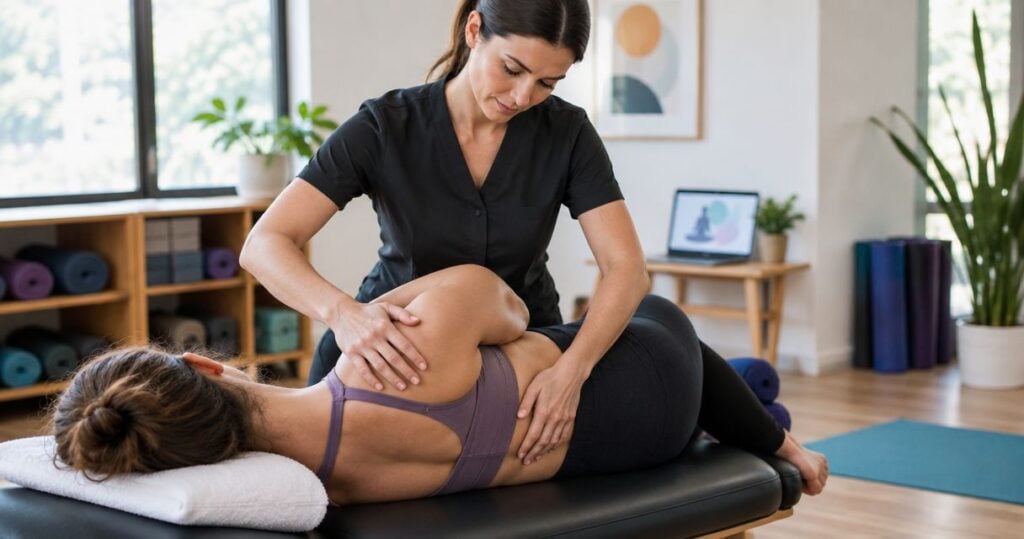
Chiropractic care for yoga instructors with repetitive strain looks at the wrist, shoulder and lower back overload that builds from teaching multiple classes a day, and outlines the practical steps that can support joint mobility between sessions.
- Chiropractic care for yoga instructors focuses on the wrists, shoulders and lower back joints loaded by repeated demonstration and hands-on assists.
- MyChiro in Bondi Junction offers assessments for instructors with recurring joint stiffness, with any management plan discussed after review.
- Rotating which side you demonstrate on and varying hand placement during assists can reduce one-sided joint loading.
- Chiropractic care sits alongside remedial massage and strength coaching rather than replacing either for most instructors.
Why chiropractic care matters for yoga instructors
Teaching yoga is repetitive in ways that differ from most standing or desk-based jobs. A vinyasa instructor might demonstrate the same chaturanga-to-updog transition dozens of times across a single class, then repeat it in the next class an hour later. Downward dog and plank load the wrists in extension under body weight, a joint position rarely stressed this way outside a yoga or gymnastics context.
Hands-on assists add another layer. Adjusting a student's hip or shoulder alignment repeatedly, often from the same stance or with the same hand, concentrates load on one side of the body across a teaching day. Instructors who also practise extensively tend to be more hypermobile than the general population, which can mean joints move through a wider range but tolerate repeated loading differently. Back-to-back class schedules leave little built-in recovery time between sessions, which is different from a job with a lunch break between physical tasks.
Some instructors manage early wrist or shoulder tightness with yoga poses for lower back pain relief and their own mobility practice. Others find symptoms persist despite stretching and want an assessment that looks specifically at teaching-related movement patterns rather than general fitness.
Track your teaching load and rest windows
Start with a simple log before changing anything else. Instructors often underestimate how many classes stack up in a week once private sessions and cover shifts are added to a regular schedule.
- Log how many classes and which styles you teach across a week, since vinyasa and restorative styles load joints differently
- Note which poses you personally demonstrate most and roughly how many times per class
- Flag which joints feel tight or sore at the end of a teaching day, not only after a heavy week
- Build at least one full rest day into a five- or six-class week where the schedule allows it
- Track sleep and general fatigue alongside physical symptoms, since poor recovery compounds joint strain over 2026's busier studio schedules
Vary which side you demonstrate and assist from
Most instructors default to a dominant side without noticing. Facing the same direction and assisting with the same hand class after class turns a balanced practice into a one-sided load.
- Alternate the side you face when cueing so one shoulder and hip aren't always loaded first
- Switch your dominant assisting hand across the week rather than defaulting to the same wrist
- Rotate between verbal cueing and hands-on assist within the same class instead of assisting every student
- Change your position in the room between classes so you're not always twisting toward the same mirror or wall
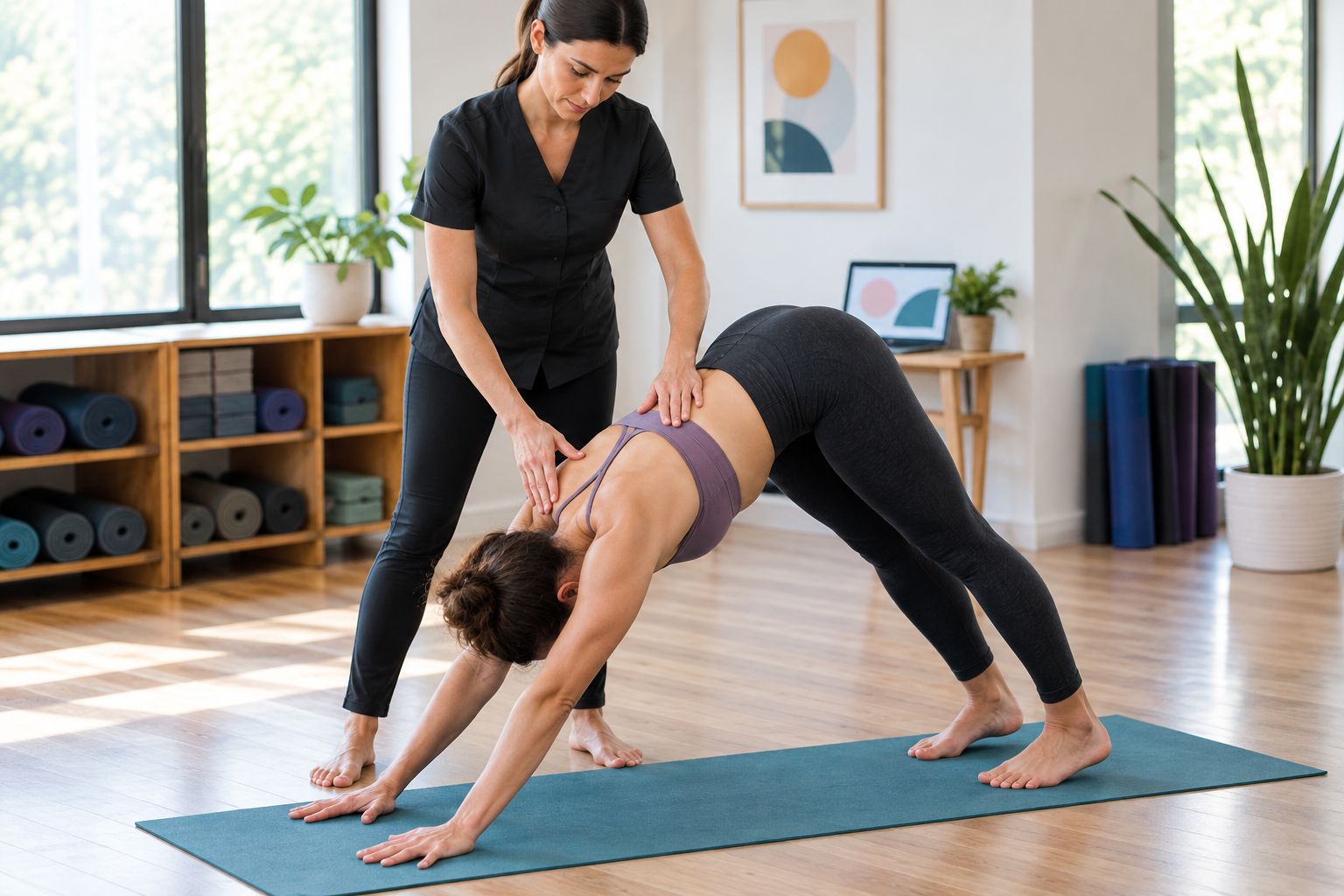
Support wrist and shoulder loading points during vinyasa
Chaturanga and plank are the two poses instructors mention most often when wrist or shoulder tightness shows up mid-week.
- Reduce the number of chaturangas you personally demonstrate per class, cueing the transition verbally instead
- Widen hand placement slightly in plank and downward dog to reduce concentrated wrist load
- Use a folded mat edge or wrist wedge under the heel of the hand if wrist extension feels restricted
- Build wrist mobility drills into your own warm-up before the first class of the day
- Avoid teaching several back-to-back vinyasa classes without a lower-load class, such as yin or restorative, between them
Strengthen supporting muscle groups off the mat
A yoga practice alone doesn't build the same loaded strength that protects joints under repeated demonstration.
- Add rotator cuff and scapular stabiliser work outside your regular yoga practice
- Build posterior chain strength through glutes and hamstrings to reduce reliance on lumbar extension in backbends
- Include grip and forearm strengthening if wrist fatigue shows up by midweek
- Work with a personal trainer or strength coach if programming your own accessory work isn't realistic around a teaching schedule, similar to the approach outlined for personal trainers and fitness instructors managing their own repetitive load
Build a recovery routine between classes
Recovery gets treated as an afterthought when the day is full of back-to-back bookings, but short breaks between classes matter more than one long stretch session at night.
- Stretch tight hip flexors and hamstrings after standing-heavy teaching blocks, not only before
- Use short mobility breaks between back-to-back classes rather than saving all stretching for the end of the day
- Apply heat or use a foam roller on areas that stay tight through the week
- Prioritise sleep on days with early morning and evening class blocks, since the gap compresses recovery time
The joint and tendon overload pattern in this segment overlaps with what shows up in massage therapists with repetitive strain, where repeated hand and wrist use across a working day drives similar symptoms, and building your own core stability without straining the lower back matters just as much: see how to strengthen your core without straining your lower back for the underlying approach.
Know when to book a chiropractic assessment
Self-management has limits. If tightness or restriction doesn't ease with a rest day and the steps above, an assessment can look at the specific movement patterns behind it.
- Book an assessment if wrist, shoulder or lower back stiffness persists beyond a scheduled rest day
- Mention which poses or assists trigger symptoms, so the assessment can focus on teaching-specific movement rather than general fitness
- Raise any hypermobility or joint instability history, since this can change what's discussed in a management plan
- A chiropractor may use spinal and joint assessment, soft tissue techniques or mobility exercises depending on findings, with any plan discussed with you before care begins
Comparing your options as a yoga instructor
| Option | Best for | Key limitation |
|---|---|---|
| Self-managed stretching and mobility work | Instructors with mild, early-stage tightness | Relies on consistent technique without outside feedback |
| Remedial massage therapy | Instructors with muscular tightness and trigger points | Addresses soft tissue rather than joint alignment |
| Chiropractic care | Instructors with recurring joint stiffness across multiple regions | Requires an initial assessment before any plan is discussed |
| Physiotherapy | Instructors recovering from a specific diagnosed injury | Focused on rehab exercise rather than broader joint mobility |
| Strength coaching or personal training | Instructors building long-term load tolerance | Doesn't address existing pain or restriction directly |
Common mistakes yoga instructors make
- Adjusting every student with the same hand position, loading the same wrist joint hundreds of times across a day
- Ignoring early wrist or shoulder tightness because a packed class schedule doesn't leave room for a rest day
- Skipping their own strength work outside of teaching yoga, assuming the practice itself is enough conditioning
- Standing asymmetrically while cueing, consistently favouring one side of the room and one shoulder
- Continuing to demonstrate deep backbends or arm balances through discomfort instead of switching to verbal cueing for that pose
Book a chiropractic assessment
Discuss teaching-related wrist, shoulder or back stiffness with the Bondi Junction clinic.
FAQ
What is chiropractic care for yoga instructors?
Chiropractic care for yoga instructors is an assessment-based approach that looks at joint stiffness and repetitive strain from teaching, such as wrist load in plank and downward dog or asymmetric loading from hands-on assists. Any adjustments or soft tissue work are discussed with the instructor after assessment, not applied as a standard package.
Can chiropractic adjustments help with repetitive strain from teaching yoga?
Chiropractic adjustments may be appropriate following assessment for joint stiffness linked to repeated movement patterns in teaching. What’s discussed depends on which joints are affected and how long symptoms have been present, so an individual assessment comes before any specific claim about outcome.
How often should a yoga instructor see a chiropractor?
There’s no fixed frequency that applies to every instructor; it depends on class load, symptom severity and what’s discussed at the initial assessment. Instructors teaching five or more classes a week with persistent wrist or shoulder tightness are more likely to benefit from a review than those teaching one or two classes.
What should hypermobile yoga instructors know before chiropractic care?
Hypermobility changes how a joint responds to repeated loading, so it’s worth raising during an initial assessment rather than assuming it doesn’t matter. A chiropractor can factor joint laxity into what’s discussed for a management plan.
What’s the difference between chiropractic care and remedial massage for yoga instructors?
Remedial massage targets muscular tightness and trigger points, while chiropractic care focuses on joint alignment and movement restriction. Many instructors use both depending on whether the main complaint is muscle tightness or joint stiffness.
Can wrist pain from downward dog and plank be addressed with chiropractic care?
Wrist and forearm strain from repeated weight-bearing poses can be discussed at a chiropractic assessment, which looks at joint mobility in the wrist and any compensation patterns further up the arm. Reducing personal demonstration volume alongside any care discussed is usually part of managing the load.
When should a yoga instructor see a doctor instead of a chiropractor?
Sudden severe pain, numbness, weakness, or symptoms following a fall or acute injury warrant a GP or emergency assessment rather than a chiropractic visit first. A chiropractor can also refer onward if findings during an assessment suggest that’s the appropriate next step.
Does chiropractic care replace stretching and strength work for yoga instructors?
No. Chiropractic care is generally discussed as one part of managing repetitive strain, alongside stretching, strength work and adjusting teaching habits like assist technique and class sequencing.
One last thing
Instructors often show up with wrist and shoulder complaints before lower back complaints, which is the reverse of what's common in most standing or desk-based occupations. That pattern traces back to how much time is spent bearing weight through the hands in plank, chaturanga and downward dog, a joint position most other jobs never load repeatedly. Addressing hand and wrist mechanics early, well before 2026's busier studio calendars push class counts up, tends to matter more for this group than lower back-focused advice written for other professions.
Related guides


