
Instead of repeating your work restrictions separately to your employer and each clinician, use one written return-to-work plan that connects agreed duties, clinical advice and review dates. This 2026 guide explains where chiropractic care at Mychiro can be discussed within that process, without confusing appointments with work clearance.
- A chiropractic return to work plan should connect clinical advice with agreed duties, responsibilities and review dates.
- Mychiro provides chiropractic care in Bondi Junction; suitability for your circumstances requires individual assessment.
- Keep workplace duties, clinical care and workers compensation approvals distinct, then coordinate the relevant information.
- Agree who updates the plan when your duties, capacity or circumstances change.
Why this matters
A chiropractic return to work plan is a workplace coordination document, not a prescribed course of adjustments. Chiropractic care may be discussed following assessment, but an appointment schedule does not establish which duties you can perform or when you should resume them.
Mychiro is a chiropractic clinic in Bondi Junction, not a substitute for workplace planning or required work-capacity documentation. Keep those roles separate when deciding what information belongs in your plan.
For a NSW workers compensation claim in 2026, check the current State Insurance Regulatory Authority requirements and your insurer’s instructions. Ask who is responsible for capacity certification, which documents are required and whether proposed services need approval; do not assume one document covers every purpose.
This guide covers communication and paperwork after appropriate clinical assessment. It does not determine your fitness for work or recommend chiropractic care for a particular injury.
Before you start
- Gather the relevant documents: your current capacity advice or certificate, any existing workplace plan, a description of actual duties, and claim correspondence if applicable. Use documents relevant to your circumstances rather than arranging additional investigations solely for this checklist.
- Identify the people involved: your workplace contact, the clinician responsible for capacity advice, any rehabilitation coordinator and your claims contact. Agree what information each person needs and how you will authorise relevant communication.
- Check the paperwork distinction: a clinical recommendation, a capacity certificate and insurer approval are different things. Confirm the required signatory and approval process before assuming chiropractic appointments can be included in a claim-funded arrangement.
Work demands and communication setup
Start with the work itself, not a list of appointments. A job title such as receptionist, nurse or storeperson leaves too much unexplained for someone who has never seen your workplace.
The bold labels below are suggested headings for a document you create, not fields in an insurer portal or clinic system.
- Describe your duties. Under Work tasks, record what you actually do: keyboard work, customer service, driving, lifting, reaching, standing or other relevant activities. Include occasional duties and handovers, not just your main task.
- Record the context. Under Work conditions, describe shift patterns, access to breaks, available equipment and whether tasks happen alone or with assistance. Distinguish what your employer can offer from what you hope will be available.
- Assign contacts. Under Plan contacts, identify who can confirm duties, who provides clinical advice and who answers claim questions. Ask how conflicting instructions should be resolved.
- Agree information sharing. Under Communication consent, record what relevant information you authorise clinicians and workplace contacts to exchange. Ask what will be shared before signing a broad consent form.
Expected result: you have a practical description of the job and a named contact for each decision. A clinician can understand the proposed duties without relying on your job title alone.
Avoid replacing a task description with a diagnosis. Your supervisor needs an actionable account of agreed work arrangements; detailed clinical information should only be shared where relevant and appropriately authorised.
Clinical roles and chiropractic care
Use the clinical discussion to establish whether chiropractic care has a role, rather than assuming adjustments belong in every plan. Mychiro provides chiropractic care and spinal adjustments; whether these are appropriate for you requires individual assessment and discussion.
- Bring the duty description. Show your chiropractor the proposed tasks and relevant capacity advice. Explain what you are being asked to do, rather than asking only whether you can return to work.
- Clarify the proposed care. Under Clinical care, record what is being proposed, why it is being considered, its material risks and alternatives, and how its appropriateness will be reviewed. You can ask questions or decline a proposed intervention.
- Separate clinical and workplace decisions. Under Decision responsibilities, record who provides capacity advice, who confirms suitable duties and who handles approvals. Ask whether additional documentation is needed from another practitioner.
- Coordinate overlapping advice. If several clinicians are involved, ask them to clarify inconsistent instructions through an agreed communication channel. Do not combine separate exercise or activity instructions yourself.
Expected result: chiropractic care has a defined, conditional role, with clear responsibilities and a review process. The plan does not promise an outcome or make ongoing appointments a condition of workplace participation.
For questions about communication between practitioners, see the guide to combining chiropractic care with physiotherapy in one plan. The relevant question is how advice will be coordinated, not how many services can be added.
Keep each document’s purpose clear
The following comparison distinguishes administrative documents; it does not rank clinical services or establish which documents your particular arrangement requires.
| Document | Use it for | Useful feature | Limitation |
|---|---|---|---|
| Workplace return-to-work plan | Recording agreed duties, contacts and reviews | Makes workplace arrangements explicit | Does not replace required clinical certification |
| Capacity certificate or advice | Communicating assessed work capacity within the applicable process | Gives the workplace a clinical basis for planning | Must meet the relevant scheme or employer requirements |
| Clinical care plan | Recording proposed care and its review | Explains the clinical discussion | Does not establish insurer approval or available duties |
| Insurer correspondence | Confirming claim decisions and approval conditions | Provides a written record | Does not itself describe your day-to-day job |
Use each document for its stated purpose. Where documents disagree, ask the responsible people to reconcile them rather than choosing whichever instruction seems easiest.
Written duties and review settings
Translate the discussion into a document your workplace can use. For your 2026 plan, include a version date so an old attachment is not mistaken for the current arrangement.
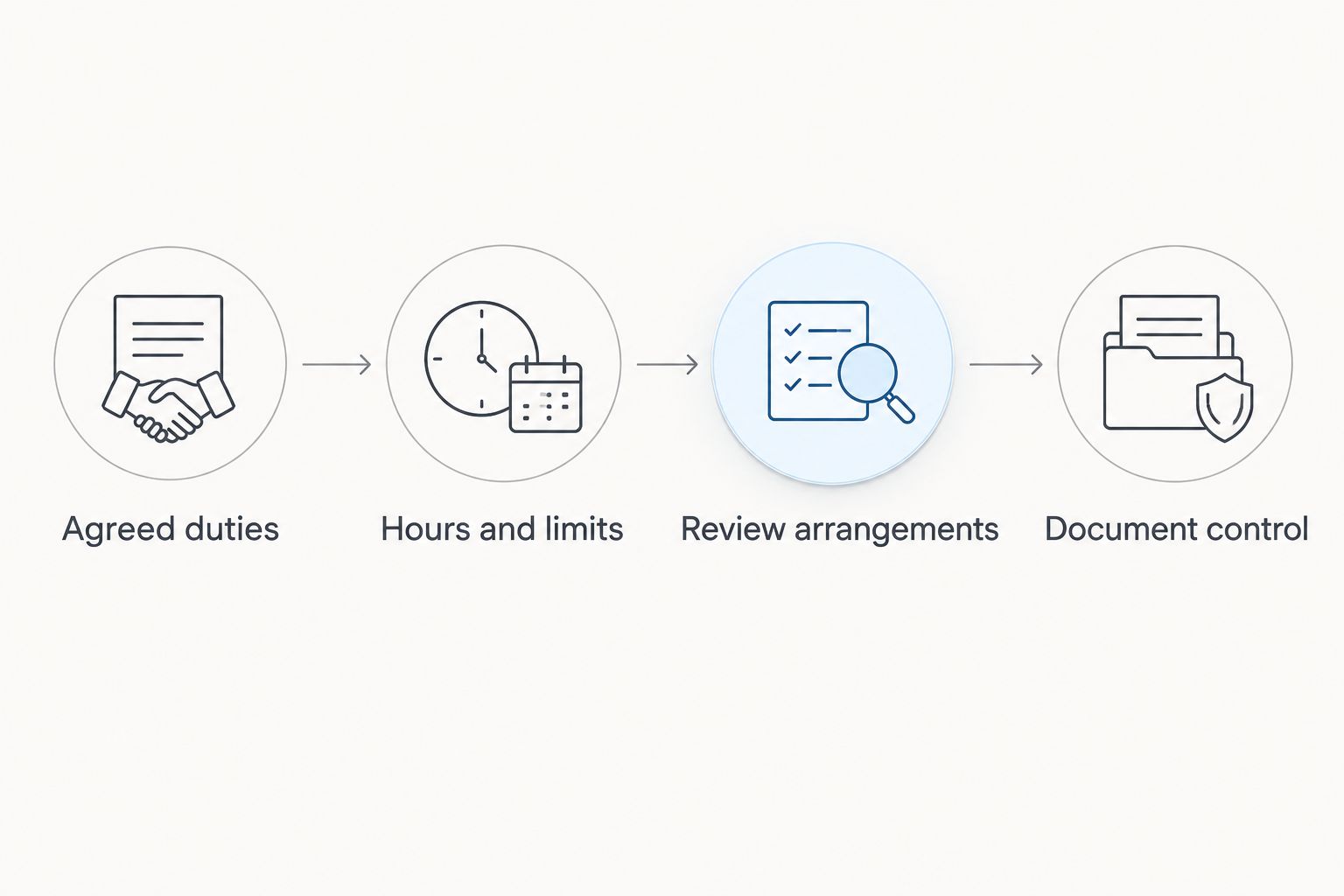
- Record agreed duties. Under Agreed duties, list the tasks your employer has confirmed within the applicable capacity advice. Replace vague phrases such as light duties with specific activities.
- Copy individual limits accurately. Under Hours and limits, record only the hours, task restrictions and other parameters agreed for you. Do not borrow lifting limits, break schedules or shift lengths from an online example.
- Set review ownership. Under Review arrangements, name the person who coordinates updates and enter the agreed review date. State how you should report difficulty with the arrangement before that date.
- Confirm the current version. Under Document control, add the date and version identifier, then distribute it to the agreed recipients. Ask them to confirm that it replaces earlier versions.
Expected result: your plan identifies what you will do, which limits apply, who coordinates changes and when the arrangement will be reviewed. It contains no automatic progression based solely on appointment attendance.
A useful check is to ask whether a different supervisor could follow the plan without calling you for an explanation. If not, clarify the task descriptions and escalation contact before relying on it.
Update the plan whenever duties change
A second workflow applies when you are already back at work but the arrangement changes. A different roster, temporary reassignment, altered equipment or new task can require clarification even when your appointment schedule stays the same.
For example, a plan written around seated administration does not automatically cover stock handling added later. Ask the workplace contact to describe the proposed change and refer it through the agreed review process.
- Capture the change. Record what is proposed and when it would start. Keep factual task information separate from assumptions about your capacity.
- Request the relevant review. Send the change to the person responsible for coordinating the plan. Seek updated clinical advice or claim approval where the applicable process requires it.
- Replace the document. Once the arrangement is agreed, issue a dated version and identify what it replaces. Check that the roster and supervisor instructions match.
Expected result: changes pass through the same decision process as the original plan. You are not left interpreting whether an old restriction covers a new task.
When updating a plan in 2026, check current forms and instructions rather than reusing a saved template without checking it. A familiar document is not proof that its requirements remain current.
Troubleshooting
Your employer says the duties are too vague
Replace general phrases with observable tasks. Ask your employer to describe the proposed work, then seek clarification from the clinician responsible for capacity advice where needed.
Do not invent a lifting limit or standing duration to complete an empty field. An unresolved field should become a question for the responsible person.
Your clinicians give different instructions
Write down the conflicting advice and ask for a coordinated response, with your consent. Identify which instruction concerns clinical care and which concerns work capacity; they are not necessarily answering the same question.
Avoid selecting parts of each instruction to create your own programme. Ask for one clear account of what applies.
You have an appointment but no approval confirmation
Contact the insurer or claims contact before assuming the service is covered. Ask what approval is required and request the decision in writing.
A booking confirmation is not an approval document. Keep the clinical discussion separate from the funding decision.
The workplace cannot offer the proposed duties
Ask your employer to identify which tasks are available and which are not. Return that factual information to the plan coordinator so the arrangement can be reconsidered through the appropriate process.
Do not rewrite your own clinical restrictions to fit the roster. The mismatch needs clarification between the relevant people.
Your symptoms change while the plan is underway
Use the agreed reporting process and seek clinical advice rather than waiting for the next scheduled administrative review. Do not interpret new symptoms as proof that adjustments or more appointments are needed.
New bladder or bowel control problems, numbness around the groin, or rapidly worsening weakness require urgent medical assessment. Healthdirect Australia identifies these as warning signs in its back-pain guidance; this is medical-assessment advice, not a chiropractic care pathway.
Customise your workflow
Expand the detail where your job needs it, not the number of appointments. A workplace plan should describe your circumstances rather than follow a generic care package.
For desk-based work, discuss workstation access, task variation and meeting arrangements with your workplace contact. For manual work, describe actual handling tasks and available assistance; for shift work, make sure the plan reaches every relevant supervisor.
Include practical barriers in the discussion. Travel, fatigue, language needs and uncertainty about workplace expectations belong in a coordination conversation, without being reduced to a posture problem.
Ask how proposed care will be reviewed and what would prompt a change in approach. A care decision and a work decision each need their own rationale. Neither should be inferred from the other.
FAQ
What is a chiropractic return to work plan?
A chiropractic return to work plan connects any agreed chiropractic care with a wider workplace plan. It should distinguish clinical advice, duties, capacity documentation, approvals and review responsibilities rather than prescribe adjustments automatically.
Can a chiropractor decide when I return to work?
Do not assume a chiropractor’s advice alone completes your return-to-work requirements. Confirm who can provide the required capacity documentation under your employer’s process or compensation scheme.
Do I need chiropractic adjustments before returning to work?
A return-to-work plan does not automatically require chiropractic adjustments. Whether chiropractic care is appropriate requires individual assessment and discussion of the proposed care, alternatives and risks.
Will workers compensation cover chiropractic appointments?
Coverage depends on the applicable scheme, claim decision and approval requirements. Ask your insurer what is required and obtain written confirmation rather than treating a booking as approval.
What should I bring to a chiropractic appointment about work?
Bring your actual duty description, relevant capacity advice, existing workplace plan and applicable claim correspondence. Explain the proposed tasks and ask what information the chiropractor needs to assess your circumstances.
What if my employer changes my duties after I return?
Ask your plan coordinator to review the proposed change against the current advice and arrangements. Record any agreed update in a dated version and confirm that the relevant supervisors receive it.
How many chiropractic sessions belong in a return-to-work plan?
There is no session count established by this guide. Discuss whether care is appropriate and how it would be reviewed; appointment attendance does not itself establish work capacity.
One last thing
Check who receives the plan, not just who signs it. A carefully written document cannot guide a supervisor who has only seen an earlier version.
Before starting your agreed arrangement in 2026, ask the workplace coordinator to confirm which version is current and who holds it. Keep your own copy alongside the relevant clinical advice and approval correspondence.
Related guides
- How to prepare for your first chiropractor appointment
- How to get workers compensation approval for chiropractic care
- How to access chiropractic care through a workplace health programme