


Instead of repeating your history and reconciling separate instructions, combine chiropractic and exercise physiology through a shared plan: confirm whether both services are appropriate, define each practitioner’s role, and agree how updates will travel. MyChiro provides chiropractic care in Bondi Junction; discuss any proposed exercise physiology involvement with the relevant practitioners rather than assuming a combined service is available.
- Combine chiropractic and exercise physiology through assessment, consent, defined responsibilities and a shared exercise plan.
- MyChiro provides chiropractic care in Bondi Junction; ask separately about communication with an exercise physiologist.
- Adding another practitioner is not automatically necessary; discuss the purpose of each service.
- Agree who changes your exercise programme and what should trigger a review.
Why this matters
Combining services is a coordination decision, not a promise of better clinical results. Before adding appointments, ask what each practitioner would contribute and whether that contribution is relevant to your circumstances.
Separate advice becomes difficult to follow when nobody owns the current exercise programme. A written plan gives you somewhere to check responsibilities, agreed activities and review arrangements without relying on memory.
MyChiro is a chiropractic clinic for people in Bondi Junction seeking to discuss chiropractic care. Whether chiropractic care, exercise physiology, both, or another pathway is appropriate requires individual assessment.
Use the workflow below to organise those discussions in 2026. It is an administrative guide, not an exercise prescription or a recommendation to undergo adjustments.
Before you start
- Gather your information: bring your current exercise programme, relevant correspondence, medication list and questions. Supply existing reports if requested; do not arrange new tests simply to complete this checklist.
- Check access and consent: confirm each practitioner’s identity, qualifications, contact details and process for sharing information. Ask what information will be shared, with whom and for what purpose.
- Resolve the hidden duplication: tell both practitioners about every current programme, including gym sessions and home exercises. Agree who maintains the exercise instructions before accepting another list.
Do not assume the practitioners share a booking system, patient record or referral arrangement. Ask directly, including whether communication requires a separate request from you.
If your concerns require medical assessment, arrange that rather than using this workflow to choose between appointments. Do not wait for a routine coordination discussion when you need urgent medical assistance.
Configuration unit: the shared brief
Establish your starting point
- Write your goal. Describe an activity that matters to you, such as returning to a usual walk or discussing an existing gym routine. Separate what you want to do from what you expect a particular service to deliver.
- List current care. Include your GP, allied health practitioners, current exercises and relevant advice. Record what you actually do, not only what an old programme says.
- Prepare a shared brief. Use a document or paper sheet with the suggested headings Goal, Current activity, Current advice and Questions. These are headings you create, not software fields or clinic requirements.
For example, an entry might read: current walking duration, 10 minutes; current organised exercise, 2 sessions per week. Those figures illustrate how to record an existing routine, not how much activity you should undertake.
Keep the brief to 1 page where practical. Put supporting correspondence behind it rather than copying every report into the summary.
Expected result: you can give each practitioner the same factual starting point and identify questions that still need an answer.
Separate goals from assumptions
A goal describes something you want to discuss or work towards. An assumption says you must receive a particular procedure before that activity is possible.
Do not build the plan around an assumed sequence such as adjustments first, exercise second. Ask each practitioner to explain any proposed sequence, its rationale, alternatives and review arrangements for your circumstances.
For your 2026 shared brief, include a date and the name of the person who prepared it. A document without a date is harder to distinguish from an earlier version.
Configuration unit: practitioner responsibilities
Agree who does what
- Ask each practitioner to define their proposed role. Request an explanation of the assessment, advice or service being considered, including its limitations and alternatives.
- Nominate the exercise-plan contact. Ask who will maintain the exercise programme and answer questions about its instructions. Do not assume this responsibility transfers automatically when another practitioner becomes involved.
- Confirm the communication arrangement. With your consent, ask how relevant assessment summaries and programme changes can be exchanged. Confirm who initiates the next update.
Expected result: you know who holds the current exercise programme, who answers each type of question and how the practitioners can communicate.
Compare responsibilities, not promised outcomes
The table describes matters to clarify with each profession. It does not establish that you need either service or that a combined plan produces a particular result.
| Practitioner | Contribution to discuss | Practical advantage | Limitation to clarify |
|---|---|---|---|
| Chiropractor | Musculoskeletal assessment and any proposed chiropractic care, including adjustments where appropriate following assessment | A defined contact for questions about proposed chiropractic services | Chiropractic involvement does not establish that adjustments are necessary or that another service is available through the clinic |
| Accredited exercise physiologist | Assessment and an individually considered exercise programme | A defined contact for exercise instructions and programme reviews | An exercise programme needs individual consideration; this article cannot supply your exercises or progression rules |
| GP | Medical assessment, relevant health information and referral questions where needed | A contact for medical concerns that sit outside the agreed allied health plan | A GP consultation does not automatically establish eligibility for funding or a particular service |
Choose roles by the question that needs answering, not by the number of practitioners involved. If responsibilities substantially overlap, ask whether a simpler arrangement would meet your needs.
When discussing chiropractic care at MyChiro, ask what information the chiropractor would need from your exercise physiologist. Do not assume the clinic employs an exercise physiologist or has an established shared-care arrangement.
Configuration unit: the working plan
Create one current set of instructions
- Request written exercise instructions. Ask the responsible practitioner to specify the activities, technique guidance, amount, frequency and individual modification advice. Leave unclear details for that practitioner to complete.
- Record coordination decisions. Note any agreed relationship between appointments and exercise sessions. If no timing restriction has been discussed, ask rather than inventing a waiting period.
- Add a version date. Put Current plan and the date at the top. Store superseded instructions separately so you do not accidentally combine programmes.
Expected result: you can identify the current instructions and know where to direct a question before changing them.
Your 2026 working plan should distinguish practitioner instructions from your own observations. A note that an activity felt difficult is useful feedback; it is not, by itself, a replacement prescription.
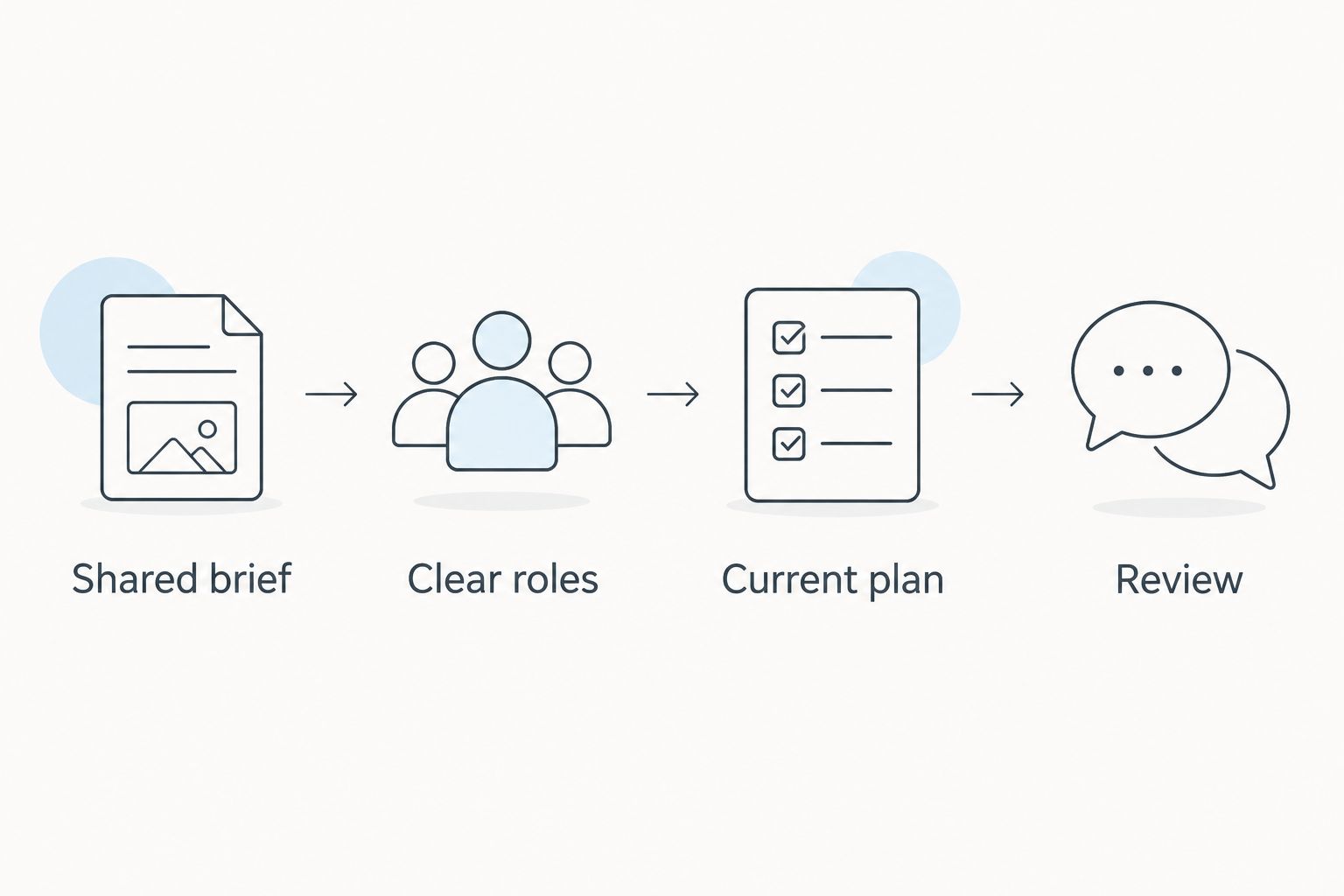
The workflow has four stages: Shared brief, Clear roles, Current plan and Review. Keep those stages visible wherever you store the document.
Check the plan before using it
Read the programme back in your own words. Ask the practitioner to clarify anything you cannot explain, including unfamiliar exercise names or instructions that differ from an earlier version.
An appointment calendar and an exercise programme serve different purposes. Putting appointments beside workouts does not establish whether the combination or timing is clinically appropriate.
Avoid filling gaps with online exercises. If you want to add something you have seen elsewhere, take it to the practitioner responsible for the programme and ask whether it belongs in your plan.
Configuration unit: reviews and updates
Close the communication loop
- Record what happened. Note which planned activities you completed, what you changed and what questions arose. Keep observations factual rather than diagnosing the reason for a change.
- Send updates through the agreed channel. Use the practice’s accepted method and confirm the intended recipient. Do not send health information through an unfamiliar channel merely because it is convenient.
- Confirm the next decision. Ask whether the plan continues, changes, needs reassessment or no longer requires the same arrangement. Request an updated document when instructions change.
Expected result: the next appointment begins with current information, and you leave knowing which instructions apply.
For a 2026 review note, record the date, the decision and who made it. A vague entry such as continue everything does not identify which version of the programme was discussed.
Appointment frequency also needs an individual rationale. The guide to how often to see a chiropractor provides a related discussion topic; it does not replace advice about your circumstances.
Variant: coordinate care when you already exercise
You do not need to restart the whole process because chiropractic care is being considered alongside an existing exercise physiology programme. Start with the current programme and identify the specific question prompting another assessment.
- Give the chiropractor the current programme and relevant correspondence, with your consent.
- Tell the exercise physiologist that you are considering chiropractic care and ask what information would be useful.
- Ask the practitioners to clarify any proposed changes before you replace existing instructions.
- Retain the current version until you receive clear individual advice about what should change.
An adjustment is not an automatic prerequisite for exercise. Whether any assessment, procedure or change is appropriate should be discussed individually, rather than assumed from a generic combined-care schedule.
The same principle applies in reverse. If you already attend chiropractic appointments and are considering exercise physiology, ask what question the additional assessment would address before arranging an ongoing series of visits.
Troubleshooting
You receive conflicting exercise instructions
Identify the exact disagreement: the activity, amount, technique or timing. Ask the practitioners to clarify it directly, with your consent, rather than asking you to interpret competing explanations.
Do not average the instructions or combine both programmes. Request one current written version from the practitioner responsible for the exercise plan.
Nobody knows who should send an update
Ask both practices who initiates communication and what consent process applies. Record the agreed contact and method in the shared brief.
If direct communication is not arranged, ask whether you can carry a written summary. Confirm that each intended recipient has received it.
Your symptoms change or exercise becomes difficult
Contact the practitioner responsible for the relevant instructions and describe what changed. Ask whether reassessment or medical advice is needed rather than assuming the change is an expected response.
Do not use a future routine appointment as the response to an urgent health concern. Seek medical assistance appropriate to the situation.
The schedule becomes hard to manage
Explain the practical barrier, including travel, work or competing responsibilities. Ask what each appointment is intended to decide and whether the arrangement can be simplified.
More appointments are not a coordination goal. The plan should have an explained purpose and review points, not simply continue because it is already in your calendar.
Customise your workflow
Adapt the document to your actual activities: work demands, a gym programme, recreational sport or everyday tasks. Do not add exercises simply to make the plan look more complete.
Ask the practitioners how your preferences, confidence and practical circumstances will inform decisions. You can also ask about alternatives, the option not to proceed and when the need for each service will be reconsidered.
Use your next MyChiro discussion to clarify the chiropractic component, not to assume that the clinic manages every part of a multidisciplinary programme. Keep responsibility for each service explicit.
FAQ
Can I combine chiropractic and exercise physiology?
You can discuss using both services, but whether both are appropriate requires individual assessment. Agree their purposes, responsibilities and communication arrangements before committing to a combined plan.
Do I need an adjustment before starting exercise physiology?
An adjustment is not an automatic prerequisite for exercise physiology. Ask the relevant practitioners whether any assessment or change is needed for your circumstances.
Should I exercise on the same day as a chiropractic appointment?
Ask for individual advice about your planned activity and any proposed procedure. There is no same-day schedule prescribed by this guide.
Who should change my exercise programme?
Agree which practitioner maintains your exercise programme and coordinates proposed changes. Ask for updated written instructions when a change is made.
Does MyChiro offer exercise physiology?
MyChiro is described as a chiropractic clinic and wellness centre in Bondi Junction. Ask the clinic directly about exercise physiology services or communication with an external practitioner.
What should I do if my practitioners disagree?
Ask the practitioners to clarify the specific disagreement, with your consent. Request one current exercise plan rather than combining incompatible instructions yourself.
How many appointments will I need when combining services?
Appointment frequency requires individual discussion and review. Ask what each visit is intended to address and when the need for ongoing appointments will be reconsidered.
One last thing
Put a review question beside every recurring appointment: what decision will this visit help make? That small administrative step keeps the purpose visible and gives you a clear starting point for discussing continuation, changes or discharge.
Related guides
- How to prepare for your first chiropractor appointment
- How to combine chiropractic care with physiotherapy in one plan
- What qualifications should a Sydney chiropractor have?