

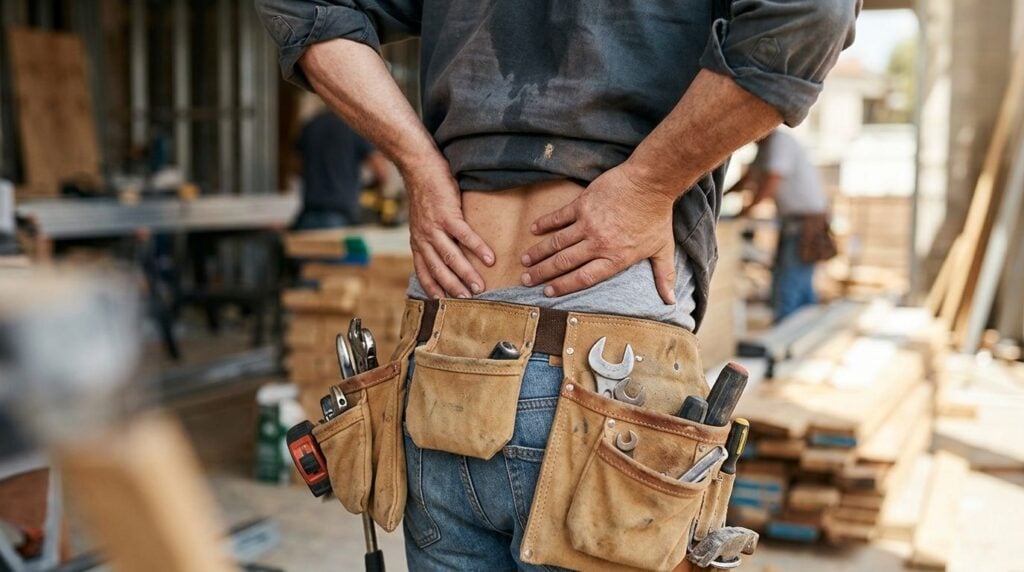
Mid-back pain from a tool belt usually comes from carrying 5 to 15 kilograms of gear low and to one side of the spine for hours at a stretch, which pulls the thoracic vertebrae and shoulder blades out of a neutral position. Relief depends on redistributing that load, taking scheduled breaks, and building the mid-back and core muscles that hold the spine upright against the pull. The detail most tradies miss: a belt that feels fine in week one can still load the same three or four spinal segments every single shift, and that repetition is what turns a mild ache into a persistent one over a full year on the tools in 2026.
- Back pain from tool belt use is usually mechanical load, not injury — redistribute weight and take breaks.
- Suspender-style rigs and dual-side pouches spread load more evenly than a single hip belt.
- Breaks every 60 to 90 minutes reduce sustained thoracic strain during a shift.
- Mid-back pain lasting past two weeks, or pain with numbness, is worth getting assessed rather than stretched through.
Why this matters
Tradies and manual labourers wear a tool belt for most of a working day, and the mid-back sits directly under that load. Chiropractic care for tradies and manual labourers tends to see the same pattern come through the door: an ache between the shoulder blades that builds by midafternoon, eases overnight, then comes back the moment the belt goes on again the next morning.
That repeating cycle is the actual problem, not just the ache on any given day. A belt loaded the same way every shift asks the same three or four thoracic segments to do the stabilising work, shift after shift, in 2026 and every year the pattern continues. Fixing the load pattern matters more than treating any single sore day.
How to relieve mid-back pain from wearing a heavy tool belt
The pain responds to changes in how the load sits on your body and how long it stays there, not to any single stretch. Work through these in order:
- Rebalance the load across both hips. Most belts drift heavier on the dominant side (hammer, drill, tape). Split weight as evenly as you can between left and right pouches.
- Move your heaviest tools closest to your body. Anything hanging low and out from the hip acts like a lever on the thoracic spine — pull it in tight.
- Add suspenders or a padded back support. Suspender-style rigs shift some load from the hips up through the shoulders and thoracic spine, changing where the strain concentrates rather than removing it.
- Take the belt off every 60 to 90 minutes, even for two minutes. Sustained static load is what irritates the mid-back, not the total weight carried across a day.
- Stretch the thoracic spine during those breaks. Open-book rotations and doorway chest stretches for a couple of minutes counter the forward-rounded posture that reaching for tools creates.
- Strengthen the mid-back and core outside work hours. Learn how to strengthen your core without straining your lower back so the muscles supporting the spine can handle the belt's load without compensating through the thoracic joints.
None of these are a substitute for assessment if the pain keeps returning. A chiropractor can look at how you load the belt and whether the mid-back stiffness is coming from the thoracic joints, the shoulder girdle, or both.
Why tool belt back pain varies from tradie to tradie
A handful of factors decide whether a tool belt causes discomfort or stays manageable across a 2026 work year:
- Belt height — worn too low it drags on the lumbar spine and hips; worn too high it loads the thoracic region directly.
- Tool placement — heavy items positioned behind the hip rotate the pelvis and torso to compensate, pulling on the mid-back.
- Static posture — standing or crouching for long stretches under the same load is more provoking than the total weight itself.
- Repetitive bending — reaching down to the belt dozens of times a shift adds cumulative flexion stress on top of the static load.
- Shoulder and thoracic mobility — stiffness through the upper back limits how well the spine adapts to an uneven load.
- Core and mid-back strength — weaker stabilising muscles hand more of the job to the joints of the thoracic spine.
Before lifting materials on top of a loaded belt, check your form — how to lift heavy objects safely covers the bend-and-brace pattern that stops a loaded belt compounding lifting strain.
Hip belt vs suspender rig vs split-pouch: how the load sits
| Setup | Where the load sits | Trade-off | Best for |
|---|---|---|---|
| Single hip belt | Concentrated on one hip and the lumbar spine | Twists the torso to reach tools on the loaded side | Short jobs with light gear |
| Split-pouch belt (both hips) | Shared across both hips | Still fully hip-loaded for the full shift | Tradies whose pain sits mid-back and is one-sided |
| Suspender-style rig | Shoulders and thoracic spine carry part of the weight | Moves strain upward rather than removing it | Tradies whose pain sits low in the back |
No setup removes the load — each one moves it somewhere else, which is why breaks and strength work still matter regardless of the belt you choose.
“No tool belt removes the load. Every design just decides which part of your spine carries it.”
Does a suspender-style tool belt reduce mid-back pain?
Suspender-style rigs redistribute part of a tool belt's 5 to 15 kilograms from the hips to the shoulders and upper back, which can ease pressure on the lower back but hands more work to the thoracic spine and shoulder girdle. Whether that trade-off suits you depends on where your current pain sits, which is worth discussing with a qualified health professional after an assessment.
How long can I wear a tool belt before taking a break?
Mid-back discomfort from a tool belt commonly builds after roughly 60 to 90 minutes of continuous wear, because static loading gives the muscles around the shoulder blades no chance to unload. Taking the belt off for even two minutes in that window resets the position before the next stretch of work. Across an eight-hour day in 2026 that is five or six short breaks, not lost productivity.
When does tool belt back pain need a chiropractor instead of stretching?
Mid-back pain persisting beyond two to three weeks despite load changes and breaks — or pain with numbness, tingling or weakness down an arm — is a signal to be assessed rather than self-managed. How to know when back pain needs a chiropractor vs a doctor sets out the red flags that separate a mechanical load pattern from something needing broader medical review. MyChiro in Bondi Junction sees tradies with this pattern regularly, and an assessment is the starting point rather than any assumed course of care.
Get your mid-back pain assessed
Discuss thoracic pain, posture and work load with a registered chiropractor in Bondi Junction.
FAQ
What causes mid-back pain from wearing a tool belt?
Mid-back pain from a tool belt comes from carrying 5 to 15 kilograms of gear off-centre against the hip for extended periods, which pulls the thoracic spine and shoulder blades out of a neutral position. The static, repeated nature of the load across a shift is usually more provoking than the total weight.
How much weight in a tool belt causes back pain?
Tool belts loaded with 5 to 15 kilograms are common on trade sites, and discomfort relates more to how that weight is distributed and how long it is worn than the raw number. An unevenly loaded 8 kilogram belt worn all day can be more provoking than a balanced 12 kilogram one.
Is a suspender-style tool belt better for back pain?
A suspender-style belt shifts part of the load from the hips to the shoulders and thoracic spine rather than removing it. It may suit tradies whose pain sits low in the back, but it can move discomfort upward instead.
How long should I wear a tool belt before taking a break?
Taking the belt off every 60 to 90 minutes for a couple of minutes lets the mid-back muscles unload before static strain builds again. Longer unbroken stretches on the tools are what tend to turn a mild ache into a persistent one by the end of a shift.
Can stretching help back pain from a tool belt?
Thoracic rotations and chest-opening stretches during breaks can ease the tightness that builds from reaching forward for tools all day. Stretching works alongside load changes and breaks rather than replacing them.
Is mid-back pain from a tool belt a sign of a disc problem?
Mid-back pain from a tool belt is most often mechanical strain from load and posture rather than a disc issue, though persistent pain with numbness or weakness down an arm should be assessed rather than assumed. An assessment can help identify which pattern fits your symptoms.
When should a tradie see a chiropractor for tool belt back pain?
Consider an assessment if mid-back pain lasts beyond two to three weeks despite adjusting the belt and taking breaks, or if pain comes with numbness, tingling or weakness. A chiropractor can assess what is contributing before the pattern becomes long-standing.
Does core strength reduce tool belt back strain?
A stronger core and mid-back let the spine handle an uneven belt load without the thoracic joints doing all the stabilising work. Building that strength outside work hours is a change worth discussing as part of a wider plan.
One last thing
The belt height most tradies default to — sitting right on the hip bone — is often the least forgiving position for the mid-back, because it forces the torso to twist to reach tools on the low side. Dropping the belt slightly, or shifting the heaviest pouches forward toward the hip flexors, changes the lever arm on the thoracic spine more than most posture cues do. It is a five-second adjustment that costs nothing and is easy to test across a week of shifts in 2026 before assuming a bigger change is needed.
Related guides
- Best ergonomic setups for shift workers with back pain
- Best foam roller exercises for lower back pain