


Chiropractic treatment can involve discomfort, but nobody can predict exactly what your first appointment will feel like before assessing you and discussing the proposed procedure. Temporary soreness is a recognised possible side effect of spinal manipulation; you can ask questions, decline an adjustment or withdraw consent at any stage. Pain is not something you need to endure to demonstrate that an adjustment is working.
- Is chiropractic treatment painful for first time patients? Sensations vary; assessment and informed consent come before an adjustment.
- Mychiro provides chiropractic care in Bondi Junction; discuss your concerns before agreeing to a procedure.
- Temporary soreness can follow spinal manipulation, but worsening or unexpected symptoms need professional advice.
- You can decline an adjustment, request an explanation or ask the practitioner to stop.
Why this matters
If you are considering a first chiropractic visit in 2026, a promise that it will not hurt is not a substitute for an explanation. You need to understand what is proposed, its potential benefits and risks, the alternatives, and what happens if you choose not to proceed.
Mychiro is a chiropractic clinic and wellness centre in Bondi Junction, Sydney. Whether chiropractic care is appropriate for you requires an individual assessment, rather than a general reassurance about how an adjustment feels.
Is chiropractic treatment painful for first-timers?
It can be uncomfortable, and experiences differ. A first visit does not oblige you to receive an adjustment. The relevant question is not just whether a procedure hurts, but whether you understand it and agree to it after discussing your circumstances.
The US National Center for Complementary and Integrative Health, in Spinal Manipulation: What You Need To Know, identifies temporary increased pain, discomfort and stiffness among possible side effects. It also discusses serious adverse events. That general information cannot establish your individual risk or predict your response.
Use this sequence to structure the conversation before any proposed procedure:
- Describe your symptoms. Explain where you feel discomfort, when it began and whether it has changed.
- Share relevant history. Include medical conditions, medicines, previous procedures and any recent injury.
- Ask for the assessment findings. Request an explanation in plain language, including anything that remains uncertain.
- Discuss the proposal. Ask what the procedure involves, why it is being considered, and its risks and alternatives.
- Decide whether to proceed. You can agree, decline, ask for more time or seek another opinion.
These are conversation steps, not a checklist that establishes suitability for manipulation. The practitioner still needs to assess your circumstances and explain the recommendation.
What should happen before an adjustment?
Before consenting, ask the chiropractor to describe the proposed movement and body position. You should not have to guess which area will be involved or whether the procedure includes a quick movement.
The Australian Commission on Safety and Quality in Health Care describes informed consent as a process involving information, understanding and a voluntary decision. A signature alone does not replace that discussion.
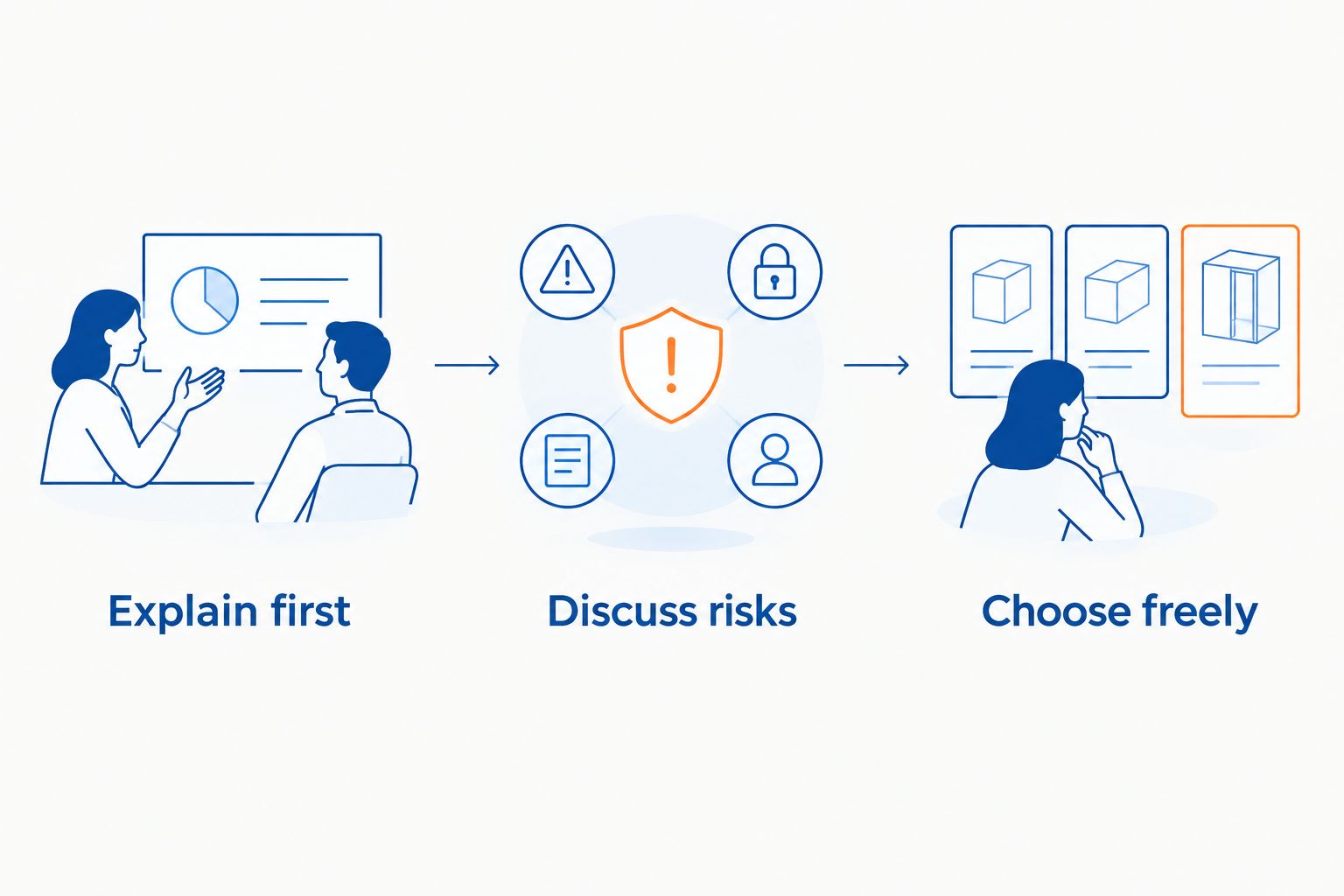
Explain first
Ask what you will be asked to do and what contact or movement the procedure involves. If unfamiliar terms appear, request an explanation without technical language.
You can also ask the practitioner to explain before touching or repositioning you. Make that preference explicit rather than assuming it is understood.
Discuss risks
Ask about risks relevant to the particular procedure and your health history, not just chiropractic care in general. An answer about a lower-back procedure does not replace a discussion about a proposed neck procedure.
Request clarification if an explanation focuses only on expected benefits. You need information about uncertainty and alternatives as well.
Choose freely
You can decline the proposed procedure or ask for time to consider it. Agreeing to an assessment does not mean agreeing to every intervention discussed afterwards.
Before proceeding, agree on how you will signal that you want a pause. Saying stop should be enough; you do not need to justify that request while a procedure is underway.
What choices can you discuss at a first appointment?
Your choices are not limited to accepting an adjustment immediately or abandoning the conversation. Ask what assessment, further discussion or referral is appropriate before deciding on any intervention.
The comparison below describes decisions you can discuss. It does not rank procedures, establish suitability or suggest that every clinic offers every approach.
| Choice to discuss | What it involves | What to clarify | Limitation |
|---|---|---|---|
| Assessment without an adjustment | Discussing symptoms and examining relevant concerns | What can be assessed and what remains uncertain | Assessment does not guarantee a diagnosis or an immediate management decision |
| A proposed manual adjustment | A practitioner-applied procedure discussed after assessment | The movement, intended purpose, risks and alternatives | Discomfort and adverse effects are possible; suitability is individual |
| An alternative management discussion | Considering other approaches or another health professional | Why an alternative is relevant to your circumstances | A different approach also needs its own assessment and explanation |
| Deferring a decision | Taking time before consenting | Whether any symptoms require medical assessment rather than waiting | Deferral is not appropriate for symptoms requiring urgent medical attention |
Choose based on an informed discussion, not on a promise that one approach never hurts. A description such as light pressure does not, by itself, explain the potential benefits or risks of a procedure.
For a first appointment in 2026, bring your questions in writing if that makes the discussion easier. Ask which decisions need to be made during the appointment and which can wait.
Why experiences of discomfort differ
A general article cannot determine how a particular procedure will feel for you. The following details belong in the assessment and consent discussion because they describe the circumstances of the proposed care:
- Your existing symptoms: Explain what already hurts so the practitioner can distinguish your starting symptoms from anything new.
- The proposed procedure: Ask what movement or pressure is involved rather than relying on the word adjustment alone.
- The body area: Identify exactly where the procedure is proposed and ask about area-specific risks.
- Your health history: Disclose conditions, medicines and previous injuries that require consideration before a procedure.
- Your preferences: Tell the practitioner if a position, movement or type of contact is unacceptable to you.
These details do not produce a reliable pain forecast. They help make the conversation specific enough for you to decide whether you want to proceed.
Avoid accepting pain as proof of a useful procedure. Equally, an absence of pain does not establish that a procedure was appropriate or that it achieved an intended outcome.
What should I say if something hurts during the appointment?
Tell the practitioner immediately and ask them to stop. Describe what you feel, where you feel it, and whether it is familiar or new.
You do not need medical vocabulary. Plain descriptions such as sharp, aching, spreading or different from my usual symptoms give the practitioner information to assess.
Useful requests include:
- Please stop so I can explain what I am feeling.
- Please explain that movement before we consider it again.
- I do not want to continue with this procedure.
- What alternatives can we discuss?
These are requests you can make, not testimonials or accounts of a particular appointment. If you are unsure about continuing, ask for the proposed plan to be reconsidered before any further intervention.
Does every hands-on procedure feel the same?
No single description covers all procedures discussed in musculoskeletal care. Ask about the specific intervention rather than assuming that adjustment, mobilisation, soft-tissue work and needling describe the same experience.
Questions about whether dry needling hurts concern a different procedure from a manual chiropractic adjustment. An explanation of one procedure's sensations or risks cannot substitute for consent to another.
If an additional procedure is proposed, ask why it is being considered and what its own risks and alternatives are. The fact that you agreed to one intervention does not remove the need to understand another.
For this 2026 first-visit guide, the practical distinction is straightforward: consent relates to the procedure actually proposed, not to a broad label such as hands-on care. This does not imply that Mychiro offers every procedure mentioned here.
What if I feel sore after an adjustment?
Temporary soreness is a recognised possible side effect of spinal manipulation, according to the National Center for Complementary and Integrative Health. However, a general description of soreness cannot determine whether your symptoms need assessment.
Before leaving, ask what changes should prompt contact with the practitioner and what should prompt medical attention. Request clear instructions rather than assuming that any symptom after an appointment is expected.
If symptoms worsen, are unexpected or concern you, seek advice from an appropriate health professional. Do not assume that additional adjustments are the answer to a new problem.
When should I seek urgent medical help instead?
Call 000 in Australia for a medical emergency. Healthdirect advises urgent action for possible stroke symptoms, including facial weakness, arm weakness or difficulty speaking; do not wait for a chiropractic follow-up if these occur.
New loss of bladder or bowel control, numbness around the groin or rapidly worsening limb weakness also require urgent medical assessment. These examples are not a complete emergency checklist, and this article cannot assess symptoms remotely.
This is referral guidance, not a suggestion that chiropractic care manages these symptoms. If you are uncertain about the urgency of a health concern, contact a medical service for advice.
How should I prepare without overthinking the appointment?
Prepare information, not a prediction about how the visit will feel. Bring a concise account of your symptoms, relevant medical history and current medicines, along with any questions about the proposed assessment.
For a 2026 appointment, these questions keep the conversation focused:
- What have you found, and what remains uncertain?
- Why are you proposing this procedure for me?
- What are the potential benefits, risks and alternatives?
- Can I have time to consider the proposal?
- What should I do if my symptoms change afterwards?
If you contact Mychiro about chiropractic care, explain that you are a first-time patient with questions about discomfort and consent. That communicates your concern without committing you to an adjustment or a course of appointments.
FAQ
Is chiropractic treatment painful for first time patients?
Chiropractic treatment can involve discomfort, and nobody can predict your individual experience before assessment. Temporary soreness is a recognised possible side effect of spinal manipulation; ask about the particular procedure and its risks before consenting.
Can I have a first chiropractic appointment without an adjustment?
You can decline an adjustment and discuss assessment findings, alternatives or further evaluation. Ask the clinic what the appointment involves before attending.
Can I ask a chiropractor to stop during an adjustment?
Yes, you can ask the chiropractor to stop and withdraw your consent. Explain any new discomfort and discuss whether further assessment is needed before considering another procedure.
Does soreness mean a chiropractic adjustment worked?
Soreness does not establish that an adjustment achieved an intended outcome. Discuss new, worsening or unexpected symptoms with an appropriate health professional rather than interpreting pain as evidence of progress.
Should I agree to a neck adjustment at my first visit?
A neck adjustment requires an individual assessment and a procedure-specific discussion of potential benefits, risks and alternatives. You can decline it or ask for more time to decide.
What should I tell the chiropractor before an adjustment?
Describe your symptoms, relevant health conditions, medicines, previous procedures and any recent injury. Also explain any movement, position or type of contact you do not want.
When should I get medical help rather than wait for another appointment?
Seek urgent medical help for emergency symptoms such as facial weakness, arm weakness or difficulty speaking. Call 000 in Australia for a medical emergency rather than waiting for a chiropractic appointment.
One last thing
Your first visit is not a test of how much discomfort you can tolerate. It is an opportunity to understand an assessment and decide whether a proposed procedure is acceptable to you.
Keep that distinction in mind when reading chiropractic information in 2026: reassurance about sensations is not the same as informed consent. Ask for an explanation you understand, and make the decision without pressure.
Related guides
- How to prepare for your first chiropractor appointment
- What to expect from spinal manipulation
- Questions about soreness after an adjustment
- What qualifications should a Sydney chiropractor have?