


There is no single evidence-based deadline for when posture exercises will show results: the answer depends on whether you mean easier movement, greater exercise capacity or a visible change in how you stand. Those outcomes need separate measures, and a photograph cannot establish whether an exercise programme is appropriate for you. This 2026 guide explains how to set a useful goal, track changes and recognise when professional advice is appropriate.
- How long until posture exercises show results depends on the goal; a universal deadline is not justified.
- Track a repeatable daily activity rather than judging posture exercises solely through photographs.
- MyChiro provides chiropractic care in Bondi Junction; exercise suitability requires individual assessment.
- New or worsening symptoms warrant advice, not a harder posture correction routine.
How long until posture exercises show results?
There is no fixed number of days or weeks that applies to everyone. Before deciding whether your routine is working, separate the result you want from the appearance you expect.
| What you mean by results | What to record | What the record cannot establish |
|---|---|---|
| Easier everyday movement | Your experience during the same familiar activity | Why the experience changed |
| Greater exercise capacity | The prescribed exercise, resistance and repetitions | Whether your resting posture has changed |
| A visible posture change | Photographs taken under comparable conditions | A diagnosis or the cause of discomfort |
| More consistent habits | Whether you completed the agreed routine | Whether the routine suits your needs |
MyChiro is a chiropractic clinic and wellness centre in Bondi Junction, Sydney. A discussion about posture should distinguish your goals from any proposed care, without promising a particular result or completion date.
A useful answer to the timing question therefore starts with a measurable goal. Ask what you will review, how you will record it and what would prompt a change of plan.
Why this matters
A deadline without a defined outcome creates a poor test. You might complete your exercises consistently yet remain unsure what counts as progress, particularly if your only reference is a mirror.
For your 2026 exercise plan, replace a broad aim such as looking straighter with a question you can actually review. Examples include whether a particular movement feels easier or whether you can complete an agreed exercise with the intended technique.
An exercise review should assess the goal, not reward you for enduring an unsuitable routine. Persistent difficulty is a reason to reconsider the plan with a qualified health professional, rather than assume you need more effort.
What counts as a result from posture exercises?
Everyday function: choose a relevant activity
Start with something you want to do, rather than a body position you want to maintain. You might choose reading at your desk, preparing food or reaching for a familiar shelf.
Describe that activity clearly. If you use a 10-minute reading task as a tracking example, record the chair, reading position and your experience; the 10 minutes is a comparison task, not an exercise prescription or promised milestone.
Keep the question neutral: what happened during the activity? Do not assume every change comes from your exercises, particularly if your workload, sleep or other activities also changed.
Exercise capacity: compare the prescribed task
If a health professional has given you exercises, record what was prescribed and what you completed. Include any technique instructions or modifications rather than counting repetitions alone.
Completing more repetitions is not automatically the goal. Ask whether the intended measure is technique, resistance, movement range or something else, and use that same measure at review.
Do not increase difficulty simply to produce a more impressive diary entry. Progression should follow the instructions appropriate to your circumstances.
Appearance: keep photographs in perspective
If appearance is your goal, use photographs as a record rather than a diagnosis. Keep the camera height, distance, clothing and standing instructions comparable, and avoid deliberately posing differently for the later image.
A photograph records a position at one moment. It does not establish the cause of symptoms or demonstrate that a particular intervention is necessary.
You can also decide not to use photographs. If repeated checking makes you increasingly concerned about normal variations in your appearance, choose a functional goal to discuss instead.
Why the time to notice changes varies
A useful review considers the following factors rather than assigning everyone the same countdown:
- Your chosen outcome. Exercise completion, daily function and appearance are different questions. Do not use evidence of one as proof of another.
- Your starting record. Without a clear baseline, you cannot make a meaningful comparison with a later observation.
- The exercise instructions. An exercise name alone leaves out technique, resistance, frequency and progression. Record the actual plan.
- How consistently you follow that plan. Note what you completed without turning missed sessions into a reason to double the next session.
- Changes outside the routine. Record relevant differences in work, recreation or other care so your review does not overlook them.
- Whether the plan remains appropriate. New symptoms, difficulty with technique or a changed goal are reasons to seek advice about the programme.
These factors provide a review framework, not a formula for predicting your result. Your 2026 diary should help explain what you did and experienced; it should not become a countdown to a guaranteed posture change.
How can I track progress without chasing a deadline?
Choose the goal
Write down the reason you started. Be specific enough that another person could understand what you want to review.
For example, replace improving my posture with discussing comfort during desk work. That wording leaves room to consider the activity and your circumstances without assuming a particular spinal position is the explanation.
Record the baseline
Choose 1 familiar task for your initial record. Describe the task and your experience before changing several parts of your routine at once.
If you use a 0–10 rating scale, define what the endpoints mean for you and keep that definition consistent. The scale is a personal recording method, not a diagnosis or proof of treatment benefit.
Follow the agreed plan
Keep the instructions somewhere you can check them. If you are unsure about a movement, ask for clarification rather than copying a more demanding version from social media.
Record modifications as well as completed exercises. A diary that accurately shows what happened is more useful than a perfect-looking attendance record.
Review the record
Agree on a review point with the health professional advising you. It should give you an opportunity to discuss technique, suitability and the chosen outcome, not simply renew the same routine automatically.
Bring the record to that discussion. Ask whether you should continue, modify the plan, choose another measure or seek a different assessment.
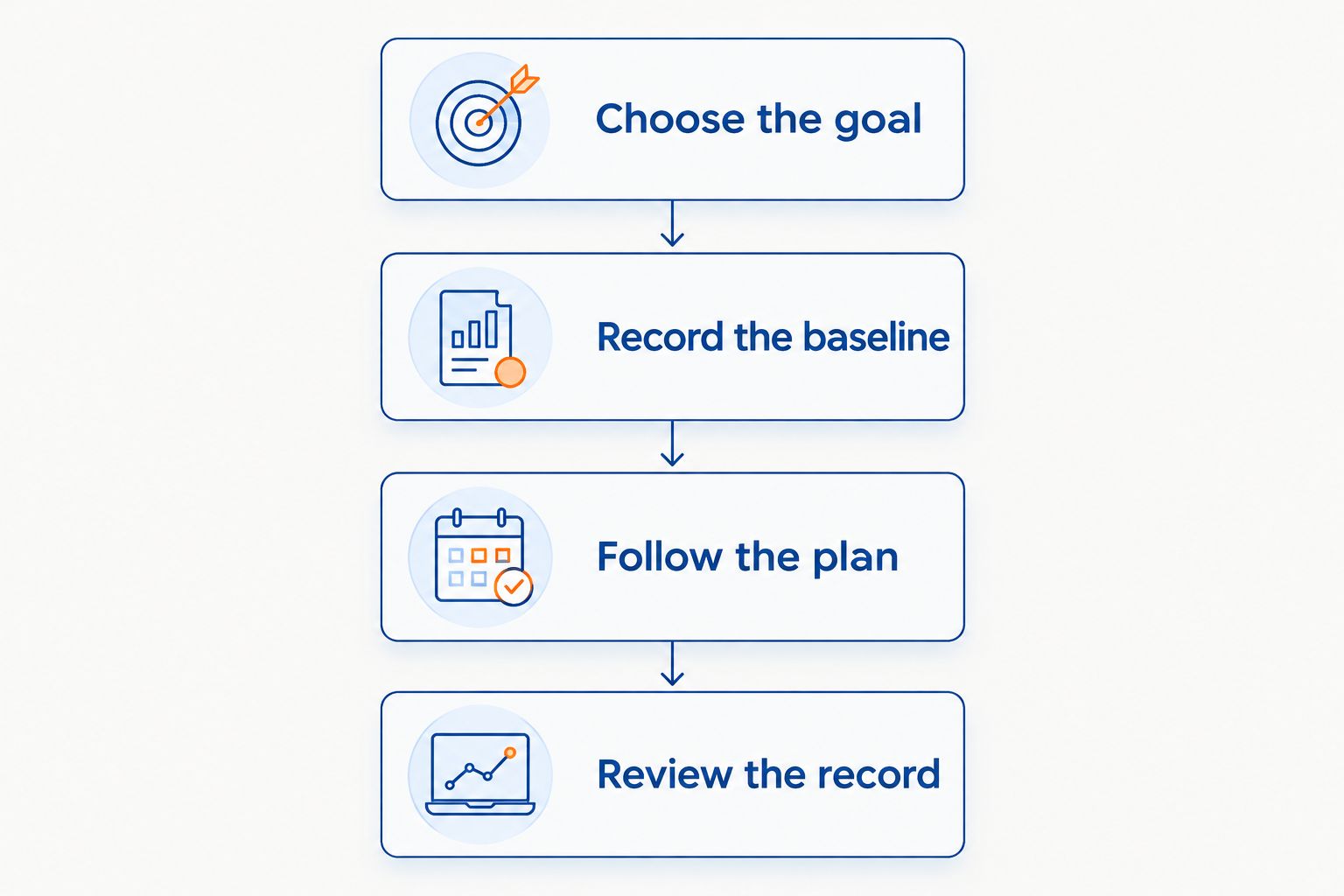
A simple record is enough. You do not need a posture score, a wearable device or a photograph collection to prepare useful questions for a review.
What should I change if I cannot see progress?
Review the plan before adding more exercise. Check whether you are measuring the outcome the routine was intended to address and whether you understand the instructions.
Then consider what you actually completed. If the routine is too complicated to follow, explain that; an honest account gives the person advising you something practical to work with.
If your concern relates to sitting, describe the task and workspace rather than reporting only that your posture looks wrong. The guide to lower back pain when sitting: causes and practical steps provides related reading, but it does not replace an individual assessment.
You can prepare these questions for a review:
- What is each exercise intended to address?
- Which outcome are we measuring?
- What should I do if I cannot follow the technique?
- What would justify changing or stopping this exercise?
- Does my concern need assessment by another health professional?
Avoid buying additional equipment merely because a deadline has passed. First establish what problem the equipment is supposed to address and whether it belongs in your plan.
Should posture exercises feel harder as I progress?
Not necessarily. A more demanding exercise is not automatically a more appropriate exercise, and difficulty alone does not demonstrate progress.
Ask the person advising you what progression means for your routine. The next step might involve a technique change, a different task or no increase at all; it should not be inferred from an online calendar.
If you develop symptoms during an exercise, stop that movement and seek advice about whether to continue. Do not use discomfort as evidence that you are correcting your posture.
Do I need chiropractic adjustments alongside exercises?
A posture concern does not, by itself, establish that you need chiropractic adjustments. Any proposed care should follow an assessment and a discussion of its purpose, alternatives, risks and expected review process.
MyChiro provides chiropractic care and spinal adjustments in Bondi Junction. Whether any service may be appropriate for you requires individual assessment; this article does not recommend adjustments to produce a posture change or shorten an exercise timeline.
Ask how any proposed appointment relates to your specific concern. You should understand the reason for care rather than assume that a posture exercise programme requires an ongoing appointment schedule.
When should I seek medical advice instead of exercising?
Do not assume new or unexplained symptoms are simply a posture issue. General Australian health information from Healthdirect identifies symptoms such as new bladder or bowel changes, loss of sensation around the groin, and significant weakness with back pain as reasons for urgent medical assessment.
Seek urgent medical care if these occur. Posture exercises, online advice and a routine chiropractic appointment are not substitutes for urgent assessment.
For symptoms that persist, worsen or interfere with daily activities, discuss the situation with your GP or another qualified health professional. If symptoms follow an injury, seek advice before treating them as an exercise-technique problem.
What should my posture goal look like in 2026?
Choose a goal that helps you make a decision. A statement such as I want to discuss difficulty during desk work gives a review a clearer purpose than I want perfect alignment.
Your 2026 plan should also state what you will do if the goal is not being met. That might be asking for a technique check, reconsidering the measure or seeking an assessment—not automatically continuing indefinitely.
MyChiro is a Bondi Junction chiropractic clinic, not a source of guaranteed posture-change timelines. Keep the same distinction when reading any exercise advertisement: a service description is not evidence that you will achieve a particular result.
FAQ
How long until posture exercises show results?
There is no fixed deadline that applies to everyone. Define whether you mean daily function, exercise capacity or appearance, then agree on an appropriate way to review that outcome.
Can I expect visible posture changes by a particular date?
A particular date is not a justified promise of visible posture change. Comparable photographs can document appearance, but they cannot establish a diagnosis or explain symptoms.
Should I do posture exercises every day?
Exercise frequency should follow instructions appropriate to your circumstances. Ask the health professional advising you how often to practise and what should prompt a modification.
Do posture exercises have to hurt to work?
Pain is not proof that an exercise is correcting your posture. Stop a movement that causes symptoms and seek advice about whether it is appropriate to continue.
What should I track besides posture photographs?
Track a clearly described everyday task and your prescribed exercise routine. Record relevant changes in your activities so you can discuss the observations without assuming what caused them.
Do I need a chiropractor to start posture exercises?
A posture concern alone does not establish that chiropractic care is necessary. A qualified health professional can discuss whether assessment or individual exercise advice is appropriate.
What if my posture routine is not changing anything?
Review the goal, instructions and suitability of the routine rather than simply increasing the workload. Persistent or worsening symptoms warrant professional advice.
One last thing
Before starting another routine, write down what would make you decide to continue, change or stop it. A plan with no review question can keep you exercising without clarifying whether it serves your goal.
For the rest of 2026, keep that question beside your exercise instructions. The useful milestone is an informed review—not reaching a promised date with a different-looking photograph.
Related guides
- Sway-back posture: what it means
- Is it worth seeing a chiropractor for desk posture?
- How to prepare for your first chiropractor appointment