


Seeing a chiropractor before a marathon may be appropriate following assessment of a specific musculoskeletal concern, but the race itself is not a reason to have an adjustment. An appointment should not be presented as a way to improve your finishing time, prevent injury or confirm that you are fit to race. If you are considering care, separate the decision to seek an assessment from the decision to consent to any procedure.
- Is it worth seeing a chiropractor before a marathon? Consider assessment for a specific concern, not routine race preparation.
- Mychiro is a chiropractic clinic in Bondi Junction; suitability for care depends on individual assessment.
- Ask about the reason for any proposed adjustment, its risks, alternatives and implications for running.
- New or worsening symptoms need assessment, not an assumption that an adjustment will make racing appropriate.
Why this matters
A race date creates a deadline, not a clinical indication. For your 2026 marathon, the useful question is what you need to understand about your symptoms or proposed care—not which extra appointment belongs on your checklist.
You can ask questions without agreeing to an adjustment. If you decide an assessment is appropriate, preparing for your first chiropractor appointment starts with explaining your concern, training history and race plans rather than requesting a particular technique.
Is it worth seeing a chiropractor before a marathon?
Consider an assessment for a defined concern, not an adjustment simply because race day is approaching. Your reason for seeking care should be clear enough to explain without mentioning the marathon: for example, discomfort that you want assessed or uncertainty about an existing care plan.
The following comparison separates different decisions. It does not diagnose symptoms or rank practitioners.
| Situation | Decision to discuss | Potential value | Limitation |
|---|---|---|---|
| You have no symptoms and want a performance boost | Whether there is any clinical reason for an appointment | Clarifying what a service can and cannot offer | A race date does not establish a need for an adjustment |
| You have a specific back or neck concern | An individual assessment with a qualified health professional | Discussing the concern and appropriate next steps | Assessment does not promise a particular result or establish race fitness |
| You already have a care plan | Whether the plan needs reviewing around your event | Clarifying advice and responsibilities | Previous appointments do not make another procedure automatically necessary |
| You have new, worsening or concerning symptoms | Medical assessment and appropriate referral | Establishing what requires investigation | A routine chiropractic appointment is not a substitute for urgent medical care |
Do not confuse receiving care with receiving clearance. Ask explicitly whether the practitioner is advising on your symptoms, your proposed care or your ability to participate; these are different questions.
If you have no symptoms: question the purpose
If your only reason for booking is that other runners recommend a pre-race adjustment, ask what specific concern the appointment would address. Another runner's routine is not an assessment of your needs.
Useful questions include:
- What is the clinical reason for proposing an adjustment?
- What finding would change the recommendation?
- What are the alternatives, including no procedure?
- What evidence supports the particular outcome being discussed?
For a 2026 event, avoid treating a package labelled for runners as proof that it is necessary. A service description should explain what is offered without implying that every entrant needs it.
You do not need to invent a problem to justify asking a question. Equally, you can decide not to proceed when the purpose of a proposed service remains unclear.
If you have a concern: describe it before choosing care
Start with what you have noticed rather than a self-diagnosis. Describe where the discomfort is, when it began, what brings it on and whether it has changed your running or everyday activities.
Bring relevant information about previous injuries, existing diagnoses, medicines and advice from other health professionals. Tell the practitioner about any recent change in training, footwear or exercise, without assuming that the change explains the symptoms.
Ask for an assessment before asking for a technique. Choosing an adjustment in advance reverses that order and leaves the central question unanswered: is the proposed care appropriate for this concern?
Mychiro provides chiropractic care and spinal adjustments in Bondi Junction. Runners considering chiropractic care at Mychiro can discuss their concerns; whether an adjustment is appropriate remains an individual assessment and consent decision.
If you already receive care: review rather than assume
An existing appointment does not automatically need to move closer to race day. Explain your event plans and ask whether there is a clinical reason to change the current arrangement.
Discuss what has happened since your previous visit, including any symptoms you experienced afterwards. Do not assume that repeating a familiar procedure is necessary simply because it forms part of your usual routine.
Ask who is responsible for advice about running participation. If several practitioners are involved, request a clear explanation of their different roles rather than trying to reconcile conflicting instructions yourself.
For your 2026 race plan, write down any agreed next step and the circumstances that would prompt reassessment. A defined plan is more useful than a general instruction to return whenever the race gets closer.
Why the decision varies between runners
The relevant factors are personal, not a standard pre-marathon appointment schedule:
- Your reason for attending: a particular concern requires a different discussion from a request for general preparation.
- Your symptom history: explain whether the concern is new, recurring, changing or already assessed.
- Your existing health information: relevant diagnoses, medicines and previous procedures belong in the discussion.
- The proposed procedure: ask what it involves and why it is being considered for you.
- Your previous experience: describe any response to earlier care without assuming the next response will be identical.
- The race context: explain the event date and your running plans so advice is not given without that information.
None of these factors, alone, proves that you need an adjustment. They are topics for assessment and shared decision-making, not a checklist that automatically leads to a procedure.
What should you ask before agreeing to an adjustment?
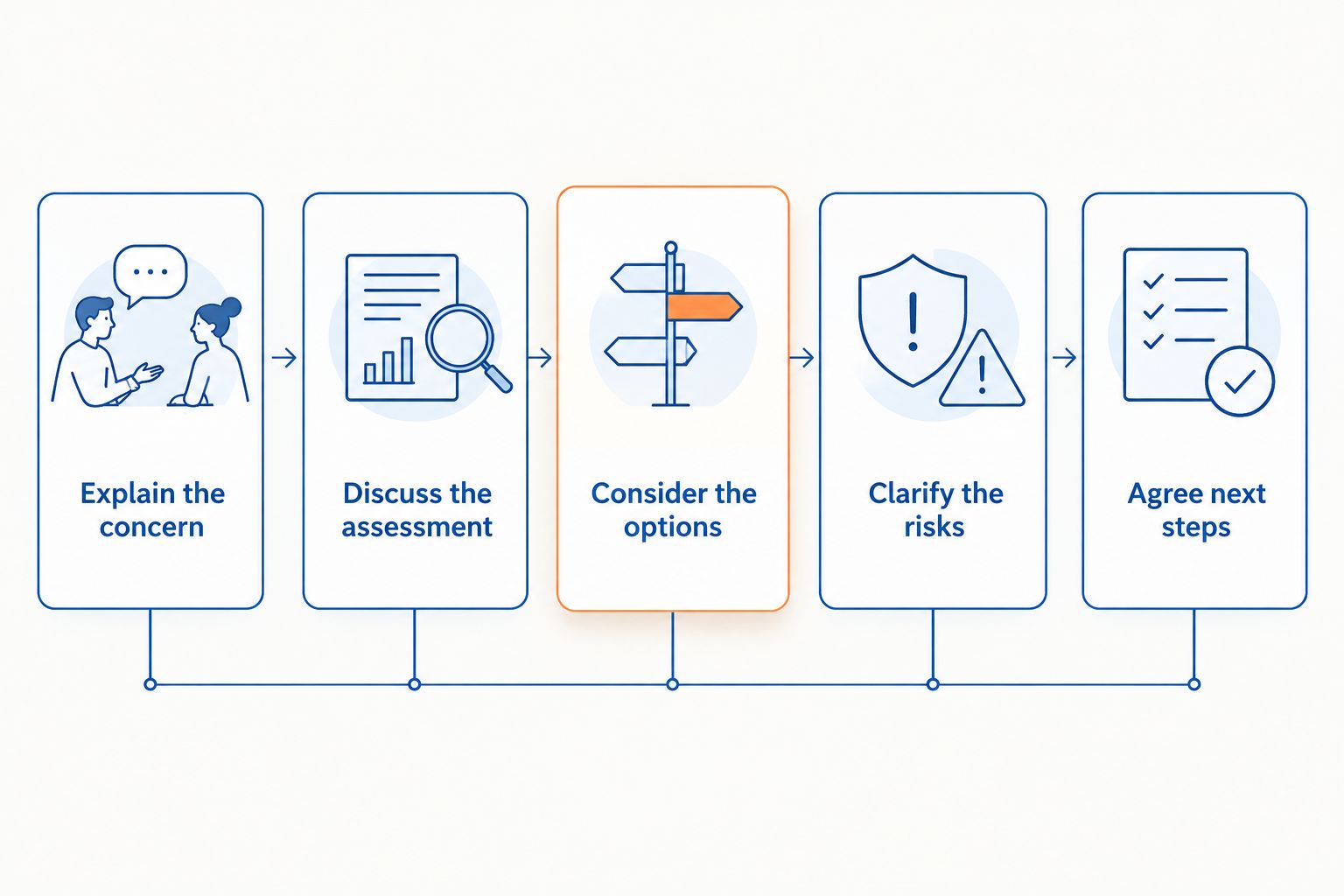
Use a short sequence that keeps the decision clear. You can take these questions to any discussion about proposed chiropractic care before a marathon.
- Explain the concern. State what you want assessed and how it affects your activities. Mention the race date without making participation the assumed outcome.
- Discuss the assessment. Ask what the findings mean, what remains uncertain and whether referral is appropriate.
- Consider the options. Ask about the proposed procedure, alternatives and the option of not proceeding.
- Clarify the risks. Request an explanation relevant to the particular procedure and your circumstances.
- Agree next steps. Confirm what to do afterwards, what changes require advice and who can answer follow-up questions.
The purpose is informed consent, not getting through a form. If you cannot explain why a procedure is proposed or what the alternatives are, ask for clarification before deciding.
How close to race day should you book?
There is no appointment interval in this guide that applies to every runner. Timing depends on the reason for seeking assessment and the advice relevant to your circumstances, not a universal race-week rule.
If someone proposes a first adjustment shortly before your 2026 marathon, ask why that timing is appropriate. Also ask what would happen if you experienced symptoms afterwards and whether your running plans would need review.
Do not interpret an appointment on the calendar as permission to race. An assessment can also lead to further questions, another professional's opinion or a decision not to proceed with a procedure.
Make space for that uncertainty in your planning. Avoid asking a practitioner to promise an outcome by your event date.
What if you are considering home care instead?
Choosing not to have an adjustment does not mean you must choose another intervention. Start by distinguishing general comfort advice from advice about an unexplained symptom or your ability to run.
Online discussions of home remedies for lower back pain address a different question from whether a particular runner should start a marathon. An at-home suggestion does not establish the cause of pain, confirm that it is appropriate for you or replace an individual assessment when one is needed.
Apply the same questions to self-care as to a proposed procedure: what is its purpose, what are its limitations and when should you stop and seek advice? Do not combine unfamiliar approaches simply because each is described as preparation or recovery.
If symptoms change, report the change rather than trying to counter it with another technique. Keep any advice you receive specific to your circumstances.
What should you do if you feel sore after an appointment?
Ask the practitioner for advice relevant to the procedure you received and the symptoms you are experiencing. Do not assume that soreness confirms a procedure was necessary or that worsening symptoms should be ignored.
Describe the location, onset and effect on ordinary activities. Explain whether the symptoms are new or different from the original concern, and mention your race plans again.
The guide to soreness after an adjustment covers a separate question from race participation. Reading about post-appointment symptoms does not establish whether you should continue training or start the event.
A previous appointment is not a reason to disregard a new concern. Seek medical assessment for severe, worsening or otherwise concerning symptoms rather than relying on a general aftercare explanation.
When should medical assessment take priority?
Do not route an urgent concern through a routine pre-race appointment. Healthdirect Australia's back-pain guidance identifies symptoms such as new bladder or bowel difficulties, numbness around the groin and leg weakness as reasons for urgent medical assessment.
Chest pain, collapse or severe difficulty breathing also require urgent medical attention. In Australia, call 000 for a medical emergency.
This is general referral guidance, not a complete symptom checklist or a remote diagnosis. If you are uncertain about a new or changing symptom, discuss it with a qualified medical professional rather than using an adjustment as a test of whether you can race.
FAQ
Is it worth seeing a chiropractor before a marathon if I have no pain?
A marathon entry alone does not establish a need for a chiropractic adjustment. If you are considering an appointment, ask what specific concern it would assess and what clinical reason supports any proposed procedure.
Can a chiropractic adjustment make me run a faster marathon?
Do not use a proposed adjustment as a promise of a faster marathon. Any performance claim requires evidence specific to that claim, rather than an assumption based on receiving care.
Should I have my first adjustment just before race day?
Do not choose a first adjustment solely because race day is approaching. Ask whether it is appropriate following assessment, what the risks and alternatives are, and how any symptoms afterwards would be managed.
Can a chiropractor tell me whether I should run with back pain?
Ask explicitly what advice the practitioner can provide about your symptoms and participation. Assessment of a concern and confirmation of fitness to race are different decisions, and medical referral may be appropriate.
Should I continue running if I feel worse after an appointment?
Seek advice about new or worsening symptoms rather than assuming you should continue running. Severe or concerning symptoms require medical assessment, and an emergency requires urgent medical care.
What should I bring to a pre-marathon assessment?
Bring relevant health information, details of your symptoms and your race plans. Include previous injuries, medicines, existing professional advice and changes to your running routine.
Does Mychiro offer chiropractic care in Bondi Junction?
Mychiro is a chiropractic clinic and wellness centre in Bondi Junction, Sydney, offering chiropractic care and spinal adjustments. Whether a proposed service is appropriate for an individual runner depends on assessment and informed consent.
One last thing
The most useful sentence to take into a pre-race discussion is: I want to understand this concern before deciding about care or racing. It leaves room for assessment, alternatives and referral without presuming that an adjustment is the answer.
For a 2026 marathon, ask for a reason—not a ritual. An event deadline should not replace an individual decision about your health.
Related guides
- How often should you see a chiropractor?
- What to expect from spinal manipulation
- What qualifications should a Sydney chiropractor have?