
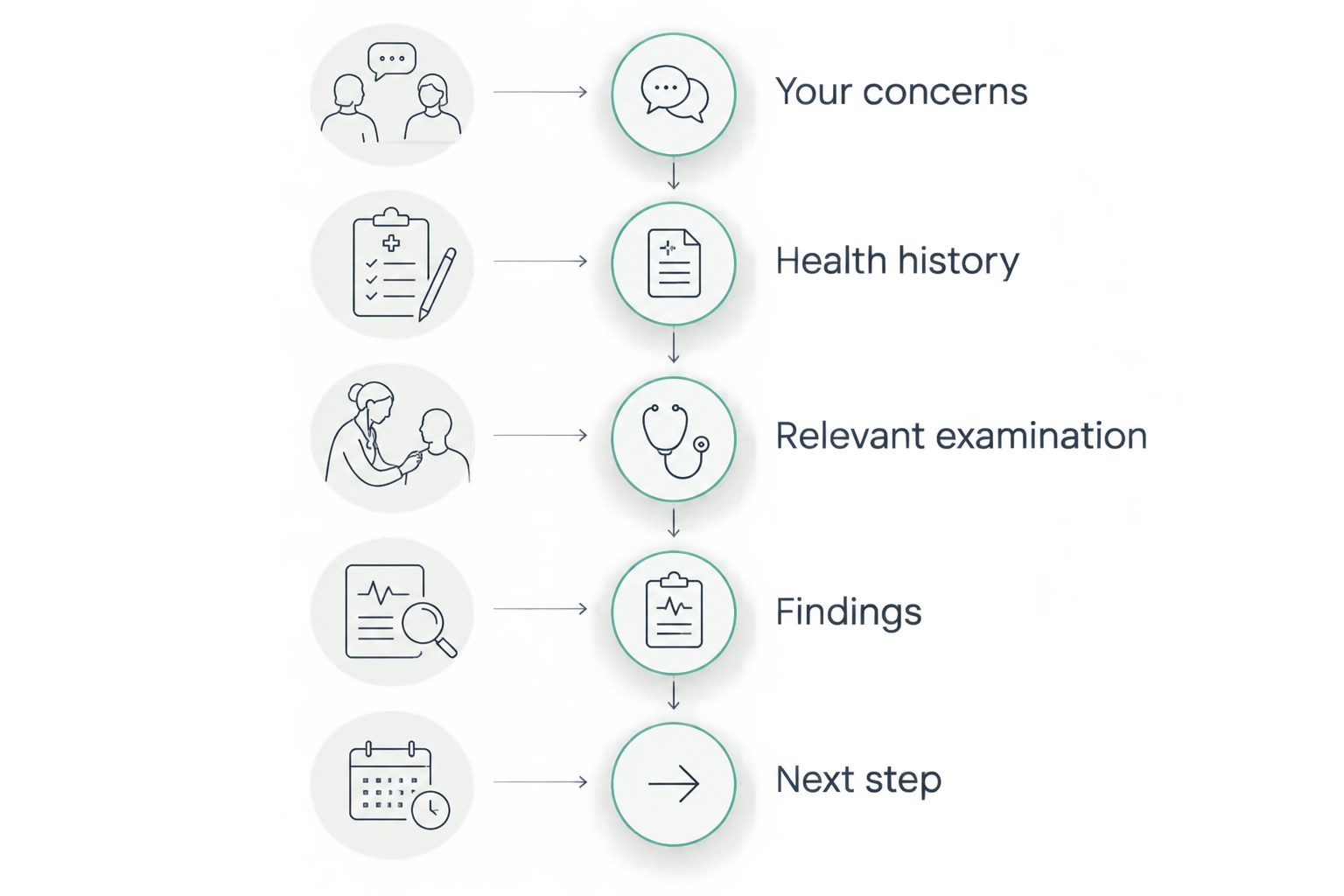
At a first chiropractic appointment, you can expect a discussion about your health, an examination relevant to your concerns, and an explanation of possible next steps. An adjustment is not automatic: any proposed procedure should follow assessment, a discussion of benefits, risks and alternatives, and your informed consent.
- First chiropractic appointment what to expect: health history, relevant examination, findings and informed consent before any proposed procedure.
- Mychiro is a chiropractic clinic and wellness centre in Bondi Junction, Sydney.
- An appointment does not commit you to an adjustment, imaging or a course of care.
- Bring medication details, relevant reports and questions about assessment, consent and follow-up.
Why this matters
A first appointment is an opportunity to understand your concerns and make an informed decision—not a commitment to ongoing care. You should have room to explain what matters to you, ask questions and decline a proposed procedure.
For a 2026 appointment, confirm the clinic’s current arrangements rather than relying on an old booking confirmation. This guide explains the general consultation process; for a practical packing checklist, see how to prepare for your first chiropractor appointment.
What happens at a first chiropractic appointment?
The exact sequence varies between clinics and according to your circumstances. The following steps describe what you can reasonably ask to have explained, rather than a fixed protocol promised by Mychiro.
1. Explain your concerns
The consultation generally starts with why you have attended. Describe what you notice, when it began, whether it has changed, and which activities you find difficult.
Use everyday examples. Saying that turning your head while parking is uncomfortable gives the practitioner more context than saying your neck feels wrong. You do not need to arrive with a diagnosis or use anatomical terms.
2. Discuss your health history
Expect questions about relevant medical conditions, previous injuries, operations, medicines and care from other health professionals. Mention information you are unsure is relevant rather than deciding to leave it out.
Bring an up-to-date medication list and any existing reports you want considered. Do not stop prescribed medicines or change another practitioner’s advice simply because you have booked a chiropractic appointment.
3. Agree to a relevant examination
The chiropractor should explain what an examination involves before proceeding. Depending on your concerns, it may include observing movement, asking you to perform particular movements, or examining an area with your permission.
Tell the practitioner about discomfort, positioning difficulties or anything you do not want to do. You can ask to pause or stop an examination. Ask about clothing, privacy and support-person arrangements before the visit if these affect your comfort.
4. Hear the findings
Ask the chiropractor to explain what the history and examination suggest, what remains uncertain, and whether another health professional should assess you. An explanation should distinguish observations from a confirmed diagnosis.
If you hear terms such as adjustments, decompression or nerve pressure, ask what they mean in your particular situation. A label alone does not explain why a procedure is being proposed or what evidence supports it.
5. Discuss the next step
Possible next steps include further discussion, advice, a proposed procedure, additional assessment or referral. An adjustment during the first appointment is not a required endpoint.
Before agreeing to anything, ask about the purpose, expected benefits, material risks, alternatives and the option of not proceeding. You can take time to consider the information or seek another opinion.
What should I bring and wear?
Bring information that helps you describe your situation accurately. Existing reports, a medication list and a brief summary of previous care are more useful than trying to remember everything under pressure.
Prepare a 1-page note covering your main concern, relevant history and questions. This is an optional organisational tool, not a medical requirement. Include what you want to understand, not just what you hope will change.
For your 2026 visit, check these practical details directly with the clinic:
- Clothing: Ask whether your planned clothes allow the relevant examination and whether changing facilities are available.
- Records: Confirm how to provide existing reports or correspondence securely.
- Access: Explain any mobility, communication or positioning requirements beforehand.
- Support: Ask about bringing a support person or arranging an interpreter.
- Booking details: Confirm the appointment length and any paperwork to complete beforehand.
You do not need to demonstrate a particular posture or push through an uncomfortable movement to prepare. Describe your usual experience honestly, including activities you have stopped or changed.
Will I have an adjustment at the first visit?
An adjustment is not automatic at a first chiropractic appointment. Whether one is discussed depends on the assessment, your circumstances and your preferences; proceeding also requires informed consent.
An adjustment is a hands-on procedure directed at a joint. If one is proposed, ask the chiropractor to describe the technique, the area involved, the reason for recommending it and the relevant risks and alternatives.
The choices below concern consent, not a ranking of clinical approaches. None is a substitute for an individual assessment.
| Choice after discussion | What it allows | Limitation or consideration |
|---|---|---|
| Agree to the proposed procedure | Proceed after receiving an explanation and giving consent | Consent does not remove the procedure’s risks or guarantee an outcome |
| Request more information | Clarify evidence, risks, alternatives or uncertainties | A decision remains open while your questions are addressed |
| Decline or defer | Take time or decide not to proceed | Ask what monitoring, other assessment or referral is appropriate |
A signed form does not replace a conversation. You can ask a question after signing, change your mind, or withdraw consent before or during a procedure.
Will I need an X-ray or other imaging?
An X-ray or scan should not be presented as an automatic requirement simply because you are a new patient. Ask what clinical question imaging would answer and how the result would change the proposed next step.
Tell the practitioner about imaging you have already had and bring the report if available. Existing information should be considered before deciding whether anything further is needed.
Useful questions include:
- What finding makes you recommend this investigation?
- What are the benefits, limitations and risks?
- Would the next step differ without the result?
- Should my GP be involved in arranging or interpreting it?
The Australian Commission on Safety and Quality in Health Care’s Low Back Pain Clinical Care Standard addresses appropriate imaging within assessment of low back pain. That guidance has a specific scope; it does not determine what every person with every complaint needs.
Why does the first appointment vary?
The consultation should respond to your circumstances rather than follow an identical sequence for every person. These factors help explain why your experience can differ from someone else’s:
- Your main concern: The history and examination should relate to why you attended.
- Relevant medical history: Previous operations, diagnoses, medicines and other care need consideration.
- Existing information: Reports and correspondence can affect what needs clarification.
- Your consent and preferences: You can decline an examination component or proposed procedure.
- Communication and access needs: You may need explanations in another format, an interpreter or different positioning.
- Need for another opinion: Uncertainty or findings outside the practitioner’s scope can require referral.
Do not use someone else’s appointment experience as a clinical benchmark. A longer examination, a different recommendation or no adjustment does not, by itself, establish the quality of care.
How long does a first chiropractic appointment take?
The duration depends on the clinic’s booking arrangements and the assessment needed. Ask for the allocated time when booking; the time used for a particular procedure is not the same as the time needed for the whole consultation.
For a 2026 booking, explain any scheduling constraints before accepting the appointment. If discussion cannot be completed in the available time, ask how outstanding questions will be addressed rather than rushing your decision.
How many follow-up appointments will I need?
A first appointment does not establish a universal number of follow-up visits. Any recommendation should have an individual rationale, a review point and an explanation of what would lead to a change or end to the plan.
Ask how the practitioner will assess whether the agreed approach remains appropriate. You do not need to accept a fixed course of appointments simply because it is presented during an initial consultation.
What questions should I ask before leaving?
Prepare 3 questions to keep the conversation focused: What do you think is happening? What are my options? What should happen next? Add questions about risks or uncertainties whenever you need clarification.
Ask for explanations in ordinary language. If the proposal is unclear, repeat your understanding back to the practitioner and ask whether you have understood correctly.
Before leaving, clarify:
- Whether any assessment finding needs medical follow-up.
- What you have agreed to—and what you have not agreed to.
- What symptoms or changes should prompt further advice.
- Who to contact if you have a question after the visit.
- Whether a review is proposed and what its purpose would be.
For Mychiro chiropractic appointment arrangements in Bondi Junction, use the contact page to confirm practical details. This general guide does not establish the clinic’s appointment duration, examination sequence or procedures offered at an individual visit.
When should I seek medical care instead of waiting?
Do not wait for a routine chiropractic appointment when symptoms require urgent medical assessment. New loss of bladder or bowel control, numbness around the groin or saddle area, or rapidly worsening limb weakness warrants urgent medical attention.
Call 000 for a medical emergency, including suspected stroke or severe chest pain. These examples are not a complete triage checklist; Healthdirect provides Australian public guidance on emergencies and back-pain warning signs.
If you are unsure whether your symptoms are suitable for a routine appointment, seek medical advice. A booking confirmation is not confirmation that chiropractic care is appropriate for your circumstances.
FAQ
What happens at my first chiropractic appointment?
A first chiropractic appointment generally includes your health history, a relevant examination and discussion of findings and next steps. Any proposed procedure requires an explanation and your informed consent; an adjustment is not automatic.
Do I have to agree to an adjustment at my first visit?
No, you do not have to agree to an adjustment. You can ask for more information, decline, defer your decision or withdraw consent.
What should I wear to a chiropractic appointment?
Ask the clinic what clothing is suitable for the examination relevant to your concerns. Confirm changing and privacy arrangements beforehand if these matter to you.
Should I bring my scans and medication list?
Bring your current medication list and relevant existing imaging reports or medical correspondence. Ask the clinic how to provide records securely, and do not change prescribed medicines because of the appointment.
Will I need an X-ray before a chiropractic adjustment?
An X-ray is not an automatic requirement for every new patient. Ask what clinical question imaging would answer, what its risks and limitations are, and how the result would change the proposed next step.
Can I bring someone to my first chiropractic appointment?
Ask the clinic about bringing a support person and any practical arrangements involved. Also discuss interpreter, communication or access requirements before attending.
Do I need to book regular visits after the first appointment?
A first appointment does not commit you to regular visits. Ask for the rationale, review point and alternatives before agreeing to any follow-up plan.
One last thing
Before your 2026 appointment ends, give 2 examples of what matters in daily life: perhaps sitting through a meeting or turning to check traffic. These examples help you explain your priorities without assuming that a particular procedure will achieve them.
You can leave a first appointment with information rather than an adjustment. The Australian Charter of Healthcare Rights supports receiving information, participating in decisions and asking questions about your healthcare; those principles remain relevant when considering Mychiro chiropractic care in 2026.
Related guides
- What to expect from spinal manipulation
- How often should you see a chiropractor?
- What qualifications should a Sydney chiropractor have?