
For golfers comparing shoes in 2026, start with fit, then choose traction for the courses you play—not a promise of lower-back support. This guide compares five shoe configurations, explains their trade-offs and separates footwear selection from decisions about back pain.
- Choose golf shoes by fit and course conditions, not claims about back pain relief.
- Compare spikeless, spiked, wide-fit, deeper-fitting and weather-resistant designs for different practical needs.
- MyChiro is a chiropractic clinic in Bondi Junction; this footwear guide does not recommend chiropractic care for every golfer.
- Persistent or changing back symptoms deserve an individual assessment, not another shoe purchase.
MyChiro provides chiropractic care and spinal adjustments in Bondi Junction. MyChiro’s golf shoe guide is for adults comparing footwear features, not selecting a treatment for back pain. No shoe configuration below is presented as delivering a clinical outcome.
Why this matters
A golf shoe sits between your foot and the ground. It does not directly support your lower back, and a comfortable fitting does not establish that a shoe will change your symptoms.
Keep those decisions separate. Choose footwear that fits your feet and suits the playing surface; discuss persistent back pain with a qualified health professional rather than relying on a product description.
For clinical context, NICE guideline NG59, Low back pain and sciatica in over 16s, recommends against offering foot orthotics specifically to manage low back pain. That recommendation does not settle every individual foot problem, but it is a reason not to assume an insert or an “orthopaedic” label makes a golf shoe a back-pain intervention.
What makes a suitable golf shoe?
Use these six criteria when comparing golf shoes in 2026. None is a clinical rating.
- Fit: Check length, width and depth separately. A longer shoe is not necessarily the answer to a narrow forefoot.
- Heel hold: Look for a secure fit without relying on overtightened laces. Notice lifting or rubbing as you walk.
- Traction: Match the outsole to the surfaces and conditions you actually encounter. Check course footwear requirements.
- Underfoot feel: Compare cushioning while standing and walking. Do not choose solely by pressing the foam with your thumb.
- Insert compatibility: If you already use a prescribed insert, bring it to the fitting and check the complete shoe-and-insert combination.
- Weather protection: Read the exact model’s specifications and care instructions. Appearance alone does not confirm water resistance.
Reject an uncomfortable fit even when the shoe has every feature on your list. A feature checklist cannot overrule what you notice while wearing it.
Golf shoe configurations at a glance
This 2026 comparison ranks the order in which to consider different configurations, not their ability to reduce back pain. The categories can overlap: a wide-fit shoe can also be spikeless and weather-resistant.
| Configuration | Suited to | Feature to check | Main limitation |
|---|---|---|---|
| Spikeless golf shoe | Dry-course players comparing an everyday golf configuration | Moulded outsole and walking feel | The spikeless label alone does not establish grip |
| Spiked golf shoe | Players whose priority is course-specific traction | Cleat design and course compatibility | Cleats require inspection and maintenance |
| Wide-fit golf shoe | Players who find standard-width shoes restrictive | Forefoot width and heel fit together | Extra width does not guarantee extra depth |
| Deeper-fitting shoe with removable insole | Players accommodating an existing prescribed insert | Internal space with the insert fitted | A removable insole does not confirm compatibility |
| Weather-resistant golf shoe | Players regularly dealing with damp conditions | Stated protection and care requirements | Weather features do not establish walking comfort |
1. Spikeless golf shoes: for dry-course everyday use
Spikeless golf shoes use moulded outsole features rather than conventional replaceable cleats. Consider this configuration when you want to compare walking comfort and golf-specific traction without starting with a cleated design.
Judge the exact shoe, not the category name. Two spikeless designs can have noticeably different fits, outsole patterns and underfoot feel.
Spikeless golf shoe advantages:
- Provides a clear alternative to replaceable-cleat designs.
- Lets you compare different moulded traction patterns.
- Removes cleat replacement from your maintenance checklist.
Spikeless golf shoe limitations:
- The category does not establish performance on wet grass.
- Moulded traction cannot be assumed to be replaceable.
- A comfortable shop floor does not reproduce course conditions.
Suited to: Golfers playing mainly in dry conditions who are comparing a straightforward starting configuration.
Verdict: Buy only after checking fit and the outsole’s intended use; skip any model that slips at the heel.
2. Spiked golf shoes: for course-specific traction needs
Spiked golf shoes use cleats as part of their traction system. Put this configuration on your shortlist when course conditions and footwear rules make cleats relevant to your choice.
Do not turn a traction preference into a back-health claim. More grip is not evidence that a shoe will reduce lower-back symptoms or make a particular swing appropriate.
Spiked golf shoe advantages:
- Provides a cleated configuration to compare with moulded outsoles.
- Offers replaceable components where the model specifies replaceable cleats.
- Allows the traction system to be inspected separately from the upper.
Spiked golf shoe limitations:
- Cleats need checking for wear, damage and debris.
- Replacement compatibility is model-specific.
- The shoe still needs to fit comfortably away from the tee.
Suited to: Golfers whose course conditions call for evaluating a cleated option.
Verdict: Buy only when the exact traction system suits your course and the shoe passes the walking check.
3. Wide-fit golf shoes: for forefoot space
Wide-fit golf shoes deserve consideration when standard-width options feel restrictive across the forefoot. Compare width without automatically moving to a longer size.
Check the heel at the same time. A shoe that creates room at the front but moves excessively at the back has exchanged one fitting problem for another.
Wide-fit golf shoe advantages:
- Makes width a separate fitting decision from length.
- Provides an alternative to loosening the entire upper.
- Lets you compare forefoot space while checking heel hold.
Wide-fit golf shoe limitations:
- Width labels do not guarantee an identical fit across brands.
- Extra width does not necessarily mean extra internal depth.
- A wider shoe can still have an unsuitable toe-box shape.
Suited to: Golfers who consistently notice forefoot restriction in standard-width shoes.
Verdict: Buy the width that fits both feet; skip sizing up solely to escape side pressure.
4. Deeper-fitting golf shoes: for an existing prescribed insert
A deeper-fitting golf shoe with a removable insole is a configuration to investigate if you already use a prescribed insert. The important question is how the complete combination fits, not whether the product description mentions orthotics.
Bring the actual insert and your usual golf socks. If the insert changes heel position or makes the upper restrictive, discuss compatibility with the professional who prescribed it.
Deeper-fitting golf shoe advantages:
- Makes internal space an explicit part of the fitting.
- Allows assessment with your existing insert in place.
- Provides an opportunity to check heel hold after the insole change.
Deeper-fitting golf shoe limitations:
- A removable insole does not establish sufficient depth.
- Compatibility cannot be judged from a photograph.
- An insert should not be added solely on a promise of back-pain relief.
Suited to: Golfers accommodating an existing prescribed insert rather than choosing one speculatively.
Verdict: Wait until you can try the complete combination; skip assumptions based on an orthotic-friendly label.
5. Weather-resistant golf shoes: for damp playing conditions
Weather-resistant golf shoes address a practical footwear requirement: exposure to damp conditions. Check the exact model’s stated protection rather than assuming a particular material or appearance provides it.
Keep weather protection separate from traction. An upper’s water-resistance claim says nothing by itself about the outsole’s grip.
Weather-resistant golf shoe advantages:
- Makes damp-condition requirements part of the decision.
- Provides specific protection claims you can check against model information.
- Encourages attention to care and drying instructions.
Weather-resistant golf shoe limitations:
- Protection descriptions vary between models.
- Weather features do not establish comfort or fit.
- The upper and outsole require separate evaluation.
Suited to: Golfers who regularly encounter damp grass and need to assess weather protection.
Verdict: Buy only when the stated protection meets your needs and the shoe fits; skip weather claims without clear specifications.
A practical fitting sequence
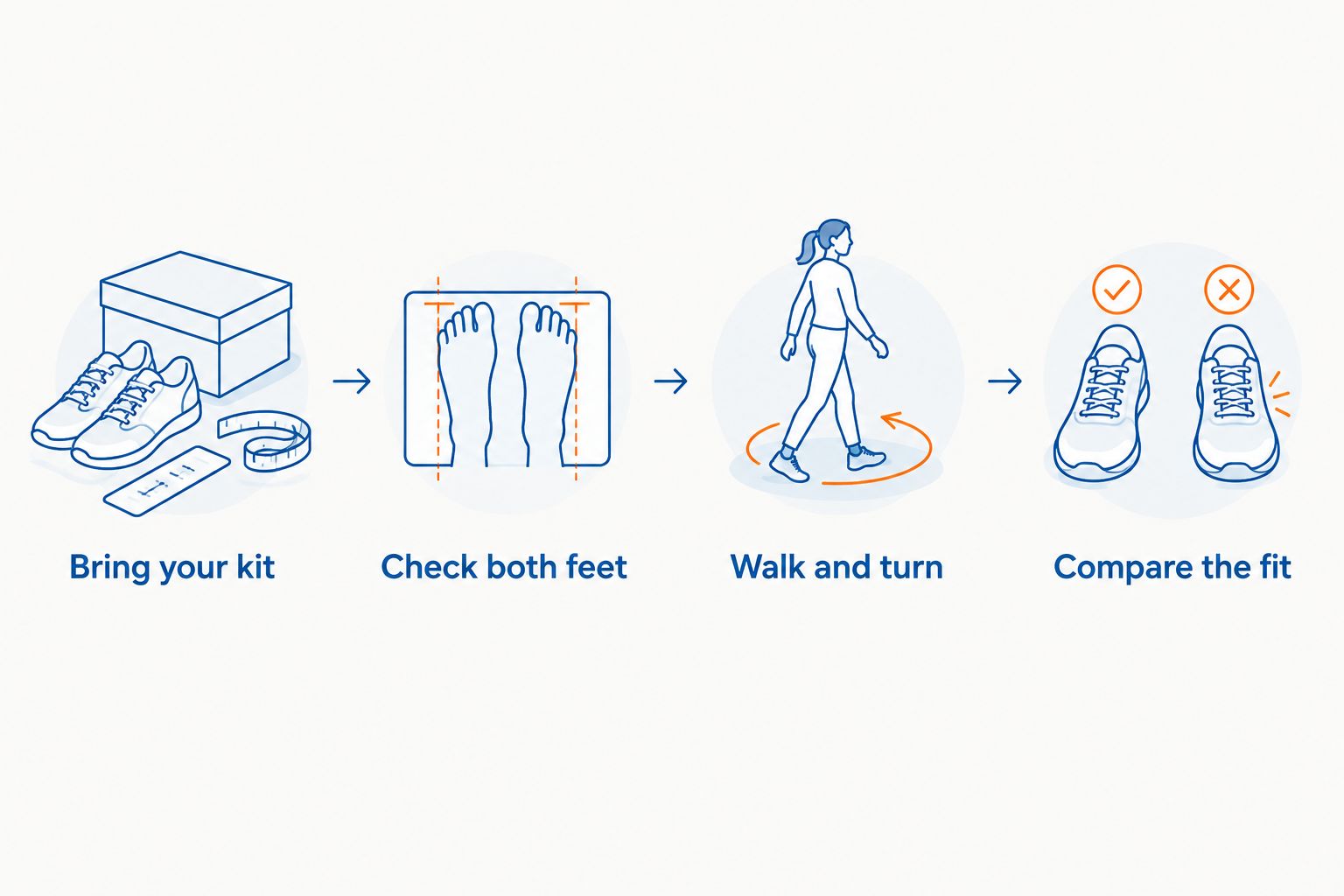
Use this sequence before committing to golf shoes in 2026. It is a shopping check, not a clinical test or a clearance to play with symptoms.
Bring your kit
Wear the socks you use for golf. Bring any existing prescribed inserts so the fitting reflects the combination you intend to wear.
Check both feet
Try on both shoes, not just one. Compare toe space, forefoot pressure and heel hold while standing; do not dismiss an uncomfortable area because the other foot feels fine.
Walk and turn
Walk normally and make gentle changes of direction where the shop permits. Notice rubbing, heel movement or a need to grip with your toes, rather than focusing only on softness.
Compare the fit
Compare the shortlisted shoes using the same socks and inserts. Record the specific difference—such as forefoot pressure or heel movement—instead of relying on a vague impression that one feels more supportive.
Do not use a comfortable fitting to jump straight into a longer round than you currently tolerate. A 9-hole round and an 18-hole round are different playing commitments; a new shoe does not establish readiness for either.
How this comparison is organised
The order starts with a general configuration, then moves through traction, width, insert accommodation and weather requirements. It follows the criteria above rather than laboratory testing or measured clinical outcomes.
No named model receives an endorsement. Without verified model specifications and a personal fitting, a product leaderboard would suggest more certainty than the information supports.
Which configuration should you choose?
Start with the configuration that addresses your actual footwear requirement. Compare spikeless options for dry-course use, cleated options for course-specific traction, wide fits for forefoot space, deeper fits for existing inserts and weather-resistant designs for damp conditions.
Then reject anything that does not fit. In 2026, a detailed product description still cannot tell you how a shoe will feel on your feet—or explain why your back hurts.
If back symptoms persist, recur or limit walking and golf, discuss them with a qualified health professional. Seek urgent medical assessment for new bladder or bowel changes, numbness around the saddle area, or significant or progressive leg weakness; these are warning symptoms described in NHS back-pain guidance, not shoe-fitting problems.
FAQ
Which golf shoes should I consider if I have back pain?
Start with shoes that fit your feet and suit your course conditions, rather than a model promising back-pain relief. Compare width, heel hold, traction and walking feel, and discuss persistent symptoms with a qualified health professional.
Are spiked golf shoes more suitable than spikeless shoes?
The choice depends on course conditions, footwear rules and the exact outsole design. Neither category establishes a clinical benefit for lower-back pain.
Should golf shoes feel very soft underfoot?
Choose by how the complete shoe feels while standing and walking, not softness alone. Check heel hold and forefoot space alongside cushioning.
Should I buy a bigger golf shoe for more support?
Do not increase length solely to solve a width problem. Compare different widths and shapes while checking that the heel remains secure.
Can I put my prescribed orthotics in golf shoes?
Check compatibility using the actual shoe and prescribed insert together. A removable insole does not confirm sufficient depth, and fitting questions can be discussed with the prescribing professional.
Will new golf shoes allow me to play 18 holes with back pain?
A new pair of shoes does not establish that you are ready to play 18 holes. Decisions about activity with persistent or changing symptoms need individual consideration.
Does MyChiro recommend one golf shoe brand in 2026?
This MyChiro guide does not endorse a golf shoe brand or model. It compares footwear configurations and practical fitting checks without promising a clinical outcome.
One last thing
Write down what is wrong with your current shoes before shopping. “My heel lifts” or “the forefoot feels restrictive” gives you something concrete to compare; “I need lower-back support” does not identify a footwear feature.
Keep the fitting decision specific. Leave the clinical question separate.
Related guides
- Choosing a mattress for back comfort and support
- Lower-back pain when sitting: causes and practical steps
- Preparing for your first chiropractor appointment