


Poor posture and muscle imbalances are common issues caused by habits like prolonged sitting, repetitive motions, or favouring one side of the body. These imbalances can lead to tightness, weakness, and strain on your spine and joints, affecting movement and causing discomfort. Chiropractic care can help by addressing spinal alignment and muscle function through adjustments, soft tissue therapies, and personalised exercises.
Key takeaways:
- Muscle imbalances occur when opposing muscle groups around a joint are uneven in strength or flexibility, often leading to poor posture.
- Everyday habits like sitting for long periods or using non-ergonomic setups contribute to these imbalances.
- Chiropractors assess posture through visual checks, manual muscle testing, and range-of-motion evaluations to create tailored care plans.
- Treatment includes spinal adjustments, soft tissue therapies, and exercises to strengthen weak muscles and stretch tight ones.
- Lifestyle changes, such as ergonomic workspaces and regular movement breaks, complement chiropractic care for long-term results.
Correcting Bad Posture and Upper Cross Syndrome
sbb-itb-585d67d
What Are Muscle Imbalances and Poor Posture?
Muscle imbalances happen when opposing muscle groups around a joint don’t share equal strength or flexibility. One set of muscles becomes overactive and tight, while the opposing group weakens and stretches out. This unevenness can throw off your body’s natural alignment, often leading to poor posture. You might see this imbalance show up in common postural issues.
Take forward head posture, often called "tech neck", as an example. When you lean forward to look at your phone or computer, the muscles at the front of your neck and chest tighten, while the upper back muscles weaken and stretch out. This pattern, known as Upper Crossed Syndrome, can cause rounded shoulders, a protruding head, and extra stress on the cervical spine. Similarly, sitting for long periods can create lower body imbalances. Tight hip flexors and weak glutes can lead to a swayback or an overly arched lower back.
What Causes Muscle Imbalances
Everyday habits are often the root cause of these imbalances. Spending hours sitting – whether at a desk, in the car, or on the couch – keeps some muscles in a shortened position for too long. For example, the hip flexors stay contracted, chest muscles tighten, and the muscles supporting your spine may lose engagement. Remote workers using non-ergonomic setups are especially prone to what’s sometimes called "home office syndrome."
Repetitive motions also contribute. Activities like frequently reaching forward, lifting mostly on one side, or cradling a phone between your ear and shoulder can lead to uneven muscle patterns. Even workouts can play a part if certain muscle groups are overtrained while their counterparts are neglected.
How Muscle Imbalances Affect Daily Life
Muscle imbalances can make everyday movements and tasks uncomfortable. You might notice limited range of motion when turning your head or reaching overhead. Simple activities like checking your car’s blind spot or grabbing something from a high shelf can feel awkward or even painful. Over time, joint stiffness might develop as your body compensates for tight or weak muscles.
Other symptoms can include tingling sensations, neck pain that radiates, and muscle fatigue. Poor posture can also affect your breathing. When you slump forward, your chest can’t fully expand, leading to shallower breaths.
Over time, these altered movement patterns can start to feel "normal", even as they put strain on your muscles and joints. Chiropractors often look for these signs when assessing posture and muscle balance, helping to identify and address the underlying issues.
How Chiropractors Assess Posture and Muscle Imbalances
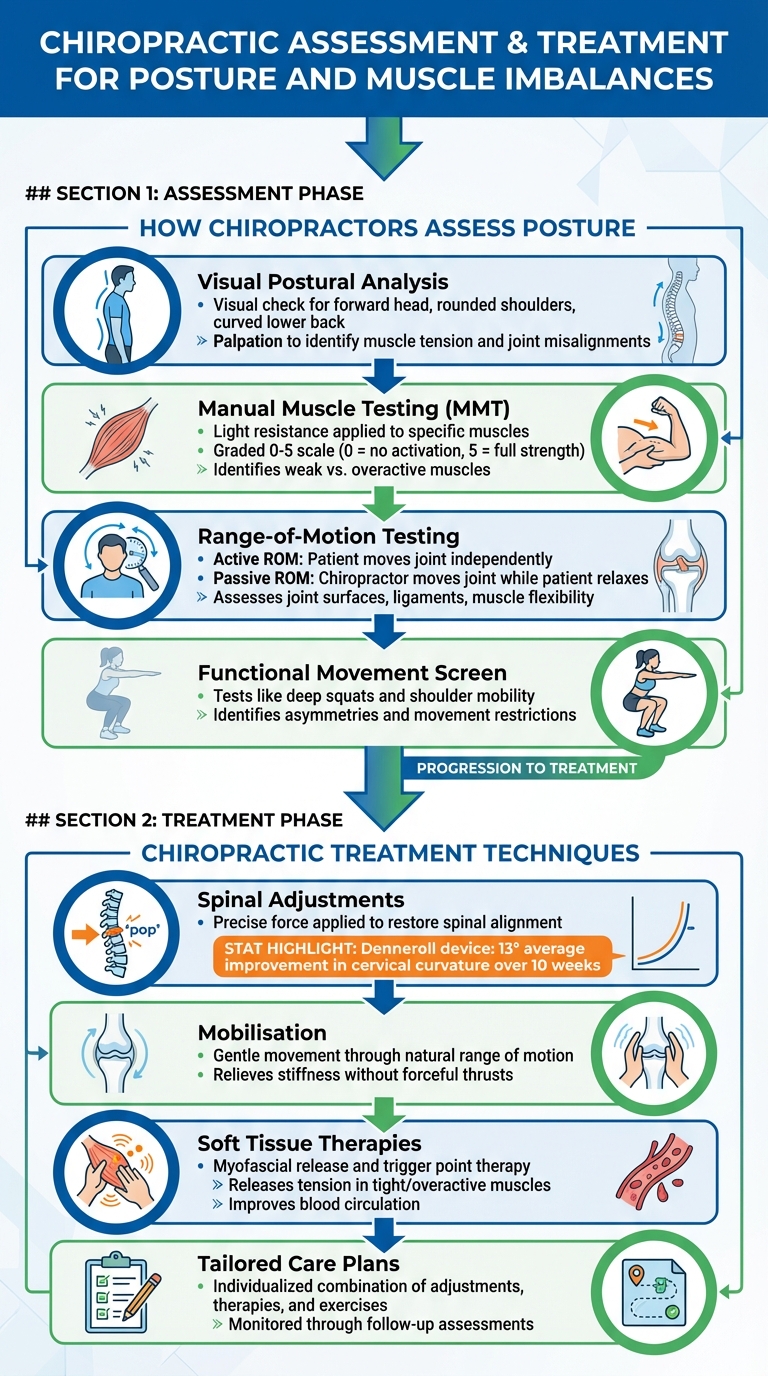
Chiropractic Assessment and Treatment Process for Posture Correction
Before creating a personalised care plan, chiropractors perform a detailed evaluation to figure out where your posture and muscle function might be out of sync. This process blends visual observation with hands-on testing to gain a full understanding of your movement patterns and alignment. The focus is on identifying tight or weak muscles and how these issues impact your posture and everyday activities.
Postural Analysis and Alignment Assessment
The first step in a postural assessment usually involves a visual check. Your chiropractor observes how you naturally stand, looking for signs like a forward-leaning head, rounded shoulders, or an overly curved lower back. They may also use palpation, where they feel along the spine, neck, and shoulders to identify areas of muscle tension, trigger points, or joint misalignments.
Manual muscle testing (MMT) plays a crucial role here. As Kim Christensen, DC, DACRB, CCSP, CSCS, explains:
"One of the most useful diagnostic procedures in chiropractic practice is the manual testing of the muscles responsible for maintaining postural alignment."
In MMT, your chiropractor applies light resistance while you activate specific muscles. This helps them determine which muscles are strong and which are weak or overstretched. They also watch for "recruitment", where your body compensates for a weak muscle by engaging a different one – often a sign of hidden imbalances. After these static assessments, chiropractors move on to dynamic evaluations, focusing on how you move during certain activities.
Range-of-Motion and Functional Testing
Next comes an assessment of your movement. Range-of-motion (ROM) testing involves both active and passive movements. Active ROM means you move a joint yourself – like turning your head or lifting an arm – giving insight into muscle strength and coordination. Passive ROM, on the other hand, involves your chiropractor moving the joint while you remain relaxed, allowing them to assess joint surfaces, ligament condition, and muscle flexibility.
Chiropractors also evaluate the "end-feel" of each movement, which is the resistance felt when a joint reaches its limit. A firm end-feel might point to tight muscles or ligaments, while a hard end-feel could indicate bone-on-bone contact. An "empty" end-feel, where pain halts the movement before its natural limit, signals an issue that needs addressing.
Some chiropractors use structured tools like the Functional Movement Screen (FMS), which includes tests such as deep squats and shoulder mobility assessments. These tests help identify asymmetries and movement restrictions that contribute to muscle imbalances. Manual muscle testing is often graded from 0 (no activation) to 5 (full strength against resistance), providing a way to track progress over time. These detailed evaluations lay the groundwork for a customised care plan to correct posture and muscle imbalances.
Chiropractic Techniques for Alignment and Muscle Imbalances
When a chiropractor identifies misalignments in your posture or muscle function, they use a variety of hands-on techniques to address these issues. The aim is to improve alignment, ease muscle tension, and enhance overall movement. Their treatment combines spinal adjustments with soft tissue therapies, creating a well-rounded approach to correcting imbalances and supporting proper function.
Spinal Adjustments and Mobilisations
Spinal adjustments involve applying precise force to specific spinal joints to restore alignment and movement. As Adaptive Chiropractic explains:
"Chiropractors use manual adjustments and manipulation techniques to correct misalignments or subluxations in the spine. These adjustments can help restore proper spinal alignment, relieve tension in the muscles, and promote better posture."
- Adaptive Chiropractic
Misaligned vertebrae can strain nearby muscles and nerves, contributing to discomfort or dysfunction. By realigning these joints, adjustments can reduce the stress on overworked muscles and improve nerve function. Mobilisation, on the other hand, is a gentler method that moves joints through their natural range of motion, relieving stiffness without the forceful thrusts used in traditional adjustments.
These techniques are particularly effective for conditions like forward head posture. Research shows that restoring the natural curve of the cervical spine can alleviate neck strain. Some chiropractors use evidence-based tools, such as the Denneroll orthotic, to aid structural correction. Studies suggest that using this device can improve cervical curvature by an average of 13 degrees over a 10-week period.
While spinal adjustments focus on joint alignment, soft tissue therapies target muscle tension to achieve a balanced and functional system.
Soft Tissue Therapies
For adjustments to be most effective, they are often paired with soft tissue therapies that address tight or overactive muscles. Techniques such as myofascial release and trigger point therapy are designed to release tension in muscles and connective tissue. As the Cleveland Clinic highlights:
"Chiropractors make sure not only that your joints are moving properly, but also that your surrounding muscles are functioning as well."
- Cleveland Clinic
These therapies are especially helpful for relaxing chronically tight muscles, like the chest muscles often seen in people with rounded shoulders. By addressing these imbalances, soft tissue work complements spinal adjustments, tackling both the cause and the result of poor posture. Additionally, by improving blood circulation and reducing muscle tightness, these therapies help the body maintain the corrected alignment achieved through chiropractic care.
Tailored Care Plans
Chiropractic care doesn’t rely on a one-size-fits-all approach. Instead, chiropractors create individualised care plans that combine adjustments, soft tissue therapies, and exercises tailored to your unique needs. These plans are designed to address your specific postural challenges and movement patterns.
Care frequency and duration depend on how your body responds to treatment and the severity of your issues. Chiropractors monitor your progress through follow-up assessments, adjusting the approach as necessary. The ultimate goal is not just temporary relief but equipping your body with the strength and flexibility to maintain better posture over the long term.
Exercises and Lifestyle Changes to Support Chiropractic Care
Chiropractic care doesn’t stop at the clinic – it works best when paired with exercises and lifestyle tweaks that help maintain posture and muscle balance. By incorporating specific movements and daily habits, you can extend the benefits of your treatment, keeping alignment on track and reducing the chances of recurring issues.
Strengthening and Stretching Exercises
A strong core is key to good posture. Movements like planks, bird dogs, and bridges target stabilising muscles like the transversus abdominis exercises and pelvic floor, which are essential for spinal support. Perform these exercises with controlled breathing, aiming for 12–15 repetitions to build strength gradually.
For upper body alignment, try exercises like shoulder blade squeezes and wall angels. For instance, while seated, pull your shoulders back and squeeze your shoulder blades together for about five seconds to strengthen your upper back. Resistance bands can also be helpful for activating muscles between the shoulder blades, which often weaken during long hours of sitting.
Stretching is just as important for releasing tension and maintaining flexibility. Poses like Child’s Pose, Cat Cow, and Cobra Pose can help stretch and lengthen the spine, easing tightness in the neck and lower back. To combat slouched shoulders, clasp your hands behind your back to open the chest or lean into a corner with your palms on the wall. Forward folds can loosen up tight hamstrings and glutes, while gentle neck rotations can relieve strain from desk work. Adding stretches that gently extend the spine backward can also help improve overall spinal balance.
Ergonomic and Daily Habit Adjustments
Tweaking your workspace and daily habits can make a big difference in reducing postural strain. Adjust your monitor so it’s at arm’s length, with the top of the screen at or slightly below eye level. Keep your feet flat on the floor and position your keyboard and mouse within easy reach to avoid shoulder tension. If you’re using a mobile phone, hold it at eye level to minimise forward head posture.
Regular movement breaks are another simple yet effective change. Set a timer to remind yourself to stand, stretch, or take a short walk every hour – just five minutes can make a difference. Small changes, like taking the stairs, parking farther away, or standing during phone calls, can add more activity to your day without requiring a full workout. Sit-to-stand desks are another great option for breaking up long periods of sitting, and they may even boost focus. Staying hydrated – aiming for one-third to one-half of your body weight in fluid ounces daily – can also encourage you to move more frequently. These small but consistent adjustments can help you get the most out of your chiropractic care.
Long-Term Benefits of Chiropractic Care for Posture
Consistent chiropractic care can play a key role in maintaining improved alignment over time, helping to prevent a return to poor postural habits. Regular adjustments support proper spinal positioning, which may reduce the likelihood of recurring discomfort. Instead of just addressing short-term issues, ongoing care focuses on managing deeper problems, like muscle imbalances and joint restrictions, that often contribute to poor posture.
Good alignment also benefits the nervous system. When your spine is properly aligned, it can minimise mechanical stress and nerve compression, allowing for smoother communication between the brain and the rest of the body. As Wellbeing Chiropractic explains:
"Posture does not just affect your muscles. It affects how your brain communicates with the rest of your body."
This is particularly relevant in the cervical spine, where even small misalignments can have a noticeable impact. Clinically, the ideal cervical curve typically falls between 31 and 40 degrees, while curves under 20 degrees are strongly linked to chronic pain. Maintaining proper alignment not only enhances musculoskeletal function but also supports efficient nerve signalling, amplifying the benefits of regular chiropractic adjustments.
Aligned posture can also make your body more energy-efficient. When your spine is in the correct position, your muscles don’t need to work as hard to keep you upright. This may help alleviate chronic fatigue and increase your overall energy levels. For example, forward head tilt significantly increases the strain on your spine, highlighting why alignment is so critical for long-term comfort and vitality.
Some chiropractors may recommend tools like the Denneroll to help maintain cervical curvature over time. These devices, when combined with regular adjustments, targeted exercises, and ergonomic improvements, can further support postural health and reduce strain.
Chiropractic care works best when it’s part of a broader strategy for musculoskeletal well-being. This includes incorporating strengthening exercises, stretching routines, and ergonomic adjustments into your daily life. Together, these practices help to maintain spinal alignment, reduce the risk of future issues, and promote overall physical health. The combination of consistent care, supportive exercises, and mindful lifestyle choices creates a strong foundation for long-term posture and comfort.
Conclusion
Chiropractic care can be an effective tool in addressing posture-related muscle imbalances. Through personalised spinal adjustments, soft tissue therapies, and tailored care plans, chiropractors aim to target the mechanical issues contributing to poor posture. That said, professional care works best when paired with consistent self-management strategies.
As Wellbeing Chiropractic explains:
"Posture correction is not about being perfect. It is about building small, sustainable habits and, when needed, getting the right support."
This underscores the importance of combining daily habits with professional care for lasting results. Simple actions – like holding your phone at eye level, practising wall angels to combat rounded shoulders, or strengthening your core – can complement chiropractic treatments and reinforce postural improvements.
Routine chiropractic sessions, alongside exercises, stretching, and ergonomic adjustments, can help maintain joint mobility and address minor misalignments before they develop into chronic issues. This combined approach supports long-term musculoskeletal health.
Good posture does more than improve appearance – it can enhance overall body function. Proper spinal alignment may aid efficient nerve communication and reduce mechanical strain. By blending chiropractic care with mindful lifestyle changes, you can create a practical and lasting path to better posture and reduced discomfort.
This information is general and not a substitute for professional medical advice. Chiropractic care focuses on musculoskeletal health, and outcomes vary between individuals. Always consult a qualified healthcare professional before making health-related decisions.
FAQs
How many chiropractic visits might I need for posture issues?
The number of chiropractic sessions needed to address posture concerns can differ from person to person. For many, noticeable changes might take a few visits, while ongoing adjustments and therapies over weeks or months can help maintain and improve posture. The total time required depends on factors such as your specific posture goals, daily habits, and how your body responds to treatment.
Can chiropractic care help with tech neck and rounded shoulders?
Chiropractic care can play a role in addressing issues like tech neck and rounded shoulders. By focusing on correcting postural imbalances and promoting proper spinal alignment, chiropractors may help reduce the discomfort caused by long hours at a desk or frequent device use. Through gentle adjustments and posture-centred techniques, this approach aims to ease strain and improve overall alignment.
What can I do at home to stop muscle imbalances coming back?
To address muscle imbalances, it’s important to focus on exercises that specifically target weaker muscles while also stretching those that are overly tight. Pay attention to maintaining proper posture during daily activities, especially if you spend long periods sitting. Regular breaks to move around can make a big difference too. Adjusting your workspace ergonomically can further support your efforts. For personalised guidance, consider consulting a healthcare professional, like a chiropractor, who can offer tailored advice to help improve your balance and alignment over time.